


Aug 13, 2026 10:43 PM
Updated Aug 24, 2026 10:10 PM
When America Taxed the Rich at 91%: Eisenhower, the Middle Class, and the Myth of “Socialism”
But for historical and civic ignorance, Americans would know that the progressive tax rates in the Nordic countries routinely denounced as “socialist” aren't remotely as high at the top as the rates the United States imposed during the middle of the twentieth century.
In today's MAGA parlance, apparently that would make Dwight D. Eisenhower and much of postwar America “communist.”
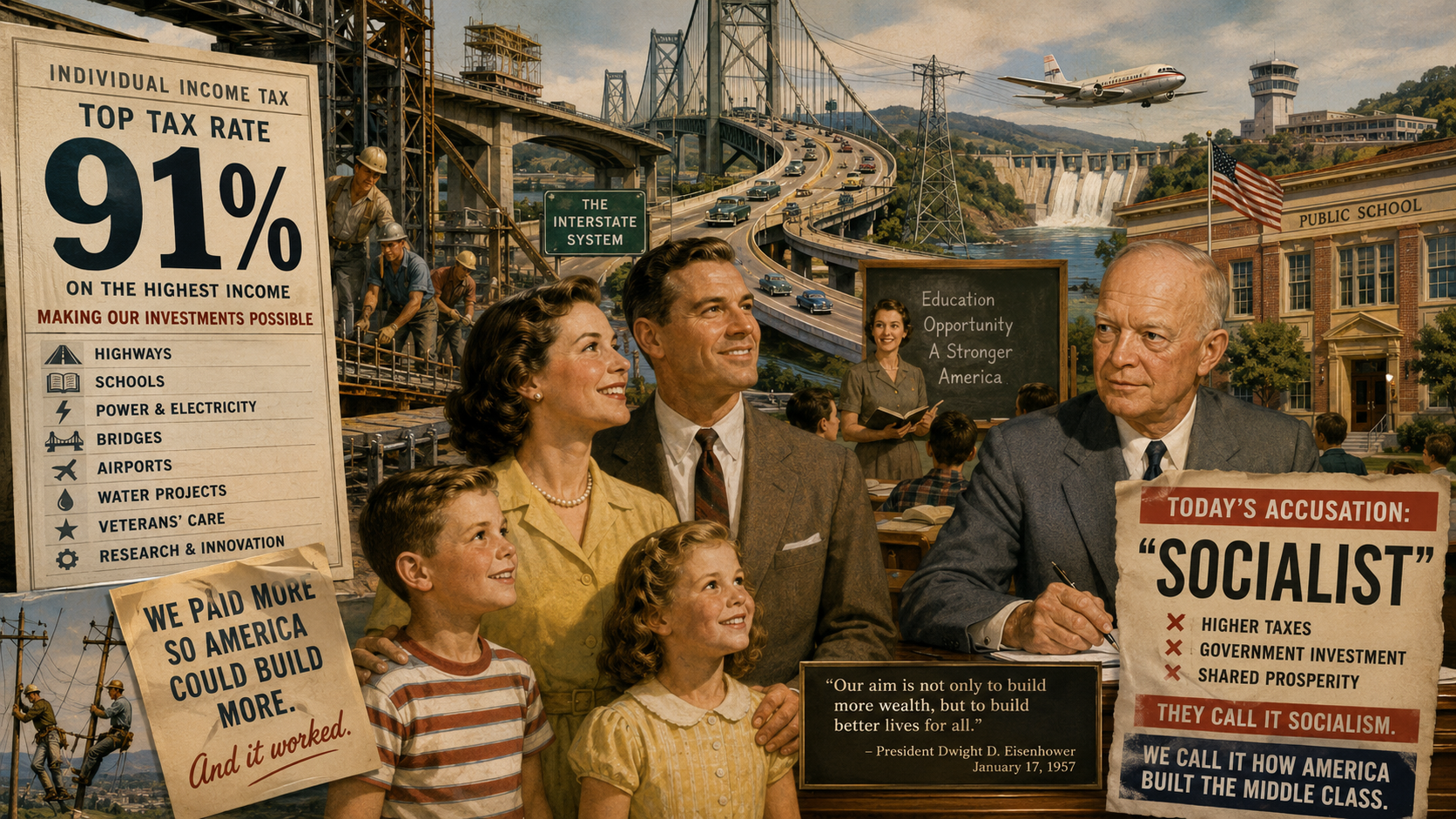
During the Eisenhower years, the top federal individual income-tax rate was 91 percent. It had briefly reached 92 percent in 1952 and 1953 before returning to 91 percent in 1954, where it remained through 1963.
In 1955, for a married couple filing jointly, the 91 percent federal marginal rate began at $400,000 in taxable income, equivalent to roughly $5 million today.
Related stories
And “marginal” is crucial. Someone earning the equivalent of $6 million would not have paid 91 percent of $6 million. The 91 percent rate applied only to taxable income above the top threshold. Income below that amount passed through a series of progressively higher brackets.
Nor should anyone imagine that wealthy Americans routinely handed Washington 91 percent of their total income. They didn't. Deductions, exclusions, preferential taxation of capital gains, business structures, tax planning, and other provisions substantially reduced what affluent taxpayers actually paid. High marginal rates also created incentives to retain and reinvest earnings rather than distribute additional taxable income.
But that doesn't make the 91 percent rate meaningless. It reflected a fundamentally different philosophy about taxation and concentrated wealth. The country had recently emerged from the Great Depression and World War II with an understanding that maintaining a modern civilization required enormous collective investment.
And invest we did. I recall the sense that booming was the new norm. It seemed like every aspect of our lives was moving full speed ahead.
We built highways, bridges, airports, dams, electrical systems, water and sewer systems, schools, universities, hospitals, and research institutions. The GI Bill helped millions of veterans attend college, receive training, and buy homes. Public investment helped create the conditions in which an enormous American middle class could flourish.
We paid our way forward. That philosophy gradually gave way to another. Over subsequent decades, top marginal tax rates fell dramatically, reaching 70 percent in 1965, 50 percent in 1982, 28 percent by the end of the Reagan administration, and eventually settling far below their postwar levels.
At the same time, organized wealth became increasingly influential in American politics through lobbying, campaign spending, think tanks, advocacy organizations, and other means of shaping public policy.
For the record, the Nordic countries aren't communist. They aren't even socialist in the traditional sense of government ownership of the means of production. They are overwhelmingly capitalist market economies that combine private enterprises with relatively high taxation, extensive public investment, and social insurance.
Their citizens receive something substantial in return: universal or near-universal healthcare, heavily subsidized education, childcare and parental benefits, pensions, unemployment protections, modern infrastructure, and other public services.
There is a larger economic reality that Americans desperately need to understand. Sustaining a prosperous modern middle class requires enormous investment in both hard infrastructure and human capital. Roads, bridges, ports, schools, universities, healthcare, scientific research, public safety, communications systems, clean water, sanitation, and an educated workforce don't materialize because somebody chants “small government.”
They cost money. Yet that doesn't stop know-nothings posing as armchair economists from calling anyone who questions today's extraordinary economic inequality a socialist or communist.
One qualification is important: high marginal tax rates alone did not create the middle class. Strong unions, postwar industrial dominance, the GI Bill, subsidized mortgages, public education, infrastructure investment, financial regulation, rising productivity, and relatively compressed wages all contributed.
But high progressive rates were part of the fiscal system that financed and accompanied that extraordinary period of broadly shared prosperity. Yet many of these other contributions are also deemed corrosive by the hard political right.
Here is a historical fact that helps explain why today's debate over progressive taxation is so distorted: roughly 96 percent of Americans alive today have no adult memory of the period when the top federal marginal income-tax rate was 91 percent. About 80 percent were either children or not yet born when the top rate was still 70 percent in 1981.
Consequently, most Americans have spent their entire adult lives inside a radically different tax structure and understandably assume today's rates are historically normal. They aren't. In 2026, Denmark's top personal income-tax rate is about 60.5 percent, Sweden's 52.3 percent, Finland's 45 percent, and Norway's 39.6 percent.
Yet during the great postwar expansion of America's middle class, the United States maintained a top federal marginal rate of 91 percent through 1963 and 70 percent for much of the period that followed.
We have gotten ourselves bogged down in the names of things that have little bearing on the argument. Much of what those who call themselves Democratic Socialists advocate is hardly radical when viewed against the backdrop of our own history.
We are now being gaslighted into associating Scandinavia with radicalism, but the tax structure of mid-twentieth-century America makes Scandinavia look conservative by comparison. That history puts our current political debate in an entirely different light, once we strip away the propaganda designed to frighten us into protecting the status quo.
Now, we are a social species, and we are groupish to a fault. Whether we grow up in an oppressive country or a relatively enlightened one, we are susceptible to nationalism and inclined to defend our own kind when our group identity is challenged.
Moreover, America was founded by intellectuals, but we did not create an education system intended to produce intellectuals en masse. The ability to think critically, question assumptions, and deconstruct arguments objectively is too often valued less than obedience and conformity. Ask too many questions in class, and you can be seen as a troublemaker.
Writ large, this tendency shows up in adult behavior, where symbolic dissent can carry enormous social consequences. Kneeling instead of standing during the national anthem, for example, can threaten or even destroy a career. The lesson begins early: belonging is rewarded, while questioning the norms of the group can come at a price.
So, you see how we are set up for this. Citizens with little knowledge of how our economy came to be what it is can be prodded into reflexive derision toward anyone who questions the fairness of the system.
They can be taught to dismiss people as socialists or communists without having the foggiest idea what socialism, communism, capitalism, or any of the other “isms” really mean. The labels become tribal weapons rather than descriptions of economic or political ideas.
We have gotten ourselves bogged down in the names of things that have little bearing on the argument. Much of what those who call themselves Democratic Socialists advocate is hardly radical when viewed against the backdrop of our own history.
President Eisenhower was neither a socialist nor a communist, yet he presided over and largely accepted an economic order built around strong unions, highly progressive taxation, massive public investment, and a growing middle class.
Whatever label we put on it, the underlying principle was that ordinary people mattered and that government had an important role to play in creating the conditions in which they could prosper.
If us ordinary people are ever to truly matter again, we have to put an end to the ideological gaslighting that teaches us to mistake policies that once built the American middle class for radicalism. Simply put, we are inundated with adamant opinions from people who know virtually nothing about what they are talking about.
Comments

Powered by RoundtableAn AI/DeFi-powered Enterprise Media Operating System. Learn more at Roundtable.io.© Roundtable 2026. By using this site you agree to the Terms of Use and Privacy Policy