
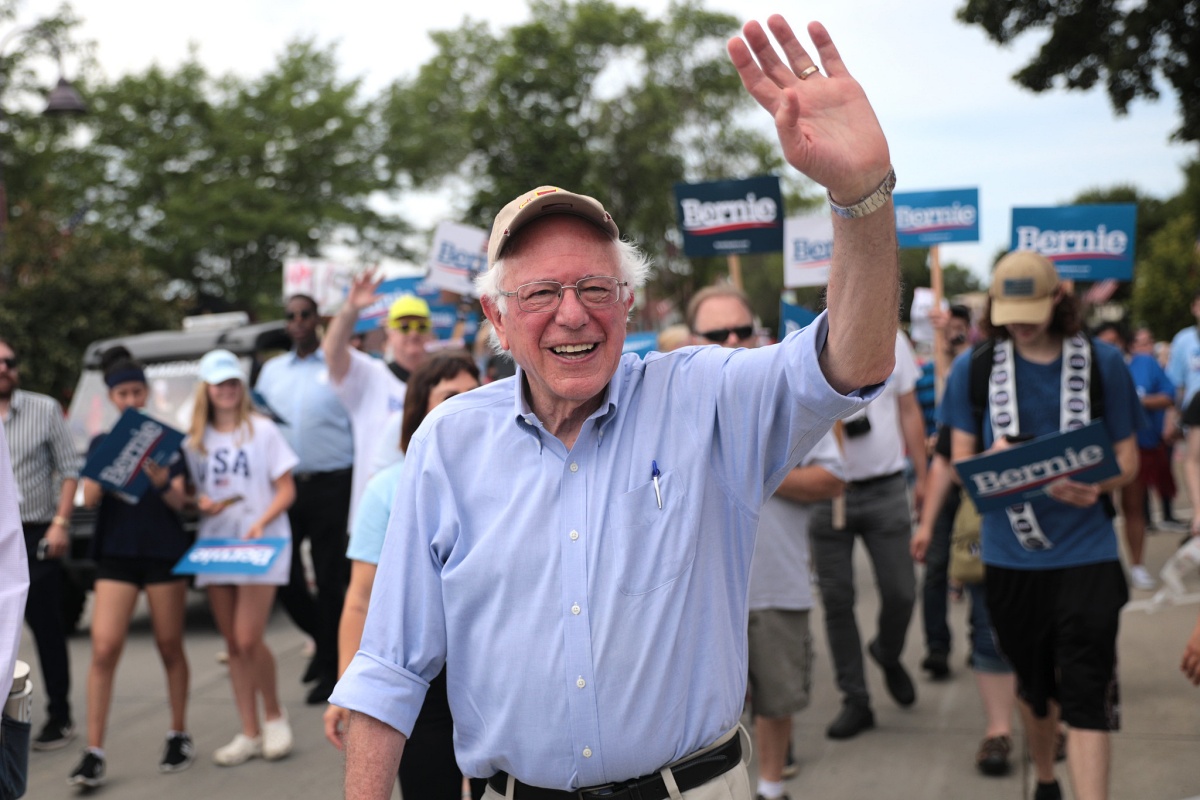
Gage Skidmore • Attribution-ShareAlike (CC BY-SA 2.0) • Flickr


Mar 6, 2023 2:01 AM
Sanders refers to our “uber” or “unfettered” capitalism, suggesting that there are different types of capitalism—just as there are different types of socialism.
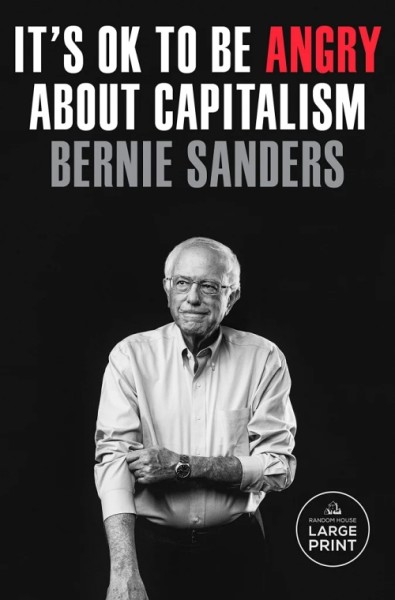
Senator Bernie Sanders has a new book out, It’s OK to Be Angry About Capitalism. And in it his main argument is essentially correct: Our “uber-capitalist economic system….is grossly immoral….In the twenty-first century we can end the vicious dog-eat-dog economy in which the vast majority struggle to survive, while a handful of billionaires have more wealth than they could spend in a thousand lifetimes.” In numerous talks and articles about the book, he has elaborated on his message about what he also calls “unfettered capitalism.”
In LA Progressive, there are frequent criticisms of capitalism’s defects, for example in "Is Capitalism Killing Our Planet and Our Concern for the Common Good?” In that essay’s first paragraph Pope Francis’s words are quoted that capitalism is a: “system, which tends to devour everything which stands in the way of increased profits, whatever is fragile, like the environment, is defenseless before the interests of a deified market, which become the only rule.”
Another LAP criticism comes from writer Wendell Berry:
No amount of fiddling with capitalism to regulate and humanize it, no pointless rhetoric on the virtues of capitalism or socialism, no billions or trillions spent on “defense” of the “American dream,” can for long disguise this failure. The evidences of it are everywhere: eroded, wasted, or degraded soils; damaged or destroyed ecosystems; extinction of species; whole landscapes defaced, gouged, flooded, or blown up; pollution of the whole atmosphere and of the water cycle; “dead zones” in the coastal waters; thoughtless squandering of fossil fuels and fossil waters, of mineable minerals and ores; natural health and beauty replaced by a heartless and sickening ugliness.
Related stories
Sanders, however, refers to our “uber” or “unfettered” capitalism, suggesting that there are different types (degrees) of capitalism—just as there are different types of socialism. In 2019 I wrote that “politics is too full of labeling.” And since “both capitalism and socialism have too much historical baggage,” I opt “for a fair and moral economy, call it what you will.” In that same article I pointed out that in 2001 the U. S. State Department shied away from labeling when it declared that though “the United States is often described as a ‘capitalist’ economy,” it “is perhaps better described as a ‘mixed’ economy, with government playing an important role along with private enterprise.”
Although Sanders has run as a “democratic socialist,” he often refers approvingly to the economic ideas and thoughts of Franklin D. Roosevelt [FDR], who was a progressive, but not a socialist. As one opinion writer noted, “Some people would say that capitalism is immoral, no matter what form it takes. But that doesn’t seem to be Sanders’ argument. Rather than making the case for a Democratic socialist government, Sanders appears to want a reform of American capitalism and to see the country embrace a kind of New Deal liberalism.”
That last sentence sounds something like the kind of definition one reliable historical work gave to the early progressivism of the 1890-1914 period: a diverse movement “to limit the socially destructive effects of morally unhindered capitalism, to extract from those [capitalist] markets the tasks they had demonstrably bungled, to counterbalance the markets’ atomizing social effects with a countercalculus of the public weal [well-being].” It did not attempt to replace capitalism, but to have government bodies and laws constrain it to insure that it served the public good.
In his new book Sanders quotes from FDR’s 1944 State of Union address, “As our Nation has grown in size and stature, however—as our industrial economy expanded—these political rights [free speech, etc.] proved inadequate to assure us equality in the pursuit of happiness. We have come to a clear realization of the fact that true individual freedom cannot exist without economic security and independence.” FDR went on to say that “necessitious men are not free men,” and he called for a “second Bill of Rights” that would include the following:
- The right to a useful and remunerative job in the industries or shops or farms or mines of the Nation;
- The right to earn enough to provide adequate food and clothing and recreation;
- The right of every farmer to raise and sell his products at a return which will give him and his family a decent living;
- The right of every businessman, large and small, to trade in an atmosphere of freedom from unfair competition and domination by monopolies at home or abroad;
- The right of every family to a decent home;
- The right to adequate medical care and the opportunity to achieve and enjoy good health;
- The right to adequate protection from the economic fears of old age, sickness, accident, and unemployment;
- The right to a good education.
After quoting FDR in his book, Sanders repeats Roosevelt’s words “true individual freedom cannot exist without economic security and independence.” And we will see shortly how seriously Sanders takes these words. But first a little historical background.
The socialist candidate for U. S. president in the first few decades of the twentieth century was usually Eugene Debs, and Sanders begins his Chapter Six writing about him including this phrase, “Debs has been my hero since I was a young man.” A New Yorker article has this to say about Debs’ ideas: His “socialism endured….significantly in Progressive-era reforms, in the New Deal, and in Lyndon Johnson’s Great Society. In the decades since….1980, many of those reforms have been undone, monopolies have risen again, and income inequality has spiked back up to where it was in Debs’s lifetime. Socialism has been carried into the twenty-first century by way of Sanders, a Debs disciple.

Reflecting a similar attitude toward progressive ideas, the poet, Lincoln biographer, early socialist, and friend of Debs, Carl Sandburg (1878-1967), went from supporting Debs to voting and working for FDR, and latter another friend, Adlai Stevenson, who said about the poet, he “is the one living man whose work and whose life epitomize the American dream.” In the 1960s Sandburg supported JFK and thought that the Democratic platform adopted at the 1960 convention was “a very good imitation of the national Socialist Party platform adopted in Chicago in 1908,” which he attended. In 1964, he also supported LBJ (who eulogized Sandburg upon his death), but did not live long enough to witness the subsequent decline of progressivism.
In that very year in which FDR ticked off the bulleted list above, a book appeared that has appealed to conservatives ever since. It was The Road to Serfdom by the Austrian economist Friedrich Hayek (1899-1992). He believed that to maintain freedom, free-market capitalism had to be allowed to operate unfettered. Government officials who disrupted the spontaneous economic order in the name of “social justice” (which Hayek labeled a myth) were to him a great threat to freedom. Along with another conservative economist, Milton Friedman (1912-2006), he encouraged conservatives like President Ronald Reagan to believe that the greatest threat to freedom was “big government.” (When asked in 1999 whether he would keep or eliminate fourteen U. S. cabinet departments, Friedman responded he would eliminate most of them, including those overseeing commerce, education, energy, and labor.)
The debate between progressives like FDR and Sanders, who think government should heighten people’s “economic security and independence,” and conservatives like Hayek, Friedman, and Reagan, who think capitalism should remain as unfettered as possible, has continued until the present.
In 1999, the same year that Friedman proposed eliminating the departments of commerce, education, energy, and labor, economist Amartya Sen’s Development as Freedom was published. In it he argued as FDR had in 1944: true freedom required not just political and civil rights, but also “substantive freedom,” which meant economic and social opportunities that might include such things as jobs and subsidies, unemployment benefits, and inexpensive health care. Poor, uneducated people without land, jobs, or access to health care, might be free to associate with whomever they please and to vote and exercise other personal and civic rights, but Sen argued that they were not as free as those who possessed many more opportunities due to their greater resources.
Arguing similarly and as FDR did in 1944, Sanders now writes that the USA should provide the following rights: “a secure, well-paying, and meaningful job”; “quality health care”; “a good education”; “decent and affordable housing”; “a secure retirement.”
In his new book Sanders quotes Martin Luther King Jr. in 1967, when he stated that “capitalism forgets that life is social. And the kingdom of brotherhood is found neither in the thesis of communism nor the antithesis of capitalism, but in a higher synthesis.” (Sander’s book often mentions his concern for minorities, for example, “From its inception, this country has been afflicted by racism, anti-immigrant xenophobia, sexism, homophobia, and other forms of bigotry.”) The senator also writes approvingly about how strong unions were and support for them until the Reagan presidency in the 1980s. And he advocates giving more workers an “ownership stake” in the companies for which they work.
Moreover, he notes that before Reagan became president the average worker was better off financially, “the average American worker today makes no more than he or she did fifty years ago in real, inflation-adjusted dollars.” Not only “no more” but, as Sanders recently stated, “$43 a week less” than today.” And “we now have more income and wealth inequality than ever before, with the richest three billionaires owning more wealth than the bottom half of our society—165 million people. Today, the top 1 percent owns more wealth than the bottom 92 percent and the CEOs of major corporations earn four hundred times what their employees make.”
Sanders’s book, however, is not just a critique of “uber” or “unfettered” capitalism. Like FDR’s New Deal, it offers a wide range of government-sponsored programs to increase well-paid employment opportunities. For example, “We can create millions of jobs by leading the world in combating the existential threat posed by climate change and transforming our energy systems away from fossil fuels and toward energy efficiency and sustainable energy. We can rebuild our crumbling infrastructure….We can put an end to our dysfunctional health care system and move toward a publicly funded Medicare for All system that guarantees health care as a human right, not a privilege.”
What prevents the transformation away from uber-capitalism toward the FDR-type society, only updated, that FDR envisioned is that the oligarchs “own” our democracy. “They spend tens of billions of dollars on campaign contributions to both major political parties in order to buy politicians who will do their bidding. They spend billions more on lobbying firms to influence governmental decisions at the federal, state, and local levels. . . . To a significant degree, the oligarchs own” the media.
In 2016 and again in 2020 Sanders appeal to some working-class voters was noted. Unlike some other Democratic candidates for the presidency he did not (and does not) lump Trump voters all together as racists or bigots. In his new book, he writes:
I think the more accurate answer as to why Trump has won working-class support lies in the pain, desperation, and political alienation that millions of working-class Americans now experience and the degree to which the Democratic Party has abandoned them for wealthy campaign contributors and the “beautiful people.” These are Americans who, while the rich get much richer, have seen their real wages stagnate and their good union jobs go to China and Mexico. They can’t afford health care, they can’t afford childcare, they can’t afford to send their kids to college and are scared to death about a retirement with inadequate income.
Less than a year ago I wrote we need “passion to create a better world, a more sustainable and just world….But passion also to fuel us to keep working patiently at getting legislation passed.” We progressives can be thankful that we have such a man of passion and persistence (Sanders) now heading the Senate Health, Education, Labor, and Pensions (HELP) Committee.
Comments

Powered by RoundtableAn AI/DeFi-powered Enterprise Media Operating System. Learn more at Roundtable.io.© Roundtable 2026. By using this site you agree to the Terms of Use and Privacy Policy