



Aug 14, 2025 4:23 PM
I have sometimes speculated about whether capitalism can be moral or is doomed to put profits before people—even if it kills them.
Almost a decade ago I wrote “Bernie Sanders Wants a ‘Moral Economy.” What’s That and Why’s It Relevant.” Last year, Steven Pearlstein’s Moral Capitalism: Why Fairness Won't Make Us Poor was published, as was a book of essays also entitled Moral Capitalism.
During the time between these publications, I have sometimes speculated about whether capitalism can be moral or is doomed to put profits before people—even if it kills them, as was the case with Purdue Pharma’s marketing of the opioid OxyContin. Thus, I was interested in seeing what last year’s two books had to say.
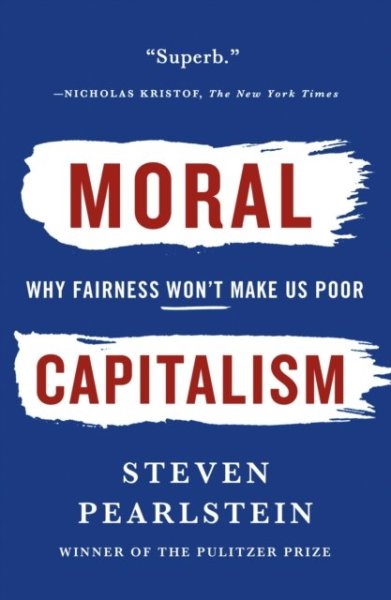
Pearlstein writes that many of us have come to believe that our present-day U. S. capitalism has “run off the moral rails, offending our sense of fairness, eroding our sense of community, poisoning our politics, and rewarding values that easily degenerate into greed and indifference...We seek a new, more moral capitalism.” In the Forward to the book of essays, we read that “most of us recognize that we should not divorce economic pursuits from moral considerations.”
Pearlstein traces the running “off the rails” to the 1980s—the Thatcher/Reagan era—when three “flawed ideas” became prominent. One was cutting taxes and eliminating government regulations; two was that “the sole purpose of every business is to deliver the highest possible financial return to its investors”; and three was “we must ignore and dismiss such moral concerns as naïve and ultimately self-defeating.”
Related stories
In citing the second idea, the author quotes conservative economist Milton Friedman: “There is only one social responsibility of business—to use its resources and engage in activities designed to increase its profits”—isn’t that what Pudue Phrama did? (When asked in 1999 whether he would keep or eliminate fourteen U. S. cabinet departments, Friedman responded he would eliminate most of them, including those overseeing commerce, education, energy, and labor.)
The overemphasis of the three ideas Pearlstein mentions eventually led to the government’s dismissal of such concerns as our climate crisis, which is now evident under the second Trump administration.
Obviously, Pearlstein does not believe that the three “flawed ideas” he mentions are essential to the “moral capitalism” he advocates. And part of the problem in opting for capitalism or democratic socialism—as some Western European governments have—is how we define each term. On this La Progressive site former Secretary of Labor Robert Reich has recently written, “Most Americans need stronger safety nets and deserve a bigger piece of the economic pie...If you want to call this socialism, fine. I call it fair.”
Reich seems correct to me, as I wrote six years ago when I pointed out, “I’m for a fair and moral economy, call it what you will. Politics is too full of labeling.” (I also quoted the U.S. State Department declaration that though “the United States is often described as a ‘capitalist’ economy,” it “is perhaps better described as a ‘mixed’ economy, with government playing an important role along with private enterprise.”)
In that same essay, I mentioned the Progressive Era (1890-1914), which one historian characterized as an attempt “to limit the socially destructive effects of morally unhindered capitalism, to extract from those [capitalist] markets the tasks they had demonstrably bungled, to counterbalance the markets’ atomizing social effects with a counter calculus of the public weal [well-being].” Then, importantly, I added: “This movement did not attempt to overthrow or replace capitalism but to constrain and supplement it in order to ensure that it served the public good.” Thus, we have sort of a progressive capitalism, or if you prefer a “moral capitalism.”
Although some right-wing conservatives labeled President Franklin Roosevelt (FDR) a “socialist,” other commentators argued that he saved capitalism. I prefer to think of him as a progressive who like earlier ones attempted “to limit the socially destructive effects of morally unhindered capitalism.”
More recently (in 2023), Sen. Bernie Sanders, an avowed democratic socialist who in 2016 ran for the Democratic presidential nomination, has expressed an admiration for FDR and made a distinction between our “uber [hyper]-capitalist economic system.” and FDR’s progressive capitalism. The first he calls “grossly immoral”; the second, he praises. These comments are in his 2023 book It’s OK to Be Angry About Capitalism.
Sanders also refers to Pope Francis’s description of the first type of capitalism as a “system “which tends to devour everything which stands in the way of increased profits, whatever is fragile, like the environment, is defenseless before the interests of a deified market, which become the only rule.” Regarding FDR, Sanders quotes from his 1944 State of the Union address, “As our Nation has grown in size and stature, however—as our industrial economy expanded—these political rights [free speech, etc.] proved inadequate to assure us equality in the pursuit of happiness. We have come to a clear realization of the fact that true individual freedom cannot exist without economic security and independence.” FDR went on to say that “necessitious men are not free men,” and he called for a “second Bill of Rights” that would include the following:
- The right to a useful and remunerative job in the industries or shops or farms or mines of the Nation;
- The right to earn enough to provide adequate food and clothing and recreation;
- The right of every farmer to raise and sell his products at a return which will give him and his family a decent living;
- The right of every businessman, large and small, to trade in an atmosphere of freedom from unfair competition and domination by monopolies at home or abroad;
- The right of every family to a decent home;
- The right to adequate medical care and the opportunity to achieve and enjoy good health;
- The right to adequate protection from the economic fears of old age, sickness, accident, and unemployment;
- The right to a good education.
As Reich wrote, “If you want to call this socialism, fine. I call it fair.” Or “call it what you will. Politics is too full of labeling.”
Reich and Sanders or Freidman and Trumpism? What does our future portend? The Progressivism of the 1890-1914 period followed our Gilded Age, a period of the type of uber-capitalism that Sen. Bernie Sanders decries. In a recent interview the senator indicated that after a second Gilded Age (Trumpism), we are going to have another Progressive era. Let’s hope he’s right.
Comments

Powered by RoundtableAn AI/DeFi-powered Enterprise Media Operating System. Learn more at Roundtable.io.© Roundtable 2026. By using this site you agree to the Terms of Use and Privacy Policy