
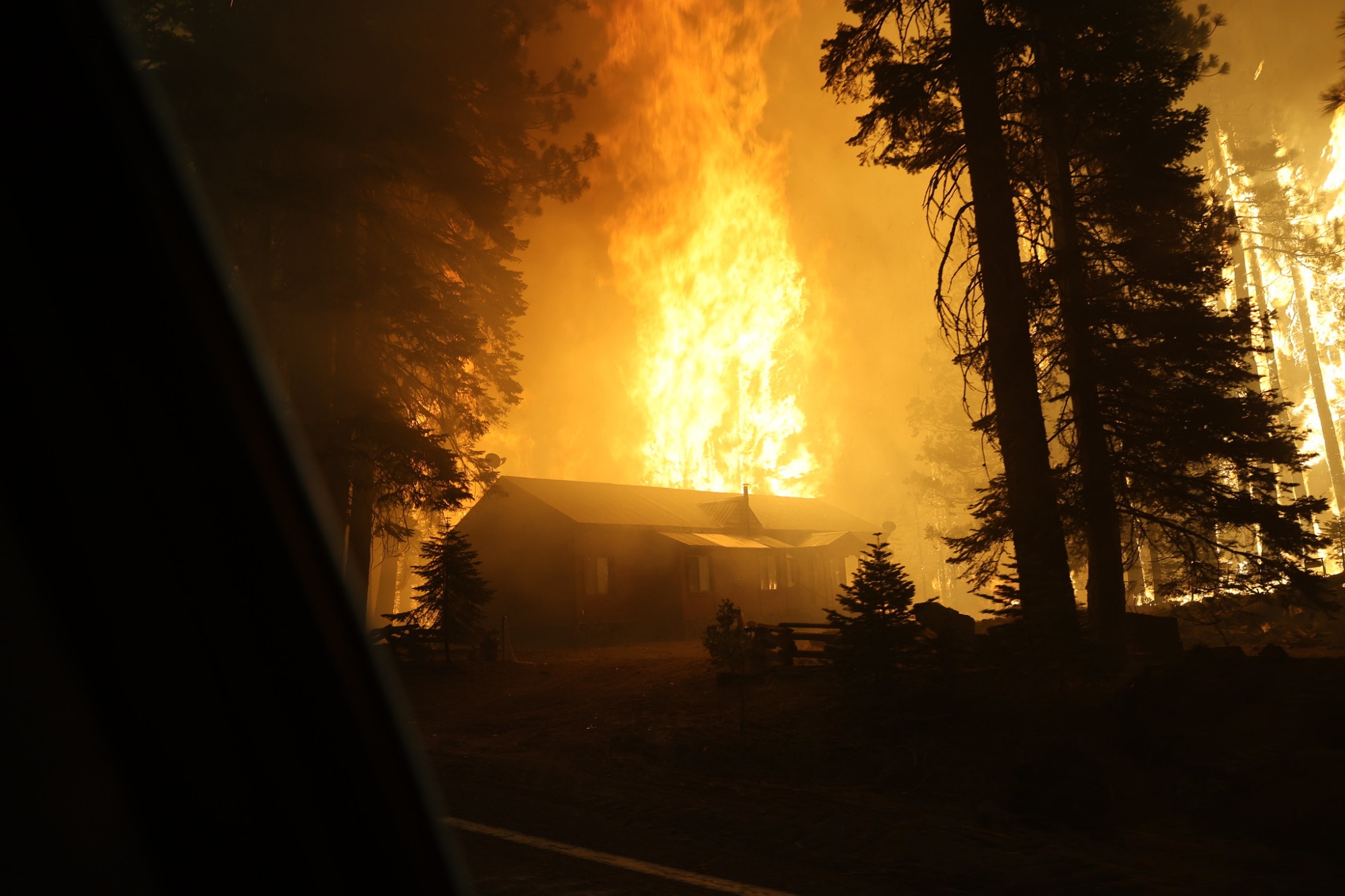
2021_DixieFire_August4 (53) by CALFIRE_Official is licensed under CC BY-NC 2.0 / Flickr


Jun 7, 2023 3:00 PM
Why do bankruptcy courts protect corporations from the natural consequences of their reckless or criminal activities?
As we enter this year’s fire season, we should recall that this year is the 5th anniversary of the Camp Fire, which incinerated the northern California towns of Concow and Paradise. The fire left 85 people dead, officially. But in the weeks and months after the fire was contained, dozens more died of lingering injuries. And thousands still live with the agony of losses, of family, friends, pets, homes full of memories, pictures, artifacts, heirlooms and jobs.
The fire was caused by Pacific Gas & Electric Corporation, known as PG&E. A PG&E power line broke, showering sparks onto dry brush beneath the power line. The dry brush flamed into nearby forest, and then burned over 240 square miles of northern California.
This was neither PG&E’s first nor last huge fire. For decades, PG&E had made the financial decision to withhold maintenance on power lines, and to withhold even inspecting power lines, so that more money could be showered on executive salaries and stockholder dividends. PG&E had routinely paid fines for neglecting its power lines. The fines were simply a cost of doing business, much less than the cost of proper line maintenance.
And when the lax maintenance caused fires and damage, government paid the firefighters who fought the fires and government paid for social services and welfare to take care of fire victims. Corporate socialism.
Related stories
After the fire was out, and investigated, PG&E pleaded guilty to criminal charges of killing 84 of the 85 official fire victims. The 85th victim, elderly, immobile, sitting at home as the fire engulfed his entire neighborhood, with no rescue available, killed himself rather than suffer burning to death. Officially, PG&E was held not liable for thiat victim’s death.
If a person was at work and had to flee the fire without going home, what was the value of a beloved lap cat, raised from a kitten, then left locked in a house as it burned to the ground?
Thousands of people sued PG&E. If a person was at work and had to flee the fire without going home, what was the value of a beloved lap cat, raised from a kitten, then left locked in a house as it burned to the ground? What is the monetary value of the guilt felt year after year of remembering that cat, or dog, or horse, and the feeling of having abandoned them, to flee with your own life? What is the value of the wedding dress carefully stored in the closet, to be given to your own daughter when her time comes, but now just ashes?
PG&E filed for bankruptcy, to let the government courts sort out the proper values. Ultimately, amounts were set aside to provide something for victims, to provide medical care for the injured, and rebuilding parts of the public infrastructure its fire had destroyed. With extreme generosity, PG&E agreed to pay billions of dollars. An amount that was almost equal to one year of PG&E’s routine annual profits.
PG&E also agreed to improve its inspection and maintenance programs and budgets. But PG&E power lines have caused more fires in each of the years since 2018, and will certainly cause a few in this fire season.
The good news is that PG&E still pays regular dividends to its stockholders, mostly hedge funds and large investors.
This spring, in the fifth year since the Camp fire, the bankruptcy court also resolved another big corporate bankruptcy, in very much the same way that the PG&E case resolved. The bankruptcy court decided that the Sackler family of drug distributors could pay a settlement worth a couple of years of drug sales, and then be protected from any future civil liability to the victims of its decades of pushing oxycodone on drug addicts around the nation.
Unlike the PG&E fires, which number cumulative victims in the several hundreds, the Sackler’s drug distribution schemes have been responsible for tens of thousands of deaths, and the family suffering that go along with those losses.
Corporations are people too, we are told. Consider the reality.
- If a local arsonist set fire to an aging shopping center because the owner could collect more from insurance than from store rents, would we say to the arsonist, “Pay about one year’s worth of your regular income, say how sorry you are, and we’ll let you walk away, if you promise not to get caught in the future”?
- If a local drug dealer group got caught selling drugs that killed a few hundred, or even just a few dozen local people, would we say to them, “Cough up a fine of a year or two of your drug profits and promise to move your drug business elsewhere, and we’ll drop all charges”?
The Sackler family has another drug company, named Mundipharma, through which they spread their joy worldwide, not just in the U.S., as with their PurduePharma. With the booming Chinese economy worked by a billion or so highly stressed workers, the marketing potential is immeasurable.
American-style capitalism at its finest.
Corporations are people too. PG&E and Purdue Pharma have both inflicted criminal injuries on regular people. Both have been forced into bankruptcy. Both remain profitable, after hundreds and thousands of people have died at their hands, simply so that they could inflate their profits wildly beyond what could be made through legal business operations. No executives went to jail, or were executed for first degree murders. Is that how our legal system treats all drug dealers and every person who causes recklessly negligent mass deaths?
Purdue Pharma and PG&E are not alone in this behavior as corporate people. In 1971, Ford introduced the Pinto economy car. By 1972, people were dying in flames when Pintos were struck from behind by other cars. The Pinto gas tanks ruptured and spewed gas into the passenger compartment, where it could ignite with horrible effects. When the cases went to trial, evidence was introduced showing that Ford knew before production began that the fire danger could be substantially reduced by spending only $5-$10 per car. Ford decided not to make fire safety changes because they would cut into profits.
The result was that several people died in Pinto rear end crash fires, while Ford prospered. Ford was not pushed into bankruptcy, and no Ford executive was ever charged with a crime for any of the deaths caused by the cost saving, profit boosting elimination of safe design.
There is almost no industry in the United States that doesn’t have a history of killing either its workers or its customers or innocent bystanders in pursuit of increased profits.
Cars, drugs, electricity and on and on. There is almost no industry in the United States that doesn’t have a history of killing either its workers or its customers or innocent bystanders in pursuit of increased profits. Here in California, agriculture regularly kills workers who are often legally at risk, seasonal hires, at the bottom of the pay scale. Every year, consumers are fed tainted or infected produce and other food products, natural and highly processed.
What doesn’t happen every year, or any year, is corporations being treated the same way we treat people who injure or kill other people. Corporate profits make a big difference in how elected prosecutors, who all depend on corporate campaign funds, treat corporate crimes. But corporations are people too.
Stockholders are people too, we are told, although most stocks are held by corporations, hedge funds, mutual funds, trust funds, etc. Why should they be “punished” by a corporation’s crimes?
To ask that question is to buy into the mythology of corporate personhood and corporate misspeak on business operations.
Corporations provide a legal structure that make complex businesses and business relationships possible. A union organized as a corporation can shield its members from legal liability to a corporate employer as it asks for better pay and safer working conditions for its members. Corporate interactions make it possible for Chinese companies to make huge, vibrantly colored OLED TVs, that Costco can sell at ridiculously low prices, including the costs of shipping and moving across various national (sometimes hostile) borders.
Stockholders should be able to form corporations to conduct businesses and earn reasonable profits. But is there any reason to allow corporations to commit crimes? Is there any reason to allow them to put unsafe products into the stream of commerce? Corporations never decide to commit crimes or offer unsafe products. Those decisions are made by people within the corporation - people in corporate management. Those criminal deciders are people too.
Why are their criminal or negligent or reckless decisions protected from any responsibility when a local shoplifter can go to prison for years? Why do bankruptcy courts protect corporations from the natural consequences of their reckless or criminal activities which would earn criminal prosecution for any other “person”?
Let us revert to PG&E: What if they were criminally or civilly required to fully pay for all of the costs of losses, injuries and deaths they caused? What if they were allowed to go on providing electricity, generating profits, but had to pay every single penny of their profits to their victims until their victims were fully compensated, before they could pay a single dividend or executive bonus?
Corporate economists might tell us that stockholders wouldn’t stand for it. They’d sell their stock. But to whom, if the stock was going to tank? PG&E would still be there, still generating profits. And the victims would get paid before the stockholders.
If bankruptcy courts found PG&E, or Ford, or Purdue Pharma, or any other corporation able to continue profitable business, directing those profits to victims before shareholders, instead of to shareholders before victims, as is the current system, corporations could survive, could still be profitable. But with one huge change. Stockholders would begin to demand that corporations like PG&E inspect and maintain their power lines, that Ford make safe cars, that Purdue Pharma not pay bonuses to doctors willing to push pills to addicts.
Stockholders are protected by the corporate business form. Protected so that they can provide new products, innovative ideas, and public benefits. As the preamble to the Constitution says, “to promote the public welfare.” There isn’t any Constitutional provision that says corporations can be formed to commit crimes or recklessly or even negligently cause injury, let alone mass injuries, without liability.
Dianne Feinstein is coming to the end of her term in the senate. She has always been a corporate senator. As we choose her successor, we should be asking every candidate, do you support making corporate persons liable for misconduct in the same way the individual persons are held liable?
Comments

Powered by RoundtableAn AI/DeFi-powered Enterprise Media Operating System. Learn more at Roundtable.io.© Roundtable 2026. By using this site you agree to the Terms of Use and Privacy Policy