


Dec 1, 2025 5:47 PM
With the election of Ronald Reagan in 1980, a long era began with the agenda of rolling back both the economic equality of the New Deal and the social equality of Johnson’s Great Society.
Rising Inequality and the Crisis of Democracy
In these polarized times, I am lucky to be a member of an informal group of people who want to talk to people on the other side. Not everybody can do it. Right or left, you have to be willing to courteously listen when those on the other side spout nonsense, and to courteously respond with what you see as the truth.
At one of our recent meetings, one of the conservatives asked, “What’s wrong with getting rich?” He’s a good man, very community-spirited, doesn’t much like Trump but voted for him anyway. Implicit in the question was the idea that liberals are just jealous of those who do well and get rich.
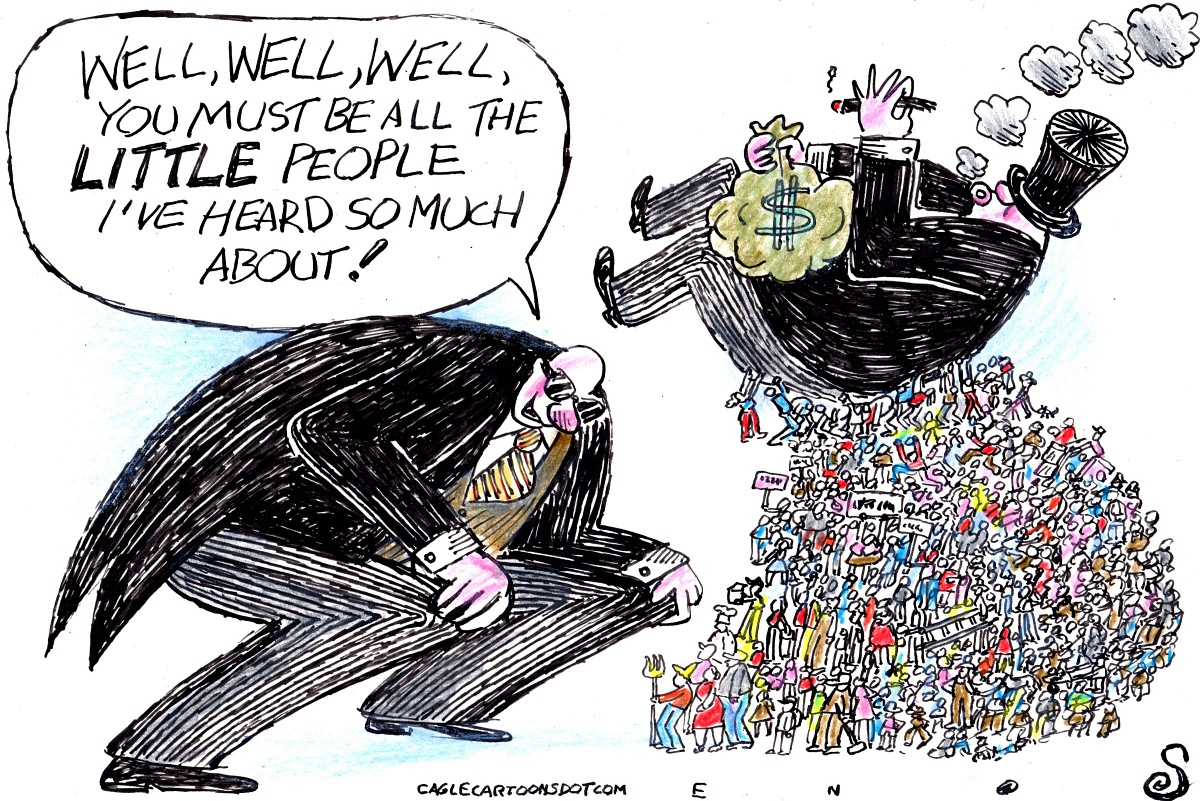
I tried to tell him that some inequality is acceptable if we want to have a working economy, but the we have gotten to such extreme inequality that it undermines democracy. Democracy assumes that all citizens are equal, while extreme inequalities of wealth imply extreme inequalities of power. I didn’t convince him. This is my second try.
Donald Trump is right when he cites the 1950s as the time in America’s history when America was Great. But he’s right for the wrong reasons. He’s thinking back to when men ruled women, when Whites dominated Blacks, when immigrants were few and mostly White. That’s what he wants to get back to.
Related stories
But he really wants to flee from another key feature of the 1950s: economic equality. In 1953, the highest quintile (20 percent) of the population received 25 percent of income (Federal Reserve Bank of St. Louis). In 2024, the top quintile received 52.6 percent of personal income (Bureau of Economic Analysis). Focus on this: in 1953, the top 20 percent only had 25 percent of income, while a few decades later the top quintile had over 50 percent. The other 80 percent of people got by on less than 50 percent.
Why is this important? We traditionally regard our country as the world’s greatest democracy. One thing sets democracies apart from other types of polity: the principle that every citizen is equal to every other citizen. One person, one vote. But if you have $1.00 and I have $1,000,000, there is no realistic equality in the power each of us can wield to shape public policy. We each have one vote, but I have the resources to make myself heard, and you don’t. Under the extreme inequality that we have now, democracy is an illusion.
The relative equality of the 1950s was the result of deliberate policies adopted during the New Deal years of the 1930s, such as Social Security, coupled with substantially higher income tax rates on higher incomes and active regulation of the economy. The New Deal provided an economic floor for the poorest people, and paid for it by taxing the rich. As late as the 1960s, that bargain held.
But the coalition that sustained it fell apart. Conservative Southern Democrats were never enthusiastic about the egalitarian New Deal policies, but they supported Roosevelt as long as he would block Blacks from getting most benefits. When the Civil Rights movement gained power and civil rights laws were enacted in the 1960s, the Democrats lost their Southern wing. Starting with the Goldwater campaign of 1964, Republicans increasingly attracted the Southern conservatives.
With the election of Ronald Reagan in 1980, a long era began with the agenda of rolling back both the economic equality of the New Deal and the social equality of Johnson’s Great Society. Democratic presidents of this era (Carter, Clinton, Obama, Biden) have only been able to moderate the general thrust toward more inequality.
A half century of reaction has led us to this place. Donald Trump is its culmination. His blatant, open corruption, profiting from the office he holds, tells us that the rich are in control. We, each of us with our single vote, are window dressing.
The game is not entirely lost, though. The Trump regime has not yet taken full control of the electoral machinery. But time is short for taking the country back to democracy.
Comments

Powered by RoundtableAn AI/DeFi-powered Enterprise Media Operating System. Learn more at Roundtable.io.© Roundtable 2026. By using this site you agree to the Terms of Use and Privacy Policy