
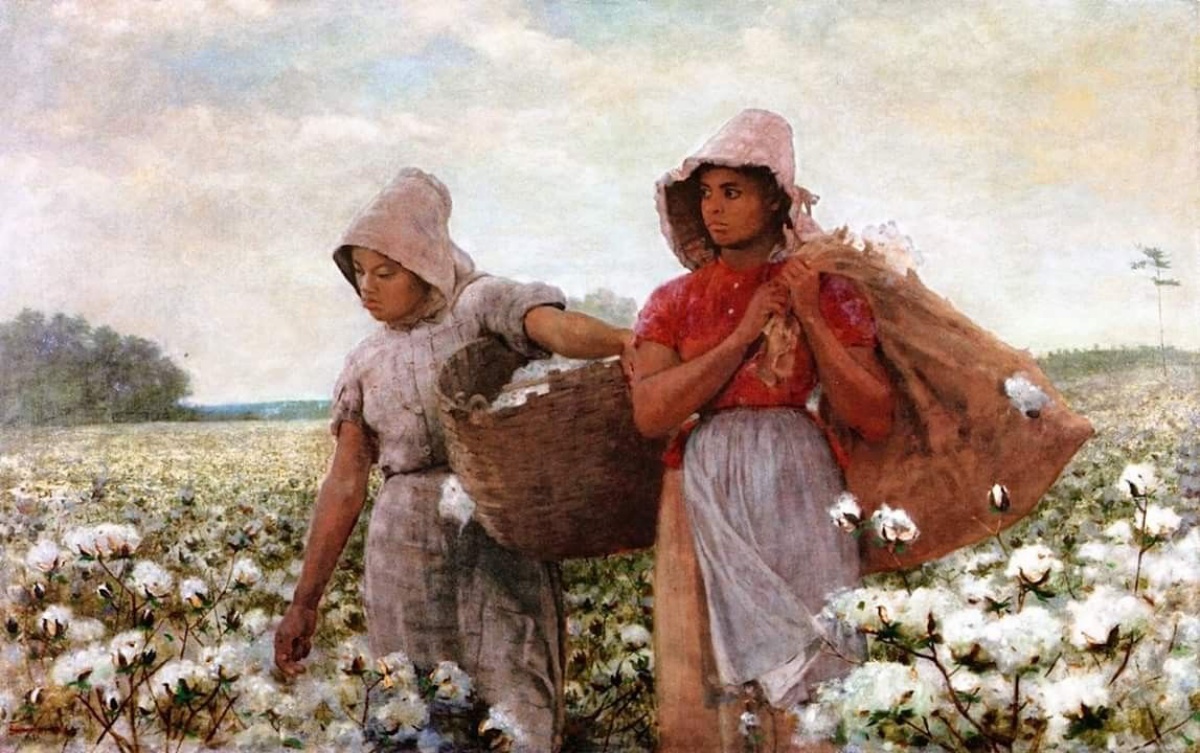
Rawpixel Ltd • The Cotton Pickers (1876) by Winslow Homer. Flickr


Jun 21, 2023 12:00 PM
The economic system most often identified with the USA and the rest of the Western world has been guilty of both imperialism and degrading our environment.
Having just finished reading British author Peter Frankopan’s new environmental history, The Earth Transformed: An Untold Story I was struck once again by how the lust for profits spurred on capitalism, imperialism, and environmental degradation. Considering the world around 1500, shortly after Columbus’ first three trips to the Americas, he writes, “what drove the next cycle in global history was the pursuit of profit.” And near the beginning of a chapter dealing with the approximate 50 years from c. 1870 to c. 1920, he states that “the ecological implications of rapid transformation of landscapes that were motivated by the chase for a fast buck" were “severe and shocking.” He adds, “the dovetailing of evangelical ideas about racial superiority, religious virtue and capitalism was a core element of the way that Europeans, and the British above all, saw both themselves—and the rest of the world.”
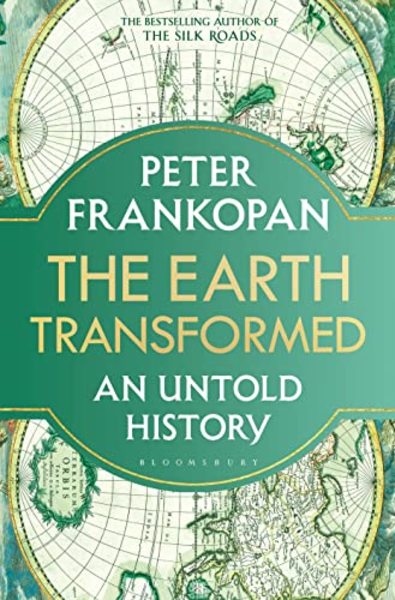
Indeed. Frankopan furnishes us with material that suggests just how detrimental this dogged “pursuit of profit” was, at least for our planet and for indigenous peoples (like Native American) and slaves. Regarding smallpox and measles, he writes that they “proved devastating for the inhabitants of Central America,” who had built up no immunity to these diseases brought from Europe. He mentions that some estimates place the population of the “Valley of Mexico” at around 1.5 million people around 1500 but only about 5 percent of that in 1650. And he mentions the “‘Great Dying’ of the indigenous populations of the Americas which was caused by violence, malnutrition and disease.”
Regarding slavery, what strikes this reader is how extensive U. S. and Caribbean slavery was and how its aftereffects continue to influence us even today. In the 1780s “more than 900,000 souls were sent from the coast of Africa.” “The demand...was driven by the vast profits that could be generated from tobacco, cotton, indigo and sugar.” And many enslaved people from Africa never even made it across the Atlantic. In the seventeenth century it was estimated that between 20 and 30 percent of the enslaved that boarded British and Spanish ships never survived the Atlantic journey.
In a 2020 article here on LA Progressive, I quoted Jill Lepore’s These Truths: A History of the United States, which provided earlier evidence of how extensively we inflicted historical injustices on these peoples. “Between 1500 and 1800, roughly two and a half million Europeans moved to the Americas [note: not just the USA]; they carried twelve million Africans there by force; and as many as fifty million Native Americans died, chiefly of disease,”
Related stories
Frankopan mentions that many of our finest eastern universities, including Harvard, Yale, Princeton, and Georgetown, “owed much to the profits of slavery,” and between 1789 and the 1920s, 1,700 members of Congress “owned” or once “‘owned’ other human beings.” He also indicates that U.S. counties that possessed large numbers of slaves in the early 1860s are “more likely today not only to vote Republican, but to oppose affirmative action and express racial resentment and sentiments towards black people.”
Of the relationship between capitalism and slavery much has been written, especially since Eric Williams’ book of that name appeared in the 1940s. Ditto for the connection of capitalism and imperialism. Lenin’s Imperialism, the Highest Stage of Capitalism (1920) indicates in its very title what he thought about the relationship between capitalism and imperialism. But let’s put those relationships aside for a moment and instead just concentrate on the profit-seeking that Frankopan emphasizes.
In 1970 the conservative, ultra pro-capitalist economist Milton Friedman wrote, "The social responsibility of business is to increase its profits."
In 1970 the conservative, ultra pro-capitalist economist Milton Friedman wrote, "The social responsibility of business is to increase its profits." Six years later, in The Cultural Contradictions of Capitalism, Daniel Bell stressed that “in its products and in its advertisements, the corporation promotes pleasure, instant joy, relaxing, and letting go,” and that this situation left “capitalism with no moral or transcendental ethic.”
In 2021 I wrote about how capitalist corporations—like Purdue Pharma (maker of the opioid OxyContin), Boeing, Pacific Gas & Electric, and Facebook—put profits before people, even if it sometimes (as with OxyContin) killed them. I also quoted Pope Francis, who stated that the “pursuit of the common good” should be “the chief aim of all politics.” And who criticized capitalism for being a “system, which tends to devour everything which stands in the way of increased profits, whatever is fragile, like the environment, is defenseless before the interests of a deified market, which become the only rule.”
Now back to capitalism’s relationship with imperialism—and environmental degradation. Before his death in 1883 Karl Marx recognized, as Frankopan writes, humans’ “determination ‘to exploit the earth’s surface, the bowels of the earth, the air,’ which was driven by the desire to profit at nature’s expense.”
But the 1890s witnessed a major switch regarding consumption. As William Leach has written, “American corporate business, in league with key institutions, began the transformation of American society into a society preoccupied with consumption, with comfort and bodily well-being, with luxury, spending, and acquisition, with more goods this year than last, more next year than this. American consumer capitalism produced a culture almost violently hostile to the past and to tradition, a future-oriented culture of desire that confused the good life with goods. It was a culture that first appeared as an alternative culture...and then unfolded to become the reigning culture in the United States.” As Frankopan observes, “the demand for goods and commodities was not merely ravenous but ecologically catastrophic.”
With 1898 and the beginning of the Spanish-Cuban-American War, the U. S. joined the European countries, which were then dividing up Africa, by displaying its own imperialism in the Philippines, Hawaii, and Cuba. Albert Beveridge, political orator and soon-to-be senator from Indiana, expressed our country’s dominant sentiment: “American factories are making more than the American people can use; American soil is producing more than they can consume. Fate has written our policy for us; the trade of the world must and shall be ours...We will establish trading-posts throughout the world as distributing points for American products. We will cover the ocean with our merchant marine. We will build a navy to the measure of our greatness. Great colonies governing themselves, flying our flag and trading with us, will grow about our posts of trade. Our institutions will follow our flag on the wings of commerce...The Philippines are logically our first target.”
Thus, it’s true that the economic system most often identified with the USA and the rest of the Western world has been guilty of both imperialism and degrading our environment. But—and it’s an important “but”—other economic systems like Soviet communism were also imperialistic at times—think, for example, of the imposition of the Soviet bloc on Eastern Europe, of Hungary in 1956, etc.
One of the Western world’s most astute critics of capitalism’s damaging environmental impact, British economist/environmentalist E. F. Schumacher (1911- 1977), faulted not just capitalism but also other twentieth-century economies, including that of the USSR. The main problem, he thought, was that the modern world had “been shaped by technology,”which“was the greatest destructive force in modern society.”
For plenty of evidence of Soviet communist environmental destructiveness, one need look no further than Ecocide in the USSR: Health and Human Nature Under Siege (1992), by Murray Feshbach and Alfred Friendly, Jr. And regardless of how one labels Russia’s present economic system, Vladimir Putin has continued that ecocide tradition.
Frankopan’s The Earth Transformed brings its history up into 2022, and here are some of his thoughts on where we now stand: “Human impact on the natural environment has been devastating almost everywhere, in almost every way, from water contamination to erosion, from plastics entering the food chain to pressure on animal and plant life that has reached such a high level that the most recent United Nations report talks of declines in biodiversity at rates that are unprecedented in human history, and that threaten an erosion of ‘the very foundations of our economies, livelihoods, food security, health and quality of life worldwide.’”
In 2020, I wrote that “historians’ main allegiance should be to truth-telling. And the truth includes owning up to the grievous harm we have done to Native and African Americans.” After reading Frankopan’s new book I would add we should also acknowledge the harm we have done to our environment. The 2020 article, also cites Susan Neiman’s Learning from the Germans: Race and the Memory of Evil, where she argues that in recent decades post-Nazi Germans have done a much better job than we in the U. S. have done at facing up to the historical wrongs we have perpetrated.
In Florida in 2022 Governor Ron DeSantis signed into law the Individual Freedom act (sometimes referred to as the Stop Woke act). Among other provisions, it forbids schools and workplaces “from promoting concepts that make anyone feel ‘guilt, anguish or other psychological distress’ related to race, color, national origin or sex because of actions ‘committed in the past.’”
If, as individuals, we have been blameless in the past—a big “if”—individual guilt may be inappropriate, but how about collective guilt? If we believe that the Germans needed to acknowledge it for the Holocaust, do we not need to own up to wrongs a majority of U. S. citizens once perpetrated on Native and African Americans?
Also, as Frankopan suggests and some past thinkers like E. F. Schumacher have maintained, have societies and governments been wrong for centuries in valuing so highly the seeking of monetary profits? Has that been the best way to achieve the common good? Has that been a value that we should have placed at the top of our list?
Comments

Powered by RoundtableAn AI/DeFi-powered Enterprise Media Operating System. Learn more at Roundtable.io.© Roundtable 2026. By using this site you agree to the Terms of Use and Privacy Policy