


Sep 8, 2025 5:05 PM
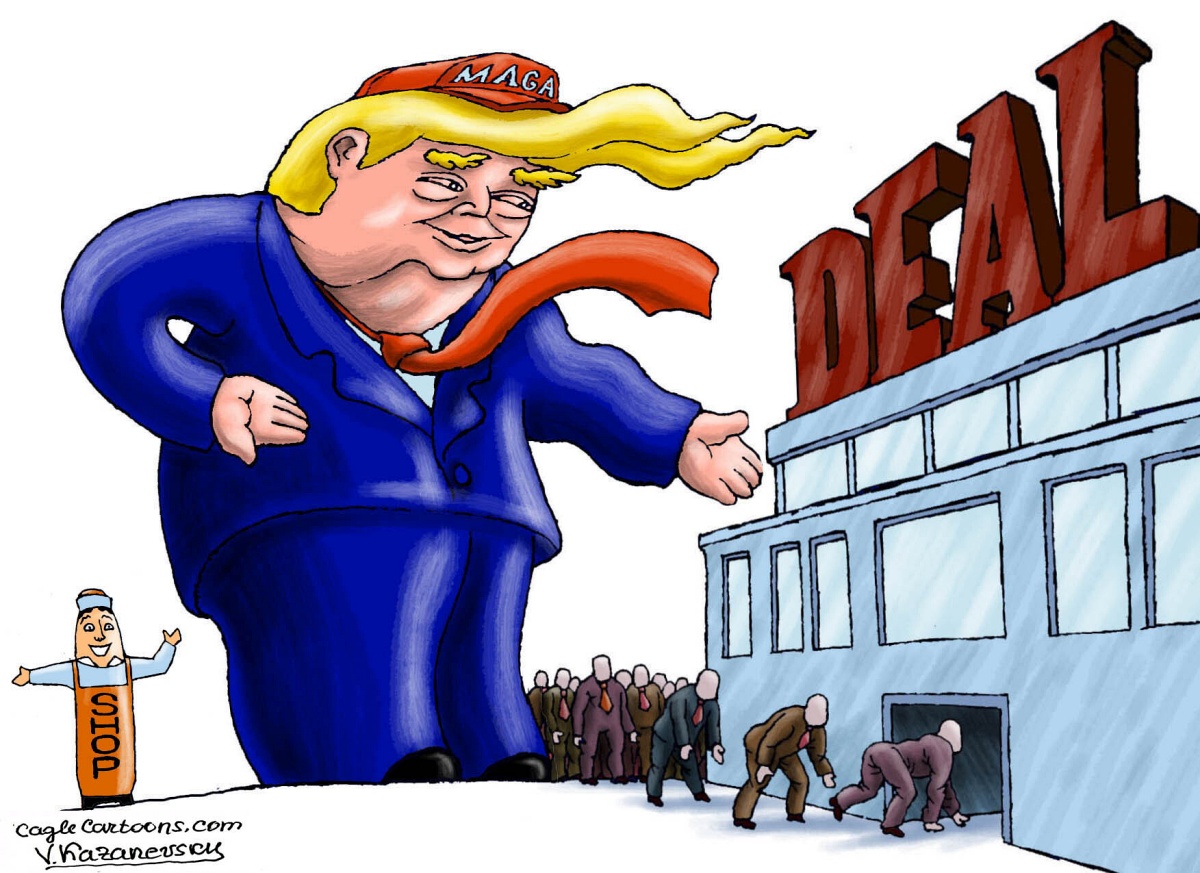
Trump's focus is mainly how he, his family, and some other rich people who support him can become richer. Caring for workers and the poor? Not really.
Making money has always been important to Donald Trump. Perhaps the most important thing in his life. That doesn't mean, however, that he's always been successful at this goal. Yet, by the time he began his second term, “the Trump Organization, collected money from all over the world for luxury condos, hotel rentals, development projects, and club memberships, and he had made deals that put his name on everything from mail-order steaks to get-rich-quick courses. Could citizens trust him to put the common good ahead of personal profit? How would he assure Americans that payments to his business weren’t doubling as payoffs?” These were questions a recent essay by David Kirkpatrick in The NewYorker asked.
One could argue that “it is highly regrettable that in preparing for a career more people in our society probably ask themselves which careers pay the most money rather than which ones enable us to do the most good.” But Trump’s upbringing was that profits come first. His thinking was akin to that of conservative economist Milton Friedman: “There is only one social responsibility of business—to use its resources and engage in activities designed to increase its profits.” When Trump entered politics, he never made the transition from being a capitalist entrepreneur to being concerned with what should be the main concern of politics—furthering the common good.
The New Yorker article indicated that “many payments now flowing to Trump, his wife, and his children and their spouses would be unimaginable without his Presidencies,” and it quoted a source that stated that he has “done more to monetize the presidency than anyone who has ever occupied the White House.”
Some people voted for Trump in each of his three presidential candidacies because they thought he was a successful businessman, and if he could make money for himself, he could make our country more prosperous. Yet, as conservative columnist David Brooks argued earlier this year, “Trump really seems not to give a crap about the working class.” His focus is mainly how he, his family, and some other rich people who support him can become richer. Caring for workers and the poor? Not really. Stoking their fears and prejudices is more his specialty.
Related stories
The remainder of this essay, however, will not focus on them but rather on the many ways he has enriched himself and those closest to him. If the president of Citizens for Responsibility and Ethics in Washington is right that “the American people ultimately don’t like people using public office to enrich themselves,” then U. S. voters—if only they become more aware of his lust for personal profits—should grow increasingly alienated by Trump and his circle. Consider the various categories where the NY essay details Trump and his family have made money—money that the essay totals at about “three and a half billion dollars in Presidential profits.”
The essay begins with Trump’s Mar-a-Lago club in Florida, estimating that “Trump’s Presidencies have brought him at least $125 million in extra profits” from it.
The next category Kirkpatrick lists is “Legal Fees and Trump Merch.” He states, “Trump has spent more than a hundred million dollars of his supporters’ contributions to defend himself against an array of charges.” Regarding “Merch,” Trump has made more than 17 million dollars from such sales as a “Gulf of America” baseball hat, “a pair of Trump beer koozies,” and “Trump flip-flops.” He has been the first presidential candidate “to run a private online store that competes against his own campaign in selling campaign-style merch.”
Dealings with Persian-Gulf monarchs has been especially lucrative for Trump and his family, especially son-in-law Jared Kushner. This spouse of daughter Ivanka founded the private-equity firm Affinity Partners and got Saudi leader Mohammed bin Salman—yes, he who orchestrated the murder of Washington Post reporter Jamal Khashoggi—to invest two billion dollars in it.
After Trump’s reelection, his sons Donald, Jr. and Eric also got in on Saudi arrangements, signing “a blitz of licensing deals” with a Saudi firm to manage Trump hotels and/or golf courses in several Persian-Gulf countries. As Kirkpatrick writes, “these mega-deals are inconceivable without Trump’s Presidency.”
The most publicized Persian-Gulf deal has been the announcement in May 2025 that the “Emir of Qatar had agreed to make a ‘free gift’ of a royal Boeing 747-8 for Trump’s use as a flashy Presidential jet...The Air Force would retain ownership of the plane until he left office. Yet Trump also said that the Pentagon would then pass the jet to his Presidential-library foundation.” The Emir wanted it in writing, however, that the deal was made “only at the President’s request.”
Trump’s tariff policies in 2025 also offered new opportunities for personal profiteering. Partly as a result of his animus against Chines imports, many U. S. businesses have shifted “operations to Vietnam, and exports to the U.S. now account for about a third of Vietnam’s economy.” This switch has given Vietnam “a singular incentive to cultivate” Trump’s goodwill. In September 2025, he and son Eric signed a deal with a Vietnamese company that will “pay the Trumps for the use of their name” in branding a Hanoi development that will include a “hotel, residences, and fifty-four holes of golf.”
Before moving on to a new company (Trump Media & Technology Group), Kirkpatrick indicated that present Trump wife, Melania, had also fed out of the Trump-family money trough. Following his election to a second-term presidency, she negotiated a deal with Amazon, which has benefited from government contracts, to produce a documentary “about her return to the White House.” Kirkpatrick admitted that “former Presidents and their wives routinely earn gigantic advances for memoirs. Yet First Couples have customarily waited until they’ve left office to open those auctions, avoiding the appearance that they might be selling influence.” But Melania didn’t wait, and her “cut of Amazon’s payment is reportedly about $28 million.”
The main holding of Trump Media & Technology Group (TMTG) is Trump’s own social-media platform, Truth Social. It is where “Trump releases news-making Presidential statements...exploiting his public position to draw attention to his private platform.” TMTG named Trump its chairman and provided him “a roughly sixty-per-cent stake” in the business. “The company’s customer base is the MAGA [Make America Great Again] movement,” and it has about four hundred thousand daily users. Although it is difficult to estimate Trump’s monetary gain from TMTG, Kirkpatrick estimates it at about $25 million.
In April 2025, Trump’s son Donald, Jr. announced plans for an exclusive social club, Executive Branch, of two hundred people, whose 20 founding members would each pay a half-million-dollars and others closer to a hundred thousand. Donald Jr. formed the club “with his friend Omeed Malik, who is a financier, a Trump donor, and a Mar-a-Lago member;” and with two sons of President Trump’s old friend and now diplomatic envoy Steve Witkoff. How much Donald, Jr. will make off of the club is yet to be determined.
In the fall of 2024, Malik also made Donald, Jr. a partner in a venture-capital firm he co-founded, 1789 Capital. As Kirkpatrick writes, “It’s unlikely that Donald Jr.’s experience at the Trump Organization would have landed him any similar job in the venture-capital industry had his father never entered the White House...Donald Jr.’s take from 1789 and GrabAGun [where the online gun retailer and Malik acquisition made him an adviser] adds $19.6 million” to the Trump family profits.
After some big banks ended their relationship with the Trumps following the January 2021 Capitol riot, son Eric, "the public face of the Trump Organization while his father is in office," says that his family first “fell in love" with cryptocurrency.
Although the currency is as opaque as murky water, Kirkpatrick states that it "essentially refers to marks in an online ledger called a blockchain, which tracks the contents of digital wallets. The blockchain is like a giant spreadsheet in the sky." He adds that "for many boosters, getting around anti-money-laundering laws and other regulations appears to be the main appeal of crypto...indeed, criminals love crypto...As late as 2021, he [Donald Sr.] told an interviewer that crypto ‘seems like a scam.’”
More recently, however, he has promoted crypto including "non-fungible tokens, or N.F.T.s, which are essentially marks on that spreadsheet in the sky proving that a buyer has paid, often dearly, to own a digital image." Ones President Trump has pushed are of himself "as a muscled superhero in a cape, a guitar-wielding biker, and so on, and on Truth Social he announced that they cost 'only $99 each!' On his past three disclosure forms, Trump reported that he had earned $13,180,707 in N.F.T.-licensing fees. The forms also show that Melania Trump made $1,224,311 from licensing an N.F.T.”
In September, 2024, Donald, Jr. and Eric announced a new crypto venture, called World Liberty Financial (WLF), which would involve itself in the "borrowing, lending, and trading of cryptocurrency...The startup offered few details about its plans” except that it would sell digital tokens. They “resembled stock certificates, except that they conferred no share of the company’s profits, couldn’t be sold or transferred, and came under scant government regulation."
By 2025, WLF’s website said that President Trump had agreed “to promote the WLF and the WLF protocol from time to time.” In exchange “a shell company controlled by his family would receive roughly three-quarters of the revenue from the voting token.” Kirkpatrick estimates that the “Trump family’s cut appears to be about $412.5 million...[and adds] Trump’s new Administration soon ended virtually all legal or regulatory actions against crypto traders.”
In March, 2025 WLF announced it would sell stablecoin. “Purchasing stablecoin is supposed to resemble putting money into a checking account. A buyer can pass them to other digital wallets the way you might transfer money from one checking account to another...Until July, stablecoins were largely unregulated, and the best known have become a mainstay of money laundering; some issuers, meanwhile, have diverted supposedly secure deposits into crypto Ponzi schemes. World Liberty, however, offered the special credibility of a Presidential endorsement, and promised to back its stablecoin, USD1, with short-term U.S. Treasury bills.”
In May, a company owned by the ruling family of the United Arab Emirates (U.A.E.) became the “first major stablecoin customer, buying two billion dollars’ worth of USD1.” Kirkpatrick’s comment? “Doing business with the U.A.E.’s rulers posed an obvious conflict of interest for the Trumps.”
Kirkpatrick refers to American Bitcoin—a new company the two oldest Trump sons helped establish—as the “Trump family’s third crypto business.” He conservatively estimates the Trump sons’ involvement with the company could bring them a profit of about $13 million.
“The family’s fourth crypto venture,” according to Kirkpatrick, is an April 2025 attempt by TMTG “to reinvent itself. In April, the company capitalized on the new Administration’s crypto-friendly policies by announcing a plan to sell volatile crypto assets to ordinary investors.”
Kirkpatrick refers to the digital token $TRUMP as “the fifth of his [Trump’s] family’s crypto vehicles. It’s a meme coin, a novelty, a bit of fun—the fun, for those who enjoy it, of paying Donald Trump. Eight years after his lawyer promised that his family would never exploit the Presidency for profit, Trump had distilled that exploitation to its purest possible form.”
In mid-July 2025 the White House website proclaimed, “Today, President Donald J. Trump signed the GENIUS Act into law, a historic piece of legislation that will pave the way for the United States to lead the global digital currency revolution.” It also declared that the Act will protect “consumers from nefarious actors in financial markets.”
It does not suggest that President Trump himself—and members of his family—may be the most “nefarious actors.” But by Kirkpatrick’s estimate the whole group will garner a profit of about $3.4 billion from the family’s financial shenanigans.
Toward the end of Trump’s first term, several members of The Washington Post Fact Checker team declared, “Donald Trump, the most mendacious president in U.S. history...[is] not known for one big lie — just a constant stream of exaggerated, invented, boastful, purposely outrageous, spiteful, inconsistent, dubious and false claims.” During the half year of his second term, such false claims have just increased.
As citizens of the country he now presides over, we might hope that he has finally come to the realization that politics should be primarily about enhancing the common good and not his own profiteering. But such a hope, I fear, would describe a trait that Psychology Today refers to as “false-hope syndrome.” Even worse, however, would it be if “grifter in chief” turns out better to describe our current president than “profiteer in chief.”
Comments

Powered by RoundtableAn AI/DeFi-powered Enterprise Media Operating System. Learn more at Roundtable.io.© Roundtable 2026. By using this site you agree to the Terms of Use and Privacy Policy