


Mar 5, 2026 1:18 AM
Updated Mar 7, 2026 8:54 PM
What a Castle Renovation Show Reveals About Worker Exploitation, the Power of Hierarchy and War
Recently I’ve taken to watching home improvement shows. At the end of a long day publishing the LA Progressive, home improvement shows serve to get the insanity that is the Trump administration out of my head. It’s a pleasant diversion, but there is one show that seems to have the opposite effect. Instead of helping me escape the news, it puts a spotlight on one of the core issues of our day—abuse of power and structural inequality.
The show Castle Impossible on HGTV is a renovation series that follows a young Californian couple who inherited a centuries-old European castle. I was drawn to the show because it is a complete do-it-yourself bonanza. The series follows the couple’s trials and tribulations as they attempt to restore a 25,000-square-foot castle complete with 1,000 acres of land, stables, a moat, 30 rooms, and four floors—you get the picture.
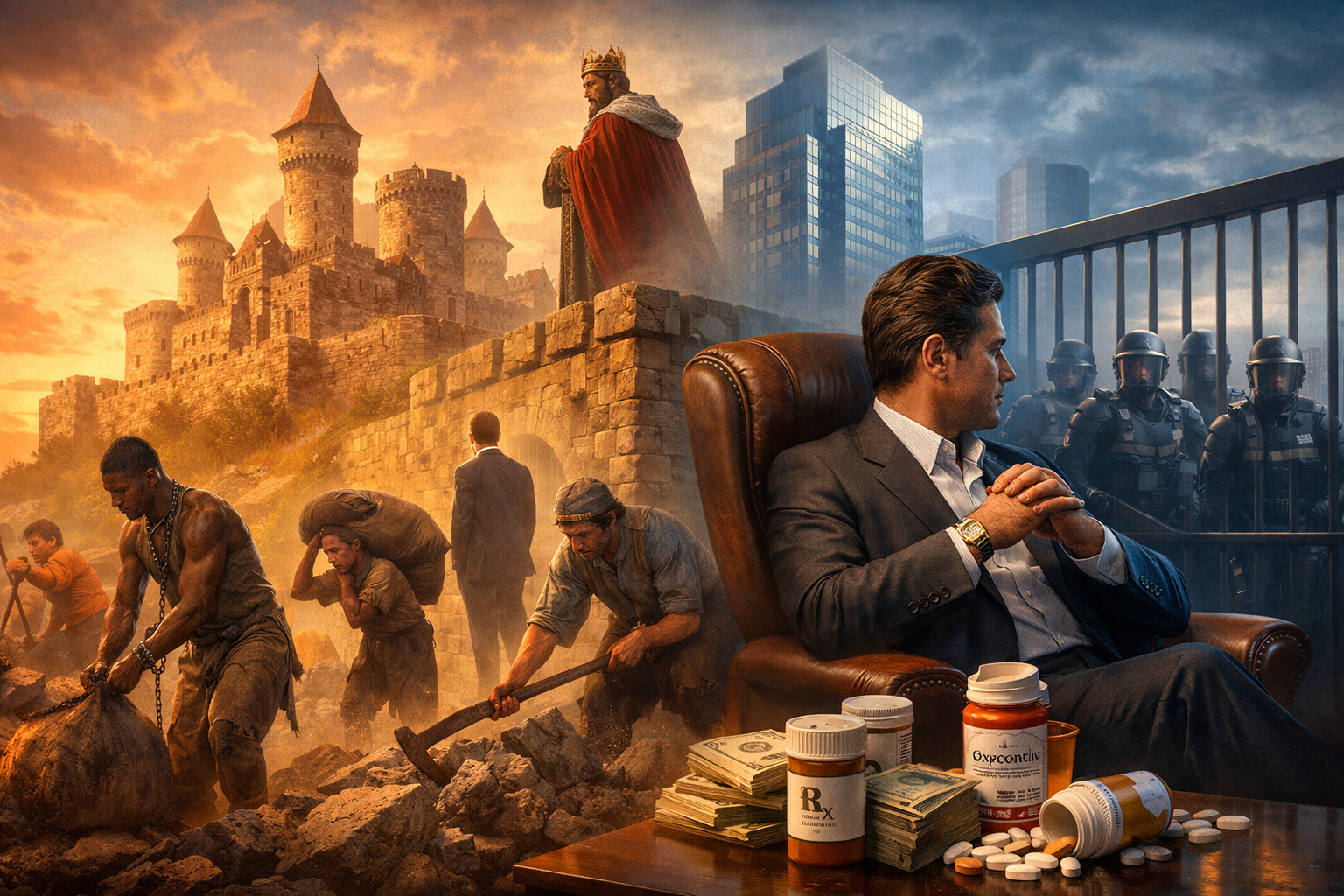
This working-class couple came to own the castle because today castles are simply too expensive to maintain. As a result, many across Europe are falling into ruin because the labor that once built and sustained them is no longer available. Average people are now buying these castles. Watching just a few episodes made it painfully clear that it must have taken the blood, sweat, and tears of a small army to build and maintain these structures—a small army of serfs.
In medieval Europe, most rural people were serfs, meaning they were legally tied to the land controlled by a lord. As part of their obligations, they owed labor services—known as corvée labor. For a certain number of days each year, they were required to work directly for the lord instead of tending their own small plots.
Related stories
When the castle was built, this obligation supplied much of the heavy labor, including:
• Digging the moat and foundations
• Quarrying and hauling stone
• Cutting and transporting lumber
• Mixing lime mortar
• Carrying materials to masons and carpenters
• Clearing land and maintaining access roads
This work was physically brutal and usually unpaid because it was considered part of the serf’s duty to the lord who controlled the land they lived on.
Unpaid and unacknowledged labor created and maintained these enormous symbols of wealth and power. Yet the prestige attached to these structures was never attributed to the people who built and maintained them—some of which have stood for more than 500 years. That glory went to those who never lifted a finger.
There was a moment in the series that stopped me. The couple had just finished restoring a bedroom—one of the most exhausting projects they had tackled so far. After hours of scraping plaster, hauling materials, repairing beams, and rebuilding the room piece by piece, the wife turned to her husband and remarked in awe that it was quite possible King Louis XIII had once slept there!!!
Why the exclamation points?
Because, what struck me in that moment was not the historical speculation, but the instinct behind it. Here was someone who, more than almost anyone alive today, had just experienced firsthand the sheer volume of labor required to bring even a single room in a castle back to life. She had lifted the materials, endured the dust, and wrestled with failing tools and collapsing plaster. Yet when the work was done, admiration flowed not toward the countless laborers who figuratively broke their backs building and maintaining the castle over centuries, but toward the royal figure who never lifted a finger in that castle except maybe to lift the blankets he slept under in the royal bed, if that.
That moment captures how hierarchy reproduces itself. The people who build, repair, and sustain the world are rarely remembered with awe. That reverence is reserved for those at the top of the structure—those who never swing an axe or haul a stone.
This is precisely the dynamic the Italian political thinker Antonio Gramsci tried to explain when he wrote that “the supremacy of a social group manifests itself in two ways: as domination and as intellectual and moral leadership.” In other words, power does not survive through force alone. It survives because people are taught—often unconsciously—to admire the very hierarchy that depends on and exploits their labor.
Gramsci understood that ruling classes maintain stability not only by controlling institutions but by shaping cultural imagination. People come to see authority as natural, hierarchy as inevitable, and submission as proper. That is what he called cultural hegemony—a condition in which the values of the powerful become the common sense of society.
Seen through that lens, the moment in that restored bedroom is more than a casual remark about royal history. It illustrates how deeply embedded respect for hierarchy remains. Even in a room brought back to life through ordinary labor, the figure who captures the imagination is not the mason, the carpenter, or the peasant who hauled stone centuries ago. It is the king who once lay down beneath the roof they built.
So where do we see this today? Or perhaps the better question is: where don’t we see it?
Has Deference to Hierarchy Actually Disappeared?
If castles were the physical architecture of feudal power, deference was its psychological architecture.
Stone walls alone did not keep serfs in their place. Armies alone did not maintain feudal systems for centuries. What stabilized those systems was a deeply embedded social expectation that hierarchy was natural, permanent, and deserved.
Peasants deferred to lords. Lords bowed to kings. Kings claimed divine sanction. The entire structure rested on the belief that rank mattered and that those at the bottom were expected to recognize their place.
This culture of obedience was reinforced everywhere—in law, religion, custom, and daily life. Medieval sermons emphasized obedience to authority as a spiritual virtue. Social mobility was almost nonexistent. A peasant born into obligation was expected to remain there. Questioning hierarchy was not simply rebellious; it was often framed as sinful.
People were taught to internalize their subordination.
That internalization made feudal systems remarkably stable. If every castle required constant armed repression to maintain order, feudal societies would have collapsed far sooner.
Deference turned domination into routine.
And that raises an uncomfortable question for modern democracy:
Have we truly escaped that pattern—or have we simply reorganized it?
The Modern Hierarchy of Work
In contemporary societies, we like to believe hierarchy operates differently. Workers are not legally bound to employers the way serfs or slaves were bound to land. Labor contracts can be terminated. Jobs can be changed.
Freedom of movement exists.
Yet millions of people remain in jobs they dislike, fear their supervisors, and hesitate to challenge workplace authority even when conditions are exploitative.
The most obvious explanation is economic necessity. Rent must be paid. Health insurance is tied to employment. Families depend on steady income.
But another force operates quietly in the background: deference to authority.
Corporate cultures reinforce it constantly. Employees are encouraged to respect “leadership.” Managers are positioned as decision-makers whose judgments should not be openly questioned.
From the first day of employment, workers learn the boundaries of acceptable dissent.
Speak too loudly and advancement may stall. Challenge authority too directly and employment itself may become uncertain.
The result is familiar.
People comply—not always because they agree, but because compliance becomes part of survival.
Race and the Architecture of Hierarchy
In the United States, hierarchy did not evolve along economic lines alone. It was also deliberately organized along racial lines.
If castles represented the visible architecture of feudal power in Europe, racial classification became a comparable architecture of power in America. Beginning in the 17th century, colonial elites constructed a system in which people of African descent were permanently enslaved while poor Europeans were granted a different legal status—even when their economic conditions were similarly harsh.
This division was not accidental. It was a political solution to a recurring problem for ruling classes: preventing the people doing the labor from recognizing their shared interests.
Early colonial societies included large numbers of landless Europeans who worked alongside enslaved Africans. Events like Bacon’s Rebellion in 1676 revealed the danger of cross-racial solidarity among the laboring population. In response, colonial lawmakers hardened racial categories into law. Africans and their descendants were permanently enslaved, while Europeans were granted small legal privileges tied to the emerging category of “white.”
Race became a tool for stabilizing hierarchy.
By granting poor Europeans a measure of social distinction above enslaved Africans, elites created a buffer within the labor force. Economic exploitation could continue, but the possibility of unified resistance was weakened.
In the centuries that followed, racial hierarchy continued to shape American institutions—from slavery to segregation, from redlining to mass incarceration. Race influenced who performed the most dangerous labor, who accumulated wealth, who received legal protection, and who was most vulnerable to state violence.
Just as castles were built with the forced labor of serfs, the economic foundations of the United States were built with the forced labor of enslaved Africans and their descendants. In both systems, power relied not only on coercion but on cultural narratives that made hierarchy appear natural.
Elite Immunity and the Protection of Power
One of the clearest indicators that hierarchy persists lies in how societies treat wrongdoing by the powerful.
The term “Epstein class” has emerged to describe a troubling pattern: wealthy individuals who appear able to evade accountability for crimes that would devastate ordinary citizens.
The case of Jeffrey Epstein exposed a network of powerful figures who moved comfortably within elite circles despite serious allegations. The scandal was shocking not only because of the crimes involved but because of how long those around him appeared unwilling—or unable—to challenge him.
Powerful people benefit from an unspoken social contract. Staff hesitate to question them. Employees fear retaliation. Institutions weigh reputational risk before pursuing accountability.
Status becomes a shield.
History suggests this kind of insulation is dangerous. In his book Collapse, Jared Diamond observed that many civilizations that ultimately failed shared a common trait: leaders made decisions that harmed society while remaining personally protected from the consequences. When those at the top are insulated from the damage their decisions create, the feedback mechanisms that might correct destructive behavior break down. The costs are pushed downward—onto ordinary people, ecosystems, and future generations.
We can see this dynamic in modern economic life as well.
Consider the opioid epidemic and the role played by Purdue Pharma and the Sackler family. Hundreds of thousands of Americans have died from overdoses tied to drugs aggressively marketed by pharmaceutical companies, while the Sacklers accumulated billions during the years those prescriptions surged.
Civil settlements have been negotiated. Corporate restructuring has occurred. Yet many critics argue that the individuals who benefited most financially have largely avoided consequences proportional to the harm.
Part of the explanation lies in how societies interpret wealth itself. Billionaires are often portrayed as innovators, visionaries, or exceptional figures whose success signals intelligence and discipline. Those narratives shape public perception—and make it easier to excuse behavior that might otherwise provoke outrage.
In this way, hierarchy protects itself not only through institutions but through culture.
The Divine Right of Capital
Wealth commands respect—even when it should provoke scrutiny.
Writer Marjorie Kelly calls this phenomenon the “Divine Right of Capital.”
Just as kings once claimed divine authority, modern corporations and investors occupy a position resembling untouchable authority. Their wealth is treated as proof of virtue. Their decisions are presumed legitimate.
Questioning them is often framed as naïve or economically irresponsible.
The environmental crisis illustrates the consequences. Corporations extract resources, pollute ecosystems, and accelerate climate change while society largely tolerates the damage.
Forests disappear. Rivers are contaminated. Air is poisoned.
Yet the institutions responsible retain prestige.
Environmental destruction is framed as the cost of progress rather than the predictable outcome of concentrated power.
Why This Matters
Understanding the role of deference—or blind submission to authority—is not merely historical.
It is strategic.
If hierarchical systems depend on cultural acceptance, change requires more than policy reform. It requires rebuilding a sense of agency among people trained—sometimes subtly—to defer.
The question for our own time is far less medieval but no less urgent: how much harm must accumulate before we stop mistaking wealth, status, and authority for legitimacy?
Castles were never sustained by kings.
They were sustained by labor—and by the willingness of those who labored to bow before the people who ruled them.
Today the architecture of hierarchy looks different, but the mechanism is strikingly familiar.
When leaders can launch wars without clear justification, when billionaires escape accountability for actions that devastate communities, and when entire societies are pulled into crisis while the powerful remain insulated from the consequences, we are witnessing the modern version of an old system.
The spectacle has simply changed.
The castle has become the boardroom.
The throne has become the executive office.
And sometimes the battlefield becomes the distraction.
But the structure underneath remains the same: power endures when people accept it as natural.
And when that acceptance allows leaders to “wag the dog,” the damage never reaches the top of the hierarchy.
It lands, as it always has, on the people whose labor—and whose silence—keep the system standing.
Nonprofits Challenging Concentrated Corporate Power
1. American Economic Liberties Project
Website: https://www.economicliberties.us
This nonprofit works to break up corporate monopolies and strengthen antitrust enforcement. It advocates policies that reduce corporate concentration and restore democratic control over markets.
Focus areas:
- Antitrust reform
- Tech monopoly regulation
- Corporate accountability
2. Public Accountability Initiative
Website: https://littlesis.org
This group investigates connections between political power, wealth, and corporate influence. It operates the LittleSis database, which maps networks of elite influence—sometimes described as “an involuntary Facebook for powerful people.”
Focus areas:
- Corporate influence tracking
- Elite power networks
- Political transparency
3. Project On Government Oversight
Website: https://www.pogo.org
POGO investigates corruption, abuse of power, and government failures, particularly when government policies serve powerful corporate interests over the public.
Focus areas:
- Corporate influence in government
- Defense contracting oversight
- Whistleblower protections
4. Government Accountability Project
Website: https://whistleblower.org
This organization supports whistleblowers who expose corporate fraud, environmental damage, and government corruption, helping hold powerful institutions accountable.
Focus areas:
- Corporate wrongdoing
- Environmental violations
- Whistleblower protection
5. Campaign for Accountability
This nonprofit uses research, legal action, and investigations to expose misconduct by corporations, lobbyists, and public officials.
Focus areas:
- Corporate lobbying abuses
- Political corruption
- Ethics enforcement
6. Environmental Working Group
Website: https://www.ewg.org
EWG researches corporate pollution, toxic chemicals, and environmental risks, often challenging industries that profit while shifting environmental costs onto the public.
Focus areas:
- Toxic chemicals
- Corporate pollution
- Environmental health
7. Ekō (formerly SumOfUs)
Website: https://www.eko.org
Ekō organizes campaigns to hold multinational corporations accountable for climate damage, labor abuses, and corruption.
Focus areas:
- Corporate accountability
- Climate justice
- Labor rights
8. American Oversight
Website: https://americanoversight.org
This nonprofit uses Freedom of Information Act requests and litigation to expose abuses of power and hold officials accountable.
Focus areas:
- Transparency
- Government accountability
- Public records investigations
9. Democracy Collaborative
Website: https://democracycollaborative.org
Founded by political economist Gar Alperovitz, the The Democracy Collaborative develops and promotes models of democratic ownership of the economy, including worker cooperatives, public banks, and community wealth-building strategies.
Marjorie Kelly is also a senior fellow there and has written extensively about corporate governance and the concentration of capital.
Focus areas:
- Worker cooperatives
- Community wealth building
- Democratic ownership of assets
- Local economic development
The organization’s work directly challenges the assumption that corporations should exist primarily to maximize profits for shareholders.
10. Democracy at Work Institute / Democracy at Work
Website: https://www.democracyatwork.info
Founded by economist Richard D. Wolff, Democracy at Work promotes worker self-directed enterprises and other forms of workplace democracy as alternatives to traditional corporate ownership.
Focus areas:
- Worker cooperatives
- Workplace democracy
- Economic justice
- Public education on alternatives to corporate capitalism
Their central argument is that democratizing the workplace reduces the concentration of power and wealth that characterizes modern corporate capitalism.
Comments

Powered by RoundtableAn AI/DeFi-powered Enterprise Media Operating System. Learn more at Roundtable.io.© Roundtable 2026. By using this site you agree to the Terms of Use and Privacy Policy