
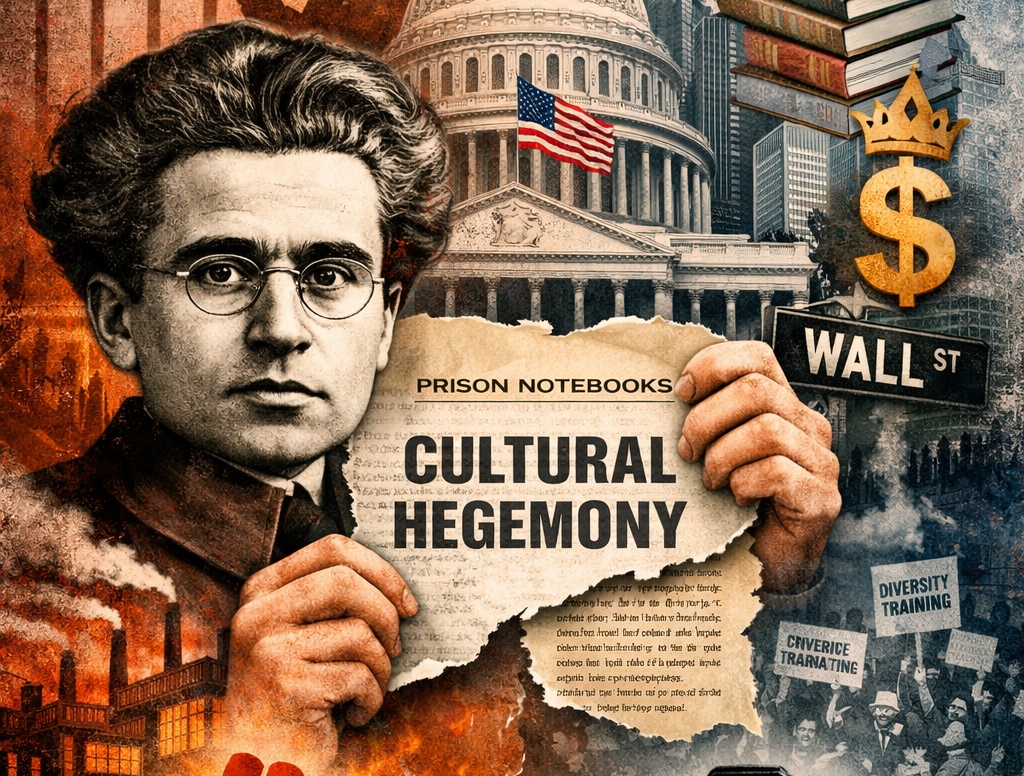


Antonio Gramsci
Jan 2, 2026 6:02 PM
Updated Jan 5, 2026 9:48 PM
How Neoliberalism Turned a Revolutionary Communist into Academic Wallpaper
Prince Kapone’s “Gramsci Disarmed: How Empire Turned a Communist Strategist into a Cultural Mascot” makes a simple but uncomfortable point: Antonio Gramsci didn’t write all that theory so it could sit politely on a university syllabus. He wrote it to help working people win power. Kapone argues that Gramsci’s ideas—especially “cultural hegemony” and the “war of position”—have been scrubbed clean of their revolutionary purpose and turned into academic jargon and liberal talking points. What was once a toolbox for dismantling capitalism has been reduced to buzzwords that let people sound radical without actually threatening the system.
Antonio Gramsci Was Never Meant to Be Safe
That argument lands because Gramsci was never meant to be safe. He was a communist organizer imprisoned by Mussolini, not a cultural commentator angling for tenure. As the fascist prosecutor famously said, “We must stop this brain from functioning.” The Prison Notebooks weren’t written for admiration; they were written for use.
The term “cultural hegemony” is often reduced to the idea that “culture matters” or that politics is mostly about messaging. But Gramsci meant something sharper. He argued that ruling classes maintain power by making their worldview feel like common sense. “Every social group,” he wrote, “creates together with itself… intellectuals which give it homogeneity and an awareness of its own function.” That was a warning to the working class: If we don’t build our own institutions, leaders, and ideas, we will live inside the world of the predatory class forever.
Empire Didn’t Ban Gramsci — It Absorbed Him
Kapone’s key insight is that Empire learned how to neutralize this insight. Instead of banning Gramsci, it absorbed him. Universities teach hegemony as analysis, not strategy. NGOs use it to critique media narratives while steering clear of class power. Corporate America nods along in diversity training that never questions ownership or exploitation. Gramsci is quoted, but never followed.
Related stories
This is where rejecting neoliberalism—and the political machinery that defends it—becomes unavoidable. Neoliberalism, in plain terms, is the belief that society should be run like a market: privatize public goods, deregulate corporations, weaken labor, and let profit decide what matters. Both major parties operate inside this worldview, but Democratic Party leadership has perfected its “kinder” version—wrapping corporate power in progressive language while keeping the economic structure intact. Free trade deals, Wall Street bailouts, privatized healthcare,and union-busting are quietly tolerated. These are neoliberal policies, regardless of the party branding.
The Democratic Party as a Containment System
Kapone’s argument makes clear that Gramsci cannot be reclaimed while tethered to this framework. The Democratic Party functions as a containment system for dissent, translating anger into symbolism, representation, and endless campaigns, while blocking any real challenge to capital. In Gramscian terms, it manages hegemony on behalf of the ruling class. Treating that party as a vehicle for liberation isn’t strategy—it’s surrender.
The same distortion shows up in how the “war of position” is used today. Gramsci argued that in advanced capitalist societies, revolution required a long struggle across civil society—unions, schools, media, and political organizations—to build counter-power before direct confrontation. He warned that this demanded “a concentration of unheard-of hegemony.” It was preparation for conflict, not an excuse to avoid it.
Reclaiming Gramsci Means Breaking with Neoliberalism
Today, that concept is often twisted into justification for permanent delay. “Change the culture,” they say. “Win the narrative. Be patient.” Meanwhile, capital keeps consolidating power, crushing labor, and burning the planet. A strategy meant to guide revolution becomes a rationale for doing nothing that risks losing elite approval.
Gramsci himself warned against this fate. “The philosophy of praxis,” he wrote, “does not aim at the peaceful resolution of existing contradictions.” If your politics never collide with power, they aren’t politics—they’re decoration.
Kapone’s essay is a reminder that theory without rupture serves the status quo. Reclaiming Gramsci means breaking with neoliberal common sense, rejecting the parties and institutions that enforce it, and rebuilding politics around organization, class power, and material struggle. Gramsci wasn’t writing for commentators or campaign consultants. He was writing for people preparing for a long fight.
Comments

Powered by RoundtableAn AI/DeFi-powered Enterprise Media Operating System. Learn more at Roundtable.io.© Roundtable 2026. By using this site you agree to the Terms of Use and Privacy Policy