
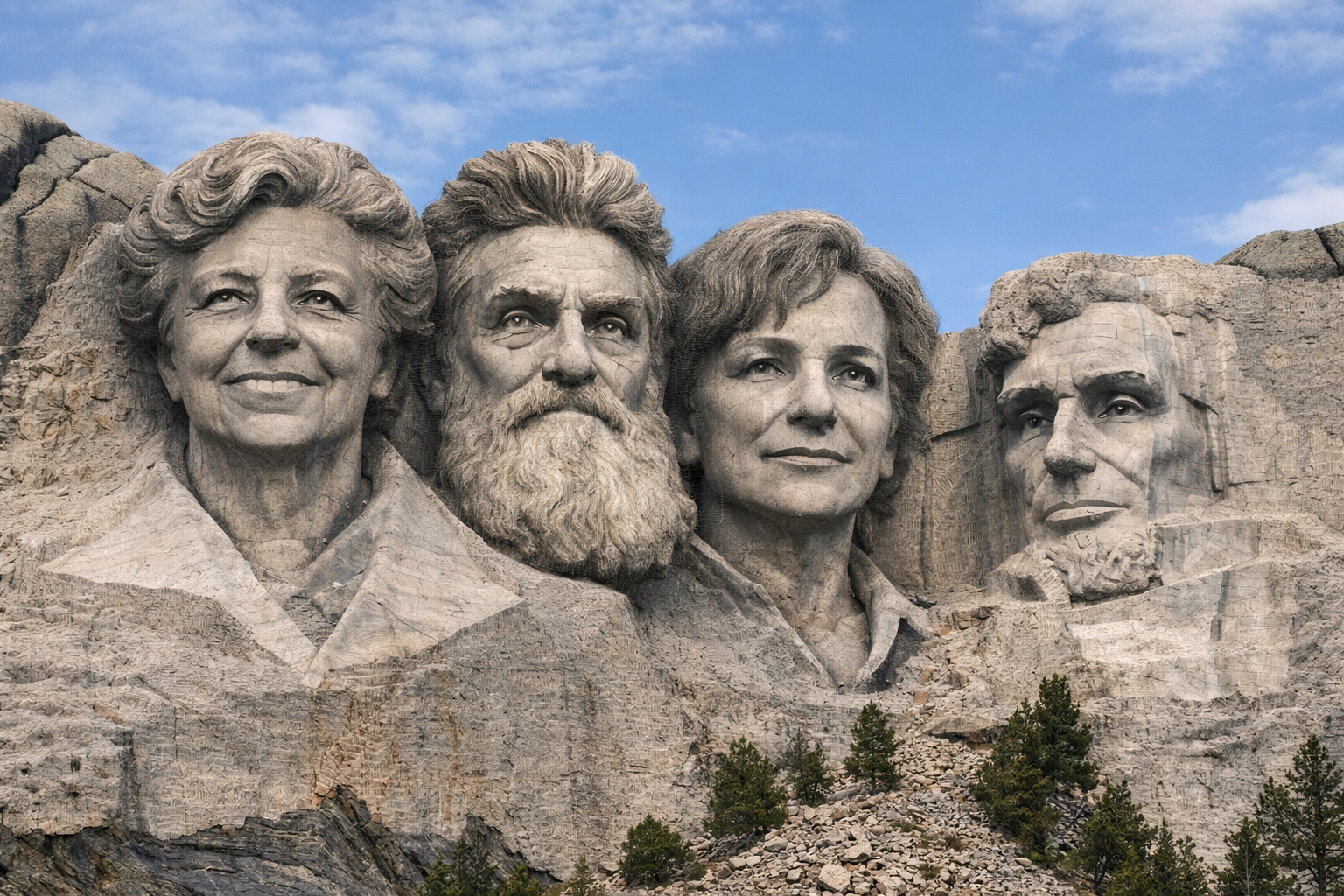


Reimagined Faces of Mount Rushmore
Feb 1, 2026 10:57 PM
Updated Feb 1, 2026 11:38 PM
The deaths of Renee Goode and Alex Pretti show the difference between sympathy and courage — and why white Americans hold a decisive role in stopping authoritarianism.
May all the world’s gods bless Renee Goode and Alex Pretti, two names that shouldn’t have to sit in the same sentence with the words “killed,” “footage,” and “official statement.” But here we are, as usual, living inside the part of the American story where the country talks a big game about courage and then gets weirdly quiet when courage shows up with a pulse. However the details are ultimately litigated, spun, and “contexted” to death, the moral outline is plain: both were held up, in public memory and in reported accounts, as people who put their bodies in the line of danger on behalf of people of color. And they paid in the one currency the state never refunds.
That’s the part that should haunt the nation, but America prefers its heroes tidy and historical, preferably carved into stone and safely dead for 150 years. What we don’t like is the living version. The modern version. The version that makes the rest of us look like what we are most days: careful, convenient, and allergic to consequences.
When Allyship Requires a Receipt
America loves “allyship” right up until it requires a receipt. We adore the idea of the “good white person” the way we adore a mythical creature: beautiful in stories, rare in the wild, and best enjoyed without any actual inconvenience. We love the caption. We love the yard sign. We love the tasteful donation that doesn’t change the way you vote, work, hire, fear, or police your neighborhood. Then someone actually steps into danger, and suddenly the nation’s favorite hobby kicks in: disbelief, distraction, smear, spin, and the sacred chant of the cowardly class, “Well, we don’t know the full context.”
That’s how you know the context is probably ugly.
Related stories
In Trump’s America, MAGA 2.0, vengeance with a flag pin, the question for Black folks and other people of color isn’t academic anymore. It’s not a seminar topic or a hashtag trend. It’s a pulse check. It’s whispered in barbershops and beauty salons, muttered at kitchen tables, and shouted into the social-media void between bans and “community guideline” warnings: where are all the good white folks at?
Yes, white folks are in the streets. Marches. Signs. Chants. Sincere faces trying to do the right thing. Some have taken real risks. Some have taken real hits. That matters. It is a beautiful thing to see bodies show up. Because here’s the blunt truth nobody wants to say out loud: only white Americans, in mass numbers, can prevent the fire of fascism from consuming the whole house. Only they can walk into the spaces where this madness is normalized, school boards, union halls, suburban kitchens, church foyers, and say, “No, not in our name,” without needing permission slips from anyone. Only they can puncture the lie at the source, because the source keeps wearing their face like a mask.
Marching Is the Appetizer — Conflict Is the Main Course
Marching is cute. Stopping the Fourth Reich takes a tad more than weekend courage
But let’s not kid ourselves. A lot of today’s solidarity still feels like fair-weather friendship: present when the sun is out and the optics are righteous, gone when the forecast changes. The news cycle pivots. The costs rise. Somebody’s boss starts side-eyeing them. Somebody’s group chat turns into a Confederate nostalgia tour. Somebody’s pastor pleads for “unity,” which is code for shut up so we can stay comfortable. And then, like clockwork, last week’s allies perform the ancient progressive ritual of disappearing, as if moral duty is seasonal and justice is a limited-edition drop.
That’s how fascism becomes mundane. Not always with jackboots. Often with yawns. With silence so complete you can hear a rat piss on cotton. With polite bystanders holding the door while authoritarianism strolls in wearing a red cap and a legal memo. If you want to know how a nation goes from chest-thumping “We the People” to “Well, both sides,” watch what happens after the protest ends and the consequences begin. Marching is the appetizer. The main course is conflict, and most folks don’t like their dinners spicy.
The People Who Actually Decide the Direction of the Country
So no, the question isn’t whether progressive white friends exist. They unquestionably do. The real question is: what about the tens upon tens of millions of white folks who aren’t card-carrying liberals? The suburban moderates. The union guys who vote red because of “taxes.” The church ladies who are “nice” but allergic to truth. The dads who insist they aren’t racist while clutching property values like holy scripture. The folks who say racism is bad, sure, but also think “both sides” is a personality and “I don’t like politics” is a moral philosophy.
These are the people who decide elections, write school board policy, normalize bloated police budgets, and keep the national spine permanently in traction. They don’t have to chant for fascism to win. They only have to keep shrugging while it advances, like a slow-moving tank fueled by denial. That shrug is the grease in the gears. That shrug is what turns a democracy into a haunted house where everyone swears they heard something upstairs but nobody wants to go look.
That’s why the old question keeps coming back, dressed for modern times: where are the John Browns, the Eleanor Roosevelts, the kind of white Americans who don’t just whisper support from across the street while the building burns, but run into the fire and come out reeking of smoke and consequence. The kind who spend social capital like it’s meant to be spent, not hoarded like a retirement account.
Goode and Pretti sit in that conversation precisely because they force the line into view. Not the “I agree with you” line. The “I will risk something for you” line. America loves the first. America hates the second. America will applaud you for empathy and punish you for intervention, because intervention disrupts the machine.
A Different Mount Rushmore: White Americans Who Risked Something
So let’s build a new Mount Rushmore, not the colonial fairy tale carved into stolen land in South Dakota, the original influencer collaboration between land theft, genocide, and national delusion. A different mountain. A moral one. Four faces, not because white saviors are needed, but because white co-conspirators are so rare they deserve to be named, remembered, and honestly evaluated, not worshiped, not sanitized, not turned into Hallmark characters.
First face: John Brown. Abolitionist. Insurrectionist. A walking middle finger to America’s slow, cowardly addiction to compromise. While respectable men held debates and sipped brandy, Brown armed up. He didn’t draft resolutions in cursive. He didn’t beg enslavers to soften their cruelty. He grabbed his sons, allied with Black revolutionaries, and stormed Harpers Ferry with one mission: break the system and force the nation to confront its nightmare. Was it doomed? Probably. Was it righteous? Absolutely. When they hanged him in 1859, he didn’t plead for mercy or try to rebrand himself as “misunderstood.” He left behind a truth America still dodges: slavery doesn’t retire politely. Evil doesn’t politely step down because you asked nicely. When cruelty is legal and profitable, change arrives only when somebody is willing to force the issue.
Second face: Viola Liuzzo. A Detroit mother of five with no reason to be in Selma except that her moral compass worked. She heard Dr. King’s call after Bloody Sunday and got in the car. She did the unglamorous labor movements run on, ferrying marchers, standing in the gap, doing the work history usually edits out because it’s not cinematic enough. The Klan murdered her for it. Then Hoover’s FBI tried to murder her reputation, because America can’t stand a clean story about a white woman dying for Black freedom out of conviction. It has to be scandal, not conscience. Liuzzo didn’t post. She moved. She paid.
Third face: Eleanor Roosevelt. The First Lady who treated polite racism like a stain you scrub until it screams. She backed Marian Anderson when the DAR tried to lock her out. She invited Black thinkers into the White House when that alone could trigger scandal. She prodded federal agencies, pushed anti-lynching efforts, and used access not as decoration but as a crowbar. She understood something that still escapes modern liberals: being liked is not the mission. Justice is. Eleanor didn’t “raise awareness.” She raised discomfort. She made the comfortable squirm, which is what moral progress actually looks like in real time.
Fourth face: Franklin Delano Roosevelt, footnotes and all. No civil-rights saint. He compromised with segregationists and blinked when he should have fought, because politics is often just cowardice in a suit with better lighting. But he cracked the door open, expanded what government could be, and floated the idea that people have economic rights, a Second Bill of Rights that still makes today’s oligarchs sweat through their tailored lies. He didn’t swing the hammer, but he built part of the forge, and later generations grabbed the tools. When the modern right snarls at the very idea of a safety net, you can hear the echo of the old fear: what if government helps the “wrong” people, meaning anyone who isn’t already comfortable.
Now notice who doesn’t make the cut: Abraham Lincoln. He’s on the cultural Rushmore because Americans love tidy myths, but Lincoln’s guiding star was the Union, not Black liberation. He said it himself: if he could save the Union without freeing a single enslaved person, he would. Emancipation was strategy. And he flirted with colonization schemes because the idea of Black equality here made him uneasy. That’s not the spirit of this mountain. This mountain isn’t for accidental virtue. It’s for deliberate risk.
If we had more granite, we’d carve a short bench for the other rare few who showed up before it was safe, before it was trendy, before it was profitable. Wendell Phillips, torching white moderates with sermons made of gasoline. James Reeb, murdered in Selma for walking beside Black people. Anne Braden, prosecuted for helping a Black family buy a home and then refusing to apologize for it. Father Groppi, marching with Black youth while respectable society clutched pearls and called it “divisive.” You can add names like Albion Tourgée, who fought the legal fights when “civil rights lawyer” wasn’t a brand but a threat, and countless lesser-known teachers, ministers, union organizers, and neighbors who did one brave thing at the wrong time and paid for it quietly.
The Line That Matters: ‘I Agree With You’ vs. ‘I Will Risk Something for You’
And yes, add Goode and Pretti to that bench, not as mascots, not as props, but as modern proof the cost hasn’t gone away. If anything, the cost is rising. Because the machine is more reckless now, more careless, more bloodthirsty, more trigger-happy, and more confident that it can kill and then bury the story under procedure. Call it what it feels like: a Fourth Reich with better PR, a state that wants obedience and calls it order.
We don’t just need white folks who will chant on Saturday. We need white folks who will confront the uncle at Thanksgiving, the pastor on Sunday, the boss on Monday, and the policy on Tuesday. We need people who will refuse to be deputized by silence. We need people who will stop treating fascism like a weather pattern and start treating it like a fire, because it is a fire, and it spreads.
If you’re white in America, this is your fight whether you like it or not. Fascism is recruiting in your name, in your accent, under your flag. Marches are the spark. The grind is the firebreak. The firebreak is millions of ordinary white people choosing discomfort over complicity, daily, loudly, consistently, even when no one is clapping and no one is filming.
We don’t need white saviors, we need white co-conspirators....
Teach the names, yes, but teach the standard they demand. Not balcony applause. Not brunch-based activism. Fire. Real fire. Because until those tens of millions decide democracy is worth personal discomfort, people of color will keep asking, again and again: where are the good white folks at, and why does it still feel like we can count them on one mountain?
Comments

Powered by RoundtableAn AI/DeFi-powered Enterprise Media Operating System. Learn more at Roundtable.io.© Roundtable 2026. By using this site you agree to the Terms of Use and Privacy Policy