


Feb 13, 2026 5:37 AM
Updated Feb 15, 2026 7:27 PM
Why Americans Trust Socialized Fire Protection but Fear Socialized Housing, Healthcare, and Wages
When Americans hear the word socialism, many imagine something foreign, centralized, or authoritarian. The word carries decades of Cold War residue.
But the type of socialism promoted by Kshama Sawant is not about state control of every industry. It is about shifting essential systems away from private profit and toward democratic accountability.
Who Is Kshama Sawant?
Sawant rose to national prominence during her decade on the Seattle City Council (2014–2024), where she championed a $15 minimum wage, corporate taxation for affordable housing, and stronger tenant protections. Her politics are openly anti-corporate and explicitly pro–working class. She rejects the idea that essential human needs should be treated primarily as commodities.
At its core, the socialism she advances rests on three principles:
Related stories
- Essential needs should not depend on private profit.
- Workers should have greater economic power.
- Public systems should be democratically accountable.
Strip away the rhetoric, and what remains is a structural question:
Which human needs are too fundamental to be governed by market logic?
That question is not abstract.
It is embedded in systems Americans already rely on.
Today, Kshama Sawant is running for congress. She is dedicated to building the strongest antiwar, anti-genocide election campaign in the nation. Listen to the interview above or click here to learn more: https://www.kshamasawant.org/why-im-running/
Now back to socialism...
The Fire Department Test: Socialism Americans Already Trust
When your house is on fire, do you want to check whether your fire department coverage is paid up before dialing 911?
Do you want to confirm your subscription hasn’t lapsed?
That you’re in-network?
That your deductible has been met?
Of course not.
You call. A truck arrives. Water flows. Lives are saved.
No invoice is presented before the flames are extinguished.
No one checks your income before turning on the hose.
But there was a time in American history when fire protection did operate like a subscription service.
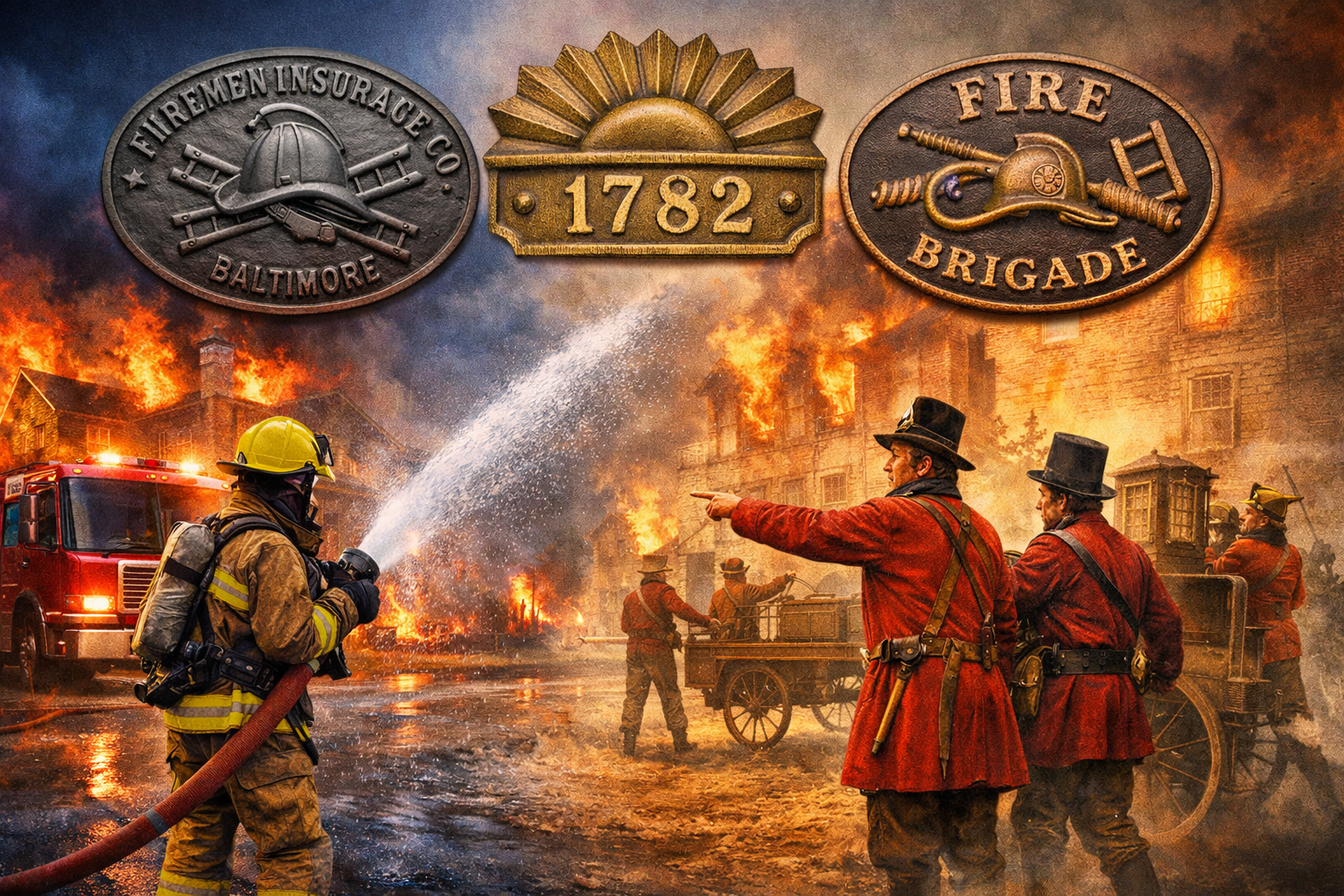
In the 18th and early 19th centuries, many cities relied on private fire brigades funded by insurance companies. Property owners who paid for fire coverage displayed metal plaques — known as fire marks or fire medallions — on the exterior of their buildings. These emblems signaled which insurance company’s brigade should respond if flames broke out.
If a building bore the correct medallion, the brigade fought the fire.
If it did not, they often stood by and did nothing.
Sometimes rival brigades even competed at the scene, arguing over jurisdiction while structures burned. Protection was fragmented. Response depended on payment. Public safety was secondary to contractual obligation.
Cities eventually abandoned this model because it was inefficient, chaotic, and dangerous. Fire does not respect property lines. A blaze left unchecked in one building spreads to the next. Fragmented protection endangered entire neighborhoods.
Municipal fire departments replaced private brigades because shared response proved more rational and more humane. Communities recognized that emergency protection could not depend on subscription status.
Fire protection in the United States now rests on a simple collective principle: we all pay in, and everyone is protected.
Fire departments do not make your survival contingent on your financial stability. They do not tie your safety to your economic usefulness. They do not require proof of income before responding.
They protect the community before damage spreads.
That is socialized provision in practice.
And Americans trust it.
The political question is not whether collective systems work — they do. The question is why we accept them in some areas of life and fiercely resist them in others, especially where instability produces profit — and where race shapes perception.
Stabilization vs. Structured Insecurity
The United States is not purely capitalist. It is hybrid.
We collectively fund:
- Fire departments
- Public schools
- Social Security
- Medicare
- Public libraries
- Roads and water systems
These are not profit-driven enterprises. As a society, we made a deliberate choice: some needs are too vital to be governed by private ownership and the exclusions it creates. They are too essential to be conditional — too essential to be bought, negotiated, or withheld.
Yet housing, healthcare, higher education, childcare, and food security remain largely privatized and commodified. Access depends on income. When income disappears, access disappears with it.
That structure is not neutral.
Planned Precarity and the Discipline of Labor
Political economists call this planned precarity — a design in which insecurity shapes behavior. It “disciplines labor” by creating conditions that make workers more risk-averse and less confrontational. When rent is due, medical bills loom, and debt hangs overhead, bargaining power shrinks. The quiet lesson absorbed is simple: don’t rock the boat. Employment feels less like a contract between equals and more like a lifeline that cannot be challenged. The underlying message becomes clear: be grateful you have a job — because losing it could unravel everything including your life.
Karl Polanyi warned that turning human essentials into commodities destabilizes society itself.¹
But what if we treated all essential human needs the way we treat fire protection?
It does not sort people by income.
It does not pause to verify payment.
It steps in immediately and protects the community before harm multiplies.
That is what real stabilization looks like.
We Have Chosen Collective Solutions Before
Americans have repeatedly embraced collective systems.
The New Deal established Social Security and labor protections.² Medicare followed in 1965.³ Public education predates both.⁴
At the time, each was condemned as radical.
Today, they are foundational.
Municipal fire departments themselves replaced private subscription brigades in the 19th century because market competition during emergencies proved chaotic and deadly.⁵
Essential systems cannot depend solely on purchasing power.
We learned that once.
The question is why we hesitate to apply that lesson elsewhere.
The Racial Undercurrent: Who Belongs Inside the Circle of Protection?
Economic arguments alone do not explain backlash to expanding public goods.
Jonathan Metzl in Dying of Whiteness shows how racial resentment has shaped policy choices that harmed even those who supported them. States rejecting Medicaid expansion experienced higher mortality — particularly among working-class white residents.⁶
Symbolic racial resistance outweighed material self-interest.
Heather McGhee in The Sum of Us describes the “drained pool” phenomenon.⁷ When public pools were desegregated, some towns drained them rather than share them.
The public good disappeared rather than integrate.
Public housing, welfare, and even schools have been similarly racialized.
When collective provision becomes coded as benefiting “others,” support collapses — even if everyone loses.
The backlash is not only about markets versus government.
It is about who belongs inside the circle of protection.
Only the bosses profit from divisions among the working class. We need to build a united, multi-racial, multi-gendered movement of working people.
-- Kshama Sawant
Why Fire Departments Survive Political Attack
Fire protection is perceived as universal.
It is not racially coded.
It is not means-tested.
It is not framed as redistribution.
It is shared infrastructure.
Universality builds durability.
Visibility builds urgency.
Racial neutrality — at least in perception — preserves support.
That is the political lesson.
Reframing the Socialism Debate
Instead of asking:
Do you support socialism?
Ask:
Should healthcare operate more like the fire department or more like a subscription service?
Should housing be treated as speculative capital or stabilizing infrastructure?
Should education be a public investment or a debt-financed commodity?
The argument shifts from ideology to design.
Which needs are too fundamental to leave to profit?
And who counts as “us”?
Electoral Containment
The United States’ first-past-the-post system reinforces two-party dominance, making independent movements structurally difficult.⁸
But electoral mechanics alone do not explain resistance.
Racial division remains the deeper fault line.
If public goods are framed as zero-sum transfers across racial lines, backlash intensifies.
If they are framed as shared stabilization, support grows.
Narrative determines viability.
From Emergency Response to Democratic Design
Americans already trust collective systems.
They trust firefighters.
They trust roads.
They trust Medicare.
The fire department model teaches something essential: shared systems protect the community before damage spreads.
The question is whether we are willing to apply that same principle to housing, healthcare, wages, and education.
Policy expansion alone is insufficient.
Participatory democracy — citizen assemblies, participatory budgeting, local co-governance — turns collective provision into collective authorship.
When people shape the systems that protect them, suspicion weakens.
From emergency response to everyday stability.
From drained pools to shared infrastructure.
From precarity to participation.
We have already chosen collective protection once.
The next step is to democratize it. Kshama Sawant’s brand of socialism does not begin with theory. It begins with a question: which human needs are too essential to be left to profit?
Americans have already answered that question once. We answered it when we built public schools. When we created Social Security. When we replaced private fire brigades with public fire departments.
We chose shared protection.
The resistance to expanding that principle is real. It is economic. It is racial. It is structural.
But the logic of stabilization is stronger than the politics of fear- so maybe we have a chance.
If Americans already trust collective systems in moments of emergency, there is reason to believe they can learn to trust them in everyday life as well.
Kshama Sawant Isn't Shy About it
The future of Sawant’s brand of socialism will not depend on ideology alone. It will depend on whether we continue to recognize what we have already built — and whether we are willing to extend it.
The ground has been prepared before.
It can be prepared again.
References
- Polanyi, Karl. The Great Transformation (1944).
- Social Security Act (1935).
- Medicare Act (1965).
- Kaestle, Carl. Pillars of the Republic.
- History of municipal fire brigades, 19th-century urban governance.
- Metzl, Jonathan. Dying of Whiteness (2019).
- McGhee, Heather. The Sum of Us (2021).
- Duverger, Maurice. Political Parties (1954).
Comments

Powered by RoundtableAn AI/DeFi-powered Enterprise Media Operating System. Learn more at Roundtable.io.© Roundtable 2026. By using this site you agree to the Terms of Use and Privacy Policy