
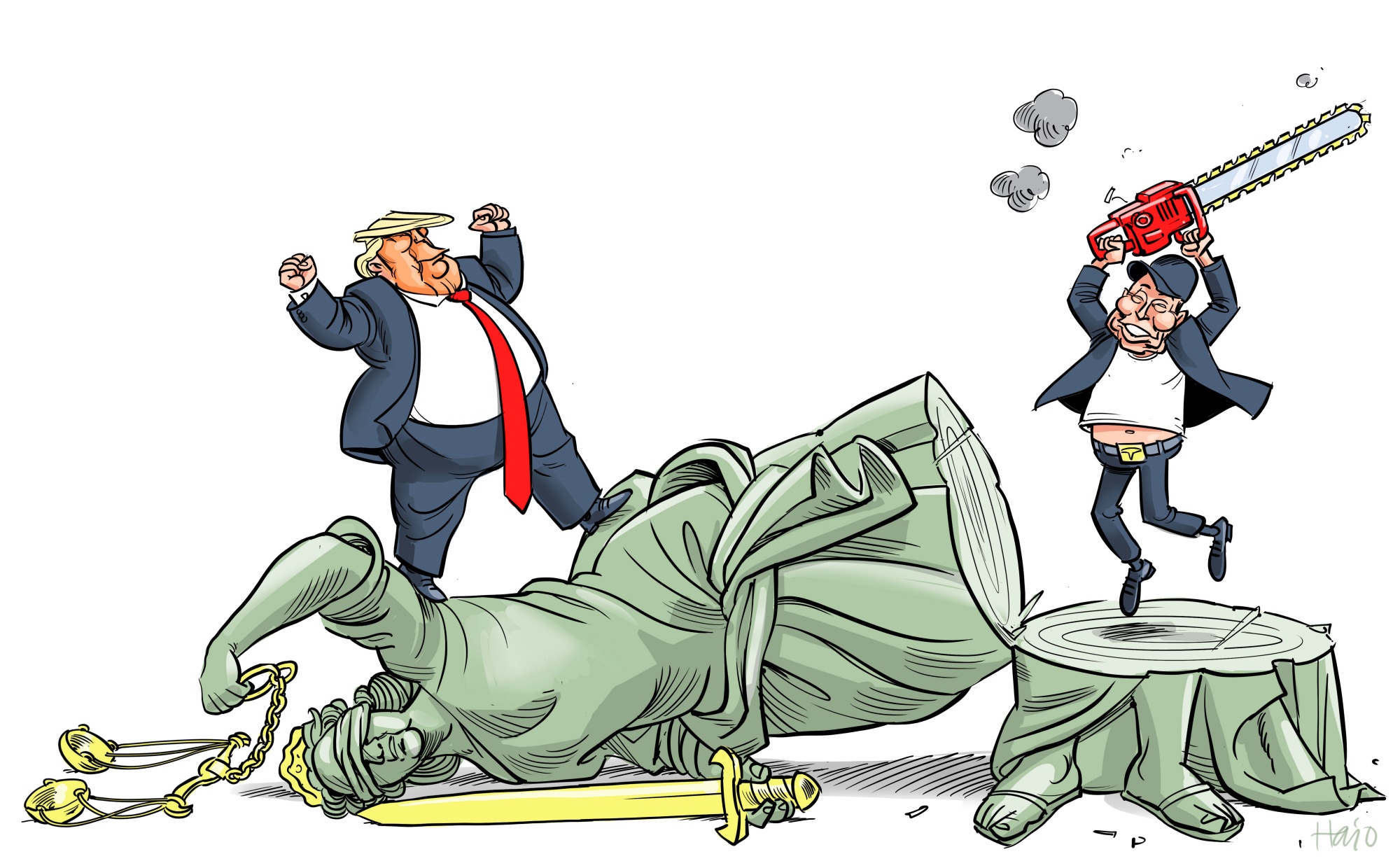
Illustration by Hajo deReijger on CagleCartoons.com


Has Trump changed history in ways that would not have occurred without him, or was a Trump-like figure inevitable? Is Trump the symptom, or the disease himself?
Mar 13, 2025 4:09 PM
Has Trump changed history in ways that would not have occurred without him, or was a Trump-like figure inevitable? Is Trump the symptom, or the disease himself?
Scholars have debated the so-called “Great Man Theory” of history since at least 1840, when Thomas Carlyle delivered a set of lectures that was later published as On Heroes, Hero-Worship, & the Heroic in History. “The History of the world is but the Biography of great men,” said Carlyle.
This view was widely embraced by European elites, and why not? It fit perfectly with the distorted self-image held by architects of empire and capital. It was hyper-masculine, aggressive and hierarchical. It reinforced the idea that there existed a few humans of superior intellect and leadership skills before whom the rest of humanity should bow and submit. They were, in Carlyle’s description,
“the leaders of men, these great ones; the modellers, patterns, and in a wide sense creators, of whatsoever the general mass of men contrived to do or to attain.”
This perspective has had its challengers from the beginning. Beginning in the 1840s, Marx and Engels put forward a view of history that focused on broad forces rather than individuals—an approach Engels called “historical materialism.” Social history, or “history from below,” arose later and focused on the lived experiences of the many rather than the biographies of the few.
Related stories
But is it any wonder that the so-called “great man theory” has survived for so long? It was ideally suited to a civilization built by usurers, robber barons, colonizers, and enslavers. That’s why it lingers, even today. It’s implicit in the American fixation with billionaires, charismatic leaders, and the giant shadows of all-powerful villains that threaten us. In its shadow form, it’s also why so many science-fiction stories discuss going back in time and killing Adolf Hitler in infancy.
Which gets us to Donald Trump. I explored this question with Professor Wolff: Has Trump changed history in ways that would not have occurred without him, or was a Trump-like figure inevitable due to historical forces?
In other words: is Trump the symptom of a deeper societal disease, or is he the disease himself? That question led us to a number of related topics, including the desperation of leaders in a declining capitalist system, the erosion of democratic norms, and the need to address underlying structural problems rather than merely treating symptoms.
I hope you find it interesting. It’s in the video at the top of the page.
This article was produced by The Zero Hour Report.
Comments

Powered by RoundtableAn AI/DeFi-powered Enterprise Media Operating System. Learn more at Roundtable.io.© Roundtable 2026. By using this site you agree to the Terms of Use and Privacy Policy