
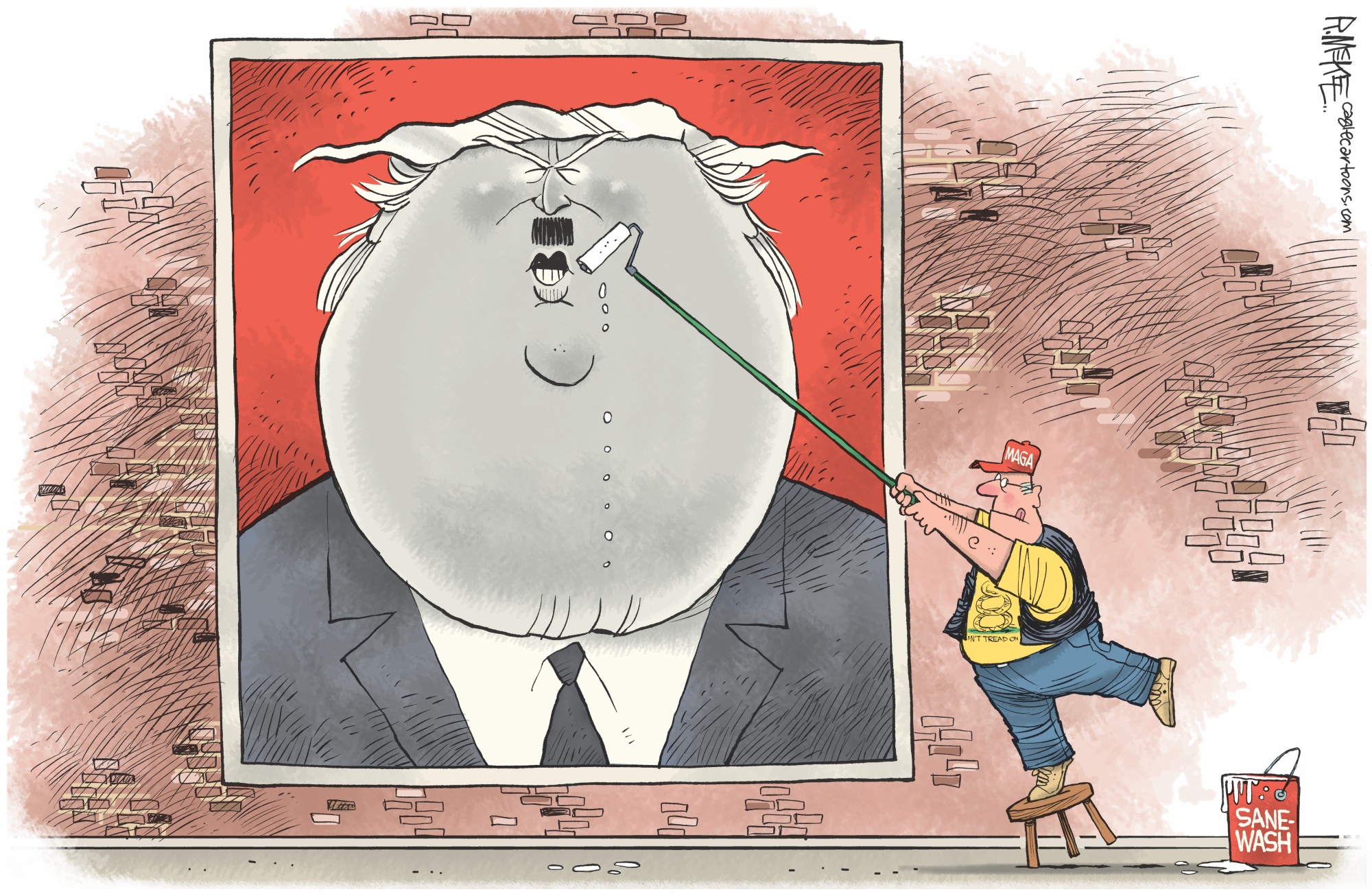


The Trump–Hitler comparison isn’t about saying history is repeating but about recognizing it is rhyming. If we wait until the concentration camps, it’s too late.
May 15, 2025 4:45 AM
Updated May 15, 2025 4:47 AM
The Trump–Hitler comparison isn’t about saying history is repeating but about recognizing it is rhyming. If we wait until the concentration camps, it’s too late.
I am one of several hundred professors accused of poisoning young minds with the toxin of thought—of daring to question, to challenge, to teach. My name appears on the so-called “Professor Watchlist,” a blacklist with a smile, its grin stretched thin over the bones of McCarthy and Hoover, perfumed in the language of parental concern.
According to Turning Point USA, I am a dangerous professor—one who “discriminates” against conservative students, one who “advances leftist propaganda” in the classroom, demonstrating “radical behavior”. The tag-line they provided for me reads “racial ideology” which I take to mean that I take a stand against systemic racism.
But make no mistake: this is not a list. It is a map of future purges, a scaffolding for fear, a whisper of chains. For some, over time, it could mean a paper trail to a foreign gulag—in El Salvador, perhaps, or in Libya, where the archives wait to be filled with names and photographs and betrayals.
Its cadence echoes Orwell; its purpose is redolent of 1984. It joins a macabre symphony of registries—roll calls of the condemned that are currently curated by the Trump administration. There exist lists for suspected terrorists, foreign agents, enemies of the state: the SDN List (Specially Designated Nationals and Blocked Persons), the Terrorist Exclusion List, the Foreign Sanctions Evaders List.
Related stories
There are ledgers kept by the FBI, by the Treasury, by shadowed offices where the lights never turn off. And now, there is one more: a roll call of teachers. A blacklist in a land where education once meant liberation.
I write this not as a mere academic, but as a witness—one among many. The reporters of old would recognize this scent: the burning paper, the ink turned to smoke. We have smelled it before—in Berlin, in Santiago, in Phnom Penh.
Remember the moment when O’Brien held up four fingers to Winston and demanded he see five. When Winston resisted, O’Brien did not argue—he pressed the lever. “If the Party says two plus two is five, then how many?” he asked. And Winston, through agony, through the unmaking of his mind, was broken. Not into silence—but into belief.
That is the quiet horror of authoritarianism: it does not stop at your words. It reaches your sight, your memory, your sense of what is. It razes the very ground on which your thoughts stand.
This is the logic of Turning Point USA—not education, not discourse, but submission. Their glossy brochures and Instagram hashtags are not tools of enlightenment. They are the velvet gloves that cover the iron fist. They hold up four fingers and demand you see five—and they smile while doing it.
Let me be clear: the existence of a list is never neutral. A list is a prelude. A list is a net. A list is a premeditated forgetting. And the moment we grow accustomed to its presence—when we nod and say, “Well, perhaps some of them deserved it”—is the moment we begin to vanish, line by line, into its pages.
Let the ink dry on this page only if we are willing to write with it again—boldly, truthfully, against the gathering dark.
I have been named before. I was placed at the top of the “Dirty Thirty,” a scarlet list curated by a Republican operative to discredit left-leaning professors at UCLA. My crimes? I can only guess.
Participating in the Bolivarian Revolution? Meeting with President Hugo Chavez, Marta Harnecker, and Ernesto Cardenal? Flying around Venezuela in a Guardia Nacional airplane, openly contesting the Venezuelan opposition’s attack on the working-class? Planning schools in the Venezuelan countryside for the children of the working poor? Creating a curricula grounded in the work of Paulo Freire and Simón Rodríguez that speaks to struggle, to liberation, to hope?
History groans beneath the weight of such lists.
Which is why those accused of progressive positions on race, class and gender renamed ourselves In Good Company.
Hitler knew the power of watchlists. He built his Reich not only with guns and gulags but with erasure—of professors, bureaucrats, poets, and priests. Those who thought too freely, who read too widely, who saw past the slogans, were rounded up, silenced, destroyed.
This is the quiet calculus of totalitarianism: truth is treason, and knowledge must be hunted.
This is the logic behind Turning Point USA’s glossy pamphlets, the smiling tablers, the hashtags polished to a gleam. They do not seek dialogue. They seek obedience. They do not want students to think. They want them to see five fingers when there are only four.
Let the lesson be clear: the existence of a list is never neutral. It is always a weapon. And the moment we grow used to its presence—when we dismiss its danger or shrug at its cruelty—is the moment we begin to disappear into it.
History teaches us that those who rule by blacklists often become objects of derision and hate. Donald Trump is certainly one of the most polarizing figures in modern history, inspiring intense devotion from his supporters and profound animosity from his critics. But whether he is the most hated man in history is more a reflection of perspective than fact.
Historical figures like Adolf Hitler, Joseph Stalin, Pol Pot, and others responsible for mass atrocities and genocides are widely considered among the most hated due to the scale of human suffering they caused. Trump's actions—while deeply controversial and consequential—don’t rise to that level of historical infamy, at least in terms of violence or death toll. But does that mean that comparisons made between Trump and Hitler should be considered unserious, or worse, outlandish?
After all, in terms of global visibility, media saturation, and the emotional heat he generates, Trump may well be among the most widely disliked political figures of the 21st century. His impact on democratic norms, immigration, racial discourse, and global alliances has made him a symbol of reactionary politics worldwide.
Comparing Donald Trump to Adolf Hitler is a highly charged and controversial act, and it must be handled with historical precision and moral seriousness. It is not to suggest a one-to-one equivalency—Hitler orchestrated the Holocaust and led a genocidal, world-consuming war—but rather to highlight the structural and rhetorical similarities that can be seen in the early stages of authoritarianism, particularly when warning signs are ignored.
Hitler came to power legally, then dismantled democracy. Trump systematically undermined democratic legitimacy, culminating in an attempt to overturn the 2020 election and inspiring a violent coup attempt. Both Hitler and Trump employed populist rhetoric to portray themselves as saviors of a “pure” people battling corrupt elites and internal enemies.
Each rose to power within democratic systems, exploiting institutional weaknesses and eroding long-standing norms. Once in power, they repeatedly attacked the press, the courts, and legislative bodies in efforts to centralize authority.
Both relied heavily on scapegoating to consolidate power. Hitler blamed Jews, communists, and others for Germany’s decline. Trump targets immigrants—especially from Latin America and Muslim-majority countries—Black protest movements, and “globalists,” often invoking explicitly racialized language.
They also embraced militant spectacle and paramilitary aesthetics. Hitler had the SA and SS; Trump encouraged the rise of militias and extremist groups like the Proud Boys and Oath Keepers, many of whom were central to the January 6 insurrection. Their public displays—military-style rallies, parades, and strongman theatrics—served as tools to signal dominance and intimidate dissenters.
A central pillar of both regimes was the cultivation of a cult of personality, reinforced by propaganda. Each presented themselves as the only figure capable of restoring national greatness. Their consistent use of lies and misinformation created alternate realities in which truth was defined by loyalty rather than fact.
It is no longer controversial to claim that there is a bitter wind shrieking through the splintered rafters of the American experiment, a wind born not of weather but of consequence—a cold, merciless current howling through the hollow cathedrals of law and liberty. It rattles the bones of Jeffersonian ghosts and scatters the fragile ash of Lincoln’s hope. It is the sound of a republic cracking.
In this tempest, where the Constitution lies dormant like a violated scripture, its verses torn and trampled, the Trumpian order presides with the glint-eyed arrogance of empire. The state, once cloaked in democratic pretense, now drapes itself in the robes of brute dominion. The regime supports the machinery of ethnic cleansing with the same dispassionate calculus used to balance a ledger.
Children are carved out of the social body like detritus—discarded by DOGE cuts that sign their death warrants with the elegance of bureaucracy. And somewhere in the shadow of a backroom handshake, a $6 million pact delivers 300 souls into the iron belly of CECOT—El Salvador’s concrete mausoleum of the unwanted.
In Nayib Bukele, El Salvador’s fascist president, Trump has found not merely a partner, but a reflection — a fellow architect in the cathedral of cruelty. Both leaders not only undermine the rule of law but revel in doing so — turning cruelty and the suspension of rights into spectacles of strength. Together they chant the liturgy of exile and incarceration, anthems for a new world where mercy is weakness and legality a nuisance to be swatted away like a fly on a gilded banquet table.
The rule of law is not repealed outright, but hollowed from within, its shell paraded as a mask for vengeance. From the volcanic spires of San Salvador to the marble rotunda of Washington, a shared dream takes shape — of cages gleaming in the sun, of judges scorned, of borders sealed like tombs. When Trump muses aloud about reopening Alcatraz — that stone sepulcher in the bay — for “the dregs of society,” one hears the echo of Bukele’s voice, like a ghost in the walls, whispering that brutality is not a last resort but a sacred rite.
Marco Rubio, draped in the grim pageantry of diplomacy, speaks of new gulags with the ease of a man ordering stones for a wall. His voice does not tremble. It boasts. The Trump administration scans the globe for more cages, more willing tyrants, more silent corners of the world to bury the inconvenient brown bodies of the borderless poor. Even now, the architects of this dark machinery plot flights of human cargo—U.S. military planes ferrying the desperate into a Libyan abyss, where warlords write the law in blood and barter.
And still, we are told to hush.
Thom Hartmann is worth quoting at length:
“I say this unapologetically,” Rubio declared at a recent Cabinet meeting. “We are actively searching for other countries to take people from third countries. We are working with other countries to say, ‘We want to send you some of the most despicable human beings to your countries — will you do that as a favor to us?’”
Let that sink in for a minute. Our Secretary of State is publicly describing migrants — many of whom have committed no crime beyond crossing a border without permission — as “the most despicable human beings.” This dehumanizing language isn’t accidental; it’s strategic. It prepares the American public to accept increasingly inhumane treatment of migrants by portraying them as somehow deserving of such cruelty.
This is where the brutal reality of warlord-run Libyan detention centers enters the picture, and where it gets even more disturbing.
Human rights organizations have documented horrific conditions in Libya’s migrant detention facilities for years. The country has been in chaos since the 2011 revolution, with rival governments and militias vying for control. The eastern half is controlled by Haftar’s forces, while the western half including Tripoli is run by the internationally recognized Government of National Accord. Migrants caught in this system face unimaginable suffering.
What are these places like? Amnesty International has documented“severe beatings, sexual violence, extortion, forced labor, and inhuman conditions” in these prisons. Detainees report being starved, tortured, and subjected to extortion. Guards have been documented shooting at detainees for sport, causing deaths and injuries. Women have described being coerced into sex in exchange for food or promises of freedom.
The State Department’s own annual report — yes, our OWN government’s report — described conditions in Libya’s detention centers as “harsh and life-threatening” with migrants having “no access to immigration courts or due process.” Doctors Without Borders has documented female detainees being told by guards, “You’re going to die here.”
These aren’t exaggerations or hysterical claims from the left. These are documented realities from respected international organizations, the State Department, and the United Nations. And this administration damn well knows it.
Libya’s detention centers are run by various private armed groups in a fractured country with no stable central authority. Some centers are essentially criminal enterprises run by human traffickers. Migrants are frequently held for ransom, with those unable to pay facing execution. Many facilities have become sites of forced labor, beatings, rape, torture, and murder.
And now consider this grotesque theatre: the would-be orange emperor, trailing behind a court jester turned oracle. Trump, once the roaring lion, now trots obediently after the conspiratorial mutterings of Laura Loomer — a digital demagogue whose slang drips with bile, whose lexicon of paranoia has become scripture in the kingdom of MAGA.
He repeats her ravings not as a leader setting course but as a mirror held up to the movement’s most fevered imaginings, a vessel for the broken syntax of grievance and revenge. In Loomer’s wake, Trump becomes not the author of authoritarianism but its echo, chasing the tail of a language forged in irony and fury, stumbling into fascism wrapped in memes and madness. Loomer has publicly criticized the newly elected Pope Leo XIV, formerly Cardinal Robert Francis Prevost.
Loomer described him as "anti-Trump, anti-MAGA, pro-open borders, and a total Marxist like Pope Francis," expressing concerns about his stance on immigration and social issues:
"His name is Robert Prevost. He’s the first American Pope. He is anti-Trump, anti-MAGA, pro-open Borders, and a total Marxist like Pope Francis. Catholics don’t have anything good to look forward to. Just another Marxist puppet in the Vatican.
Meet the new American Pope. Of course he’s anti-MAGA and WOKE. Another Open Borders Pope. Gross."
Pope Leo XIV, the first son of America to wear the white cassock, has dared to preach a gospel that stretches wide its arms. He has stood with the stranger at the border, with the outcast in the alley, with the refugee bearing the weight of a world that has forgotten him. In a time of walls and wires, he speaks of bridges.
And for this—this heresy of compassion—he is pilloried by the court jesters of cruelty. Chief among them, Laura Loomer, whose bile runs so thick it could irrigate a pig farm. Her words, sharpened into barbs, are taken as gospel by Donald Trump, who seems to draw his counsel not from scripture but from the rage-stained corners of the internet.
One wonders: if spite is now credential enough for power, why not hand her the keys to Guantánamo? Let her run the cages. Let her determine who suffers and how long. She has already built her résumé on the ruins of decency.
But perhaps that’s the point. In an age when mercy is mocked and the Beatitudes are recast as weakness, the ones who love the poor are branded as enemies of the state.
And still the Pope speaks.
At this time of grave moral and political unease, often venturing into madness, we are asked by the MAGA police to calm down and check our hyperbolic statements at the door.
Silence, however, is virtually impossible for minds incapable of holding more than one thought at a time. President Trump responded recently to the idea of increasing taxes on the rich by saying, “Republicans should probably not do it, but I’m OK if they do!!!”
Trump then went on to dismiss Carla Hayden from her position as Librarian of Congress, a role she held since her appointment by President Barack Obama in 2016. Hayden made history as the first woman and first African American to serve in this capacity. Her abrupt termination, a politically motivated attack, communicated via a brief email from the Presidential Personnel Office, occurred nearly a year before her ten-year term was set to conclude in 2026.
Donald Trump had reached once more for the scepter of power—not through laws debated in the halls of Congress, but through decree, as if he fancied himself a sovereign of old when he scrawled his will into an executive order, one that critics say carries the weight not of justice but of exclusion, casting long shadows over the ballot boxes of millions.
Where once voting was a sacred rite of the republic, this edict aims to wrap it in barbed wire and bureaucracy, to raise gates and demand papers, to render the franchise a privilege rather than a right. It is, as Arizona Secretary of State Adrian Fontes declared, not law but fiat—an imperial gesture masquerading as governance, a paper crown on a restless autocrat. The dismissal came shortly after the conservative American Accountability Foundation (AAF) publicly criticized Hayden, labeling her as "woke" and "anti-Trump."
This action aligns with a broader initiative by the Trump administration to reshape federal agencies by removing officials perceived as unsupportive of the president's agenda.
Not content with sowing chaos in 2020, Trump now eyes the horizon of 2026, and some fear he aims not to contest the midterms, but to nullify them. To erase the page before the ink can dry. To place the ballot under lock and key, guarded not by law but by loyalists.
As if the Heritage Foundation and Project 2025 wasn’t bad enough, The American Accountability Foundation, founded in 2020, is known for its opposition research targeting federal employees and nominees it deems ideologically opposed to Trumpism. The group has been involved in efforts to influence federal appointments and policies, often labeling individuals as "woke" or left-leaning.
Project 2025 is a coordinated blueprint to radically reshape the federal government, curtail regulatory powers, politicize the civil service, and impose a hardline, right-wing vision of executive power. It's essentially a roadmap for dismantling what they see as the "deep state"—but in practice, it’s a path to authoritarianism cloaked in bureaucratic reform.
A right-wing nonprofit — calling itself the American Accountability Foundation — has begun to cast its net.
The Foundation calls it a “DEI Watch List,” but it reads like a blacklist reborn, dressed in the language of bureaucratic vigilance. The targets are not chosen at random; they are mostly Black, many work in health and education, and all are accused of the great heresy of our age—believing that equity might still have a place in public life.
This group, stitched together with the money of dynasties whose names rarely surface, operates behind a curtain of LLCs, shell foundations, and donor-advised funds—an architecture designed less to build and more to conceal. The gold that fuels them comes wrapped in discretion, cloaked in philanthropy, and wielded like a blade.
Their lists, with the cold precision of a surveillance state in gestation, identify “subversives”—a word echoing the paranoias of McCarthy and the ghosts of COINTELPRO. Today, it is DEI; tomorrow, it may be any whisper of justice that dares to bloom within the state.
What’s most chilling is not the plan itself, but how brazenly they speak of it—of purging the disloyal, of consolidating power in a single, unaccountable hand, of dismantling the scaffolding of civil rights, environmental protections, and the fragile safety nets that keep society from tearing at the seams. It does not read like a democratic platform. It reads like a manual for regime change—from within the republic, with the Constitution as kindling.
Recall Pinochet, draped in medals and the silence of the disappeared, toasted by Margaret Thatcher as a friend of the West. That too began with the promise of “order,” of rooting out subversion. The tanks rolled through Santiago not to protect freedom, but to bury it beneath rubble and ash.
We have seen this script before. It begins with a sneer at compromise, a fetish for strength, and a scapegoat offered up like a sacrificial lamb.
And it ends in a room with no windows, a name struck from the registry, a question that cannot be asked aloud.
These are just a few controversial moments in a long litany of far-right mania—each one a thread in the unraveling of democratic norms, stitched together by outrage, fearmongering, and authoritarian ambition.
But to understand the full picture, we must look beyond the headlines and examine the ideological machinery fueling these spectacles. It is worth remembering that In this fractious political climate progressive critics are cautioned to be “measured.” To show “restraint.” To speak in calm tones as the furnace of fascism is stoked. We are warned not to draw lines between the present and the black pages of the past—not to summon the taboo name of the Reich, lest we breach the etiquette of polite society.
But I say: etiquette be damned. The problem with these defenders of “reasoned debate” is not that they want caution—it’s that they mistake denial for nuance. They mistake comfort for clarity. But clarity is not always comfortable. Sometimes, it sounds an alarm. Sometimes, it shouts across decades. Sometimes, it dares to say the unutterable: It’s happening again.
In a moment that would seem surreal were it not so grimly real, House Republicans have voted against Representative Pramila Jayapal’s amendment that would have made it unequivocally illegal for immigration enforcers to detain or deport U.S. citizens.
Let that sink in. Amid the drafting of what Donald Trump calls his “one big, beautiful bill”—a sweeping consolidation of the carceral state—the party of “freedom” refused to enshrine the most basic guarantee of citizenship: the right not to be exiled from your own country.
Upon close inspection, Representative Jayapal’s amendment was not radical. It was a safeguard against state overreach, a line drawn in the sand: that ICE, a domestic arm of enforcement already rife with abuse, cannot—must not—have the power to imprison or deport people who are legally and undeniably American. And yet, the GOP said no.
Why does this matter? Because the idea that sparked this amendment—that U.S. citizens could be deported to foreign countries—didn’t arise from the margins. It came from the mouth of Donald Trump himself. In April, he floated sending U.S. citizens convicted of violent crimes to El Salvador. Not extraditing them under treaty. Not prosecuting them under law. Exporting them. As punishment. As performance. As precedent.
This isn’t policy. It’s proto-authoritarianism. No, let’s call it what it is: fascism. It's the transformation of citizenship into a conditional privilege, revocable at the whims of power. It’s a message: that identity, rights, even belonging, can be undone by decree.
The refusal to pass Jayapal’s amendment is not a bureaucratic fluke. It’s a signal. That the machinery of the state may soon no longer recognize legal identity as sacred. That no one—no matter their passport, no matter their birthright—is safe from becoming disposable in the hands of MAGA’s brute power.
This is not theoretical. This is not alarmism. This is how democracies die—not with tanks in the streets, but with eroded norms and votes cast in committee rooms while no one’s looking.
Leave it to journalist luminary Thom Hartmann to ask the right question at the right time: Why is this happening?
Because, he notes, this is not a policy accident or bureaucratic oversight. It is a continuation—a cold, calculated extension—of a strategy first crafted in the fevered minds of Donald Trump and the odious Stephen Miller. The same minds that, in the last administration, ordered that children be torn from their parents’ arms at the border, not out of necessity, but as spectacle. As warning. As psychological warfare.
The logic, Hartmann points out, was brutally simple: if America becomes synonymous with cruelty—if it is known around the world not as a beacon, but as a butcher—then fewer people will come. It is deterrence by atrocity. It is cruelty as message, as currency, as performance. “Let them see what we do to the desperate,” it says, “and let them stay away.” In Hartmann’s own words:
“Trump and Miller’s policy of mass detention isn’t about safety or security. It’s about punishment, deterrence, and performing cruelty for political gain the same way dictators around the world run their countries.
And cruelty inflicted like this, now “limited” to immigrants, rarely stays limited; what Trump and the GOP do to the least of us, history says, they’ll ultimately do to all of us.
And why isn’t anyone talking about the money? Millions of dollars are being funneled to private detention contractors and foreign governments through these agreements. Who’s profiting? Follow the damn money.”
Hartmann is correct in his assertion that what these savage enforcers fail to understand—what they cannot understand—is that such a strategy doesn’t merely brutalize those who seek refuge. It poisons the very nation that enacts it. It does not just cage children—it disfigures our collective humanity. It teaches a generation of Americans that justice is weakness, that mercy is treason, that the measure of a policy is not its righteousness but its ruthlessness.
Chesa Boudin, former Attorney General of San Francisco and currently the executive director of the Criminal Law & Justice Center at the UC Berkeley School of Law, published an article in the San Francisco Chronicle with Kenneth E. Hartman, a formerly incarcerated lifer, on Trump’s plan to end prison rape protections. Trump’s Department of Justice, as if with a single stroke of a poisoned pen, severed the lifeline to the Prison Rape Elimination Act Resource Center.
No more training for those sent to bear witness. No more support for the wounded. No more record of the unspeakable!
In California, almost daily, human flesh is defiled behind bars. Men and women — stripped not only of freedom but of personhood — suffer in the dark. This is not rumor, not myth. It is written in the hidden ledger of the state, where over 2,000 assaults were named in 2023 alone, though anyone who listens knows the truth far outpaces what is counted. So many more voices stay buried in silence, because to speak is to risk the whip, the cell, the quiet retribution of a system that punishes the wounded for bleeding.
Women — just 4% of the incarcerated — are hunted most by the very hands sworn to guard them. For all, male or female, the predator’s shadow often wears a badge.
And justice? It has been made a ghost. In 2014, nearly every case was investigated to conclusion. Now, barely two-thirds make it that far, and even those vanish into the ether, stamped “unsubstantiated” — a word that means we heard you, but we will not believe you.
The Resource Center is gone now. The lights turned off. The records may gather dust or be forgotten altogether. And still the assaults continue — behind concrete and wire, out of sight, uncounted, unanswered. The state turns its face away, and the silence grows thick, like mold, over everything.
And where did I meet the brave warrior, Chesa Boudin? In Venezuela, where he was working to improve the lives of the poor and the disenfranchised.
And so the soul of the nation curdles. The myth of America, already bloodstained, begins to rot from within. The flags still wave, but they cover camps. The anthems still play, but they echo through courtrooms that rubber-stamp deportations like death sentences. We become not what we feared, but what we once swore we’d never be.
In the twilight days before taking the oath of office—before laying his hand on the Bible he would so blasphemously invoke—Donald Trump unveiled not a policy, not a vision, but a product: TRUMP Coin, a cryptocurrency minted in the furnace of ego and avarice. It was not a promise to serve, but an invitation to invest. Not a call to national unity, but to personal enrichment.
Now, the scheme deepens.
Trump has dangled before the public a new offering: access—not to democracy, not to leadership, but to himself. A private dinner with the largest holders of TRUMP Coin, a modern-day indulgence for the gilded faithful. In the kingdom of grift, proximity is power, and power is for sale.
This is not simply a matter of bad optics. It is a grotesque ethical collapse—an ex-president-turned-president-elect using the apparatus of political ascendance to inflate his own digital currency. The implications are staggering: now a sitting head of state with direct financial interest in the market performance of a speculative asset bearing his name. A marketplace where policy could be shaped not by public need but by private portfolios.
And so we must ask: What happens when the presidency itself becomes a pay-to-play NFT? When the corridors of power are reduced to Discord servers and crypto wallets?
Trump’s foray into cryptocurrency—a venture as brazen as it is dangerous—and the expanding moral void it exposes at the center of American power should not come as a surprise. The power of billionaires, the power of oligarchy seemingly has no end.
Speaking of billionaires, Bill Gates, in a stunning and unsparing interview with the Financial Times, accused Elon Musk of doing nothing less than killing poor children.
The accusation came as Gates announced he would give away the remainder of his fortune to the Gates Foundation, a gesture heavy with both philanthropy and political symbolism. But it was his unflinching rebuke of Musk’s dismantling of the U.S. Agency for International Development—USAID—that cut deepest. Musk’s Department of Government Efficiency, grimly nicknamed DOGE, shut down the agency in February, abruptly halting food programs, medical aid, and disease prevention efforts in some of the most fragile regions on Earth.
“You don’t kill an agency like USAID without knowing exactly what you’re doing,” Gates said. “When you pull vaccines out of sub-Saharan Africa, when you stop food shipments to drought-stricken regions, when you yank maternal health programs mid-pregnancy—you are not saving money. You are letting children die.”
It is perhaps the first time one billionaire has so directly accused another of participating in atrocity. But Gates was not speaking in metaphor. Musk’s vision of a hyper-efficient, algorithm-driven government has now met the full weight of humanitarian consequence. And while his fans cheer the “slashing of waste,” the waste, it turns out, was keeping tens of thousands alive.
This is not innovation—it is the cold arithmetic of empire dressed in the sterile robes of progress. It is the algorithmic cruelty of austerity, pushed to its final, fatal equation. What they call "vision" is the gleam of a blade sharpened not for surgery, but for sacrifice.
Elon Musk, their golden calf in a titanium crown, is hailed by the Trump regime as a patriot. Perhaps he is—but only in the way a dragon is patriotic to its hoard. He raises his hand not in a salute to liberty, but in mimicry of darker histories, the past resurrected in a future that promised freedom and delivered surveillance, torture and death.
America, ever entranced by the gospel of gold, has knelt once again to the altar of wealth. Americans were told that fortunes stacked high enough would drip salvation down to the starving. But the heavens held no such rain—only ash. It was this fable of falling riches that helped Trump ascend on wings of golden lies.
And now, in a grim encore, he has returned—not to govern, but to devour. In less than a hundred days, he turned the gears of the republic in reverse, and what remained of the economy collapsed like a stage after the play, the illusion shattered, the audience left in smoke.
Americans cannot be expected to bow before the idols of civility while the fire climbs the steeples and the Constitution burns like dry parchment in its pyre. They risk the consequences of calling this moment anything less than what it is. And they should not be silent while the ghost of history bangs on the walls, demanding to be heard. And this is especially true when the discussion centers upon Donald Trump and Adolf Hitler.
Those who warn against invoking Hitler’s name when speaking of Donald Trump are, in my opinion, gravely mistaken—not only in fact, but in moral clarity. And those who claim such comparisons dishonor the memory of the Holocaust are tragically, perilously wrong. To draw these lines across time is not to play at history with the idle hands of liberal parlor talk. It is not a rhetorical indulgence, nor a game of elite provocation. It is an act of conscience. An alarm struck in the language of memory.
No—Trump is not Hitler. Hitler orchestrated a genocide so vast, so systematized in its horror, that it defies the architecture of language itself. But to refuse all comparison in the name of reverence is not solemnity—it is surrender. For history does not repeat itself in uniform; it does not reappear wearing jackboots and armbands. It returns in rhyme, in silhouette, in signs familiar yet deniable. It arrives not with the spectacle of Auschwitz, but with the shrug of administrative cruelty—the camps built quietly, the migrants shipped invisibly, the laws rewritten with sterile hands.
Fascism’s overture is not a scream but a whisper. It slinks into the body politic wrapped in the flag, bearing slogans of renewal, of “greatness,” of a nation betrayed by the weak and the foreign. It begins not in gas chambers but in language, in policy, in indifference. In the normalization of the unthinkable.
Who would have thought that an American president—an American president—would float the idea of exiling U.S. citizens to foreign gulags, trading away human beings like diplomatic currency? That the stars and stripes would be stamped on the chains of Americans sent to rot in the dungeons of Libya and El Salvador, regimes notorious not for justice, but for torture?
Donald Trump, with the authoritarian instincts of a tyrant and the showmanship of a reality star, has shattered another unthinkable norm. And Marco Rubio, now 72nd Secretary of State in this grotesque sequel to American decline, is not just complicit—he’s boasting about it. Bragging, like a salesman at a trade show, about how many countries might be willing to warehouse human beings under the banner of American law.
This is no longer the quiet erosion of democracy. This is its loud desecration. When a nation begins to entertain the idea that citizenship itself can be revoked not by law, but by executive whim—when it suggests that the state can disappear its own people into foreign prisons—it ceases to be a democracy in any meaningful sense. It becomes something else. Something darker. Something we swore, as a nation, never to become.
Who would have thought an American president would pander to Putin and side with Russia over Ukraine. It's a sobering reality that would have seemed unthinkable during the Cold War or even the early 2000s—when bipartisan consensus in the U.S. saw Russia as a geopolitical adversary and Ukraine as a fledgling democracy in need of support. But the Trump era shattered many assumptions. Trump’s open admiration for Vladimir Putin, skepticism toward NATO, and frequent undercutting of Ukraine—most notably by withholding military aid to pressure Kyiv for political favors—marked a dramatic break from decades of U.S. foreign policy.
For many, it wasn't just a shift in strategy; it felt like a betrayal of democratic values and longstanding alliances. Trump’s actions—whether in Helsinki standing beside Putin and contradicting U.S. intelligence, or echoing Kremlin talking points—raised alarm not just about policy, but about the integrity of American leadership itself.
Who would have thought that Trump would threaten Greenland, the Panama Canal and its best friend and neighbor, Canada? Who could have foreseen the surreal and imperial undertones of Trump-era rhetoric—where bluster, transactional geopolitics, and nostalgia for 19th-century power politics sometimes collided in bizarre ways.
While Trump never formally threatened to annex Greenland, he did seriously float the idea of purchasing it from Denmark in 2019, prompting international incredulity and a diplomatic spat when Denmark called the idea "absurd." Trump then canceled a state visit in retaliation. He has since stepped up his attempts at purchasing the island. Rebuked by Denmark, he has directed his international spies to focus on Greenland.
As for the Panama Canal and Canada, there were no official annexation threats, but his attitudes often betrayed a colonial mindset: suggesting Canada was taking advantage of the U.S. on trade, calling for military presence near the Canadian border during COVID, and even musing about “taking” foreign assets or resources under the guise of American interest.
Trump reportedly floated the idea—perhaps half-jokingly, perhaps not—of Canada becoming the 51st state during his presidency, a move that angered and bewildered many Canadians. While this wasn’t an official policy proposal, it fits with his pattern of making provocative, often nationalistic or imperial-sounding remarks that undermine diplomatic norms.
To the vast majority of Canadians, the idea of becoming a U.S. state under Trump’s leadership wasn’t just offensive—it was a direct affront to Canadian sovereignty, identity, and values. The reaction was swift: Canadian media, politicians, and the public pushed back strongly, treating the suggestion not as humor but as part of a broader pattern of disrespect from the Trump administration toward allies.
This fits with a larger narrative of Trump treating international relations as business deals or conquests, rather than partnerships based on mutual respect. From renegotiating NAFTA under threats of economic punishment, to mocking Trudeau, to suggesting military action near the Canadian border, Trump repeatedly challenged the foundational assumptions of the U.S.-Canada alliance.
These moments weren’t just outlandish—they reflected a deeper authoritarian and expansionist impulse, dressed up in populist, “America First” language. It shocked many not just because of their content, but because a sitting American president gave voice to ideas that seemed to come from another century—or another regime entirely.
And yet here we are.
To silence ourselves in this moment—to refrain from drawing the contours of resemblance between Hitler and Trump out of fear of impropriety—is not noble. It is cowardice dressed in etiquette. It is a betrayal not only of the memory of those who perished, but of those alive now, those being hunted, caged, and cast out.
When the wind shifts and the rhyme begins, the responsible response is not to lower one’s voice. It is to rise. To name what must be named. And to resist—before the metaphor becomes a mirror.
The structural parallels between Donald Trump and Adolf Hitler are not fevered hallucinations conjured by overzealous partisans—they are the spectral echoes of history itself, vibrating within the steel and sinew of modern authoritarianism. These echoes do not scream; they hum low and constant, vibrating through policy, language, and spectacle, reminding us that tyranny rarely repeats—it reappears.
Both men fashioned themselves as vessels of a mythic people—pure, burdened, betrayed. Hitler invoked the Volk, sanctified by blood and soil. Trump, with the same populist sorcery, summoned “the forgotten Americans”—a conjured class of virtuous victims, surrounded by enemies both foreign and domestic.
These enemies were not merely political opponents but existential threats, their opposition proof of treason. Through this lens, democracy becomes not a mechanism of compromise but an obstacle to be bulldozed. Courts become enemies. Journalists, liars. Elections, illusions. The rule of law, a temporary inconvenience. This is not spectacle—it is the opening act of fascism.
Next on Trump’s agenda is to terminate birthright citizenship. Birthright citizenship is the bedrock beneath the promise of American democracy—a quiet, powerful guarantee that the accident of your birth does not render you alien in the land where your life begins. It whispers a radical truth: that all who emerge into the world on this soil, no matter the color of their skin, the god of their ancestors, or the papers their parents hold or lack, are equals in the eyes of the law.
It is a shield against tyranny’s first temptation: to decide who belongs and who does not.
Without it, the state gains a dangerous tool—the power to sort the innocent into categories of worthiness, to write hierarchies into the very fabric of citizenship. Birthright citizenship denies the government that power. It tells politicians and demagogues alike: you do not get to choose who counts.
It is not just a legal mechanism. It is a moral line in the sand.
But fascism does not rise on a tyrant’s charisma alone. It feeds on scapegoats. It craves an Other to be cast out, a vessel into which society can pour its dread and rage. For Hitler, it was Jews, Roma, communists, and homosexuals—each labeled a contaminant. For Trump, the targets shifted with the news cycle: undocumented migrants branded as invaders, Muslims banned en masse, Black protestors met with tear gas, and “globalists” whispered into conspiracy by torchlight.
The border wall was not a solution; it was a symbol. The Muslim ban not policy, but liturgy. Fascism is a religion of blood, and every dog whistle is a prayer.
Next on Trump’s agenda is to terminate birthright citizenship. Birthright citizenship is the bedrock beneath the promise of American democracy—a quiet, powerful guarantee that the accident of your birth does not render you alien in the land where your life begins. It whispers a radical truth: that all who emerge into the world on this soil, no matter the color of their skin, the god of their ancestors, or the papers their parents hold or lack, are equals in the eyes of the law.
It is a shield against tyranny’s first temptation: to decide who belongs and who does not.
Without it, the state gains a dangerous tool—the power to sort the innocent into categories of worthiness, to write hierarchies into the very fabric of citizenship. Birthright citizenship denies the government that power. It tells politicians and demagogues alike: you do not get to choose who counts.
It is not just a legal mechanism. It is a moral line in the sand.
Might must accompany myth. Hitler had the SA and SS—militarized arms of ideological enforcement. Trump had Proud Boys and Oath Keepers, armed with rifles and wrapped in red caps, baptized in grievance and conspiracy. January 6 was not an outburst. It was a ritual—a dry run dressed in cosplay and riot gear. These militias are not fringe; they are the specter of state violence unbound, waiting for the nod. The spectacle of flags and fists, of slogans chanted with clenched teeth, is not spontaneous. It is choreography lifted straight from a century-old pageant of hate.
And above all, fascism demands a prophet—not a man of truth, but a messiah of lies. Hitler ruled through myth: a Reich that would last a thousand years, a nation reborn in purity. Trump followed suit. He declared victory when he lost. He labeled facts as fabrications. He reshaped reality into a hall of mirrors, where truth bent to will and reason was drowned in roar. In such a world, loyalty is virtue, and doubt is betrayal. This is not politics—it is pedagogy. It teaches obedience. It punishes complexity. It demands belief.
And all of it—every chant, every law, every cage and slogan—serves one purpose: the quiet assassination of democracy. Hitler did not seize power through coup, but through law. Through handshakes, elections, decrees. He hollowed out the Weimar Republic from within, using its own mechanisms as tools of its undoing. Trump followed that script line for line: lawsuits designed to discredit, lies deployed to delegitimize, a mob summoned not just to storm the Capitol but to break the spell of constitutional faith.
What breached the Capitol on that cold January day was not only a crowd—it was the culmination of decades. Decades of neoliberal cowardice, of white supremacist indulgence, of a bipartisan refusal to take the creeping specter of fascism seriously until it stood, snarling, on the steps of the republic.
To look away from these echoes is not reverence for history—it is complicity. The playbook is open. The pages are turning. And the time to read aloud is now.
Now come the scolds — the guardians of decorum, the high priests of polite discourse — Katharine Brodsky chief among them, wagging their fingers and furrowing their brows, warning that to compare Trump to Hitler is to commit a blasphemy against history. But history is not a mausoleum to be kept under glass. It is not a sacred urn filled with the ashes of suffering, guarded by the well-mannered. It is a living battleground—a struggle not just over what happened, but over what it means.
Saying “Trump isn’t Hitler” is not a sufficient argument against recognizing proto-fascist dynamics. Historical amnesia is dangerous. In the early 1930s, many dismissed Hitler as a clown who would be contained by existing institutions. That logic failed then, and repeating it now risks grave consequences.
Fascism doesn’t begin with death camps; it begins with rallies, demagoguery, and systematic attacks on the rule of law. Warning signs must be taken seriously.
Trump doesn’t need to replicate Hitler’s exact methods to pursue a similar authoritarian trajectory. Fascism today operates through digital platforms, media manipulation, and corporate alliances. Brodsky’s rejection of the comparison relies on outdated images of fascism rather than recognizing how its logic and tactics evolve.
Insisting that Trump is merely “a populist” or simply “polarizing” dangerously underplays the threat. This kind of minimization normalizes authoritarian behavior and weakens public resistance, ultimately emboldening those who seek to dismantle democracy from within.
This kind of comparison isn't about equating the figures; it's about learning from history to prevent catastrophe.
Calling out fascist tendencies isn’t alarmism—it’s a moral obligation.
Seeking civility is a velvet rope stretched across the smoking wreckage, cordoning off the comfortable from the combustible. It is the soft glove that conceals the iron fist of inaction. It is a refusal to name the fire while the curtains burn.
They do not see—perhaps will not see—that fascism does not always stomp through the square in jackboots and iron crosses. Sometimes it slips in through op-eds, dressed in journalistic neutrality. Sometimes it comes smiling from a debate stage, shaking hands, dropping soundbites engineered for cable news.
Sometimes it is not shouted, but softly whispered: “This is not that.” And yet it is. Just digitized. Market-tested. Corporate-sponsored. Fed to the masses through dopamine loops and algorithmic rage bait. The aesthetic has changed; the engine has not.
To insist, smugly, that “Trump isn’t Hitler” is not an argument. It is an escape hatch. It is a lullaby sung by those who need history to stay dead. It is the same tune played in 1932: He’s just a clown. He’s too crude to last. The institutions will restrain him. The people won’t stand for it. This, too, shall pass.
Spoiler: it didn’t.
The Trump–Hitler comparison isn’t about saying history is repeating itself identically—it’s about recognizing when it is rhyming. If we wait until the concentration camps, it’s already too late. The point of the comparison is prevention, not prediction.
Comments

Powered by RoundtableAn AI/DeFi-powered Enterprise Media Operating System. Learn more at Roundtable.io.© Roundtable 2026. By using this site you agree to the Terms of Use and Privacy Policy