
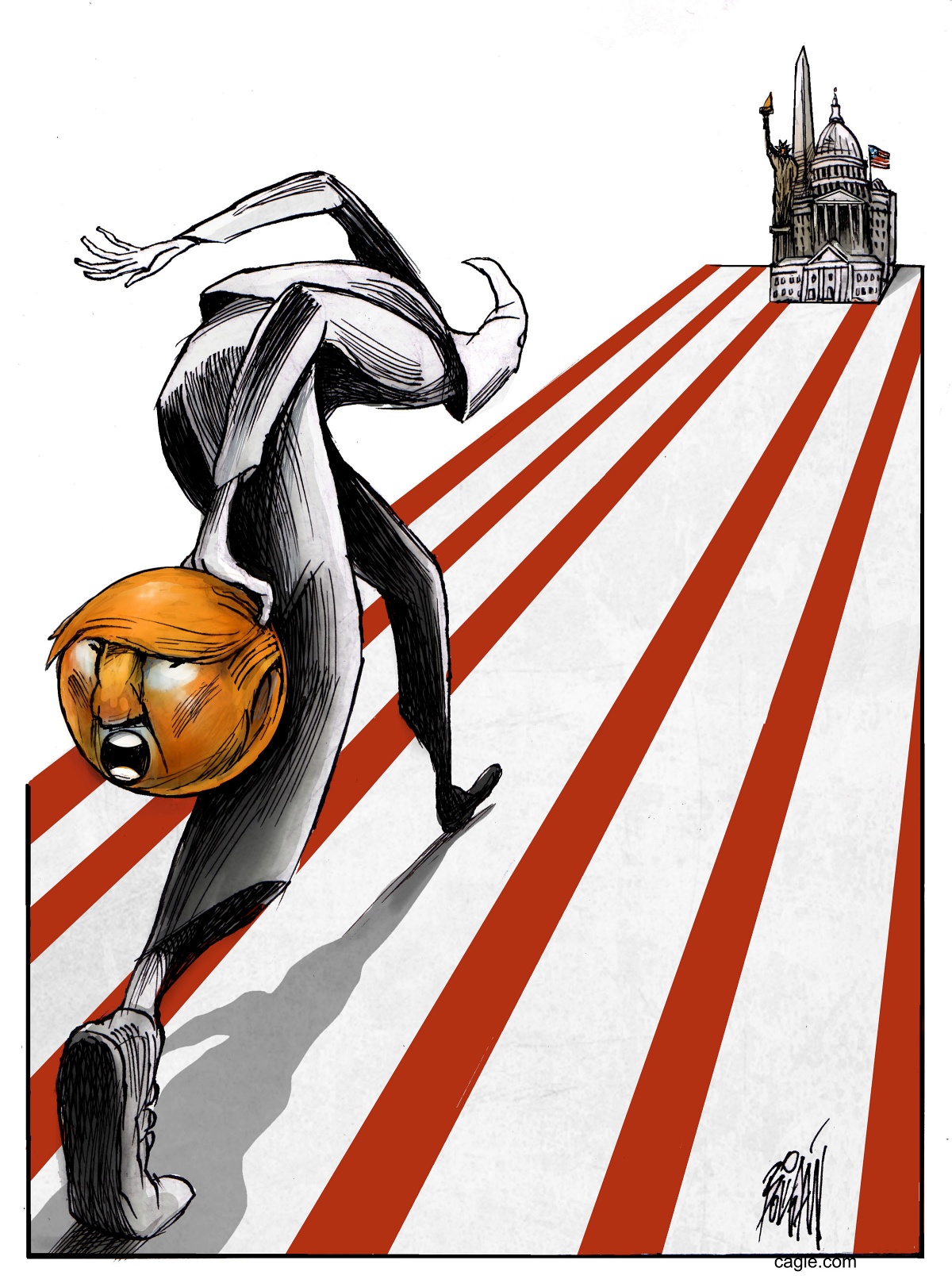
Cagle Cartoons: Angel Boligan


Storm Clouds Over K Street
Nov 16, 2024 7:50 AM
We must steel ourselves, not only for what is to come but for the reckoning that will follow, when the deeds of this era will demand an accounting in the harsh light of history.
Since 2016, I have taken up the pen as both witness and warning, chronicling the extraordinary peril Donald Trump embodies for the nation. His rise was not merely a political shift but a tectonic rupture, exposing fissures of fear and prejudice that run deep within the American psyche. In 2016, the electorate turned its back on the transformative promise of a woman’s leadership—a vision as radiant and distant as a star yet out of reach. And it remains the case that in 2024, the possibility of a woman—this time a woman of color—guiding the nation remains a dream deferred, trapped in the amber of unrealized potential.
History, that relentless arbiter, will one day hold its mirror to these days, and in its cold reflection, the nation will see the contours of its failures etched in stark relief. The shame will not be fleeting; it will settle like ash upon the collective consciousness, a testament to opportunities lost and courage forsaken.
As an educator who has walked the corridors of learning for more than half a century, speaking in lecture halls from Toronto to São Paulo, I know this reckoning cannot be escaped. It will come as surely as the tide, its judgment sharp and unyielding. And when it does, the nation will be forced to reckon not only with its past but with the sobering truth of what it allowed itself to become.
And so here we stand, looking on in disbelief as the Trump sycophants gather, one after another, pledging their loyalty with eyes alight and voices steady, like men hypnotized by the very sound of their own vows. With jaws dropped, we watch Representative Troy Nehls of Texas deliver his allegiance in words that echo the chilling subservience of history’s darkest hour. He professes his unyielding loyalty to Trump—not for reason, nor even for principle, but in a kind of cult-like trance. “If he says ‘jump,’ we jump,” Nehls declares, “if he says ‘scratch your head,’ we obey, no question, no hesitation.”
Related stories
And in those words, we hear something ancient, a haunting echo that reverberates back to the heel-clicking pledges of Nazi grunts, eyes fixed on the horizon, heads bowed to the orders of SS superiors, embracing not a vision of service, but one of blind obedience to power. This is the loyalty of the loyal without thought; the allegiance of those who would rather cede the power to choose than bear the weight of doubt. In Nehls’s pledge, we glimpse the barren road that has been traveled too many times before—a path beaten down by the boot heels of men stripped of their conscience, marching to the orders of their own enthrallment, towards open pits lined with victims in striped uniforms, waiting for their final deliverance.
The infamous refrain of Nazi perpetrators—"I was only following orders"—stands as one of history's most chilling justifications for unspeakable crimes. It is the language of abdicated morality, a surrender of conscience at the altar of obedience. In those words lies the devastating reminder of how bureaucracies can transform human beings into instruments of atrocity, where personal responsibility dissolves into the machinery of collective evil.
This defense, repeated like a mantra at the Nuremberg Trials, was an attempt to shift blame upward, to cloak monstrous deeds in the veneer of duty. Yet, the tribunal's rejection of this excuse set a precedent: that individuals are moral agents, accountable for their actions even under the weight of hierarchical command. "I was only following orders" was not just a plea; it was a revelation of the dark potential of unexamined loyalty and the peril of systems that prize compliance over conscience.
At present, we hold our judgment in uneasy suspension, haunted by the specter of Trump's past and wary of the shadows his second term might cast. The machinery of cruelty that defined his first term—children torn from their parents, confined in cages that became grim symbols of state-sanctioned inhumanity—serves as a grim prologue to what might come. Additionally, Trump’s handling of the pandemic has been a lightning rod for condemnation, emblematic of a leadership style that prioritized personal narratives over public health. From the outset, his reluctance to acknowledge the gravity of COVID-19 sowed confusion and mistrust. By downplaying the virus’s severity and dismissing early warnings, he squandered precious time that could have been used to prepare the nation.
Instead of rallying around science, Trump amplified conspiracy theories that undermined public confidence in health measures. Even as his own administration’s scientists worked tirelessly to combat the virus, he publicly undermined their credibility, framing them as antagonists rather than allies. His actions—or lack thereof—not only hampered efforts to contain the virus but also deepened the nation’s polarization, turning a public health crisis into yet another battleground in America’s culture wars. Enter RFK Jr., the anti-vaccine activist and his potentially massive oversight of America’s health industry.
The sycophant curve, that unholy alignment of blind loyalty and unchecked ambition, seems even steeper in 2024. The chorus of enablers has grown louder, their devotion more unyielding, as the architecture of power twists into something more brazenly authoritarian. The staggering selection of Matt Gaetz as Attorney General—a figure whose controversies outstrip his qualifications—speaks volumes of the contempt Trump holds for governance itself. Equally unsettling is the appointment of Tulsi Gabbard as Director of National Intelligence, a choice that has left even Trump’s supporters reeling in disbelief.
What follows may yet strain the nation's democratic fabric to its breaking point. We must steel ourselves, not only for what is to come but for the reckoning that will follow, when the deeds of this era will demand an accounting in the harsh light of history.
The era of malice in which we find ourselves—this tangled web of historical inertia and cyclical dread—bears the hallmarks of what Yale historian, and leading critic of America’s deep existential crisis, Timothy Snyder, describes as the politics of inevitability and the politics of eternity. For generations, inevitability reigned over the American imagination, casting an illusion of forward motion where all citizens, it was assumed, would move toward a brighter future together. But as economic divides widened and basic social guarantees withered, that shared faith in progress dwindled, and with it, the horizons that once stretched out toward a better tomorrow.
We in America have abandoned the politics of inevitability, according to Snyder. In other words, we have given away our “sense that the future is just more of the present, that the laws of progress are known, that there are no alternatives, and therefore nothing really to be done. In the American, capitalist version of this story, nature brought the market, which brought democracy, which brought happiness. In the European version, history brought the nation, which learned from war that peace was good, and hence chose integration and prosperity.” To accept a politics of inevitability is “to deny individual responsibility for seeing history and making change. Life becomes a sleepwalk to a premarked grave in a prepurchased plot.”
We are living now, Snyder argues, in the politics of eternity, in which “progress leads to doom”, where time no longer unfolds toward a hopeful future but coils back upon itself in an endless, haunting return to past threats. Within eternity, the forward march of history halts, replaced by a cyclical vision where the nation is perpetually under siege, its enemies lurking in every shadow. No longer are citizens urged to strive for a better world; instead, they are rallied to fortify against an encroaching disaster. According to Snyder,
Eternity arises from inevitability like a ghost from a corpse. The capitalist version of the politics of inevitability – the market as a substitute for policy – generates economic inequality that undermines belief in progress. As social mobility halts, inevitability gives way to eternity, and democracy gives way to oligarchy. An oligarch spinning a tale of an innocent past, perhaps with the help of fascist ideas, offers fake protection to people with real pain. Faith that technology serves freedom opens the way to his spectacle. The oligarch crosses into real politics from a world of fiction, and governs by invoking myth and manufacturing crisis.
Here, in eternity’s circular narrative, progress fades, and fatalism takes root, each new day an echo of some long-standing threat, sounding an alarm that “what has already happened in Russia is what might happen in America and Europe: the stabilization of massive inequality, the displacement of policy by propaganda.”
In Snyder’s terms, we see this attitude in the American response to a moment of profound shock: when Russia’s chosen candidate became president of the United States. In other words, “[i]f the flaws of American democracy could be exploited to elect a Russian client, then Putin could prove that the world outside is no better than Russia.” In the re-election of Trump, the fabric of inevitability gave way, and with it came the drumbeat of eternity—a call to fight phantoms and embrace an endless cycle of fear, in place of a shared journey into the future.
In the mythology of the MAGA movement, the politics of eternity finds its villain in “woke” culture and an imagined “invasion” of so-called murderous “vermin” across our southern border, migrants who are cast as agents of decay, carriers of moral and biological contamination. This vision draws on some of the darkest currents in American history, resurrecting fears of impurity and cultural erosion that once drove other exclusionary eras. Here, “woke” is portrayed not as a call for awareness or social justice but as an insidious threat to the very essence of American identity—a specter that purportedly endangers the values and traditions held dear by “true Americans”, those who have been born free and White on sacred U.S. soil.
Within this twisted narrative, migrants are cast not merely as outsiders seeking a better life but as existential enemies, their presence supposedly “diluting” the nation’s “gene pool” through mixed marriages and cultural blending. The language echoes chillingly, drawing upon old eugenic fears and racial purity doctrines as if to paint a picture of legacy Americans surrounded by hostile forces intent on reshaping the nation’s character. The framework of eternity politics thrives here, in the feudal past, casting today’s social changes as iterations of an age-old battle against internal decay, where the fear of impurity is weaponized to galvanize support and reinforce a rigid, exclusionary identity.
This imagined struggle against “woke” culture and migrant “vermin” offers followers a sense of purpose and an identity anchored not in forward-thinking aspirations but in resistance to an ever-present menace. The rhetoric recasts complex societal issues in stark, binary terms, inviting adherents into an endless cycle of paranoia and opposition—a loop where history is stripped of context and twisted to serve a narrative of perpetual siege. In this way, MAGA ideology transforms the American past into a monolithic monument to purity under threat of migrant poisoning, manufacturing crisis after crisis to sustain itself (Haitian migrants eating our family pets) and, perhaps most dangerously, making social progress itself seem like an existential danger.
The result is an atmosphere where crisis is not just tolerated but gleefully manufactured. Eternity politicians seize on every incident, stoking outrage and exhilaration in short, frothingly relentless bursts that keep citizens from looking too far ahead or reflecting too deeply on the past (which is why history classes in our nation’s schools are being bullied by MAGA politicians into whitewashing the history of slavery and Jim Crow. They are masters of the ancient art of spectacle, conjuring a world where truth is no longer sought, but staged—transformed into a pageant so loud and gaudy that contemplation itself is smothered. Their theater stretches far back into the darkened corridors of history, where the grisly sight of heads on pikes sent a wordless message: submit, be silent, obey. And now, the same ominous mood is cast in pixels and soundbites, a relentless digital assault that leaves no room for reasoned pause (what I have called elsewhere ‘post-digital fascism’).
In this spectacle, every gesture is exaggerated, every word an echo chamber’s roar. The artifice consumes reality, engendering a strange submission, an acceptance without assent, much as those medieval castles, high above the frightened towns, once declared: we hold dominion, and we will not tolerate dissent. The crowd’s eyes are fixed upward, but their heads are bowed; truth itself has been pinned to the pikes, replaced by the gaudy relics of performance, as history repeats in new, glittering costumes that shimmer only on the surface.
In their hands, foreign policy becomes an exercise in denigration, where the achievements of more stable nations are ridiculed, dismissed as irrelevant or dangerous, such as universal healthcare.
Both inevitability and eternity, however, thrive on illusions. The former promises an inevitable march toward collective good, brushing away every setback as a mere “blip” in the upward journey; the latter claims each new crisis as proof of a timeless peril, encouraging citizens to see themselves as eternal victims in a grand saga (imagine survivalists stockpiling endless supplies in their underground bunkers). Each style, in its own way, distorts history.
Inevitability teaches that the specifics of the past do not matter, while eternity skips across time, stringing together unrelated events into a mythical cycle of innocence and threat. Both reject accountability: inevitability insists progress will somehow emerge regardless of individual action, and eternity asserts that the enemy is ever-present, absolving citizens from responsibility as they focus instead on fortifying themselves against supposed doom.
In their rhetoric, inevitability politicians spin a web of vague optimism, hoping to silence any whispers of discontent. Eternity politicians, in contrast, spread the conviction that society cannot truly improve and that the only purpose of governance is to ward off enemies. They construct outsized fictions that command public attention, claiming all the space once reserved for quiet reflection and critical thought. Thus, it comes as no surprise that critical pedagogy is now considered the bête noire of MAGA’s attack on schools of education.
This shift from inevitability to eternity is not a leap but a slide: it begins with the erosion of civic responsibility and deepens into a state where citizens are taught only to feel—never to question, never to dream of an alternative.
The echoes of Trump’s victory will resound the praises of his cult followers, revealing their manifold ideological excrescences, creating an opportunity to pull back the curtain in the wizard’s palace and illuminate the complex and disturbing ideologies that have risen under the banner of CULT MAGA. This is more than a political movement—it’s a surge of historical forces, amplified by grievance and skillful manipulation. The impact of this political tide threatens not only domestic institutions but also reverberates across the Atlantic, where Trump’s sympathies for Putin cast a pall over Ukraine’s sovereignty. Should Trump’s loyalty to Russian interests deepen, a Ukrainian defeat could embolden Putin to continue his march, placing Europe itself in the grip of looming conflict.
In Snyder’s own words,
Russian leaders could invite Europeans and Americans to eternity because Russia got there first. They understood American and European weaknesses, which they had first seen and exploited at home.
For many Europeans and Americans, events in the 2010s – Brexit, Trump’s election, the Russian turn against Europe and the invasion of Ukraine – came as a surprise. Americans tend to react to surprise in two ways: either by imagining that the unexpected event is not really happening, or by claiming that it is totally new and hence not amenable to historical understanding. Either all will somehow be well, or all is so ill that nothing can be done.
The first response is a defense mechanism of the politics of inevitability. The second is the creaking sound that inevitability makes just before it breaks and gives way to eternity. The politics of inevitability first erodes civic responsibility, and then collapses into the politics of eternity when it meets a serious challenge. Americans reacted in these ways when Russia’s candidate became president of the US.
Trump's return to the world’s most consequential office is a boon for those seeking to widen their power through violence or subjugation, giving emboldened allies like Netanyahu a potential green light for military incursions with devastating humanitarian consequences. The Middle East stands as another powder keg, waiting for the spark that could destabilize the region further. These international stakes highlight the duty of those who remember history’s lessons: we must write, act, and resist, positioning ourselves as defenders against the return of ideologies that paved the way for untold human suffering.
It’s in these moments, under the gathering clouds of authoritarianism, that I draw strength from the stories of my own family’s stand against fascism. My father, who sailed with the Royal Canadian Engineers to fight in Italy and Holland, and my uncle, a daring aviator with the Royal Navy’s Swordfish Squadron, whose valor at the torpedoing of the Bismarck earned him the Distinguished Service Cross. These were men who recognized, without illusion, the cost of fascism—and who risked everything to see it defeated.
Reflecting on their courage, I am reminded of others who refused to bow to tyranny. I think of Sophie Scholl and the White Rose, whose clandestine leaflets scattered a bright spark of truth amidst Nazi darkness. Of Las Treces Rosas, thirteen young Spanish women who, in defiance of Franco’s fascism, were martyred for their belief in freedom and justice. The American volunteers of the Abraham Lincoln Brigade, standing alongside the Spanish Republic against Franco’s forces; and those who resisted Pinochet’s brutal grip in Chile, like the folk singer Víctor Jara, who paid with his life at Estadio Chile. And the Mothers of the Plaza de Mayo, who, with boundless resilience, defied Argentina’s oppressive regime and kept alive the memory of their disappeared children. In the face of authoritarian resurgence, these figures inspire my resolve to stand firm, to resist and speak out against the destruction of human rights.
Today, we may not face precisely the same horrors these brave individuals opposed, but the potential for systemic devastation remains. Trump may not haul protestors into stadiums or incite genocide. But we would be mistaken to overlook the ways he could mold the political landscape—perhaps irreparably—if given the chance. His recent comment to Netanyahu, “Do what you have to do,” hints at a willingness to endorse or condone brutal campaigns under the guise of strength. Underestimating Trump’s ability to reforge American democracy in ways that empower autocracy and limit freedoms is a mistake we cannot afford. As Sade once sang, he is a “smooth operator,” in this case one who uses charm and grievance alike to capture the imaginations of the disillusioned.
So, while we bear witness to this pivotal era, we must speak, we must write, and we must act. Just as those before us took up their duties in moments of peril, so too must we ensure that history’s darkest chapters are not given license to unfold once more.
The American establishment media, so often the chronicler of history and bearer of urgent truths, stood idly by, shrouded in the detachment of denial or perhaps disbelief, as a tidal shift thundered beneath the very bedrock of the republic. In these modern halls of news, a prophecy long murmured, that “when Fascism comes to America, it will be wrapped in the flag and carrying a cross,” echoed forth with renewed resonance, foretelling a chilling truth now realized: the stealthy rise of a new movement, draped in patriotic symbols and perfumed with the piety of cultish belief. Rather than confront this seismic reordering of the democratic landscape, the media turned away, unable—or unwilling—to look unflinchingly into the depths of MAGA’s fascist allure. And so, under this willful blindness, a once-marginal ideology crept forth, rooting itself in the marrow of the nation, dragging with it the dark spirits of nationalism, conspiracy, and exclusion.
Through its tacit neglect, the media abetted what it had long warned against, leaving the gates ajar for a crusade against intellectualism, diversity, and tolerance. The threat swelled and twisted as if animated by ancient specters, until what had begun as mere mutterings found its way to the highest places of influence. Trump’s rhetoric, incendiary and unfettered, simmered in the nation’s veins, its potent fascism ignored until the eleventh hour, when it was already too late to contain. The torch-lit march of white supremacists in Charlottesville in 2017—a scene of unveiled hate, chanting “Jews will not replace us”—was an omen of things to come, an augury of far-right nationalism unchained, now advancing not only on the streets but in the citadels of power. And in this distorted mirror, the ideals of fairness and equality became not the bedrock of a united people but the embattled cries of a populace accused of fracturing the nation’s once-mythical unity. No, this will be nothing like the Camelot of a JFK administration, quite the opposite—more like the time of Czar Nicholas II and his trusted advisor, Rasputin. Although I am not sure that Rasputin had an opinion one way or another on childless cat ladies or space transportation and the colonization of Mars.
And so, a reckoning dawns upon the American soul, a choice veiled in the rhetoric of past glories and future progress. Yet it is the past that calls to MAGA’s followers, the siren song of a history softened into myth, a lost age that never was. Here, America stands poised on a precipice, one path leading toward the expansion of a diverse and inclusive society, the other back into the darkened corridors of a gilded nostalgia. It is a battle of memory and imagination, a struggle for nothing less than the very soul of the republic.
But in this tale of omission, the media’s failure is doubled, for it ignored not only MAGA’s fury but also the ambitions of a quiet, entrenched oligarchic elite. As Marx once warned, the ruling ideas of any age are but the ideas of its ruling class, and in America, this has proven true. The billionaire class, once confined to the shadows of their boardrooms, has cast its influence into the public domain, asserting its presence in every crevice of daily life and discourse. Figures like Elon Musk, no longer mere captains of industry, now steer the cultural and political currents, embodying an ethos of self-preservation that has seeped into the national consciousness, transforming American values at their core. What was once private has become public creed; what was once silent has become the voice that shapes America’s moral compass.
And so, America’s crossroads appear in stark relief, where progress and regression clash, not merely as political factions but as forces in a larger, mythic struggle for the republic’s essence. Here, the people are called not only to choose but to reckon, to decide between a future of pluralistic ideals or the iron grip of a nostalgia steeped in illusion. It is a trial by fire, and the nation’s soul hangs in the balance, straining to break free from the weight of an imagined past when America was supposedly “great” and into a future forged by the spirit of inclusion and truth.
The media’s prolonged hesitation to label Trump as a fascist—a word that should have cut through the fog of political euphemism—was a tragic miscalculation, one that left the nation vulnerable to the creeping dangers of authoritarianism. The reluctance to draw parallels between Trump and Hitler, to confront the raw historical echoes in his rhetoric, was not mere caution; it was a failure to name the beast before it devoured the moment.
Trump’s language, steeped in nationalist fervor and the dark art of scapegoating, carried an unnerving resonance with the speeches of the Führer. Both trafficked in fear, division, and the allure of a "greatness" built on the exclusion—or vilification—of others. Yet mainstream critics, cautious of invoking the specter of Nazism, too often softened their critique, inadvertently obscuring the urgency of the moment.
As Trump’s words inflamed grievances, emboldened extremists, and twisted truth to serve his ambition, the parallels with history's darkest chapter grew undeniable. The refusal to confront these similarities outright—to call things by their true names—lulled the public into a false sense of security. It was a grave reminder that history rarely returns in identical form but often dons disguises familiar enough to recognize, if only we dare to see. To miss these signs is to court peril, for the past warns us not simply with echoes but with the unheeded lessons of its tragedies.
Our cherished American exceptionalism has, Timothy Snyder reminds us, cloaked us in an armor of self-satisfied virtue, as we dismiss the notion that any American leader could ever be compared to Hitler. Our resistance to naming this parallel, rooted in pride and denial, blinds us to the danger it should help us recognize. The reluctance of today’s press to draw parallels between Donald Trump and the fascist figures of a dark century past has lent an eerie legitimacy to his actions, tempering the dangers of his rhetoric. Cloaked in the language of “balance” and “objectivity,” the media too often veils the truth, sanitizing extremism to the point of familiarity. The press, once a bulwark of freedom, has become a trembling giant, shackled not by any external tyrant but by its own gilded chains—chains forged by the billionaire titans who pull its strings. And while the press is bent by corporate will, our very conception of freedom lies bound as well, held captive within a dominion where corporate interests dictate narratives.
But what ultimately won Trump his seat of power, and what threatens to sustain his influence, is not this teetering edifice of traditional media alone, but the wild, unrestrained forces of social media. Social media, once relegated to the margins, has ascended to the throne of mainstream influence; it is here that Americans increasingly form their opinions and consume their news. It is not to the polished anchors of cable news that Americans turn for truth, but to the chaotic chorus of voices on their screens, to podcasts and platforms that have eclipsed traditional media in both reach and power.
Here, Trump found fertile ground—a new kind of public square that bypassed gatekeepers and brought him directly to the people. Democrats, meanwhile, remain ill-prepared to contest this territory. Their hesitation to cultivate a social media apparatus as potent and resonant as Trump’s has left them at a distinct disadvantage in a battleground that demands immediacy, authenticity, and adaptability. The Democrats’ delayed recognition of social media’s role may well be their undoing, for in this new arena, silence is surrender, and a lack of infrastructure is a forfeiture of power.
In an age where the digital sphere pulses with an unchecked tide of disinformation and hate, we need to cast a vigilant eye on the platforms shaping public discourse. To confront this rising wave is not merely to tighten regulations but to forge new, alternative digital sanctuaries—spaces that resist the algorithms' allure, where truth and dignity are not drowned beneath torrents of fabricated myths. Here, we must labor to build and amplify counter-narratives in the creation of a counter-public sphere, and post-digital narratives crafted to reveal the insidious digital chains binding fascism and racism to the current crisis of capitalism.
This modern mutation of fascism, emboldened and accelerated by technology—what I have called post-digital fascism—is a crucible for the left—a formidable challenge, yes, but also a rare opportunity to challenge the digital fiefdoms who hold hostage young, servile minds in the echo chambers of hate. We must embrace the digital battleground not as passive observers but as architects of resistance, adept at wielding the very tools that others would use for division and oppression. And let us never forget: fascism festers not in isolation; it is a contagion of fear, an infection that scorns borders and bleeds into the global body politic. It is our duty to expose this threat in every corner, to illuminate its fractures and halt its predatory reach before it ensnares another presidential election cycle.
Trump cast himself as the savior of the working class, a man unafraid to tear down old institutions, speaking their language and conjuring an image of forgotten Americans left adrift in a sea of unfulfilled promises. The Democrats, he proclaimed, had failed them, had let their factories close, had watched their communities crumble. And they believed him, this new messiah of the disenchanted, pledging to fill their cupboards and revive their towns.
Yes, the economy’s surface gleams, buoyed by soaring stock markets and the endless accrual of wealth at the top, but beneath this thin veneer, America’s working class is furious, seething with rage about not being able to pay the bills.
As Bernie Sanders has made crystal clear, behind the facade of American prosperity lies a deeper rot. Yes, the economy’s surface gleams, buoyed by soaring stock markets and the endless accrual of wealth at the top, but beneath this thin veneer, America’s working class is furious, seething with rage about not being able to pay the bills. This is a class divided not only by income but by an ever-widening chasm of despair. The nation's childhood poverty rate continues to expand, unseen by those in lofty towers and congressional halls, leaving families struggling to get by while the gap between the ultra-wealthy and the rest grows at a relentless pace.
Here, too, is the dark shadow of Citizens United, that fateful Supreme Court decision that opened the floodgates to a torrent of money, unleashed a new era of influence where billionaires buy elections with impunity, drowning out the voices of ordinary people. Corporate interests have entrenched themselves like roots breaking apart the foundation of democracy, hollowing it from within.
To reclaim the nation, we must challenge these powers, stripping away the privileges of wealth that allow a select few to steer our collective destiny. The time has come to root out special interests and dismantle the court-made machinery that has let billionaires steal elections, returning control of our future to the people. This is not a time for half-measures but a call to action in the spirit of justice—to tear down the walls of inequity and build, in their place, a democracy that serves all its citizens, not just the gilded few.
The recent election has seared my conviction that the American public, far from insulated against the darker currents of history, has succumbed to a powerful, reactionary tide—a MAGA movement that is more than just a political alignment; it has coalesced into a kind of unholy catechism. This quasi-religious cult holds as its sacred tenets a toxic blend of grievance, suspicion, misogyny, racism, homophobia, and violence, all crystallized into a wrathful, unyielding desire for vengeance. In this fervor, a substantial segment of the electorate has chosen, with unblinking allegiance, an authoritarian demagogue as their leader, ignoring the echoes of history’s worst chapters.
The election’s reverberations stretch far beyond these shores, as much of the world watches in stunned disbelief, perhaps even horror. From this vantage, it is an unmitigated calamity of global consequence, tarnishing the very legacy that Americans once held up as a beacon of liberty and democratic ideals.
For it is not just Trump who stands revealed in this decisive moment; it is the electorate itself, an electorate that has, by this choice, shown itself complicit in the rise of a senile authoritarian crime boss.
The Democrats faltered in crafting a counter-narrative that could pierce the discontent of those who felt abandoned by the political elite, particularly on the incendiary issue of the southern border. For many working-class voters, the party’s rhetoric seemed to emanate from a distant perch, resonating more with academic idealism than with the harsh realities of daily life. The border crisis, a flashpoint of anxiety and grievance, was approached with hesitance and half-measures, its urgency acknowledged only when it had already become a do-or-die theme in the election cycle.
Vice President Harris, positioned to offer a more compassionate yet pragmatic alternative to Biden’s policies, struggled to define her stance with clarity.
Vice President Harris, positioned to offer a more compassionate yet pragmatic alternative to Biden’s policies, struggled to define her stance with clarity. Without a coherent vision, the Democrats ceded ground to narratives of fear and control. They failed to develop a lexicon that could connect with the working class, whose economic and cultural insecurities demanded not just empathy but actionable solutions.
Instead, the party’s focus appeared consumed by Trump’s legal entanglements, a relentless drumbeat of indictments and investigations that, to many, seemed more vendetta than vision. This emphasis, while justified in principle, alienated voters who yearned for tangible answers to their immediate concerns. The justice system, wielded as a weapon against Trump, may have energized the party’s base but left others feeling that the Democrats were fighting yesterday’s battles, blind to the struggles shaping today’s America.
In the end, the Democrats appeared, to a significant swath of voters, as the very embodiment of an establishment they mistrusted—a vindictive elite caught up in a vendetta against Trump, who, in the eyes of his supporters, was their sole defender against an indifferent ruling class.
Trump was able to play the martyr with an aficionado’s skill. He claimed he was being punished for defending the views of his followers: “In the end, they’re not after me, they’re after you,” Trump said. “I just happen to be, very proudly, standing in their way.” In a chilling spectacle that was the immediate aftermath of an assassination attempt, Trump stood in a gesture of provocation, his face streaked with blood, his fist thrust skyward as he roared, “Fight! Fight! Fight!” The image—a fierce, unyielding figure with a bloody ear, a symbol of defiance carved into his very flesh—spread across the nation within hours. News anchors, analysts, and commentators quickly seized upon it, hailing it as "iconic." Which it was.
The campaign sensed this feverish energy and moved with calculated swiftness, launching a fundraising appeal anchored by a simple, potent line: “I will never surrender!” This struck a visceral chord, leaving his followers with a burning imperative to get Trump back into the White House. Trump was indeed transformed into Rambo.
The election revealed the extent that Trump’s escalation of the so-called “culture wars,” positioned him with his followers as a self-styled defender of reactionary values against the tide of progressive reform. His persistent vile, aimed at movements for racial justice, LGBTQ+ rights, and accountability in policing, worked. It made Trump an unstoppable force powered by that most toxic of fuel—hatred. Attacks on critical race theory and critical pedagogy and on discussions of gender and sexuality in schools reaped benefits for MAGA by sparking legislation in several states to stem what conservatives disparaged as “woke” indoctrination. In Trump’s orbit, “woke” became a weaponized word, a catch-all for discrediting any movement that challenged established hierarchies, that sought equality, or that made “legacy citizens” convinced that they were being ‘replaced’ by dark-skinned migrants from Latin America. Anti-wokeness became a rallying cry against multicultural democracy and diversity training, framing these as threats to a nostalgic vision of America when it was overwhelmingly White. The savage allure of such a strategy helped Americans fall in love with hate.
Under Trump’s influence, his ceaseless repetition of Nazi slogans such as “vermin” and “poisoning the blood” led to a turbulent reshaping of the nation’s cultural terrain, what once were debates are now laced with accusation and vilification. Ideals of equity and inclusion are, thanks to Trump and his affiliates in the media, standing trial in the public square, recast as dangerous and unpatriotic.
The media failed to understand the extent of the widening chasm between visions of an America that look forward and those that cling fiercely to a past—and how this would become an ideological battle for the soul of a nation. Diversity, Equity, and Inclusion programs—once crafted to reflect a vision of fair representation—have now been recast as insidious instruments of a "woke” terrorism, painted as shackles that forced conformity and wronged the supposedly aggrieved. As someone who has helped develop DEI initiatives and the field of critical pedagogy, and who has been under attack for years by the Republican thought police, this was not difficult to anticipate. But identity politics should not be prioritized over class interests.
Trump’s Hitlerian discourse and his insults hurled at migrants evoke a grotesque image of migrants as carriers of a genetic blight. This has not gone unnoticed by students. Trump’s so-called "racehorse theory," that speaks to Trump’s disturbing reverence for the notion that superior "bloodlines" are forged through selective breeding, his mocking of Kamala Harris as “mentally disabled,” his program of mass deportations, are all steeped in an invidious racial paranoia and carry a venomous echo that have already reached the classrooms of America and will continue to affect the way young people and students decide to model their own behavior: “If the president can speak and act this way, well, so can I.”
The current political landscape lays bare the fractures within the left, where competing factions seem unable—or unwilling—to forge a unified vision for the working class. The "woke" left, with its focus on cultural and identity-based issues, often addresses urgent matters of equity and representation but struggles to articulate a comprehensive economic program that resonates with workers. The bedrock concerns of stagnant wages, eroded labor rights, and a skyrocketing cost of living remain frustratingly peripheral to its platform, overshadowed by cultural battles that, while significant, do little to alleviate the material suffering of millions.
Meanwhile, the corporate and establishment Democrats tread cautiously within the contours of a capitalist framework that rewards stability over transformation. Their reluctance to challenge the economic elite or advocate for structural reforms leaves their agenda mired in incrementalism, reinforcing the perception that they are beholden to America’s wealthiest rather than its struggling majority. For many workers, this wing of the party appears disconnected, offering platitudes where bold action is needed.
Amid these divides, the populist wing emerges as a rare voice willing to critique systemic inequalities, yet even its calls for reform often lack the radical clarity needed to ignite a mass movement. Proposals to raise the minimum wage, secure pensions, and expand social safety nets hover on the margins, as this faction cautiously avoids alienating moderates who might balk at a more overtly socialist platform.
The result is an agenda that, while well-meaning, fails to inspire confidence that it can meet the urgency of the moment.
This fragmentation leaves a vacuum where a unified, unapologetic commitment to the working class should be. By neglecting to center the bread-and-butter issues of economic security and labor rights, the left risks losing its most essential constituency: those who labor under an economic system that prioritizes profit over people. Without a shared vision and a determined focus on these core struggles, the left may find itself adrift, its messages of justice and equity ringing hollow to the very people it claims to champion.
Together, we must resist not only the immediate threats to democracy but the root systems of power that allow fascist ideologies to flourish and avatars of hate to potentially destroy over two centuries of American democracy.
Comments

Powered by RoundtableAn AI/DeFi-powered Enterprise Media Operating System. Learn more at Roundtable.io.© Roundtable 2026. By using this site you agree to the Terms of Use and Privacy Policy