
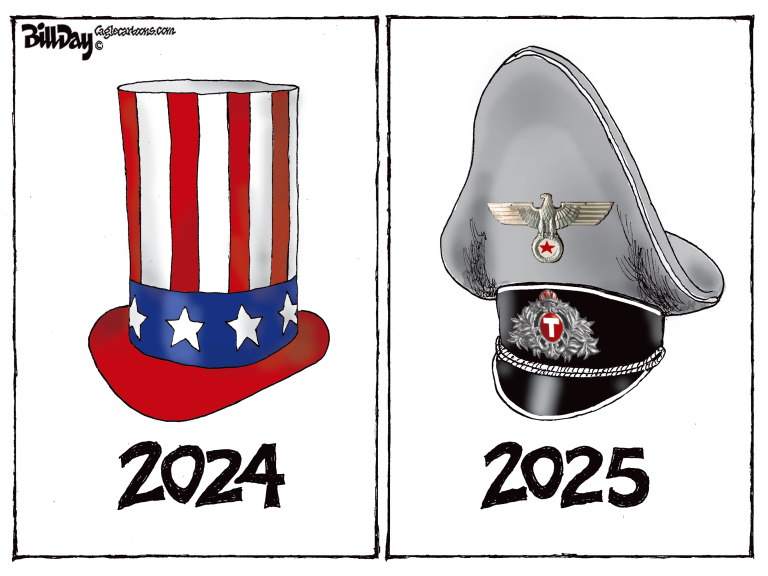


Project 2025
Dec 29, 2025 1:39 PM
How a Pre-Written Governing Manual Aims to Centralize Power, Purge Expertise, and Normalize Authoritarian Rule—Without Ever Canceling an Election
Project 2025 is a comprehensive, pre-written governing blueprint designed to let a future Republican president—most obviously Donald Trump—take control of the federal government immediately upon inauguration. It is not a campaign platform. It is an operational manual.
At its core, Project 2025 answers one question:
How do you dismantle the modern federal state quickly, legally, and permanently?
Who’s Behind It
The project is coordinated by The Heritage Foundation, with contributions from dozens of right-wing legal groups, policy shops, and former Trump officials. Many of its authors previously served in Trump’s first administration and believe they were blocked by career civil servants the last time around.
Project 2025 is explicitly about not letting that happen again.
Related stories
What It Actually Does (Plain English)
1. Centralizes Power in the Presidency
Project 2025 is built on the unitary executive theory, which argues that:
- The president controls all executive agencies
- Independent agencies (DOJ, EPA, FCC, FTC, etc.) should not be independent
- Courts should defer heavily to presidential authority
Translation: checks inside the executive branch are obstacles, not safeguards.
2. Purges the Federal Workforce
A central plank is reviving and expanding Schedule F, which would:
- Reclassify tens of thousands of career civil servants as political appointees
- Allow mass firings based on ideology or loyalty
- Replace expertise with obedience
Translation: government stops being professional and becomes partisan.
3. Pre-Writes Policy for Day One
Project 2025 includes:
- Hundreds of pages of draft executive orders
- Agency-by-agency instructions
- Staffing lists and loyalty vetting
- Legal rationales anticipating court challenges
Translation: no learning curve, no delays, no internal resistance.
4. Targets Civil Rights and Social Policy
The plan calls for:
- Rolling back federal civil rights enforcement
- Ending DEI programs across government
- Restricting abortion access nationwide via executive power
- Reframing LGBTQ protections as illegitimate
- Expanding religious exemptions in public policy
Translation: rights become conditional, not guaranteed.
5. Weakens Environmental and Labor Protections
Project 2025:
- Guts climate regulations
- Reduces OSHA, EPA, and labor enforcement
- Prioritizes deregulation and fossil fuels
- Treats regulation as economic “harm”
Translation: corporate freedom over public safety.
6. Reframes Democracy Itself
The plan:
- Attacks the administrative state as “unelected”
- Treats expertise as suspect
- Frames opposition as illegitimate
- Normalizes emergency powers
Translation: democracy becomes majoritarian rule without guardrails.
What Makes Project 2025 Different—and Dangerous
This is not rhetoric. It is infrastructure.
- It assumes a second Trump term will be more authoritarian
- It learns from what failed the first time
- It removes friction points deliberately
- It treats loyalty as a governing principle
Project 2025 is what happens when a movement stops arguing and starts executing.
Mapping Project 2025 to U.S. Historical Precedents
1) The Spoils System (and why it was curbed)
In the 1800s, the U.S. ran on patronage—winner takes all, jobs as political rewards. That system was eventually constrained because it produced corruption and incompetence on an industrial scale.
Project 2025 is, in effect, a modernized spoils system: not necessarily every job, but the jobs that shape policy and enforcement. The innovation isn’t the instinct—it’s the targeting.
2) Reagan’s “Mandate for Leadership” playbook, upgraded
Heritage has done “Mandate for Leadership” volumes for decades, but Project 2025 is the most operationalized version: policy + staffing + training + draft executive actions. Wikipedia+1
Heritage itself touts that nearly two-thirds of its earlier “Mandate” recommendations were adopted or attempted under Reagan. The Heritage Foundation
What’s changed since Reagan is the level of institutional distrust: Project 2025 is not just “shift policy right.” It’s “rebuild the state so it can’t resist us.”
3) Nixon-era lessons: “enemies,” enforcement, and leverage
Project 2025’s logic rhymes with the darkest Nixon lesson: when a leader treats the federal apparatus as a weapon, they look first to the levers that can punish, reward, and intimidate. That means law enforcement, regulators, revenue systems, and licensing power—the places where the state touches daily life.
(And to be blunt: you don’t need tanks in the streets to discipline a society. You need selective enforcement.)
4) Post-9/11 executive expansion: emergency logic without the emergency
A long U.S. drift has already favored stronger executives. Project 2025 doesn’t start that drift—it tries to finish it by grounding presidential control in an aggressive reading of Article II (“unitary executive theory”). Reuters+1
Comparison to Authoritarian Transitions Abroad
Authoritarian transitions in the 21st century often don’t look like coups. They look like elections followed by institutional capture—all in legal clothing.
A leading term for this is “autocratic legalism”: using lawful reforms to hollow out checks and constraints while claiming democratic legitimacy. The University of Chicago Law Review
Here are the closest parallels:
Hungary under Viktor Orbán: “Orbanization”
Orbán’s Fidesz didn’t just win elections. It captured the referees: courts, media regulators, prosecutors, civil service rules, and independent watchdogs—then rewrote the system to keep winning. Analysts have explicitly warned about the “Orbanization” lesson-set being studied by U.S. conservatives. European Council on Foreign Relations
Project 2025’s overlap: centralize executive control, replace neutral administration with loyal cadres, and weaken institutional veto points that constrain political power.
Turkey under Erdoğan: purges and permanent governing advantage
Turkey’s trajectory illustrates how quickly a bureaucracy can be reshaped when “loyalty” becomes the governing credential. The method isn’t only repression; it’s a bureaucratic redesign that makes dissent professionally fatal.
Project 2025’s overlap: normalize the idea that resistance inside government equals sabotage, then restructure employment rules so removals become routine, not extraordinary. (Schedule F-style reclassification is the American-friendly mechanism.)
Poland’s institutional conflict: courts, prosecutors, and state neutrality
Poland’s backsliding debates show how “legal” changes to appointment rules, discipline regimes, and prosecutorial independence can destabilize democratic safeguards.
Project 2025’s overlap: treat independence as illegitimate and concentrate decision authority in the executive.
The broader comparative pattern: capture law enforcement quietly
Democratic erosion frequently hinges on control of enforcement arms—because enforcement is how rules become real. Comparative research emphasizes that takeover of law enforcement and security agencies often occurs “quietly,” framed as lawful reform. Israel Democracy Institute
That’s the point: authoritarianism doesn’t have to announce itself. It can arrive as “management.”
What Makes Project 2025 Distinctively Dangerous in the U.S.
The U.S. has strong democratic “hardware” (federalism, courts, elections), but Project 2025 targets the “software”: the norms and professional constraints that keep raw power from becoming personal power.
And it’s engineered as a deployment plan:
- A massive written blueprint (Mandate for Leadership) Heritage Foundation
- A staffing and training pipeline (“personnel is policy”) The Guardian+1
- Executive actions designed to move faster than lawsuits and oversight The White House+1
If you’re looking for the clearest “tell,” it’s this: a government that must be staffed by loyalists is a government that expects to do things it can’t justify to professionals.
The Bottom Line
Project 2025 isn’t “just conservative policy.” It’s a plan to change the nature of governance—away from a professional public service and toward a presidency-centered system where law, regulation, and enforcement can be aligned to a single political project.
That’s why the right comparison isn’t a typical policy debate. It’s the comparative study of how democracies get hollowed out without ever formally ending. Carnegie Endowment+1
Linked Resources
(Each item links via citation.)
- Project 2025 / Heritage: Mandate for Leadership: The Conservative Promise (full PDF) Heritage Foundation
- Executive Order reviving Schedule F / “Schedule Policy/Career” (White House, Jan. 20, 2025) The White House+1
- OPM implementation guidance memo (Jan. 27, 2025 PDF) U.S. Office of Personnel Management+1
- Congressional Research Service explainer on the new “Policy/Career” schedule (Jan. 29, 2025) Congress.gov
- Original Schedule F executive order text (Oct. 21, 2020) Trump White House Archives+1
- Reuters on unitary executive theory and the courts (Feb. 14, 2025) Reuters
- Carnegie Endowment: U.S. democratic backsliding in comparative perspective (Aug. 25, 2025) Carnegie Endowment
- Kim Lane Scheppele, “Autocratic Legalism” (University of Chicago Law Review) The University of Chicago Law Review
- ECFR: “The Orbanisation of America” (Hungary lessons for Trump, Oct. 9, 2024) European Council on Foreign Relations
- IDI: capture of law enforcement/security agencies as a driver of democratic decline (Jan. 19, 2025)
Comments

Powered by RoundtableAn AI/DeFi-powered Enterprise Media Operating System. Learn more at Roundtable.io.© Roundtable 2026. By using this site you agree to the Terms of Use and Privacy Policy