


Nov 23, 2025 6:54 AM
Updated Nov 23, 2025 6:00 PM
From Plato’s warning to Project 2025, America’s shadow-makers have engineered a system built on racial myths, political manipulation, and manufactured fear. Breaking free starts with truth-telling.
Plato’s Cave is one of the oldest warnings in Western philosophy — the warning is direct: human beings will cling to comforting illusions even when the truth is blazing right behind them. I first learned the metaphor through Charles Hayes, a long-time LA Progressive contributor, who used it to expose one of America’s most dangerous illusion: the belief that extreme wealth inequality somehow leaves democracy untouched.
It’s a lie — and a convenient one for the people who benefit from it.
History is unambiguous: great fortunes are built by extracting, undervaluing, and siphoning the rewards of labor upward to those perched at the top of the hierarchy. The rest of us are expected to pretend this arrangement is fair and normal.
Not familiar with Plato’s Cave? Plato saw that most people live inside social, political, and cultural “constructed realities.” He wanted to explain why humans mistake shadows—rumors, traditions, assumptions, propaganda—for the real thing. Here’s a Shorthand Version--
Related stories
The Story of Plato’s Cave
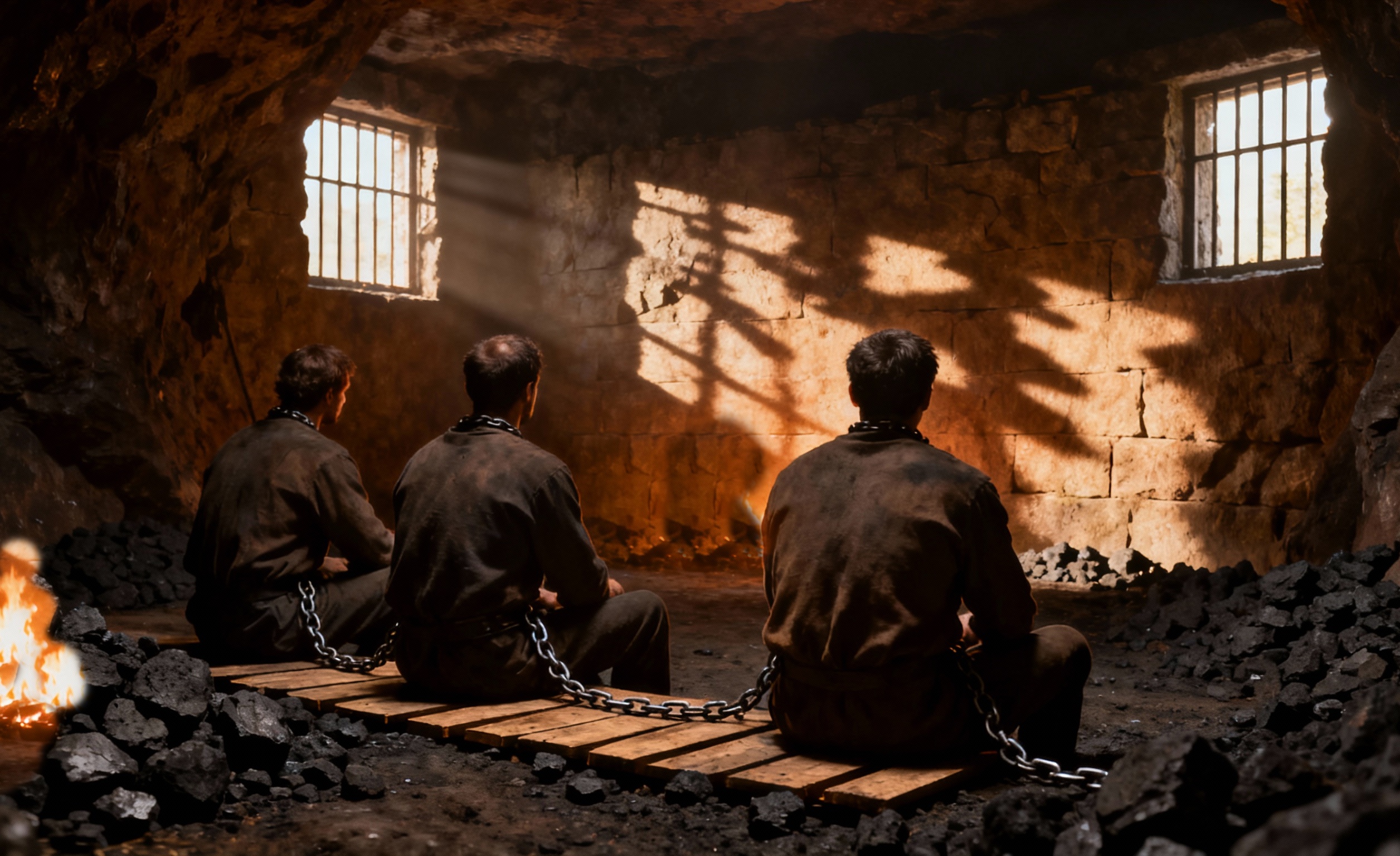
Plato asks us to imagine a group of people who have been chained inside a dark cave since birth. Their legs and necks are fixed so they cannot turn around. All they can see is the wall in front of them.
Behind them is a fire. Between the fire and the prisoners is a walkway where others carry objects—statues, carvings, everyday items. These objects cast shadows onto the wall.
Because the prisoners have never seen anything else, they believe the shadows are reality. Shadows of birds, animals, or people are not illusions to them—they are the entire truth.
A Prisoner Breaks Free
One day, a prisoner is released. At first, he is confused, angry, and disoriented:
- the fire hurts his eyes,
- the real objects look nothing like the shadows he thought he understood,
- and he resists believing the new reality.
But gradually he begins to see clearly. He is led out of the cave toward the sunlight.
The Blinding Light of Truth
Outside, the sun is so bright he can barely see. But slowly his eyes adjust.
For the first time, he sees:
- real trees,
- real animals,
- real people,
- and real light—not shadows.
He realizes everything he once believed was false. His entire worldview was built on illusions.
The Return to the Cave
Determined to help the others, he returns to the cave.
But now his eyes have adjusted to the bright world outside, so back in the darkness he can’t see the shadows clearly.
The other prisoners laugh at him. They say the journey ruined his sight. They insist the shadows are the only truth and that he is the one who is confused.
When he urges them to leave the cave, they grow hostile. Plato says they would kill anyone who tried to free them.
Plato’s Point
The Cave is a metaphor for the human condition.
- The shadows are the illusions society feeds us—false narratives, biased education, propaganda, comforting myths.
- The journey out of the cave is the painful process of gaining real knowledge.
- The sun represents truth.
- The hostile prisoners represent society’s resistance to uncomfortable truths.
- The shadow-makers are people in power who manipulate beliefs for their own benefit.
Plato’s warning is straightforward:
Most people will cling to illusions, attack truth-tellers, and defend the systems that deceive them—because illusion feels safe and truth feels dangerous.
America didn’t inherit this metaphor — it engineered its own cave from the ground up, brick by brick, policy by policy, lie by lie.
For generations, institutions manufactured illusions about white superiority to justify a racial hierarchy:
- enslaved people cast as dependent and childlike
- segregation sanitized as “order”
- Black poverty framed as personal failure instead of deliberate policy
- policing packaged as protection while targeting Black communities
- whiteness presented as the default, the norm, the standard
These narratives weren’t accidents. They were political weapons. Their purpose was simple: control perception to protect power.
The Shadow-Masters: Who Controls the Story?
In Plato’s Cave, someone is always behind the prisoners, controlling the shadows. In America, entire institutions have served this role:
- textbooks that erased Black brilliance
- newspapers that criminalized Blackness
- courts that twisted equality into a brain-teaser
- Hollywood that glorified plantations and vilified Black men
- politicians who turned fear into a currency
- corporations and think tanks that manufactured public opinion to shield concentrated wealth
They didn’t need chains. Repetition did the job.
Every Act of Black Truth-Telling Is an Escape Toward the Light
Plato describes the painful shock of seeing reality for the first time. Every era of Black resistance has mirrored that moment of blinding clarity:
- Frederick Douglass revealing slavery’s brutality
- Ida B. Wells exposing lynching as state-sanctioned terror
- W.E.B. Du Bois naming Reconstruction an interracial democracy crushed by white violence
- Dr. Martin Luther King, Jr calling out white moderates
- Malcolm X rejecting the fantasy of American innocence
- the Kerner Commission stating plainly: the problem is white racism
- Black Lives Matter exposing what police violence looks like when you stop averting your eyes
Truth-telling has always been treated as subversion — because it destabilizes the cave.
Protecting the Cave Became a White Political Identity
For many white Americans, stepping into the light doesn’t just require seeing reality — it requires giving up a worldview that centers them.
That’s why today’s culture wars feel like existential conflict:
- rage at DEI
- hysteria over CRT (which isn’t taught in K–12)
- fantasies of “anti-white racism”
- demographic panic
- anti-immigrant fear campaigns
- book bans targeting Black and queer histories
These aren’t debates. They’re attempts to guard the cave walls.
Project 2025, the Powell Memo, and the Machinery of the Cave
The modern architecture of illusion has a blueprint.
In 1971, Lewis Powell called on corporate America to seize ideological control — not through policy, but through narrative power.
That memo spawned:
- The Heritage Foundation
- ALEC
- The conservative legal pipeline
- The sprawling right-wing think tank network
Project 2025 is the culmination of that work — a plan to consolidate political, cultural, and narrative control. Its mission is clear: drag America back toward the shadows before a multiracial democracy can fully take root.
Authoritarianism always starts with storytelling — with forcing the public to stare at a curated version of reality.
Why Some Americans Would Rather Break Democracy Than Leave the Cave
When illusions become identity, truth feels like erasure. That’s why the backlash to racial progress is so unhinged:
- the Voting Rights Act gutted
- affirmative action eliminated
- DEI programs targeted
- school curricula policed
- Black political power attacked through gerrymandering
- voters of color purged and suppressed
These are not random acts. They are coordinated attempts to keep the shadows intact.
Breaking Free Requires Coalition — and Courage
In Plato’s view, once you see the light, you owe it to others to help them face it too — even if they fight you, even if they lash out.
What he didn’t foresee is the scale of America’s illusion-making machine. The U.S. didn’t just trap people in a cave; it built an entire worldview out of shadows and taught the nation to treat them as truth.
That’s where we are now. As we confront book bans, disinformation, attacks on DEI, and the authoritarian architecture behind Project 2025, the metaphor is no longer academic — it’s a warning flare.
Escaping America’s racial cave means:
- telling the truth about racial capitalism
- dismantling the myth of meritocracy
- strengthening multiracial democracy
- refusing to normalize creeping authoritarianism
- exposing organized disinformation campaigns
- building narratives rooted in shared power and shared humanity
The shadows are seductive. The light is painful. But liberation demands brightness.
Right now, America needs people willing to turn around, face the fire, and ask the only question that matters: Who has been controlling our story — and why?
Because our future won’t be shaped by the shadows we cling to, but by the truths we finally dare to see.
Comments

Powered by RoundtableAn AI/DeFi-powered Enterprise Media Operating System. Learn more at Roundtable.io.© Roundtable 2026. By using this site you agree to the Terms of Use and Privacy Policy