


Feb 6, 2026 11:39 PM
Updated Feb 7, 2026 8:59 AM
Over the past 50 years, the United States has quietly shifted civic life from public space to private space. The result isn’t just fewer places to gather—it’s a democracy that’s harder to practice
Democracy Needs a Place to Live
Democracy does not survive on ballots alone. It requires places—real, physical places—where people can show up, see one another, argue, listen, organize, and decide what they believe together.
Over the past half-century, the United States has steadily weakened those places. Not always by bulldozing parks or closing plazas. More often by moving everyday civic life into privately controlled environments—spaces that look public, feel public, and then reveal their limits the moment people try to organize, deliberate, or challenge power.
This shift has made participatory democracy harder to practice in real life—more conditional, more expensive, more surveilled, and more easily shut down.
In Los Angeles, that national pattern shows up in a very concrete way: even community education efforts struggle to find a room.
Related stories
The Lived Experience: Occupy and the Power of Space
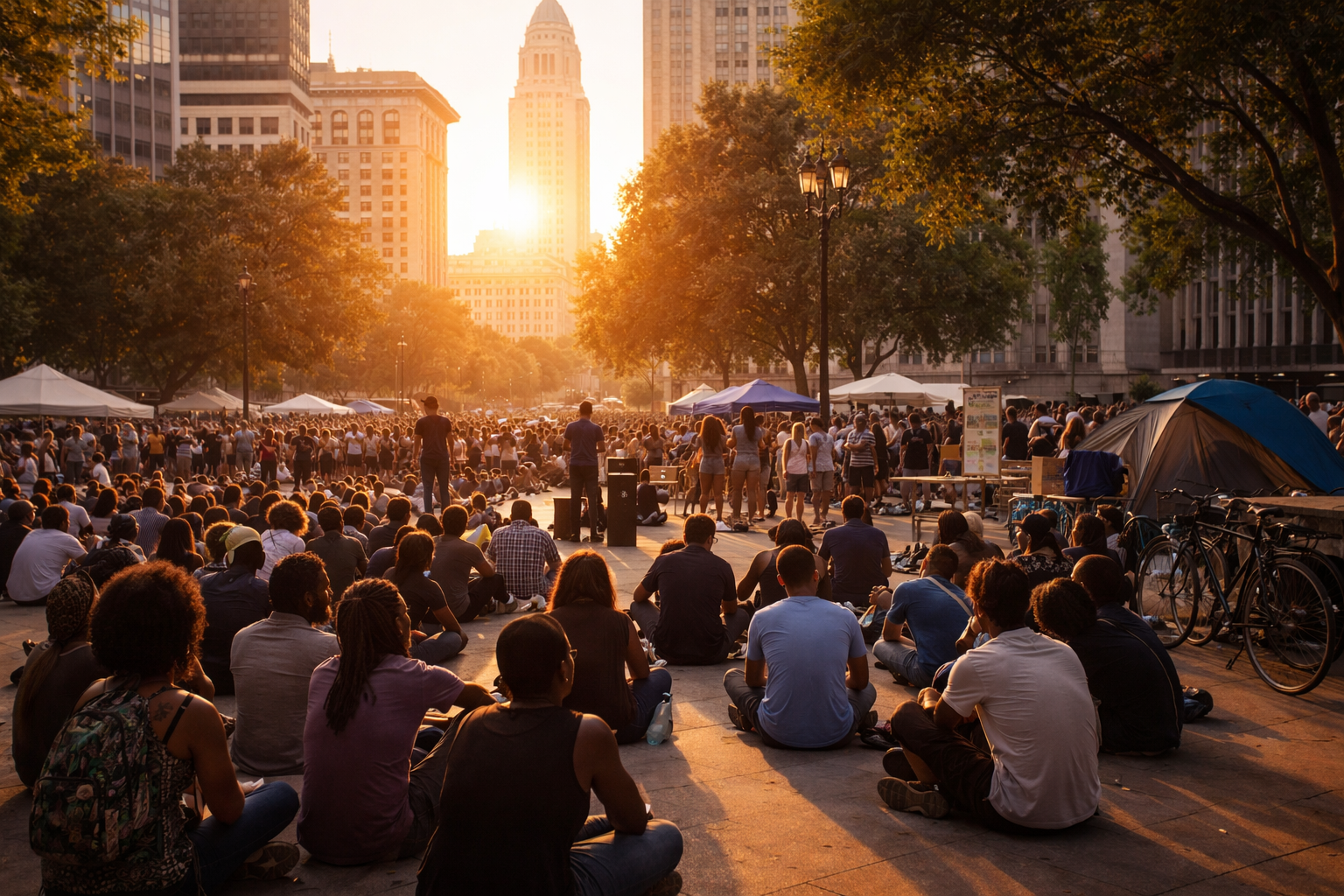
More than a dozen years ago, the Occupy encampments surrounding Los Angeles City Hall were dismantled after nearly two months of being tolerated. When city officials, backed by the LAPD, ordered the Occupiers to clear the area, a living civic experiment ended.
During those two months, Dick and I—publishing the LA Progressive largely on our own—took the train downtown several times a week. We went to report what we witnessed.
What I didn’t anticipate was that I would also experience a form of deliberative democracy I had rarely seen before.
People debated openly. They argued, revised their thinking, formed and re-formed alliances. The process was messy, inefficient, and time-consuming—and unmistakably democratic. It depended entirely on one thing: shared, accessible public space.
On the final evening, as police prepared to clear the encampment, one thought stayed with me: deliberative democracy doesn’t just require rights—it requires room.
I didn’t know it then, but what I was witnessing wasn’t just a protest—it was a glimpse of what democracy looks like when it is given physical space to exist.
When the space disappears, the democracy disappears with it.
The Warning We Ignored: Bowling Alone
Political scientist Robert Putnam provided the data to support what many people were already sensing. In his book Bowling Alone: The Collapse and Revival of American Community (2000), he documented a long-term decline in American civic life.
Putnam showed steep drops in:
- Attendance at public meetings and town halls
- Membership in civic organizations
- Participation in local political parties
- Informal socializing
- Trust in institutions—and in one another
One finding still resonates: attendance at even one public meeting per year fell by roughly 40% between the mid-1970s and mid-1990s.
Putnam did not focus on architecture or land use. But his work established the baseline. The unresolved question was why participation declined so sharply during that period.
A large part of the answer lies in where civic life was relocated.
The System at Work: The Powell Memo and the Reengineering of Civic Life
In 1971, corporate lawyer—and future Supreme Court Justice—Lewis Powell wrote a confidential memo to the U.S. Chamber of Commerce warning that corporate power was losing control over public institutions and public opinion.
The Powell Memo was not about parks or plazas. It was about power.
Powell argued that business needed to organize, litigate, fund think tanks, shape education, and reshape the environments in which ideas are formed and contested. Democracy itself wasn’t the enemy—but mass participation was.
Once you see public space as one of the engines of democratic pressure, the connection becomes clear. You don’t have to outlaw protest to neutralize it. You can simply change the terrain.
How the Town Square Was Privatized
From the 1950s onward, Americans increasingly gathered in spaces that looked public but were privately owned.
The indoor shopping mall became the new commons. Between 1950 and 1955, about 60 malls were built. Between 1961 and 1970, 240 more followed. From 1970 to 2002, more than 800 malls were constructed nationwide.
Malls were climate-controlled, convenient, and framed as community hubs—but they were never public forums in the constitutional sense. The Supreme Court made that explicit in Hudgens v. NLRB (1976), ruling that the First Amendment does not protect speech and assembly in privately owned shopping centers the way it does in government-owned public places.
You could gather—until you couldn’t.
At the neighborhood level, civic life was privatized through the explosive growth of homeowners’ associations. Units governed by private associations rose from roughly 700,000 in 1970 to over 16 million by the late 1990s. Today, more than 77 million Americans live under some form of private residential governance.
Downtowns followed suit through Business Improvement Districts (BIDs), which layered business-funded governance, security, and behavioral rules over public streets and sidewalks. Los Angeles became one of the nation’s BID capitals.
Public space still existed on paper. In practice, it became managed, conditional, and exclusionary.
The town square wasn’t outlawed. It was out-managed.
From the Powell Memo to Citizens United
This spatial shift ran alongside a legal one. In 2010, Citizens United v. FEC dramatically expanded corporate political spending as protected speech.
The imbalance is stark:
- Corporate speech gained scalable constitutional protection
- Collective civic speech lost the physical places where it happens
Corporations gained megaphones. Communities increasingly had to rent democracy by the hour.
Why This Hits Home: The Left Coast Forum
The LA Progressive is a digital publication. Words travel easily online.
But our educational work—the Left Coast Forum—requires physical space. And finding that space has been an ongoing struggle.
Left Coast Forum is strictly a community education effort. No profit motive. We accept donations and pray people will show up to learn, deliberate, and think critically about the systems shaping their lives.
And yet, we are routinely stretched to the limit simply trying to pay for space—because truly public, affordable, general-use civic venues are scarce, restricted, or booked far in advance.
This isn’t a failure of organizing. It’s a failure of civic infrastructure.
Where Civic Space Still Exists in Los Angeles—and the Barriers
Los Angeles does have civic spaces. But access is uneven, conditional, and often burdensome.
Libraries
Public libraries are among the most reliable civic venues. Many branches offer meeting rooms for educational and community use.
Barriers:
- Limited evening and weekend hours
- Competition for space
- Reservation requirements and insurance policies
Parks and Recreation Facilities
Community centers and park auditoriums provide indoor meeting rooms and halls.
Barriers:
- Rental fees that add up quickly
- Insurance and indemnification requirements
- Use rules that discourage political or controversial programming
Neighborhood Councils
Neighborhood councils often have meeting space and a mandate for civic engagement.
Barriers:
- Space is typically tied to council business
- Limited availability for independent educational events
- Procedural and bureaucratic hurdles
The pattern is consistent: spaces exist, but they are not designed for sustained, grassroots deliberative democracy.
What L.A. Could Do
Treat civic space as essential infrastructure, not an amenity.
- Guarantee low- or no-cost meeting rooms in every council district
- Fund libraries explicitly as civic convening institutions, with restored hours and staffing
- Create a Civic Space Fund to subsidize non-commercial public education events
- Audit BID and POPS rules that restrict speech and assembly
- Designate general-use civic halls not tied to elected offices or departments
Democracy should not depend on who can afford a venue.
Democracy Is Not an App
When gathering places become private, fee-based, surveilled, or difficult to access, participation becomes:
- Optional instead of expected
- Fragile instead of durable
- Unequal instead of shared
Working people, renters, immigrants, young people, and those without institutional backing are the first to be pushed out.
Democracy doesn’t always die in a coup. Sometimes it thins. It shrinks. It becomes something you watch instead of something you do.
Space Is Power
For decades, we have correctly named money, media, and law as pillars of power in American democracy.
It is time to name a fourth:
space.
- Money determines who can amplify a message
- Media determines which messages circulate
- Law determines whose voice is protected
- Space determines who can gather, deliberate, and build power together
The Powell Memo understood this implicitly. Citizens United codified it legally. Privatizing formerly public space did the quiet, everyday work.
The town square didn’t vanish on its own.
It was edged out—quietly, legally, and in plain sight.
And this brings us back to Occupy.
For all its imperfections, Occupy did something rare in modern American life: it created space where ordinary people practiced democracy together, in public, without permission. People talked. They argued. They listened. They stayed.
That experiment didn’t end because it failed. It ended because it exposed what has become scarce—and therefore threatening—in American democracy: a shared civic space that cannot be bought, managed, or quietly shut down.
The tents were removed. The plaza was cleared. And with it went a fleeting reminder of what democracy looks like when it has room to breathe.
Democracy needs somewhere to live.
Right now, we’re starving it of room.
Comments

Powered by RoundtableAn AI/DeFi-powered Enterprise Media Operating System. Learn more at Roundtable.io.© Roundtable 2026. By using this site you agree to the Terms of Use and Privacy Policy