
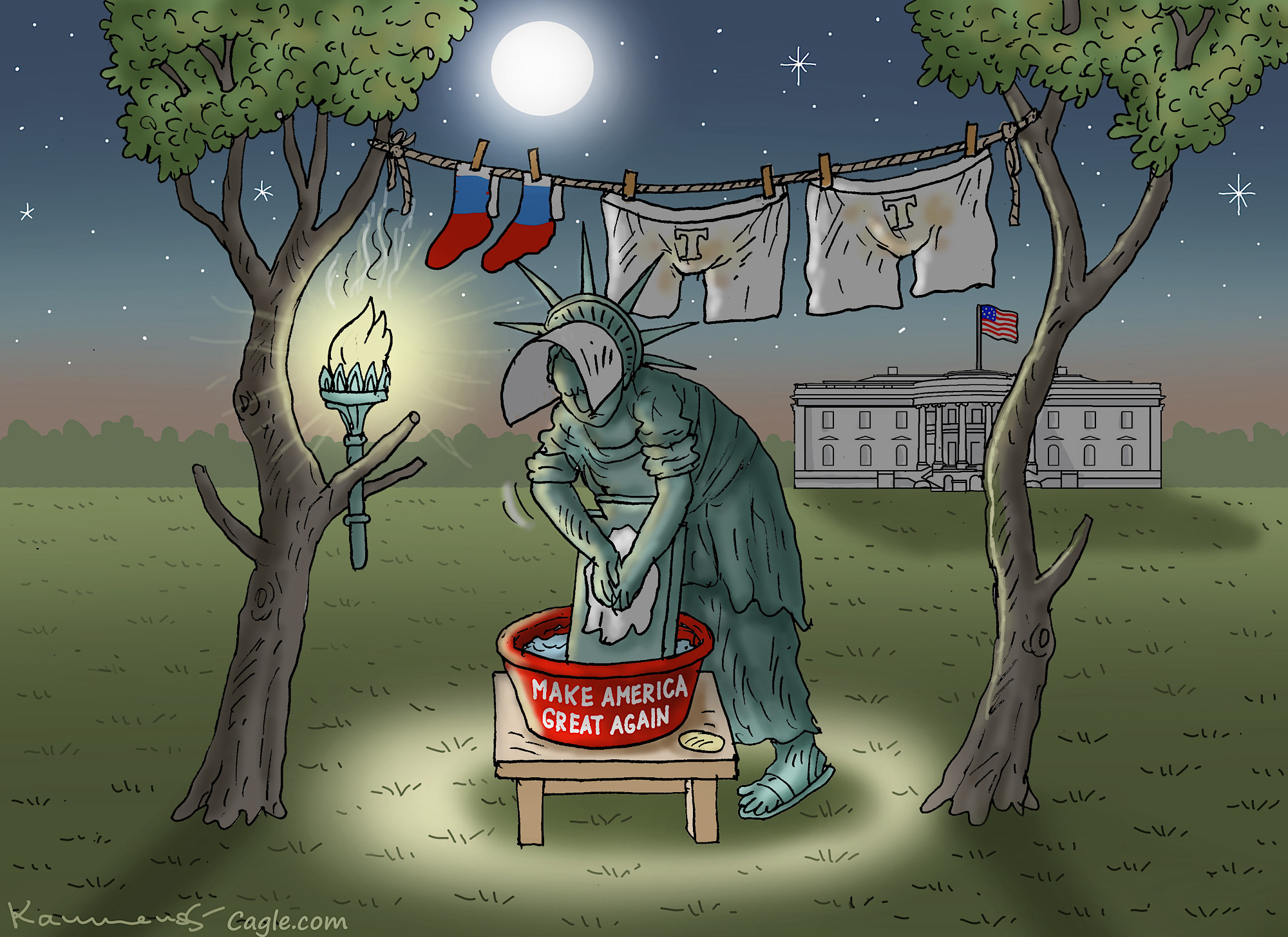
Illustration by Marian Kamensky on Cagle Cartoons


Civil society must respond to protect the principles on which this country was founded, which occupy fragile territory. But what will it take to make that happen?
Nov 14, 2024 6:35 AM
Civil society must respond to protect the principles on which this country was founded, which occupy fragile territory. But what will it take to make that happen?
I never imagined American society would be where it is today, and I would love to say I saw it coming. I did not. The recent metamorphosis to Neoliberal Fascism (the case I will make in this commentary) is the most surprising and disturbing shift in my lifetime. So, how did we get from Compassionate Conservatism to Neoliberal Fascism in little more than two decades time?
Compassionate Conservatism, a philosophical catchphrase popularized during the George W. Bush presidential administration, represents a political philosophy you rarely hear about these days even though it wasn’t that long ago when it was used, shared, and believed in. That era came immediately before President Obama’s first term in office, which means the time is the first decade of the 21st Century.
Compassionate Conservatism, as I see it, was the outgrowth of a baton-exchange that goes back at least to Ronald Reagan (Reagan Revolution) and George H.W. Bush (Thousand Points of Light). Some historians make the case that its genesis in America can be traced farther back to the nation’s founding (e.g., John Quincy Adams).
I started paying attention to Compassionate Conservativism because I had to confront it in my community work. To me it was a ruse, an attractive reference to paint Conservatives in a favorable light, even though the foundation was the same old Conservatism:
Related stories
- Trusting the free market
- Privileging elites
- Reducing the size of government
- Securing help from a reliable partner, institutionalized Christian religions.
This time it was activated via another attractive reference word, “partnership,” in this case an alliance of government, the corporate sector, and an array of “Third Sector” nonprofits, including (of course) sectarian organizations.
To me, the very label, Compassionate Conservatives, was a belly laugh. If you modify Conservative with Compassionate, does not that mean some Conservatives aren’t? Of course!
Nonetheless, the approach enabled literally all inclined (mostly Republicans) to get on board by off-loading as many public social programs as possible to the Third Sector, encouraging big-money philanthropists and others to play a larger role in social services delivery, including “to the poor.”
While the tent was large enough to accommodate every donor (“Thousand Points of Light,” remember), the danger I saw and experienced is that it was the open invitation for big-wigs to jump in—the same people who ran companies and (gosh, surprise) served on Third Sector boards. While some saw it as a community-based response, to me it was nothing more than another attempt at elite capture.
The inevitable happened.
The Third Sector, especially larger, nationally networked nonprofits, became increasingly corporatized and insular, connected more directly to big wigs than to beneficiaries and even the public. Moreover, as Anand Giridharadas pointed out in is incisive Winners Take All, it gave elites the opportunity to control the nonprofit sector and, “rebrand themselves as saviors of the poor.” How patrician!
By the time George W. Bush was into his first term (2003), I was taking my last breath as a Liberal Democrat. For 20+ years I kept bumping into reasons to loathe what Reagan and then George H. W. Bush had inflicted on America, champions of Neoliberalism as they were, along with Great Britain’s Margaret Thatcher, author of the TINA Principle, “There is no alternative.”
Their way of thinking put emphasis on free markets and economic competition, limited regulations, smaller government, and individual tenacity (you need to make it on your own)—a John Wayne-type approach to the individual life and the public sector that I felt would be better served by Mother Theresa.
But the decisive factor that pushed me out of the Democratic Party was the enemy within, namely, Bill Clinton. Clinton executed what has turned out to be a ghastly transformation of the Democratic Party—from what it was in 1960s under Lyndon Johnson and the landmark civil rights legislation that came with it.
Clinton began moving things to the economic right while, at the same time, embracing social advances, albeit selectively. Emphasis shifted from focusing on the people left behind to the middle class, a shift I (but not others) found regrettable.
Many I knew at the time benefitted personally from economic gains experienced in the mid-to-late 1990s, To them, Clinton was a star, befitting having his portrait hang on the kitchen wall, which it often did, ala FDR and JFK of decades earlier.
Yet, despite my uneasiness, I also felt a connection to what Clinton was doing. I was a Moderate Republican in my twenties (we called ourselves “Rockefeller Republicans” back in those days), and I was proud of it. But as I got older, I found myself pulled more and more to a philosophy and approach that Francis Fukuyama, among others, describes as Classic Liberalism.
Classical Liberalism is the respect for the equal dignity of individuals through a rule of law that protects their rights and through constitutional checks on the state’s ability to interfere with those rights.
But what I didn’t want, and certainly didn’t expect, was what Clinton did. He camped in the space vacated by Moderate Republicans, but still wanted to be viewed as a Johnson-style Democrat.
In truth, he was neither, even though he and Hillary had a strategy to look like both—a blend of Progressive and Conservative politics called Progressive Neoliberalism, which is socially progressive in some respects, but economically focused on ways that I could not square with my conviction that economics must serve the commonwealth. As with Compassionate Conservativism, Progressive Neoliberalism had a modifier, and so did New Democrat, as “Clintonism” was called in those days.
I remember (and value to this day) Marian Wright Edelman’s public rebuke of Bill Clinton, written in a Washington Post op-ed, published on November 3, 1995, entitled, “Say No to This Welfare Reform.” Wright Edleman resigned her position as a Clinton consultant over the policy dispute, and husband Peter resigned his post with the administration.
It was a courageous move, I thought, along the lines (but certainly not as impactful) as what Lyndon Johnson did the 1960s by advancing civil rights legislation, predicting (as he accurately did) that his actions would turn the South from Blue to Red. To me, both Edleman’s were saying, “We’re Progressives, and this administration is not.” Touche!
Finding myself misaligned with the Democratic Party, I made another personal shift, this time as a Progressive Independent. Freedom came from not having to follow “the party line” and being able to focus on policy positions and candidates of choice. And while I’d love to say that President Obama’s leadership brought me back to the Dems, it didn’t.
I wanted more policies and pronouncements to suit my progressive taste, but I got neither, especially when it came to economics and military/defense (Bush II seemed still in charge). President Biden in some ways was better, but for me it was too little, too late. Besides, there were too many hiccups on how the administration managed matters, most notably by selling arms to the Netanyahu regime, which made the U.S. complicit in the Gaza slaughter.
In between, Hillary Clinton was the Democrat 2016 nominee, and I did not to vote on the presidential line that year. Progressive Neoliberalism was a big reason, but there was more. Beginning around 2013, I felt that my time and attention would be better served by combatting what I believed was the larger issue, Neoliberalism in general, which by that time had infected society in ways that had a difficult time accepting. My focus was the impact of Neoliberalism on higher education.
I saw the impacts of Neoliberalism everywhere—in public talk, leadership circles, and across sectors. Too many people I knew had become Neoliberals, many without realizing it (some did not know it even existed), and very few people I knew self-referenced themselves as such.
The crazy thing is that I witnessed Neoliberal rhetoric and actions oozing from people who were self-described Liberal Democrats! How incredible, I thought, that they cannot see or are unwilling to admit dissonance. Clinton was right on at least one thing: “It is the economy, stupid!” The newbies progressed economically during that time, life was good, and well … you get the rest of the story.
But what I’ve just described seems like ancient history, seemingly minor when compared to what is happening today. I should have seen it coming (as Noam Chomsky and others did) but I didn’t. Through hindsight I understand it this way. Just as physical viruses morph, so do sociocultural viruses, and the longer a virus is around, the more likely it is to become a force to be reckoned with. It hangs around, infects, and spreads … as in Trump. 2015 onward, with that initial public splash that Michael Kruse calls, “The Elevator Ride that Changed America.”
One of Neoliberalism’s morphs is known as Neoliberal Fascism, and we saw its impact in the 2024 Election. A double morph (of Fascism to Neoliberalism and Neoliberalism to Fascism) it combines fascism’s strong preference for strong-man leadership/Nationalism with Neoliberal’s conception of how/when/and for whom the economy works as it should.
In virulent form (and that is what bothers me most today), Neoliberal Fascism is not only a strident rejection of Classical Liberalism, but it is full of Mafia-style cronyism and lathered with dismissiveness and hate. It invites a swarm of cockroaches into living quarters and treats them like house pets.
Capitalist excesses and authoritarianism are fused, expressed through an abiding commitment to patriarchy, White Nationalism, religious zealotry (Christian Nationalism is one), Misogyny, Xenophobia, and a rejection of various forms of diversity associated with the liberalization of America (e.g., same-sex marriage). Democracy, character, and ethics are distractions, to be endorsed or tossed aside at convenience, depending on whether one or more gets in the way of achieving valued ends.
The State of Florida is a petri dish for Neoliberalism Fascism, and Governor DeSantis and the state legislature are principal practitioners. Education is the enemy, and so is the press—anything that enables people to learn and render independent judgment. History courses are refashioned in the image of America Exceptionalism. The Governor counters citizen activism by spending state money to increase the prospects that the people’s view will be defeated. And that is only part of it.
What about Trump and the millions of voters who supported him? It is the principal motivation for writing this commentary because something I have never seen before is happening. Meaning? There have always been ism’s and ist’s, morphs, and change, but what America faces today is not simply more of past transitions. What has always been there—living on the margins—has seeped into mainstream culture, not just by a bit, but by a lot, such that America’s founding principles are threatened. How severely? America may not be America for much longer.
The most frightening thing is neighbors, friends, co-workers, and even family members support a strongman approach to government and reject the tenets of Classical Liberalism. It is everywhere, deeply felt and expressed, seen in what everyday people believe, say, and prefer. It is much too powerful and pervasive to ignore, and it took the outcome of Election 2024 to grab the attention it deserves. But sadly, some still do not see it, retreating as they are into stale interpretations of why Harris lost and what needs to be done to fix what went wrong. They do not recognize what we are up against, namely, a sociocultural phenomenon of epic proportions.
In times like this, civil society and activism must respond, to herald and protect the principles on which this country was founded, which (for the first time in my lifetime) occupy fragile territory. But what will it take to make that happen? Earlier this week, a colleague shared Rebecca Solnit’s commentary published November 9 in The Guardian, entitled, “Authoritarians like Trump love fear, defeatism, surrender. Do not give them what they want.” Solnit writes:
The fact that we cannot save everything does not mean we cannot save anything, and everything we can save is worth saving. Let Julian Aguon have the last word: “No offering is too small. No stone unneeded … All of us, without exception, are qualified to participate in the rescue of the world.
No matter how Compassionate Conservativism got to Neoliberal Fascism that is where we have settled today. I also believe the 2020s are the new 1930s (and saying that is no hyperbole), “The rescue of the world” (per Aguon) has begun, indeed.
Comments

Powered by RoundtableAn AI/DeFi-powered Enterprise Media Operating System. Learn more at Roundtable.io.© Roundtable 2026. By using this site you agree to the Terms of Use and Privacy Policy