


Mar 2, 2026 5:45 PM
Updated Mar 2, 2026 6:34 PM
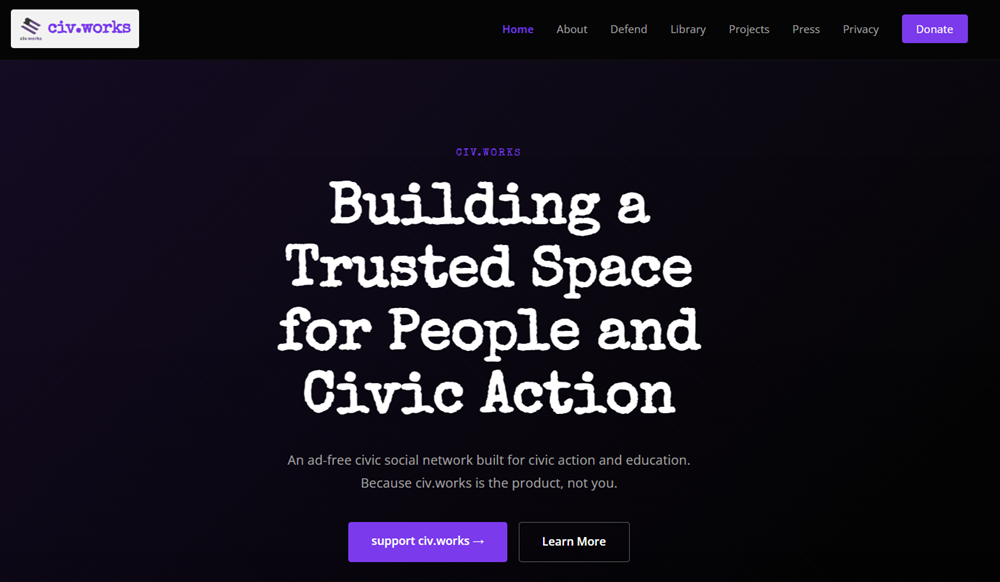
Golda Velez and George Polisner are building tools for civic power—before democracy contracts any further.
Polarization is widening. Disinformation spreads faster than truth. Public trust in institutions continues to erode. Digital platform dependence has broaden. They shape our civic life but they are not neutral public squares—they are proprietary systems optimized for profit, engagement metrics, and data extraction.
We are trying to practice democracy inside privately owned arenas - arenas that could be shut down at anytime.
That tension sits at the heart of CivWorks, the vision of George Polisner and Golda Velez. Their premise is straightforward but urgent: if democracy requires informed, engaged, empowered citizens, then it requires infrastructure built for the public interest—not for private equity portfolios.
CivWorks is not a social network chasing virality. It is an attempt to build civic infrastructure.
Related stories
And it is doing so at a moment when that infrastructure is increasingly fragile.
The Problem: Democracy on Rented Land
Today, most civic organizing flows through platforms like Mobilize and EveryAction. These tools power local rallies, national campaigns, town halls, and voter outreach efforts.
But many activists are unaware that these platforms—once nonprofit-controlled—have been acquired by private equity firms.
That matters.
Private equity exists to maximize return. Data is an asset. Political organizing data is especially valuable. In an era when administrations openly discuss tracking opposition and consolidating power, the ownership and control of civic data is not an abstract concern.
It is structural vulnerability.
When civic action is routed through platforms owned by for-profit entities, two risks emerge:
- Data exploitation
- Platform control—including the ability to restrict or shut down organizing
We have already seen media consolidation narrow the range of acceptable narratives. Corporate control over civic tools creates similar leverage over democratic action.
CivWorks asks a hard question:
Why is civic organizing dependent on infrastructure that can be monetized—or weaponized?
Project One: The Action Engine
CivWorks’ first major initiative is an Action Engine—a secure civic action distribution system designed to protect privacy and decentralize control.
Here’s the difference:
- Organizations create actions.
- Organizations own their data.
- CivWorks does not warehouse activist identity data.
- Infrastructure can be architected using European hosting to reduce exposure to U.S. government overreach.
The goal is not to build another centralized data silo. It is to remove the incentive—and the ability—for misuse in the first place.
In a time when surveillance capitalism bleeds into political surveillance, data minimization becomes democratic self-defense.
Project Two: CivicSky Media
The second initiative addresses the information crisis.
Platforms like Substack have enabled independent journalism—but they remain for-profit entities that tolerate hate speech and extremist content if it drives revenue.
CivWorks proposes an alternative: CivicSky, built on the open-source publishing platform Ghost.
The philosophy is different:
- Open-source architecture
- Decentralized engagement
- Integration with federated networks like Mastodon and Bluesky
- More revenue returned to content creators (targeting 95% of subscription revenue)
This is not a walled garden. It is an attempt to reopen the public square.
Because democracy does not function without informed citizens. And informed citizens require information systems that are not optimized for outrage.
Project Three: Economic Accountability (Alo Novo Reimagined)
The third initiative may be the most immediately transformative.
Americans exercise power daily—not just at the ballot box, but at the checkout line.
CivWorks is building a corporate behavior database that grades companies across:
- Labor rights
- Executive pay ratios
- Environmental record
- DEI commitments
- Animal welfare
- ICE collaboration
- Union stance
Users can scan a receipt and receive a breakdown:
- Which companies they supported
- Each company’s grade
- Why it earned that grade
Instead of abstract ESG jargon, the platform translates corporate behavior into plain language. Consumers can compare companies—Target versus Costco, Amazon versus alternatives—based on documented values and practices.
It’s a simple idea:
If purchasing perpetuates behavior, then purchasing should be informed.
The inspiration echoes documentaries like The Corporation, which examined how corporate structures prioritize profit over public good. CivWorks moves from critique to tool-building.
It operationalizes economic citizenship.
Why This Matters
Democracy is not sustained by speeches alone. It is sustained by systems.
- Systems that protect privacy
- Systems that distribute action
- Systems that reward truth over rage
- Systems that allow citizens to see clearly
When media consolidates and political data centralizes, power contracts upward. CivWorks is an attempt to push infrastructure back toward the public.
Golda Velez and George Polisner are not promising salvation. They are building scaffolding.
And scaffolding matters.
Because if democracy depends on informed, engaged citizens, then we need platforms designed to serve citizens—not investors.
The question is no longer whether digital infrastructure shapes democracy.
It does.
The real question is:
Who owns it? Who profits from it? And who controls the switch?
CivWorks is betting that the future of democracy requires building alternatives before the doors close any further.
For the LA Progressive community, that conversation is not theoretical.
It’s strategic.
Comments

Powered by RoundtableAn AI/DeFi-powered Enterprise Media Operating System. Learn more at Roundtable.io.© Roundtable 2026. By using this site you agree to the Terms of Use and Privacy Policy