


Jan 24, 2026 3:09 PM
Updated Jan 27, 2026 6:02 PM
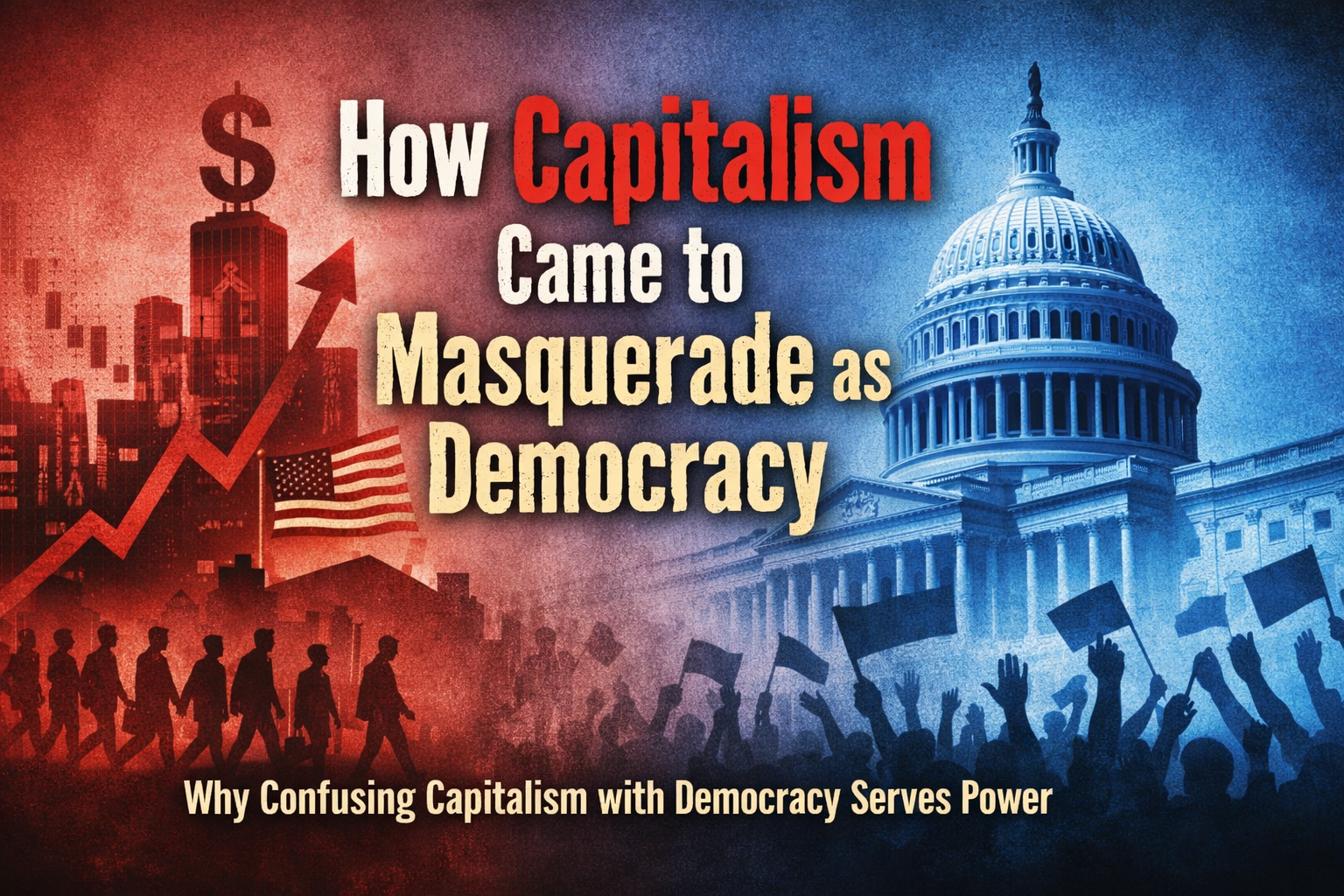
Why Confusing Capitalism with Democracy Serves Power
In American political discourse, capitalism is routinely treated as synonymous with democracy, while socialism is wielded as a slur rather than examined as an economic system. This reflexive pairing—capitalism as freedom, socialism as threat—has been repeated so often that it has hardened into common sense, despite being historically and conceptually wrong.
The fusion of capitalism and democracy in the American imagination was not organic, inevitable, nor intellectually sound. It was constructed—deliberately, over time, and for specific political purposes.
Cold War Propaganda Did the Heavy Lifting
After World War II, the United States positioned itself as the global counterweight to the Soviet Union. To do that effectively, American leaders collapsed three distinct ideas into one package:
- democracy
- capitalism
- “freedom”
Related stories
Compounding the problem, U.S. school systems largely sidestep serious engagement with socialism, leaving generations of Americans fluent in fear but illiterate in substance. The result is a political culture in which one economic system is treated as natural and inevitable, while alternatives are dismissed without discussion.
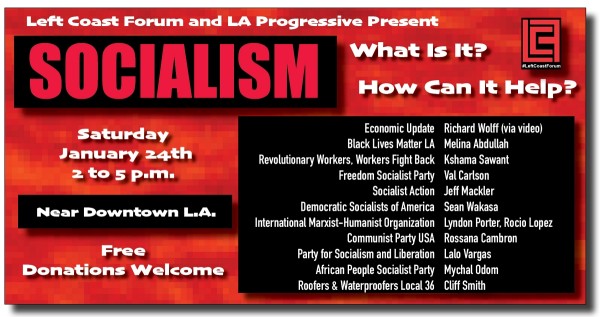
That is precisely why The LA Progressive and Left Coast Forum are joining forces to host an educational forum on socialism—not as ideology, but as political economy. What follows is a brief discussion meant to unsettle lazy assumptions, clarify distinctions, and invite a more honest conversation about capitalism, democracy, and the future of self-government.
A Clarification of Categories: Why Capitalism and Democracy Are Not the Same Thing
Capitalism and democracy are frequently spoken of as if they are inseparable— interchangeable. They are not. This confusion persists not because it is conceptually sound, but because it is politically convenient.
At the most basic level, capitalism is an economic system, while democracy is a governing system. They operate in different domains, answer different questions, and obey different logics.
Capitalism is concerned with how goods and services are produced and distributed:
- Who owns productive assets
- How labor is compensated
- How profits are generated and allocated
- How prices, wages, and investment decisions are set
Democracy, by contrast, is concerned with how collective decisions are made:
- Who has political voice
- How power is legitimized
- How laws are created and enforced
- How public authority is constrained or expanded
These are categorically distinct systems. One governs markets; the other governs people but the persistent claim that capitalism and democracy are “the same thing” or that one naturally guarantees the other collapses this distinction. But history does not support the clumping of these two disparate systems -- and never has.
Capitalism has functioned comfortably under non-democratic regimes: colonial empires, authoritarian states, monarchies, military dictatorships, and apartheid governments all operated capitalist economies without democratic governance. Conversely, democratic mechanisms—elections, legislatures, courts—do not inherently dictate how economic power is distributed. A society can hold elections while tolerating extreme inequality, labor exploitation, and concentrated ownership.
This distinction matters because economic systems can undermine governing systems.
When wealth is allowed to accumulate without constraint, it converts into political power—through lobbying, campaign finance, media ownership, regulatory capture, and agenda-setting. At that point, democracy becomes procedural rather than substantive: citizens may still vote, but meaningful choices narrow as economic power preselects outcomes. The governing system remains nominally democratic while its capacity to govern in the public interest erodes.
In other words, capitalism does not equal democracy.
Nor does democracy require capitalism in its current form.
Democracy requires political equality—one person, one voice. Capitalism, by design, produces economic inequality—disproportionate control over resources, risk, and opportunity. When left unchecked, that inequality spills into governance, distorting democratic institutions and hollowing out accountability.
Recognizing that capitalism and democracy are distinct systems is not a semantic exercise; it is a diagnostic one. It allows us to ask the right questions:
- Who decides the rules of the economy—and by what authority?
- What constraints must a democracy place on markets to remain democratic?
- When economic outcomes consistently undermine political equality, which system is failing—and which is being protected?
Confusing capitalism with democracy shields economic arrangements from democratic scrutiny. Separating them restores democracy’s right to govern the economy, rather than be governed by it.
Ultimately, democracy is a governing system that grants people the agency to self-determine their future by ensuring not only formal rights, but the material and civic capacity to meaningfully exercise their collective decision-making powers, by contrast, capitalism diminishes and ultimately erases the people’s agency from the equation.
On January 24th, we tackled this topic at an edcational forum in Los Angeles. The list of speakers are shown below. It was a great event. Go to the Left Coast Forum to stay tuned for our next event.
Comments

Powered by RoundtableAn AI/DeFi-powered Enterprise Media Operating System. Learn more at Roundtable.io.© Roundtable 2026. By using this site you agree to the Terms of Use and Privacy Policy