


Oct 24, 2024 9:30 PM
Updated Oct 25, 2024 3:24 AM
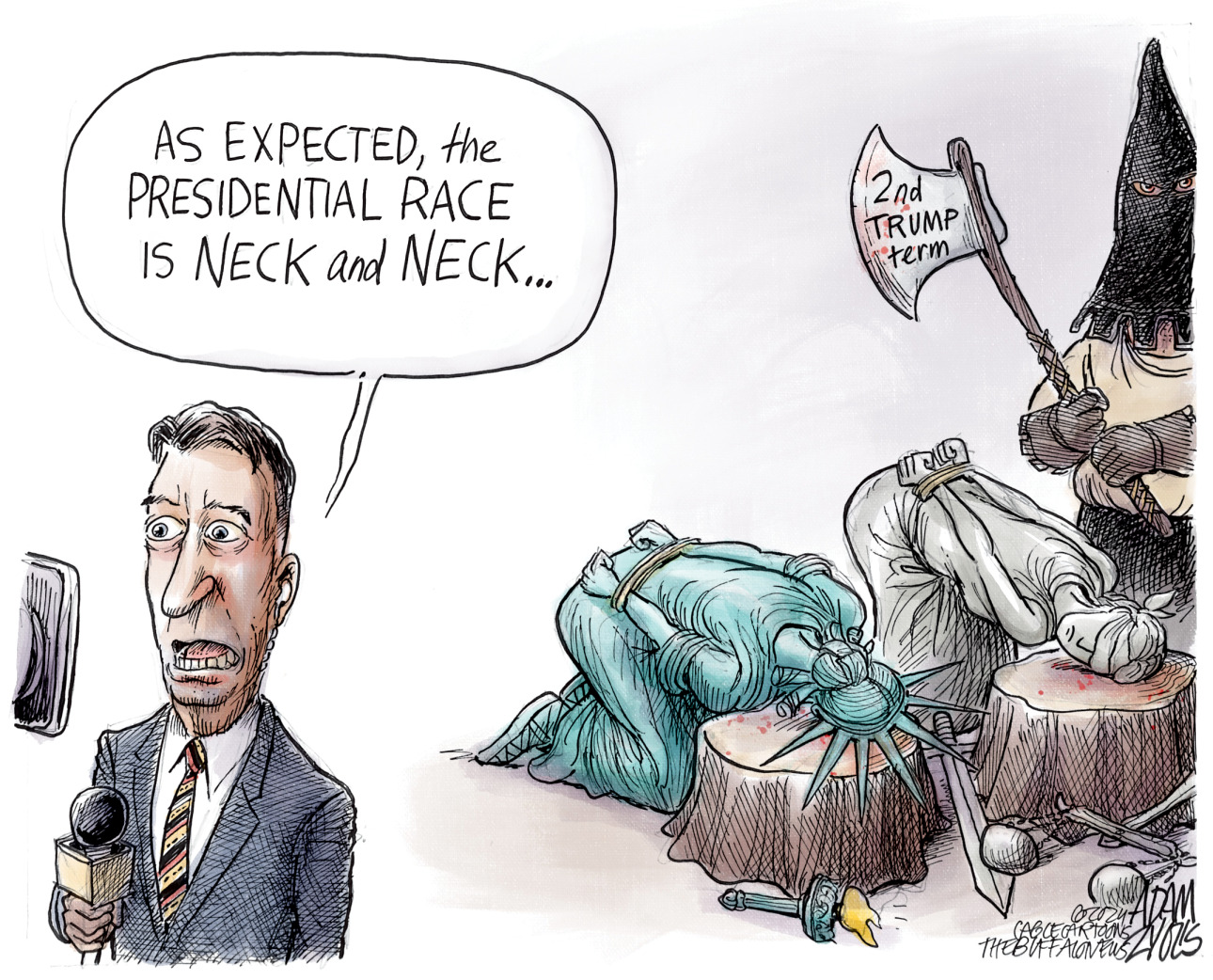
Is history repeating itself? There was a well planned coup that could have been successful. Are we there again?
In the fading autumn of 1939, as dark clouds of tyranny gathered on the horizon of Europe, my father, Larry, with the resolute tread of duty, donned the uniform of the Royal Canadian Engineers, answering the clarion call to arms against the vile specter of Nazism. His journey led him through the blood-soaked landscapes of Italy and Holland, where the earth itself trembled beneath the ferocity of battle and liberty teetered on the edge of the fascist abyss.
My uncle, Terry Goddard, not to be outdone, took to the sea, joining the Royal Navy’s valiant ranks aboard the HMS Ark Royal. From its decks, he soared in the legendary Swordfish Squadron, scouring the treacherous waves until they found the leviathan that was the Bismarck, striking a blow that echoed through history’s marrow.
In 1943, the courage that coursed through his veins was formally recognized when King George VI personally awarded him with the Distinguished Service Cross (DSC), a tribute to his "outstanding bravery and skill"—qualities that guided him through the storm of combat. After the legendary encounter with the mighty Bismarck, where his squadron played its part in sinking the pride of the Kriegsmarine, my uncle’s war was far from over. He continued with the 818 Naval Air Squadron (NAS), before joining the 803 NAS, where he faced the fierce skies once more. From the deck of the carrier Formidable in the Indian Ocean, he found himself locked in a harrowing dogfight against a Japanese fighter. Death’s shadow passed close, but through sheer skill and fortune, he narrowly escaped its grasp.
Millions of Americans, stirred by the call to war in 1941, surged forth to combat the spreading stain of fascism. Their heroism and fortitude have been duly chronicled over the past eight decades.
Related stories
This was a time, not so long ago, when the majority of North Americans stood resolute in the fight against fascism. The battle was clear and unambiguous. The world united in the face of tyranny, with democracy's defenders standing shoulder to shoulder against regimes that sought to crush liberty under the iron heel of authoritarianism. Americans went to war against fascists, knowing full well the threat they posed to the very fabric of humanity.
Yet here we stand, in the twilight of the republic, beneath the shadow of a new, insidious threat, not from beyond the seas but from within hearts and minds of a vast swath of the American public enraptured by the thrall of a malicious cult leader. The very heart of the United States of America, once the bastion of democratic ideals, now throbs with the ambitions of a former president whose aspirations and ideological allegiance align not with the guardians of liberty but with those who once threatened to smother democracy in their jackboot march across some of the darkest annals of history.
Yet today, a strange and troubling debate has emerged, one that seems almost surreal against the backdrop of history’s hard lessons: Is Donald Trump a bona fide fascist?
For some, the mere suggestion feels like hyperbole, a leap too far. But fascism, in its essence, is not just about swastikas and military uniforms; it is the convergence of power, control, and exclusion. It is the silencing of opposition, the erosion of truth, and the elevation of a single leader as the embodiment of the state. In that light, the debates about whether Trump qualifies as a fascist seem less a question of definition and more a reluctance to confront a bitter reality. Still, it appears that a large segment of the American public stubbornly disregards descriptions of Trump as a fascist as disingenuous and too far-reaching to be taken seriously. Perhaps they are unaware of how close the United States government came to embracing fascism a mere eighty years ago.
Trump's political playbook—demonizing his enemies, undermining democratic institutions, and inciting violent rhetoric against marginalized groups—mirrors the tactics of the very regimes we once united to defeat. His disdain for the rule of law, his admiration for authoritarian figures, and his relentless push to centralize power within his own hands all signal an approach steeped in fascistic ideals. And yet, the debate persists, as if naming it outright might somehow be too confrontational, too definitive.
Der Spiegel’s accusation of Elon Musk, Trump’s new pelvic affiliate, as a vocal opponent of liberal democracy in the United States, is also a provocative comparison with fascism, especially when drawing parallels between Musk and Adolf Hitler’s influential industrialists during his rise to power. The publication suggests that Musk, now joined at the hip with Trump, is wielding his considerable economic and technological power to undermine democratic values.
In many ways, the reluctance to label Trump a fascist is symptomatic of a broader issue: a failure to acknowledge how insidiously fascism can creep into the democratic framework, cloaked in patriotism, cloaked in the language of "freedom." The classic image of fascism, born from the ashes of World War II, feels so distant, so extreme, that many fail to recognize its modern incarnation as it emerges from within, subtly reshaping the very nation it pretends to serve.
We may not see the outright brutality of mid-century Europe, but the core tenets remain: the scapegoating of minorities, the glorification of violence, and the call for a return to a mythical past where a single, dominant group reigns supreme. These are the days when the battle lines are not as clearly drawn, when fascism does not march openly in jackboots but slides quietly through the corridors of power, masked by populist rhetoric.
So, while the debates rage on, the question is not whether Trump fits a historical mold of fascism, but whether we are willing to recognize the peril in time. Because history tells us that by the time the debate is settled, it may already be too late.
General Milley, a sentinel of our age, peers into the abyss and sees a man—Donald Trump—whose malice does not merely threaten but seeks to unmake the fragile edifice of democracy itself.
As foretold by the venerable journalist Bob Woodward in his imminent tome, Milley’s voice rises, not as mere conjecture but as a dire warning: “He is the most dangerous person ever. I had suspicions when I talked to you about his mental decline and so forth, but now I realize he’s a total fascist. He is the most dangerous person to this country... A fascist to the core!” [https://www.msnbc.com/top-stories/latest/trump-fascism-migrants-milley-aurora-rcna175745].
Trump’s campaign, with its toxic fervor, is an ode to the dark forces of fascism, reverberating with the vile notes of division, racism, and authoritarianism.
At a rally, beneath the feverish gaze of his followers, Trump unleashed a tirade that stoked the flames of hate, painting a portrait of a nation “under occupation,” falsely claiming that America needed to be “liberated” from an invasion of migrants. His rhetoric drips with venomous disdain, labeling these vulnerable souls as enemies, while his promises to marshal violence against them ring with chilling intent. He speaks of Operation Aurora—a grim invocation of the Alien Enemies Act of 1798—heralding a future where the machinery of the state is weaponized against the most powerless [[https://www.msnbc.com/top-stories/latest/trump-fascism-migrants-milley-aurora-rcna175745].
In this perilous hour, we face not a distant dictator but a would-be tyrant, thirsting for power, whose ambitions, left unchecked, would unravel the very fabric of the republic. Let us not forget the lessons of history, for the same evil my father and uncle once fought now threatens to rise again, not from across the seas but from the soul of America itself.
In Trump’s vision, dissent becomes dangerous, resistance becomes treason, and neighbors, friends, and families—anyone who stands in opposition—could be labeled domestic enemies of the state, more dangerous, in his eyes, than any foreign adversary. This is the foundation of his campaign: a march toward authoritarianism cloaked in the language of security and law. His vitriol is not reserved for abstract notions of political opposition but aimed directly at real people, accusing Vice President Kamala Harris of supporting “taxpayer-funded sex changes for prisoners and illegal aliens.” He has unleashed a barrage of accusations against teachers, framing them as conspirators helping children undergo gender-affirming procedures without parental consent.
Trump's campaign is a grotesque distortion of democracy, where fear is the weapon, division is the strategy, and anyone outside his narrow vision of America is cast as an enemy. He reaches back into the darkest corners of history, dusting off tools of oppression once used against immigrants and now turning them toward the heart of his own nation. What lies ahead, should this vision take root, is a future where power is maintained through the threat of force and where democracy’s pluralistic promise is drowned in the shouts of militarized control.
After decades of far-right media spectacle, a significant portion of the American populace has been conditioned to embrace the savage allure of an authoritarian leader. Years of relentless ideological messaging have created fertile ground for the strongman’s promises of order through power. For many, this vision resonates deeply, offering a sense of control in a world they perceive as chaotic and threatening. The strongman pitch—centered on decisive, unchecked authority—has seduced them, as it has done to countless others throughout history.
Trump’s barrage of falsehoods—repeated with such frequency and mendacious audacity—has disoriented the press, blurring the line between reality and fiction, making it exceedingly difficult to keep up, much less explain the existential danger he represents.
Americans who believe it impossible that there could be an actual overthrow of the government, despite the events of January 6, may wish to learn about the plot to undermine US democracy 80 years ago and how close America came to aligning its government of, by for the people with the bone-chilling imperatives of fascist hate.
A politically telling historical inquiry has emerged from the series Ultra, developed by respected journalist Rachel Maddow, that resonates eerily with recent events in the United States. Ultra, a production of MSNBC and NBC News, is an eight-episode podcast series that examines the history of a seditious plot to undermine US democracy 80 years ago and the legal struggle to try to stop it.
The series was executive-produced by Maddow and Mike Yarvitz and produced by Kelsey Desiderio. The brilliant series, which dates prior to World War II, focuses on Nazi agents working in the US, often with the support of US politicians in Washington. In a spirited discussion of her series with NPR’s Terry Gross, Maddow reveals that the primary aim of these agents and their co-conspirators during World War II was to dissuade the United States from entering the conflict.
Their strategy involved fostering distrust and disdain towards our allies, particularly Britain, who stood resilient against Germany by the summer of 1940. The intention was to sow seeds of hopelessness among Americans, portraying Germany as an inevitable victor and downplaying the severity of its actions, including Hitler’s regime and the spread of fascism.
George Sylvester Viereck was one such notable German agent with strong ties to Hitler’s government during World War II. In fact, Helmut von Gerlach a prominent European writer, in an article published in the Neue Weltbuehne, a Vienna publication, charged Viereck with being a propagandist for the Hitler government in the United States, and argued that he was “the soul of Hitler propaganda in the United States, that he visited Germany as the subsidized guest of Dr. Paul Joseph Goebbels, Nazi minister of propaganda, that he and the Nazi propaganda minister formulated plans for the Nazi propaganda system in the United States with Viereck as the paymaster.”
Viereck’s past involvement in pro-German activities, including a scandal related to the sinking of the Lusitania during World War I and his successful prosecution as a Nazi agent, rendered him unmistakably associated with Hitler’s regime, according to Maddow. Thus, any collaboration with him couldn’t be mistaken as a mere association with an ordinary publicist.
The extent of collaboration between Viereck and certain Congress members was often driven by financial incentives. Viereck would either craft or obtain propaganda materials from Berlin and request Congress members to deliver them as speeches in Congress or publish them under his imprint. By leveraging ‘the franking privilege,’ which allowed free distribution of materials set on the congressional floor, Viereck effectively utilized taxpayer resources to disseminate German propaganda across millions of American homes.
Maddow reveals that some of the Congress members who collaborated with Viereck were affiliated with the America First Committee, a prominent political group opposing US involvement in World War II whose activities would eventually lead to 17 members being put on trial for plotting an armed overthrow of the United States government. Founded by influential figures and boasting a million members, the America First movement aimed to maintain American neutrality. However, as Maddow points out, allegations of pro-German sentiments, particularly fueled by leading spokesperson Charles Lindbergh’s antisemitic rhetoric, tarnished its image and significantly eroded support.
Members of Congress often served as speakers at America First Committee rallies, lending legitimacy and prominence to the organization. Despite attempts to distance themselves from extremism, the committee attracted individuals with antisemitic, ultra-right ideologies, not unlike those seen among today’s MAGA supporters. Maddow highlights figures like Father Charles Edward Coughlin, a radio personality known for his virulent antisemitic views, who had one of the most popular radio shows in the United States and arguably the world, and who played a significant role in promoting such toxic sentiments. Coughlin was among the most pestilential personalities to come out of American politics.
During the tumultuous 1930s, a stirring symphony of discord and jingoistic fervor echoed across the airwaves of America, orchestrated by Coughlin’s magnetic and acrimonious voice that transformed sliminess into its own aesthetic category. Amidst the cacophony, which included members of the German American Bund and Crusaders for Americanism, an estimated 30 million fervent souls tuned in regularly, drawn to Coughlin’s venomous charisma, unaware of the dark currents lurking beneath his words. From his pulpit in the summer of 1939, this Canadian Roman Catholic priest unfurled a chilling manifesto, summoning forth what would soon emerge as the Christian Front, a specter of zealotry and intolerance cloaked in the guise of patriotism. His radio screeds from his own independently financed radio network were broadcast over his flagship stations, WJR and WGAR in Cleveland, attracting an audience of 30 million when the US population was approximately 120 million.
J.P. O’Malley writes about the journalistic efforts of Charles R. Gallagher, a 55-year-old Roman Catholic Jesuit priest and associate professor of history at Boston College whose 2008 book Vatican Secret Diplomacy won the John Gilmary Shea Prize from the American Catholic Historical Association. Gallagher is the author of the Nazis of Copley Square: The Forgotten Story of the Christian Front, the product of a nuanced reading of intelligence files such as the FBI’s file for the Christian Front (which amounts to some 2,500 pages) that revealed the Christian Front to be much more than their usual depiction as a group of clownish political extremists in coxcomb hats. Gallagher reveals the Christian Front to have been a serious threat to American democracy that came close to violently overturning the country’s political system. A maestro of historical revelation, Gallagher delved deep into the shadows of espionage, peeling back the layers of secrecy that veiled the true intentions of this clandestine brotherhood. What emerges from his research is a harrowing tale, resonating with the echoes of a forgotten history, whose notes still reverberate in the sotto voce whispers of today’s Republican Freedom Caucus.
Gallagher’s quest for the truth about Christian Front spanned a decade, navigating through the labyrinth of intelligence files previously shrouded from view. With the grace of a master craftsman, Gallagher deftly traced the genesis of the Christian Front to the fertile soil of Coughlin’s hate-filled propaganda. Within this cauldron of discontent, the Christian Front emerged as a bastion of fanaticism, its creed forged in the crucible of age-old prejudices and antisemitic conspiracies. Gallagher’s narrative unfurled a damning portrait of complicity, where the clergy of Rome lent their benediction to this unholy crusade, providing sanctuary to malevolence under the cloak of piety. Yet, it was the common folk, the foot soldiers of intolerance, who bore the standard of the Christian Front, marching blindly into a battle against perceived foes, their hearts inflamed with a hateful zeal directed at Jews and Communists.
As the drama unfolds, notes O’Malley, Gallagher unveils a chilling tableau of treachery and subterfuge. From the alleys of New York to the halls of power, the Christian Front conspired to overthrow the American government, amassing arms and fervor in equal measure, their ambitions reaching for the very heart of the American republic. Coughlin’s formation of the Christian Front, effectively an antisemitic militia, further intensified the spread of hatred and violence against Jewish communities, reflecting a disturbing convergence of extremism and mass influence during that era.
Maddow reports that Coughlin wants the groups to form in platoon-sized units. So, he’s essentially calling for sort of a cell structure, which is a traditional terrorist cell structure. And he wants them to stand ready, basically to be ready for his call. And he’s smart enough to not be explicit in terms of what he’s calling them to do. But given his rhetoric on his radio program, given his rhetoric, which was even actually more extremely antisemitic in his newspapers, which is called Social Justice, ironically enough – he wants these groups to get armed and start training.
And it happens all over the country particularly in New York and Boston. There are large chapters formed. And they do form these platoon-sized units, but then, they also start holding mass events. In New York, they’re often street corner rallies. In Boston, they rent out big halls and have major events, sometimes with up to 10,000 people at them. And they are rallying in support of Coughlin as if he’s sort of a semi-deity, talking about him as the greatest American, the greatest human on Earth. And they start effectively rabble-rousing in a way that results in street violence against Jewish people, boycotts of Jewish businesses and calls to support the German military in some cases.
Maddow notes that the culmination of these activities led to what is described as the largest sedition trial in American history. However, the trial was beset with chaos and controversy from its inception. During the trial proceedings, the defense engaged in tactics aimed at delaying or derailing the trial, leading to a tumultuous and protracted legal ordeal. Maddow reports that, in a surprising turn of events and despite compelling evidence implicating several congressmen in collusion with Hitler’s Germany, the Justice Department ultimately chose not to pursue indictments against them. This decision came after the prosecutor, John Rogge, presented damning evidence collected from interrogations of Nazi leaders in Germany, confirming the central charges of the sedition case. Rogge’s report identified 24 members of Congress who had been in contact with the Nazis and who had, wittingly or unwittingly, been part of the Nazi propaganda machine. However, the report containing this evidence was suppressed by President Harry Truman, ensuring that the collaboration of these congressmen with the enemy would never be officially exposed or prosecuted.
The failure to indict these congressmen raises significant questions about the political and judicial dynamics at play during that tumultuous period and underscores the enduring challenges of holding powerful figures accountable for their actions. Viereck, the lead German agent, was charged, but few others paid a price for their treasonous activities. The story is fascinating and, as Maddow is quick to note, has parallels with the political scene in the United States today.
According to Maddow:
It’s another throughline that we can see with the sedition trial of groups like the Oath Keepers. Two senior members of the Oath Keepers were just convicted on seditious conspiracy charges, and others are still facing those charges. In both instances, in both the Christian Front and the Oath Keepers, I don’t think there was anything particularly about members of the military or about members of law enforcement that made them inclined toward these extremist views. It rather went the other way. These extremist groups deliberately targeted members of the military, members of the National Guard, members of law enforcement for membership recruitment because they wanted the weapons that those guys would have access to. They wanted people who were trained in the use of physical force and the use of weapons. And they wanted the credibility that would accrue to their group from being associated with people in uniform. And so these extremist groups aggressively targeted their recruitment toward people who had those kinds of skills and associations.
According to JP O’Malley, the success of the propaganda efforts of these American traitors reached as far as key officials of the Third Reich:
In downtown Boston, the Christian Front put on a private screening of Sieg im Westen (‘Victory in the West’), a German propaganda film that portrayed the expanding Third Reich in noble terms and also compared Jews to rats. During the showing of the film, Moran spoke several times, emphasising the hopelessness of a US army fighting a mechanised Nazi army. Word of this Nazi propaganda screening made it as far as Berlin, where the chief propagandist for the Nazi Party, Joseph Goebbels, and his Nazi comrades privately noted how the film had been shown to an enthusiastic American audience. On October 20, 1941, at another packed meeting of the Christian Front, Moran described the Jews as a ‘hindrance and a source of evil to any country that held them.’ It was under these circumstances that antisemitism in Boston began to rise. Gallagher says the ‘anti-Jewish violence in Boston became pervasive in 1943.’ The violence was perpetrated largely by Irish Catholic gangs, some of whom were former Christian Front members. Gallagher says the Boston Police abetted crimes against Jews by turning a blind eye, arresting Jewish Bostonians, and sometimes even directly joining in and participating in the beatings of Jews.
By the end of 1943, the violence came to an end in Boston. Over time, so too did Moran’s career and the Christian Front, disappearing from both daily life and historical memory.
Maddow describes how the FBI, armed with what seemed like an airtight case, had meticulously cultivated an informant within the Christian Front’s ranks. The evidence piled up—stolen military weapons, elaborate plans for insurrection, and chillingly precise details of their intended targets and timeline.
The imminent threat loomed large; the FBI believed the group was on the brink of executing a violent coup that would plunge the nation into chaos. With swift determination, the FBI intervened just as the Christian Front’s nefarious machinations neared fruition. Arrests were made, the evidence laid bare, and the wheels of justice set into motion. Yet, when the dust settled and the anticipated cataclysm failed to materialize, skepticism clouded the public’s perception. The audacity of the plot seemed to defy belief, dismissed as the stuff of fantastical fiction rather than grim reality.
Maddow reports that within the hallowed halls of the Brooklyn courtroom, where the trial unfolded, a different narrative emerged. Here, amidst a sea of familiar faces, the accused found unexpected allies. Guardsmen, police officers and local heroes packed the gallery, their unwavering support casting a formidable shadow over the proceedings. It was a community united, fiercely loyal to their own, and their presence exerted a palpable influence on the jury. In a twist of fate that defied all logic, the forewoman of the jury, a staunch advocate of the Christian Front, stood as a blood relation to one of its influential figures. It was an oversight that would have far-reaching consequences, casting doubt upon the integrity of the trial itself. In the heart of Brooklyn, where allegiances ran deep and justice teetered on the edge of bias, the fate of the accused hung precariously in the balance. In a twist of fate, the judge died and a mistrial was declared. O’Malley notes that, even in the aftermath of the trial, the specter of the Christian Front lingered, its tendrils of hate weaving through the fabric of society.
Those tendrils have now been rejuvenated by the cult of Trumpism.
Rachel Leingang asserts that Trump’s vindictiveness—'the' sheer breadth of his menace and animus toward those who disagree with'him'—needs to be heard to be believed. Trump’s rhetoric towards migrants has taken a disturbing turn, with comments that increasingly dehumanize them. He has gone so far as to claim they are “vermin” who are ‘poisoning the blood’ of the US, a clear reference to the Great Replacement Theory, a far-right conspiracy alleging orchestrated migration to supplant white populations. Trump has labelled those arriving as ‘prisoners, murderers, drug dealers, mental patients and terrorists, the worst they have,’ while repeatedly referring to migrants as ‘animals.’ During a recent speech in Michigan, he defiantly stated, ‘Democrats said, please don’t call them “animals.” I said, no, they’re not humans; they’re animals.’ In another instance, he remarked, ‘In some cases, they’re not people, in my opinion,’ adding, ‘But I’m not allowed to say that because the radical left says that’s a terrible thing to say. These are animals, OK, and we have to stop it.’
Additionally, Trump has made peculiar statements regarding military defense, likening the use of an ‘iron dome’ missile defense system to a rapid sequence of sounds and actions—'ding, ding, ding, ding, ding, ding. They’ve only got 17 seconds to figure this whole thing out. Boom. OK. Missile launch. Whoosh. Boom'—and he has drawn an odd comparison between himself and Al Capone, boasting of being indicted more times than the notorious gangster.
Marx famously said that history repeats itself, first as tragedy, then as farce. The Christian Front movement of the 1930s was clearly a tragedy of American political life. Whether Trump’s attempt at a second Christian Front will be considered by historians as a farce rather than a tragedy is far from decided, which raises the question: If the Christian Front’s leaders had been held accountable in the 1930s, would the 6 January coup have ever happened? Each week the media is flooded with illustrations of Trump’s racism, misogyny, and fascist commentary. And yet his millions of followers appear all the more committed to his fascist brand of politics. I can imagine Father Coughlin smiling from the grave, his dream seemingly ever closer to becoming a reality.
An expanded version:
Comments

Powered by RoundtableAn AI/DeFi-powered Enterprise Media Operating System. Learn more at Roundtable.io.© Roundtable 2026. By using this site you agree to the Terms of Use and Privacy Policy