


May 24, 2026 7:43 PM
Updated Jun 6, 2026 7:57 PM
As the nation approaches the 250th anniversary of the Declaration of Independence, Sharon Kyle examines how slavery, racial hierarchy, and elite power were woven into America’s founding — and why the promise of equality still remains unfinished.
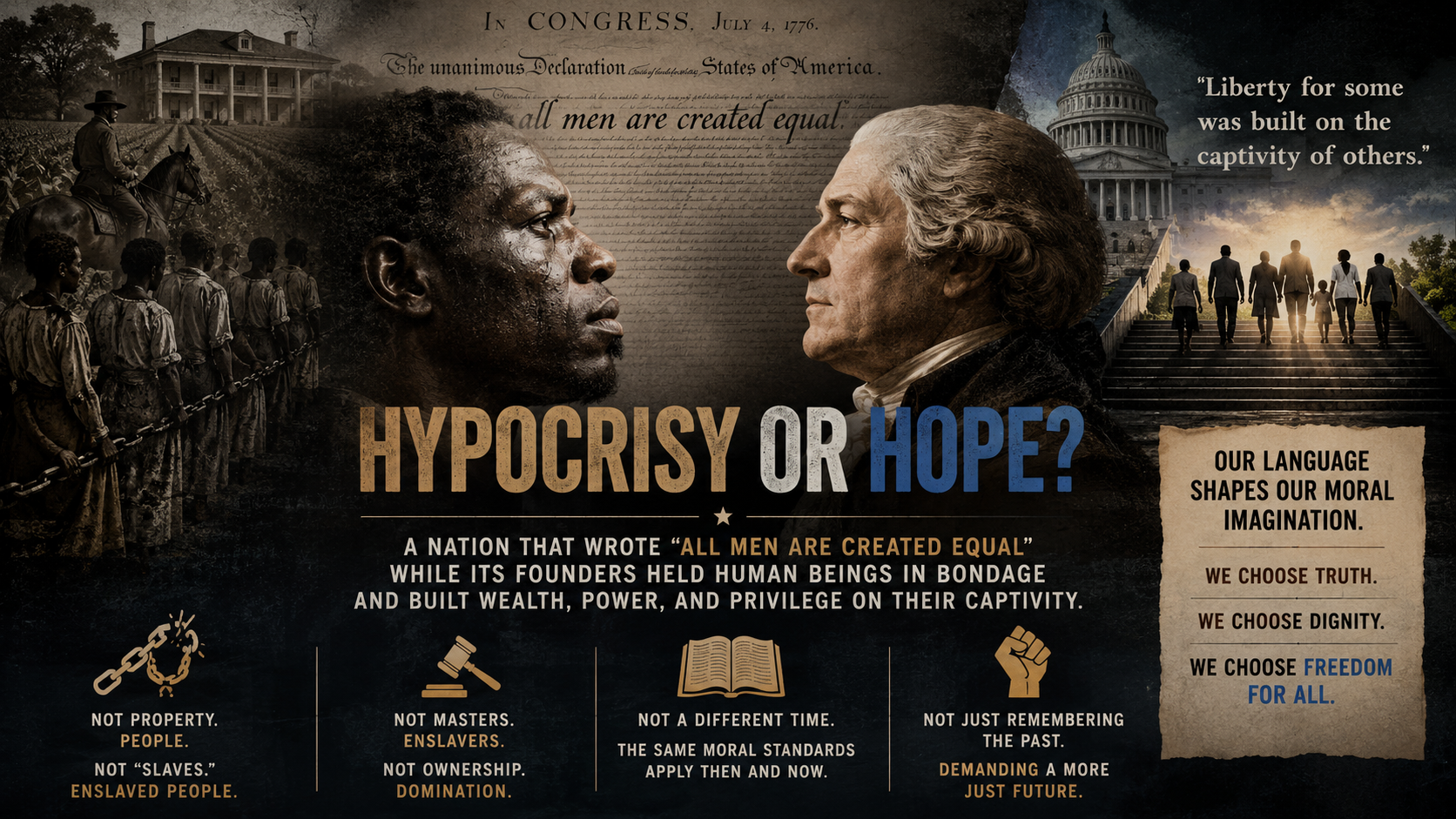
“All Men Are Created Equal”? Hypocrisy or Hope Series
This series exists not to sanitize the Founders, as is so often done, but to confront the tension at the heart of the American experiment: a nation founded on the language of universal liberty and equality while many of the very writers of that language held thousands of human beings in bondage on stolen land.
To be clear, 250 years ago a war took place that Americans describe as revolutionary. But the American Revolution could just as accurately be described as a war of secession. Unlike later revolutions in France and Russia, it did not fundamentally dismantle the underlying systems of hierarchy, concentrated property, labor exploitation, or racial domination that structured colonial life for most people living within the colonies. At its core, the war shifted political authority away from the British Crown and into the hands of colonial elites. The greatest material benefits were largely enjoyed by the elite class to which many of the Founders themselves belonged.
The American Revolution was revolutionary for colonial elites seeking self-governance, but far less revolutionary for the majority of people living within the colonies, many of whom remained excluded from power, property, liberty, and full personhood.
Related stories
Having said all of that, on this 250th anniversary of the Declaration of Independence, we ask: What was this experiment — hypocrisy or hope?
The men who wrote the Declaration were not morally clean. Not by a long shot.
The majority were enslavers. Historians generally agree that roughly 41 of the 56 signers of the Declaration of Independence held human beings in bondage. Thomas Jefferson, author of its most famous phrase, enslaved hundreds over the course of his lifetime.
That truth cannot be softened, although many have tried.
For most of my life, I have heard their conduct explained away through the endlessly repeated argument that chattel slavery “cannot be judged by today’s standards” — that enslavers were simply products of a different era.
But that argument begins to collapse under the slightest scrutiny. And scrutiny is exactly what American history has worked hard to avoid.
Although slavery was a central force in the economic rise of the United States, its scale, violence, national influence, and economic importance have often been minimized, softened, fragmented, or inadequately taught in American public schools. Even today, in an age of book bans and attacks on honest history, the avoidance continues.
So let us test the claim that the Founders cannot be judged by modern standards. My contention is that the moral standards then were not as different from the moral standards now as many people pretend.
The first evidence is that although the wealth, status, and political power of many founding enslavers revolved around slavery, they rarely spoke about it truthfully or honestly. Even the language surrounding the system concealed its reality. They were commonly referred to as “plantation owners,” not enslavers.
They did not simply say:
“We want wealth, comfort, land, labor, political power, social dominance, and sexual control, and holding human beings in bondage gives us those things.”
Instead, they constructed elaborate rationalizations that became woven into the national mythology of American exceptionalism. Africans were declared inherently inferior. Slavery was described as “civilizing.” Black people were supposedly “better off” in bondage. Slavery was framed as biblically sanctioned. Emancipation, they warned, would produce chaos and economic collapse.
Pro-slavery pseudoscience was another rationalization dressed up as legitimacy. Although this pseudoscientic justification began in the 1700s, one of its most grotesque examples came in 1851, when physician Samuel A. Cartwright coined the term “drapetomania” to describe the supposed mental illness that caused enslaved Africans to flee captivity.
Think about what that means: the desire for liberty, when expressed by Black people, was treated as a disease!
Rather than recognizing escape as a normal human response to bondage, Cartwright and others pathologized the desire for liberty itself. Wanting freedom had to be reframed as insanity because acknowledging the humanity of the enslaved would have exposed the moral bankruptcy of slavery.
The second evidence is that the behavior of enslavers exposed the dishonesty beneath their claims.
Enslavers often presented themselves as paternalistic caretakers of supposedly inferior people incapable of functioning independently. Yet that paternalism frequently disappeared the moment profit entered the conversation. If an enslaved person — or someone acting on that person’s behalf — could pay enough money, many enslavers were willing to return the freedom they had violently taken away in the first place.
That contradiction reveals the true motivation at the center of the system.
It was not care.
It was extraction. The rhetoric of paternalism and refinement, gentility and civilization functioned as camouflage for this violent system in order to protect wealth, preserve hierarchy, and maintain control over an entire population of human beings held in captivity.
The same society that claimed Black people were naturally suited for bondage had to create laws, patrols, punishments, propaganda, theology, racial pseudoscience, and terror to keep them enslaved. A system supposedly aligned with “nature” required extraordinary violence to sustain it.
That contradiction exposes the dishonesty at the center of the entire enterprise.
These were not the arguments of people unaware of moral contradiction. They were the arguments of people attempting to normalize behavior they could not fully justify. They were also part of a deliberate mythology designed to obscure the machinery of cruelty operating behind plantation walls.
Of course, none of that machinery appeared in lofty documents like the Declaration of Independence. The public was encouraged to see refined architecture, statesmanship, Enlightenment ideals, and elegant prose — not the whippings, rapes, torture, family separations, mutilations, brandings, and forced labor that made plantation wealth possible.
At places like Monticello, even the visibility of enslaved people themselves was historically minimized in public interpretation well into the 21st century.
Jefferson himself offers one of the clearest examples. In his original draft of the Declaration, he included a condemnation of the transatlantic slave trade. That passage was removed under pressure from delegates tied to slavery and the slave economy.
That deletion is revealing.
At the very moment the Founders were declaring liberty as a universal principle, many of them were profiting from human bondage — the opposite of liberty. They did not accidentally overlook slavery while declaring freedom for themselves. They negotiated around it.
The same pattern appears in the U.S. Constitution. A substantial majority of the 39 signers were enslavers or economically tied to slavery. Yet the Constitution avoided the words “slave” and “slavery” even while protecting slavery through the Three-Fifths Clause, the Fugitive Slave Clause, and protection of the international slave trade until 1808.
That is not innocence.
That is deliberate avoidance.
Taken together, these facts reveal something many Americans still resist acknowledging: slavery was not peripheral to the American founding.
It was central to it.
Economically. Politically. Constitutionally. Psychologically.
It was also one of the greatest crimes against humanity in modern history — both in scale and in the systematic cruelty required to sustain it.
Yet the United States has never conducted a full-scale national reckoning into the depths of violence embedded within American slavery. There were testimonies, abolitionist investigations, memoirs, congressional hearings, court cases, and later historical studies. But there was never anything comparable to a national truth commission, a post-slavery reckoning tribunal, or a formal state investigation similar to later inquiries into genocide, war crimes, or authoritarian abuses.
That absence matters enormously.
Instead of a comprehensive confrontation with the machinery of slavery — the torture, rape, family separation, forced labor, psychological terror, and racialized violence that sustained plantation society — the nation moved largely toward mythmaking, selective memory, and reconciliation among white Americans.
The result is that many Americans still understand slavery primarily as an unfortunate labor system rather than as a massive, organized regime of human domination enforced through violence at every level and endorsed by many of the nation’s most celebrated founders.
The wealth generated through enslaved labor helped build the colonies and early republic. The compromises required to preserve slavery shaped the nation’s governing structure. The Three-Fifths Clause, for example, increased Southern representation in the House of Representatives, increased Southern influence in the Electoral College, strengthened slaveholding power over the presidency, and shaped federal policy for generations.
In practical terms, slavery gave the South additional political power based on people it was simultaneously denying basic human rights.
The racial hierarchy developed to justify slavery became embedded in American law, labor systems, housing patterns, voting structures, education, and national mythology.
It still operates today.
Even the bodies of Black Americans carry evidence of this history. Genetic studies consistently show that most African Americans possess at least some European ancestry, much of it tracing back to the slavery era — a reminder that slavery was not only an economic system, but also a system of sexual coercion, assault, reproductive control, and unequal power.
This is one reason this piece is difficult for me to write.
I am not approaching this as an abstract intellectual exercise. I am a descendant of people who lived inside this machinery. The horrors are not distant to me. They live in memory, in bloodlines, in family silences, in inherited grief, and in the structures that still shape Black life.
And part of what makes the writing so hard is that the cruelty did not simply end. It evolved.
The forms are not identical. I am not saying that the present is the same as chattel slavery. But I am saying that the logic of devaluation, extraction, concealment, and denial did not disappear. It changed clothes.
For those who continue to argue that we cannot judge the Founders by today’s standards, a modern comparison helps expose the flaw in that reasoning.
Imagine historians in the year 2276 — 250 years from now — attempting to explain why Jeffrey Epstein remained a celebrated figure within elite circles despite widespread evidence of abuse. Imagine those future historians insisting:
We cannot judge Epstein’s behavior by the standards of the 23rd century.
The argument would sound absurd.
But even now, after Epstein’s exploitation of young girls became widely known, there are still people attempting to obscure what he and his associates did. Powerful men with the help of others worked to protect reputations, conceal evidence, preserve social legitimacy, and defend their brands.
In that sense, the elite circles surrounding Epstein are not entirely unlike the elite founders who obscured both the central role slavery played in their own lives as they crafted the Declaration and the Constitution, and the extraordinary cruelty required to sustain the system from which they benefited.
The point is not that plantation slavery and Epstein’s crimes were identical. Chattel slavery was vastly larger, more violent, more systematic, and more enduring.
The point is about elite power, exploitation, rationalization, and social protection.
In both cases, powerful men treated vulnerable human beings as instruments for their own gratification, status, profit, power, or convenience. In both cases, surrounding networks helped normalize, conceal, soften, or protect the system.
Not everyone in Epstein’s orbit directly participated in abuse. But many benefited from proximity to wealth, social access, elite networks, political influence, prestige, and institutional protection. Some looked away. Some minimized warning signs. Some rationalized continued association. Others likely convinced themselves that if powerful institutions continued embracing Epstein, the situation could not be that bad.
The same pattern existed under slavery.
A relatively small percentage of Americans directly participated in holding human beings in bondage, yet millions benefited from and accommodated the racial hierarchy surrounding the system.
Large systems of abuse rarely survive through perpetrators alone. They survive because surrounding networks learn to normalize what should horrify them.
That is why language matters. Language subtly ushers us into particular ways of seeing.
If we reject the legitimacy of human ownership itself, then phrases like “slave owner,” “owning slaves,” and “master” quietly reinforces the logic of the system by normalizing the idea that one human being could legitimately own another.
I choose “enslaver” instead of “slave owner" or "master". I choose “enslaved person” instead of “slave.” I choose “people held in bondage” instead of language that transforms their condition of captivity into their identity.
Likewise, I reject the word “master.” To describe an enslaver as a “master” carries embedded assumptions of legitimacy, authority, superiority, and rightful dominance. For descendants like me — descendants of people who were kidnapped, terrorized, brutalized, exploited, raped, sold, and denied liberty generation after generation — the continued glorification embedded in that word feels like a continuation of the original insult.
My ancestors were never naturally subordinate.
Their captors were never morally “masters” of anything except violence and coercion.
That linguistic framework matters because language shapes moral imagination. It determines whether history is remembered from the perspective of domination or from the perspective of the human beings forced to endure it.
Refusing the language of legitimacy is one small way of refusing the moral framework of slavery itself.
The Founders wrapped exploitation inside the language of liberty.
Epstein wrapped exploitation inside the language of wealth, philanthropy, sophistication, and elite social legitimacy.
Different systems. Different scale. Different historical consequences.
But both reveal how easily power constructs moral camouflage around domination — and how willing societies often are to participate in that camouflage when status, wealth, or hierarchy are involved.
And yet, the men who wrote “all men are created equal” also did something dangerous. They put into writing a principle they were unwilling to live by.
They meant it narrowly.
But we are entitled to read it universally.
Over 250 years, the Declaration has accomplished what exposed hypocrisy often does: it created a standard by which the nation could be judged. Abolitionists used it. Suffragists used it. Civil rights activists used it. Labor organizers, immigrants, Native people, women, LGBTQ people, and every excluded group have been able to say:
You wrote the promise down.
Now live up to it.
Perhaps a new Declaration is in order — not to discard the old one, but to tell the truth the first one evaded.
A new Declaration would openly name slavery, Indigenous dispossession, racial caste, gender hierarchy, economic domination, and empire as structural features of American development, not accidental deviations from it.
Did we mislead ourselves?
Absolutely.
Were the so-called Founders hypocrites?
Of course they were.
But hypocrisy is too small a word for what happened here.
The deeper issue was structural.
The republic expanded liberty for some through the containment of others.
That contradiction did not disappear after slavery ended.
It changed clothes.
The fields became factories. Plantation roads became highways cutting through Black neighborhoods. Servant entrances became segregated suburbs and office parks. The unacknowledged labor that once sustained plantations evolved into the hidden labor that now sustains modern America. We recently called them the "essential workers" — caregivers, janitors, delivery drivers, nursing aides, warehouse workers, many forced to work two and three jobs simply to survive.
This is the evolution of the same foundational lie: a two-tiered system built through exploitation while the nation tells itself a glorious story about freedom, equality, and opportunity.
America still prefers comfort without confrontation.
Consumption without recognition.
The people eating at the table still often behave as though the meal arrived there by magic.
So can we ignore the racism of the Founders?
No.
Ignoring it is how the lie survives.
But can we still use the principles they failed to honor?
Yes.
That is the work.
Not ancestor worship. Not national self-hatred.
Truth. Repair. Reconstruction. Expansion.
The Declaration is both hypocrisy and hope.
Hypocrisy because the men who wrote equality into history denied it in practice.
Hope because once the words existed, the excluded could seize them, enlarge them, and turn them against the very order that betrayed them.
The enslavers wrote the sentence.
History forced their descendants to hear it.
The question is not whether the Founders were worthy of the promise of liberty.
The question is whether we are.
Comments

Powered by RoundtableAn AI/DeFi-powered Enterprise Media Operating System. Learn more at Roundtable.io.© Roundtable 2026. By using this site you agree to the Terms of Use and Privacy Policy