


May 1, 2026 4:46 PM
We have a right to demand that our military leaders stay loyal to US, the people, and not to the whims of any passing individual.
There is a story in the news that the Donald decided to use nuclear weapons in his war on Iran but that the Pentagon high staff blocked him. The mere fact that Karoline Leavitt quickly denied the story lends it credibility. True or not, the story presents a problem for both defenders of the Donald and for people who want steps taken to rid us of his corrupt, dishonest and destructive regime.
Human history is riddled with examples of military leaders overthrowing governments and taking power. Perhaps Julius Ceaser is the most famous example. After crossing the Rubicon, he put himself above the Roman senate and gave Shakespeare plenty of material to write about.
Ceasar was only following historic examples. Socrates, famous for developing the Socratic method of argument and teaching, was a zealous supporter of the military tyrants who regularly overthrew Athenian democracy - and were in turn overthrown by the return of democracy. Hannibal marched his elephants from Africa to conquer Italy. And feudal Europe was shaped by warlords conquering and losing territories right up through the 19th century.
Although most Americans’ knowledge of the world is very euro-centric, anthropologists, archaeologists and historians tell us that same patterns can be traced across Africa, pre-Columbian Americas and throughout Asia. The occasion for a good fight seems to be engrained in the human make up.
Related stories
Our Found Fathers were philosophers well read in history and recently experienced in the social problems caused by war. Their forefathers came here to escape persecutions (often called “religious”) by whomever was in power. As they debated and negotiated to form a new government, they developed a model in which military leaders did not dictate to the government, but rather the government, representing the whole population, would exercise control over the military. Their foundational document, which they called the Constitution, forbade standing armies and gave exclusive power to declare war against anyone to the elected representatives of the people. They limited budgets which otherwise might fund long term military campaigns. And they defined treason to include any wannabe potentate who sought to gain power by taking the military to war against the nation’s own residents or by conspiring with other nations to use the military for private benefit.
We have learned over 250 years that the government out founders created is not perfect. They knew that when they wrote the foundational document. So, they included within it the ability to fix problems as they became apparent - sometimes even centuries after they had become apparent. But their structure for the military has provided strength to the government “of the people, by the people and for the people” that they crafted.
It has been clear since the Revolutionary War that profiteers existed who would do whatever they could to exploit conflicts for their own gain. They exploited human weakness to gain from contracts paying for overpriced and often unneeded supplies and to use government troops to attack striking miners, union-seeking workers, and even other troops seeking promised pay and benefits.
But the same troops also followed orders to protect little school children trying to attend school over the strident, sometimes violent objections of adults who believed that non-White children should not be educated. Troops raised in segregated households and schools have followed orders to protect the rights of those many of the troops believe are unequal and undeserving.
In other nations around the world military leaders express disagreement with government policy by rebelling and trying to overthrow the government. Ou Founding Fathers created a new structure which both encourages a citizen-based military to be obedient to the civilian government and provides for financial controls to limit military actions. Corporate exploitation of the government has changed this system very little. What corporations want from their corruption is profit from government contracts and limits on public-oriented regulations. Disruptive military action, which in other nations has pitted some financial interests against others, is contrary to the larger corporate profit motive.
Episodes like the shooting of unarmed students at Kent State have brought harsh public criticism of military leaders. More recent military atrocities like Reagan’s conquest of Grenada, garnered ridicule for the awarding of more “battle” ribbons to desk warriors in the Pentagon than to soldiers on the ground.
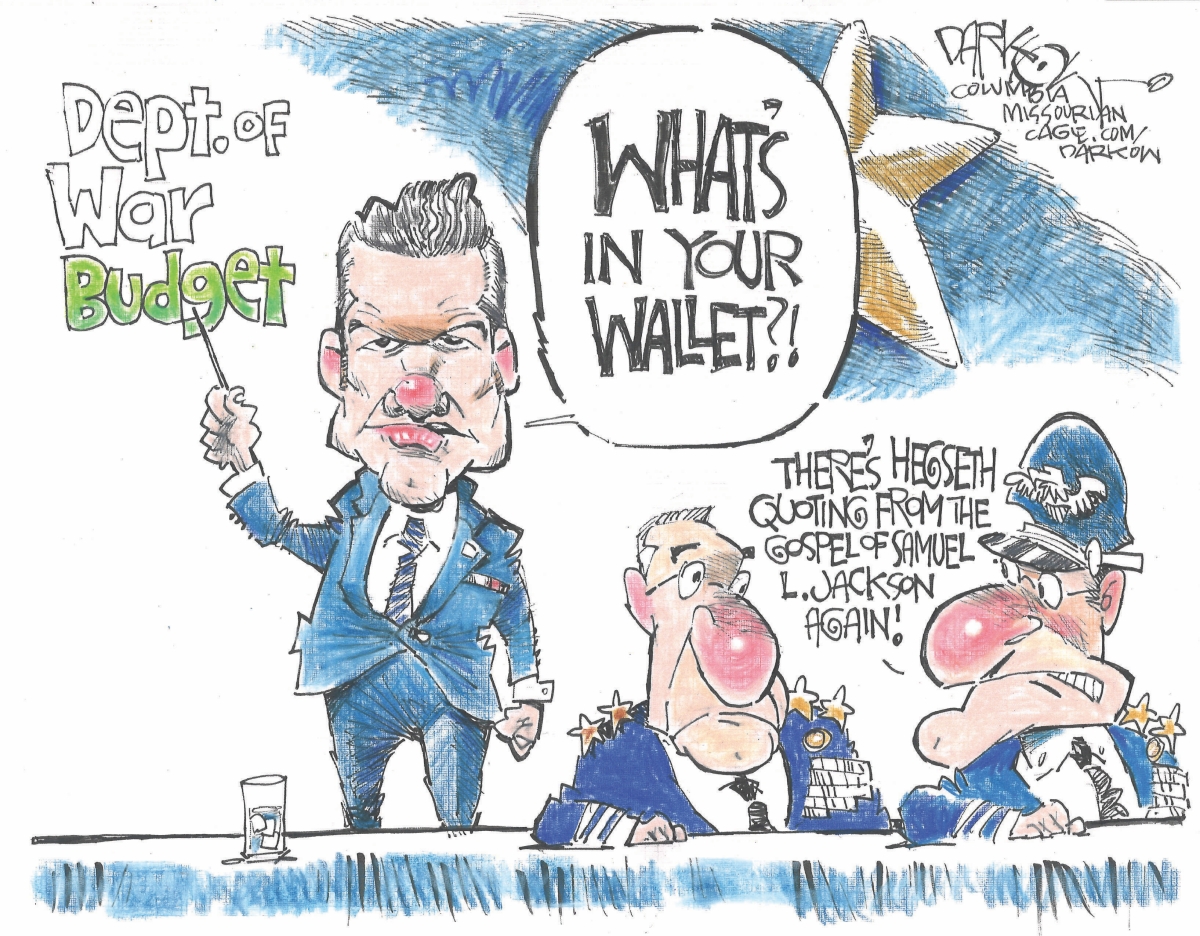
This civilian control of our military has been based on professionalism and patriotism. Neither matters in the least to the Donald’s administration. Pete Hegseth has purged experienced generals’ leadership from command roles and military legal advisors from positions reminding leaders of treaty and statutory duties, obligations and restraints.
Our military is now obeying orders to commit high seas piracy, kidnapping and initiating assaults on foreign civilian populations. The Donald’s administration is accusing people of call for obedience to treaties and even the Uniform Code of Military Justice “traitors!” And a large swath of the corporate media cheers this behavior, even as polls show that a minority, but a large minority support these actions.
When military leaders refused to allow the Donald to use nuclear weapons on Iran was it an act of simple sanity? The generals who stood up to the Donald include those who have replaced the experienced, respected officers who had been replaced for being insufficiently belligerent and “warlike.”
The newly appointed officers are being placed in a position of having to choose their loyalties. Will they be loyal to the Donald or to the nation? In 1780, John Adams wrote that government should be by laws, not by men. Differences between southern slaveholding states and northern free states were bridged in 1787 with a constitution that tried to ensure that laws would be central to our new government, avoiding what Aristotle had called the whims of rulers.
For leaders in the Pentagon, the choice is fraught. If they continue to obey the Donald, they are clearly obeying the whims of a man who wants to be a king, and whom many observers have said is no longer sane. But they are also confronted with a Party leadership which seems to accept that their ‘king’ may be as mad a King George but is not mad enough to be subject to 25th Amendment removal.
If they rebel against presidential orders, are they placing their whims above the rule of law or are they preserving the rule of law over the whims of a mad king? If they rebel, how should their rebellion be done? Is it sufficient to refuse to obey clearly illegal orders, orders that violate our Constitutional treaty obligations?
We know from Hegseth’s comments and actions that such disobedience will elicit both dismissal and retributive prosecution. And will risk replacement by new appointees more closely aligned with Hegseth’s clear desire to advance the arrival of Armageddon, general population destruction and the end of the rule of law.
The fact that Hegseth’s comments and actions include a component of ending 1st Amendment religious freedoms cannot be ignored. The Donald clearly wants his kingship to be one of theocratic dimension, as he casts himself as a replacement for Jesus and Christianity. He may want to renew the Roman imperial stance that the emperor is a god.
The Donald’s religion is personal greed combined with White supremacy. The Hegseth purge at the Pentagon has also included White supremacy, misogynistic and prosperity-gospel elements. So, a leader trying to balance between the rule of law and the rule of whims is confronted with conflicts with which law to follow.
Many “revolutionary” leaders on the left also think that part of the solution to problems with current U.S. social policy, domestic and foreign, would be cured by the installation of a “revolutionary” government of a single party, dominated by a “wise” ruler who would run the nation according to his (no one seems to suggest her) whims. The choices for our Pentagon leadership seems very much a parallel for what some revolutionaries want for the U.S.
For the rest of us, what Pentagon chiefs choose should be irrelevant. We have a Constitution and a structure which has lasted, with intermittent improvements, for 250 years. We survived Shays Rebellion in the 18th century, repeated economic disruptions caused by unfettered industrial capitalism in the 19th century and the expansion of rights to women, labor, Asians, Blacks and LGBTQ+ during the 20th century.
We have a right to demand that our military leaders stay loyal to US, the people, and not to the whims of any passing individual. For 250 years, the U.S. military has set a unique example for the world. As with other rights, our right to a loyal military depends on our duty as loyal citizens to continue our duty to politick and especially to vote. To vote to correct course when we have started to wander. And to vote to expel bad actors who sometimes come to power.
Comments

Powered by RoundtableAn AI/DeFi-powered Enterprise Media Operating System. Learn more at Roundtable.io.© Roundtable 2026. By using this site you agree to the Terms of Use and Privacy Policy