
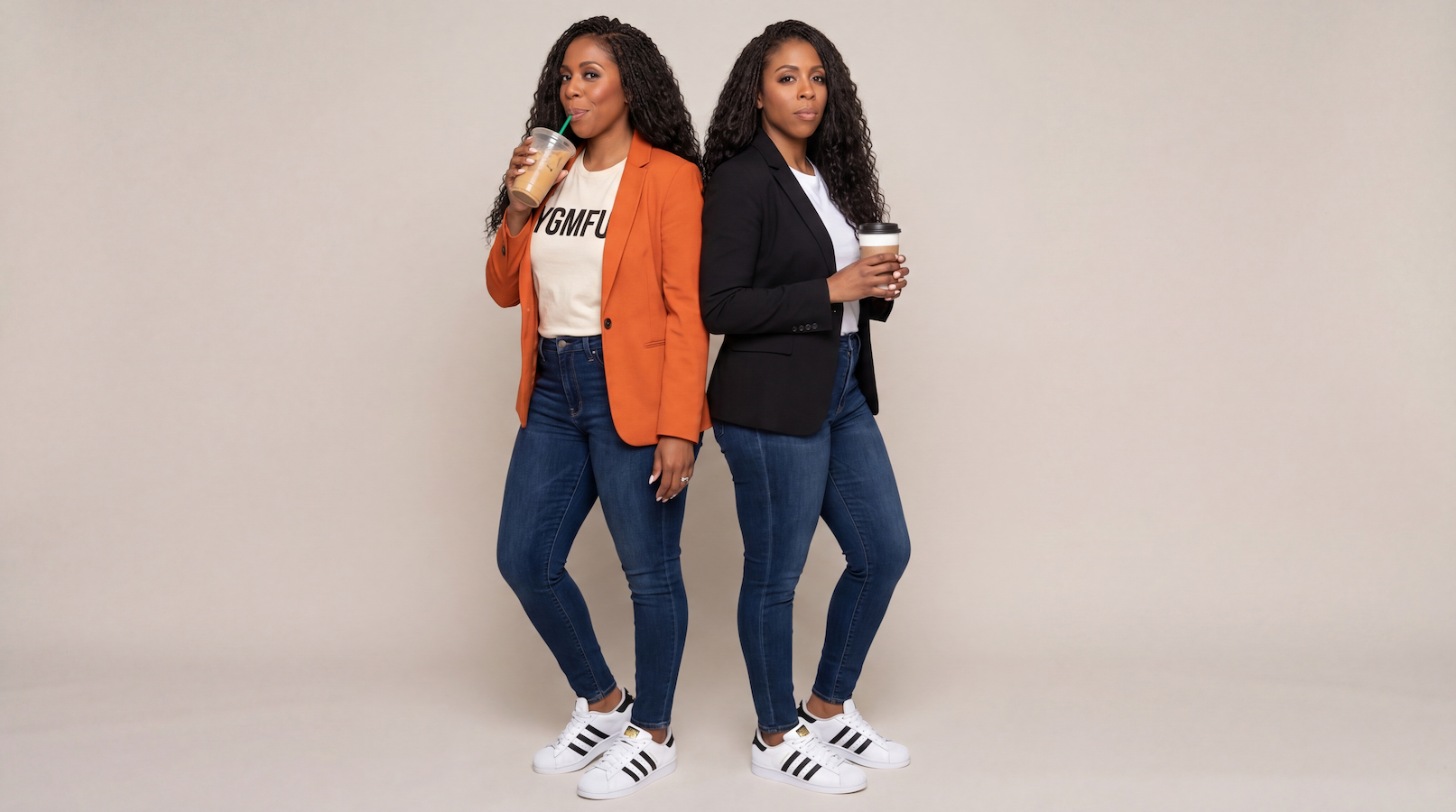


Jasmyne Cannick and her AI-generated alter ego Tawanda of Petty TV (Photo courtesy Jasmyne Cannick)
Apr 22, 2026 2:58 PM
When OpenAI’s Sora shuts down, one creator confronts what it means to lose not just a platform, but a coping mechanism for surviving America’s relentless political stress.
On April 26, OpenAI Sora—a platform that turned written prompts into hyper-realistic video—will shut down after just six months. It came in with hype, but what doesn’t get talked about enough is how quickly it became something else for people like me: a tool for mental survival.As a Black Gen X woman navigating constant political stress and a nonstop news cycle, I didn’t just use AI to create—I used it to cope. What looked like content was really release. Control. A way to process what I was feeling without letting it consume me.It helped me stay grounded.Now it’s going away.
Here’s my story.
Call it petty, call it creative, call it what you want—Sora understood the assignment and kept me grounded.
Here’s the thing nobody tells you about surviving the Donald Trump administration as a thinking, breathing, news-consuming adult: your blood pressure will file a formal complaint before you do. So I did what any rational, slightly unhinged, fully self-aware Gen X woman would do. I turned to AI.
Related stories
Not for productivity. Not for emails. Not to organize my life like some influencer with a label maker and a dream. No.
I turned to AI for my mental health. And somehow—millions of views later—I found out I’m not the only one.
Petty as a coping mechanism (but make it digital)
Let me be very clear: I am not out here committing crimes. I enjoy freedom. I look good in daylight. Jail orange is not in my color palette. But I am human. And like a lot of people watching this current political circus, I’ve had thoughts. The kind of thoughts that don’t belong in group chats, therapy intake forms, or anything that might accidentally get screenshotted and sent to your mama. Enter AI. What it gave me wasn’t just distraction—it gave me distance. Because there is something deeply satisfying about watching a version of yourself—controlled, fictional, fully aware she’s on camera—say and do the things you would never do in real life.
It’s release without consequence. It’s pressure leaving the body in real time. It kept me grounded. It kept me laughing. And yes, it probably kept me out of situations that end with phrases like “ma’am, turn around” or “5150 hold.”
We’re not going to act like that’s not valuable. AI gets a bad rap. People hear it and think shortcuts, scams, or the end of creativity as we know it. I hear it and think: this was cheaper than therapy and a whole lot faster. Not a replacement—but in a moment where everything felt like too much, it gave me somewhere to put it. No waiting room. No intake forms. Just me, my thoughts, and a way to get them out without blowing my life up.
The part I’m especially proud of
And here’s what I don’t gloss over: I taught myself how to do this from scratch with tools available to me. No film school.
No production team. Just me, curiosity, irritation, and the very specific kind of focus that kicks in when you are both fed up and determined. I built this. Every shot. Every line. Every beat of dialogue. Every camera angle. Every choice about how she moves, pauses, looks, and delivers.
That matters to me. Because too often, people assume AI replaces creativity. For me, it demanded more of it.
The day Tawanda was born
Six months ago almost to the day, I was in my bed—mad. Not mildly annoyed. Not “I’ll scroll past it” irritated.
Mad.
Because Donald Trump had posted a meme depicting him dropping poop on No Kings protesters. And what bothered me almost as much as the post itself was the response—or lack of one.
The Democratic Party wasn’t fighting fire with fire. No pushback with teeth. No energy that matched the absurdity. And I remember thinking: fine.
I’ll do it myself. So I figured out—on the spot—how to make an AI video of me taking that same energy, flipping it, and throwing it right back up into the sky… knocking his fighter jet out of it. Problem solved. That was the first one.
That was the moment.
That was Tawanda.
Meet Tawanda
Tawanda didn’t just appear—she evolved. Fully formed attitude, yes. But everything else? Built. Refined. Sharpened over time. She looks like me—because that matters. Not “inspired by.” Not “adjacent to.” Not “close enough if you squint.”
Me.
Her name is a nod to one of my favorite films, Fried Green Tomatoes—a story I understand a lot better now than I did when it first came out. We share the same face. Same body. Same presence. Same “I said what I said and I’m standing in it” energy. And she sounds like me too—me on my most centered, most controlled, most “I’m not raising my voice but I am raising the temperature in the room”day. But what people don’t always see is the work. Her role as a reporter for Petty Television News? Designed.
Her cadence? Written.
Her dialogue? Measured, intentional, deliberate.
Her love of coffee? I mean… I wonder where she gets that from. From that first chaotic, cathartic video to now, you’re watching progression.You’re watching craft.
You’re watching me figure it out in real time—and get better.Tawanda is not chaos.
She is precision.
A Gen X solution to a modern problem
This is very Gen X-coded, by the way. We are the generation that raised ourselves, processed trauma with sarcasm, and turned “I’m fine” into a personality trait. So of course when faced with a political environment that feels like a never-ending group project we didn’t sign up for, we built a workaround.
Not a meltdown.
A method.
Tawanda is that method. Through her, I talk about politics, race, culture, hypocrisy, media foolishness—all of it. But from a place that isn’t begging to be heard. She assumes the mic is already hers. And people responded.
Not because it was perfect.
Not because it was polished.
Because it was honest.
Millions of views later… it’s not just me
That’s the part that shifted everything. Because what started as my outlet turned into our space. People see themselves in Tawanda. Not just in how she looks—but in how she refuses to bend.
In the exhaustion.
In the humor.
In the very specific, very Black, very Gen X ability to say, “This is ridiculous,” and keep it moving anyway.There’s a community now. A real one. People who come for the laughs but stay because they recognize the release. Because sometimes the healthiest thing you can do is not pretend you’re okay with what’s happening around you.
The anxiety no one’s talking about
Now here’s the part I don’t love.The tools are changing.
Fast.
And yes—credit where it’s due. Tools like OpenAI Sora gave me the ability to even do this. To take an idea sitting in my head and turn it into something visual, immediate, and shareable. Whatever comes next, I don’t ignore what made this version possible.But with the looming end of platforms like Sora, there’s this very real question sitting in the room with me:What happens to Tawanda?
Because she’s not just content.She’s a coping mechanism.
She’s a voice.
She’s a version of me that people have come to rely on—and frankly, that I rely on too.And I’m not interested in losing her.So now I’m in this next phase—figuring out how to keep her alive, consistent, recognizable, and just as sharp… in a landscape that doesn’t always prioritize continuity.Which, again, feels very on brand for the times we’re living in.
Final thought
I didn’t set out to build a digital alter ego.I set out to stay sane.AI just happened to be the tool that met me where I was—frustrated, aware, and one news alert away from needing to go outside and stare at the sky for 20 minutes.Tawanda gave me a lane.
I built the road.
The audience gave it momentum.And together, we built something that sits right at the intersection of humor, truth, and “I know I’m not the only one thinking this.”Because I’m not.
And neither are you.
Comments

Powered by RoundtableAn AI/DeFi-powered Enterprise Media Operating System. Learn more at Roundtable.io.© Roundtable 2026. By using this site you agree to the Terms of Use and Privacy Policy