
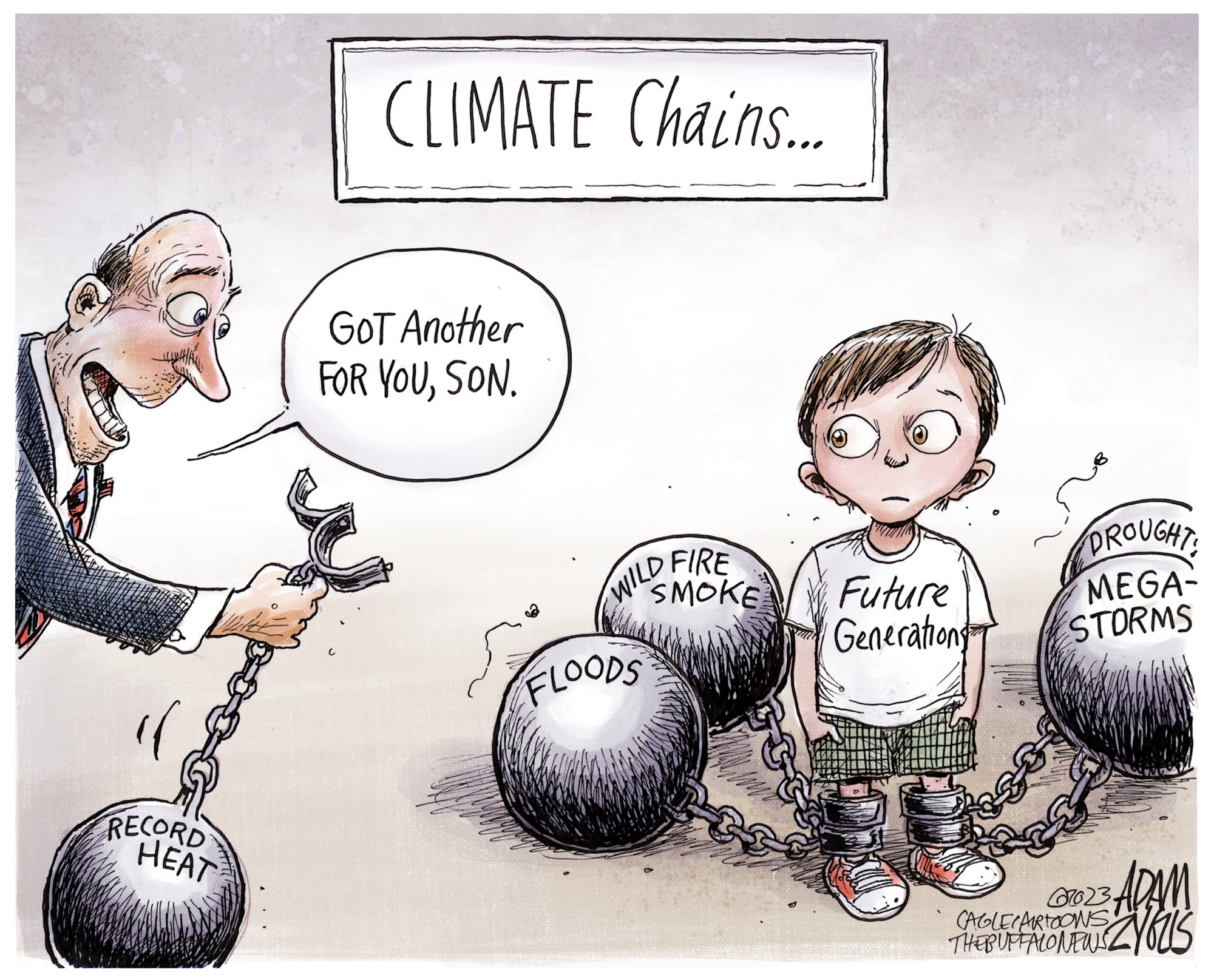
Illustration by Adam Zyglis on Cagle Cartoons


Aug 3, 2023 3:00 PM
Stop “allowing” work from home and require it. Pay workers in fossil fuel industries to learn new skills. Hire them to develop technology to store clean energy.
Hot Tub Sales Plummet as Consumers Realize They Can Simply Wade in the Ocean Instead
Vegan Diets Soar as Climate-Driven Tick Disease Causes Allergic Reaction to Red Meat
Failing Electrical Grid Offers Texans Incentive to Learn Back-to-Stone-Age Skills
White Supremacy—the Popular New Color for Roof Shingles
Related stories
We live in a world where it’s difficult to tell the difference between a real headline and one from Saturday Night Live. Before long, even the most ridiculous headlines will become commonplace.
Insurance Companies Refuse to Insure Homeowners in Florida and California: “Those suckers are on their own!”
What do the many climate disasters we face almost daily have in common?
They were preventable at one time and now they’re not.
No major party platform supports a ban on fracking, the bare minimum to begin stabilizing the climate. And no major party platform supports a ban on new fossil fuel projects. If we can’t get by on the countless fossil fuel projects already in existence, there’s no chance we’ll slow global warming before we’ve reached multiple tipping points.
It’s time to ration fossil fuels. We all knew this day would come, despite living in denial, but now that it’s here, no one wants to do it. Businesses don’t want to. Republicans don’t want to. Democrats don’t want to. Even climate scientists and climate activists don’t want to do it.
Fossil fuel corporations don’t want anyone to do it.
But it has to be done.
And just how exactly do we ration? Working out the particulars will require debate. Lots of it. Over months and years and multiple administrations. Meaning that by the time we start implementing those programs, even assuming we start those debates in Congress today, we’ll still have passed multiple tipping points.
It’s possible we’re already too late. But pilots trying to save an out-of-control plane carrying 165 passengers keep fighting to the end. Sometimes, they crash anyway and everyone is killed. Other times, the crash kills all but a handful of passengers. But even those few survivors go on with their lives because the pilots didn’t give up.
And sometimes, the pilots land safely despite overwhelming odds.
Any comprehensive approach to carbon rationing involves government regulation. Just as we can’t expect the entire population to regulate their own food rationing during wartime or famine, limits must be imposed by a ruling body.
In an emergency, only the government is powerful enough to coordinate resources and enforce laws and regulations to help the nation survive the emergency.
The global community can’t quit fossil fuels overnight. Neither can a single nation, a city, or an individual.
What we can do, though, is ration.
Rationing fossil fuels, or carbon rationing, or whatever we choose to call it, won’t simply mean everyone gets ten gallons of fuel a week. We need an even more comprehensive approach. Rationing fossil fuels will also require concrete steps to transition away from industrial agricultural farming. It will mean reducing beef and pork production.
Literal rationing of fossil fuel, of course, will undoubtedly be part of the program.
Each household is allotted so many gallons of gasoline a week. That can come in the form of credits we exchange at gas stations or that we hand to our uber driver. We’ll input the credits when we conduct online orders so that delivery drivers have the fuel they need to drop off a package. If we run out of coupon numbers to input, then we get no more deliveries for the month.
In wartime, we convert factories that make cookware into factories that make ammunition. We convert automobile factories into factories that make planes or tanks or landing crafts.
We’ll need to do the same thing in the war to stabilize the climate. We’ll need electric instead of gas-powered vehicles. We’ll need to produce more solar panels, more wind turbines, more batteries, more machinery to harness wave and thermal energy.
But we must also limit the number of personal vehicles—even electric vehicles—and produce more buses, light rail, trains, and high-speed trains. We keep our manufacturing jobs while transforming our nation to one that can function better with public transit, one that can perform at a high level while using fewer fossil fuels.
We’ll be forced to focus more on public transit eventually. We’re already behind many other nations on this front. We’ll be left behind altogether as these adaptations become unavoidable. We can talk ourselves into believing that a 31-day streak of 110-degree weather is an anomaly, but when it lasts three months? Four? It simply won’t be possible to ignore reality forever.
And there are countless other changes we’ll need to make. We stop “allowing” work from home and start requiring more of it. We pay workers in fossil fuel industries to learn new skills. We hire those workers to develop and make technology to store solar, wind, and thermal energy.
We might even need Universal Basic Income as a stop gap measure until a new economy not centered around fossil fuels stabilizes along with the climate.
Disruptive? Stressful? Difficult?
Miserable?
Like World War II?
A war can’t be won overnight. A famine isn’t overcome in two weeks.
It will take time to adapt our fossil fuel-based culture to one that won’t make a survivable climate impossible. But the alternative is to refuse to adapt.
Which means refusing to survive.
Yes, every one of these other options will require the use of some amount of fossil fuels. And every option will create its own waste and inflict its own damage on the environment. Short of eliminating all human activity on the planet, we’ll always have an impact.
But there are degrees of damage. Some damage is survivable and some isn’t.
No one likes rationing during wartime. No one likes rationing during a famine.
Only idiots and sadists like war.
But most people like surviving famine and war.
Housing Market Opens Up after 60K Homeowners Die in European Heatwave
Republican County Shifts Blue after Rural Town of 20,000 Obliterated in Wildfire
Democratic Party in Peril as Voters Demand Action over Promises
Which headline will we see next?
Rationing fossil fuels won’t be fun, but neither will 110-degree summers in New York, Chicago, and Seattle. Or 120-degree summers in New Orleans and Miami and Houston.
Let’s choose rationing, which means choosing to at least try surviving climate change.
And maybe one day we’ll read a victorious headline.
Comments

Powered by RoundtableAn AI/DeFi-powered Enterprise Media Operating System. Learn more at Roundtable.io.© Roundtable 2026. By using this site you agree to the Terms of Use and Privacy Policy