
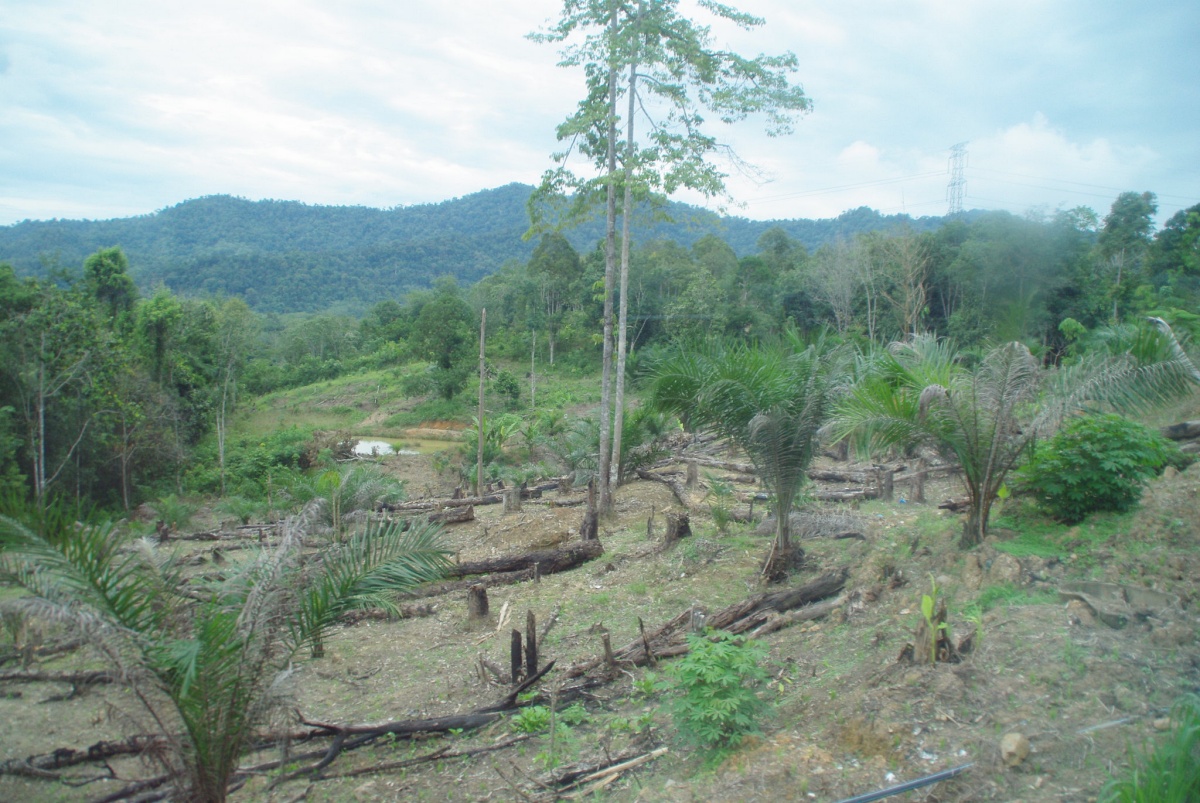
Gary Yau - Palm Oil deforestation • Original LicenseAttribution-NonCommercial (CC BY-NC 2.0)


May 12, 2023 2:00 PM
Updated Feb 28, 2024 4:54 AM
Attacked, destroyed, and sacrificed for the global demand for palm oil, timber, and coal.
Sometimes realty outperforms fiction. This is the case with an invented tale and subsequent events playing out in real time on the island of Borneo. In the early 90s, T.C. Boyle published a provocative short story titled Top of the Food Chain. It can be understood as a sharp warning to humans who tamper with ecosystems. It had a far-sighted quality, but what actually happened on Borneo during the three decades that followed was much more disturbing. Deforestation initiated campaigns against environmental damages.
One of the major culprits was Procter & Gamble. This giant American company purchased large quantities of palm oil produced on Borneo and was seen as a contributor to the island’s massive ecological decay and related human rights abuses. But then, after long struggles, came what the Financial Times called the investor rebellion of 2020, when P&G shareholders voted against the company and for serious planet-friendly changes.
To put things into perspective, it will be worthwhile to summarize the ironic logic of T.C. Boyle’s story. In shorthand, this happens within Top of the Food Chain:
A pest-control crew is invited by the authorities to help a malaria-stricken village on Borneo to get rid of mosquitos. The decision is made to use DDT for the short term despite the fact that it is already banned in the United States. Something safe and tame will not make a dent. The crew takes to the air and sprays DDT. The mosquitos are wiped out. But so are the little wasps that prey on caterpillars. The caterpillars then have a field day and eat all the area’s roofs made from palm leaves. These palm leaf roofs have been effective for ages by keeping the rain out and people dry. Now they collapsed and left the villagers wet and miserable. It rains 120 inches per year. The crew orders tin roofs for all the huts. That keeps the rain out but the noise level high. People can’t sleep.
Related stories
With the mosquitos gone, flies fill the gap. They are everywhere in huge numbers. They get into everybody’s eyes, mouth, nose, ears and food. Day and night. The crew does a good ground sweep – sanitizing the huts and open sewers. The thing with the geckos was not foreseen. The geckos gorged themselves on flies sprayed dead and then they went belly up themselves. The cats? They feasted on the geckos which are normally ultra-quick but became sluggish after eating DDT-enhanced flies. Then the cats ate every poison-enriched gecko they could find and promptly began to die too. That wasn’t a great loss except for the rats. Cats were beloved in the area because they kept the rats in check. With cats gone the rats took over, and there were first reports of bubonic plague.
It was getting expensive but the crew fly off to round up replacement cats in Australia, Singapore, and Indonesia. It imported 14,000 felines to the area of operations on Borneo. While dropping the cats it was noted that spraying had harmed the crops. The people were hungry. It was inevitable that a good proportion of the local population was lost. But the crew now had a CARE program going and something hit the rat population — it was still unknown by what, a virus, perhaps. But it could be worse.…
And that is where this saga ends.
When Boyle published this story about impudent human meddling in the 1994 anthology Without a Hero, the decimation of Borneo’s rainforests — both legal and illegal — was already progressing at a high speed. This continued until about 2017, when scientists at the Center for International Forestry Research documented a slowing down of deforestation. Even so, Arie Rompas, who was born on the island, wrote for Greenpeace that “at least 30 percent of Borneo’s tropical forests have been destroyed over the last 40 years, including its carbon-rich peatlands that can store twice as much carbon as forests.”
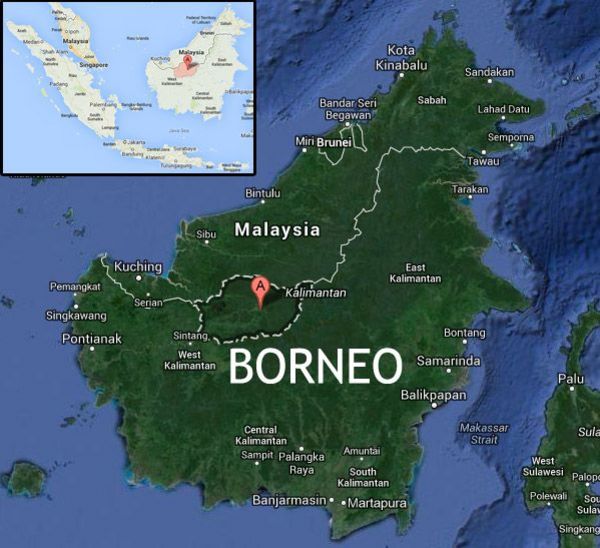
Borneo is the world’s third-largest island. It is about three times bigger than the UK, and consists politically of 3 countries: Malaysia 26.7%; Sultanate of Brunei 0.6%; and Indonesia 72.6%. As of 2020 it had a population of 17.7 million, of which 17% are indigenous Dayak people.
The island’s forest is 130 million years old, which means it is twice as old as the Amazon rainforest. It is one of the richest ecosystems on the planet, with 15,00 plant species, more than 1400 amphibians, birds, fish, mammals, reptiles and unknown insects. All that was being attacked, destroyed, and sacrificed for so-called economic development and the global demand for palm oil, timber, and coal.
In 2021, the global palm oil market was valued at USD 67.7 billion. It is expected to grow annually by 5.1. percent until 2030. Indonesia is the world’s largest palm oil producer- exporter, and the product is an important source of income for the country. As to timber, from the mid-1970s to the 1990s, more than half of all tropical hardwood exports worldwide came from Borneo to satisfy consumer appetite for garden furniture, paper pulp, chop sticks, etc.
In addition, Indonesia is also going through a huge coal mining boom. Since the year 2000, coal production has risen by 460%. The country became the world’s largest coal exporter: 86% of its production is exported, mostly to the growing economies of Asia. On Borneo, opencast coal mining is rampant in Indonesian East and South Kalimantan. It turned the land in to a scarred terrain of craters and open pits. Due to the mining land grab, many of the indigenous Dayak people have been forcibly displaced and lost their livelihood.
But there is more — Indonesia’s capital city Jakarta on Java is sinking and plagued by multiple challenges for its huge metropolitan population of more than 31 million people, many of whom rely on private wells that have depleted the underground aquifers. As a result, the ground subsides more than 10 centimeters per year. Looking for a way out, Indonesia decided to build a utopian new capital city on Borneo. This requires the construction of new roads and infrastructure. It puts the Heart of Borneo protection project under siege.
The Borneo calamity can serve as the symbol of a developing country feeling pressured into self-exploitation and depletion of its natural and human resources for the sake of trying to catch up via short-term gains.
Compared to these events, T.C. Boyle’s Top of the Food Chain story, written three decades ago, sounds almost harmless. Real life events are more bizarre than Boyle’s powerful imagination. The Borneo calamity can serve as the symbol of a developing country feeling pressured into self-exploitation and depletion of its natural and human resources for the sake of trying to catch up via short-term gains. Long- term the return on investment (ROI) could be dismal: there is a harsh humor in the fact that rich rainforests grow on extremely poor soils. The forests are teeming with life, use elaborate interactive loops, and recycle nutrients — but all this does not reach down to the soil, which is almost sterile. This makes it unfit for agriculture.
It is therefore no wonder that self-destructive deforestation leads to a portfolio of new problems. This is one of them: rainforests function like air conditioners. Cut them down and temperatures go up. And they did. There are others: devastating fires occurred in 2015 and 2019. They burned almost 4.4 million ha., and soon afterwards came the flooding. Moreover, once destroyed the old-growth tropical forests that have existed for millions of years and functioned as the lungs of the planet may never recover or grow back on degraded land. In turn, that land with its poor soils soon loses productivity on palm oil plantations. It is kept going with heavy fertilizer use which causes harmful emissions and pollution of its own. The end-stage of this downward spiral may be the open pit coal mine.
It’s a sad story, but Borneo is far away on the other side of the world. True, yet today what is local becomes global and what is global becomes local. That’s why we will now switch locations and visit Procter & Gamble, Cincinnati, Ohio, in the middle of the USA.
Procter & Gamble (P&G) is the world’s largest consumer packaged goods company with nearly $84 billion in annual sales, more than $10 billion in earnings, and a workforce of more than 10,000.
Back in 2014, Greenpeace protesters used zip lines to hang huge banners on the P & G headquarter towers to blast deforestation related to the company’s palm oil supply chains. One of the banners read: Head & Shoulders: Wipes out Dandruff & Rainforests.
At this point, environmental groups had already battled with P&G for years. A month after bringing the protests to its corporate doorsteps, P&G announced a pledge to no more deforestation and to improvements in dealing with all its suppliers, small local farmers included.
This was good news in 2014, but for the most part P&G talked the talk, but didn’t do the walk. The struggle continued. Six years later in October of 2020, began what the Financial Times called an “unusually big investor rebellion.” Prior to the annual meeting, the company had implored shareholders to vote against proposals calling for new and serious policies that protect the environment. But Procter & Gamble shareholders were defiant and 67 % voted for a resolution to end forest degradation caused by the use of palm kernel oil and forest pulp in P&G products. It is significant that Black Rock, the world’s largest investment manager with assets of USD 177 billion, participated in this revolt. It is the second largest P&G shareholder and holds 6.6 percent of shares.
The Financial Times noted that “the vote at P&G is the latest sign that global investor pressure is growing on corporate America to step up efforts to protect the environment.”
In any case, was this a turning point? No, it was just another small step forward. The controversy and the protests continued for three years in a row. In October of 2021, the annual meeting was held virtually. P&G shareholders called for the dismissal of board member Angela Brady who has ties to climate denier ExxonMobil and its board. That push failed.
For the October 2022 shareholder meeting, protests returned in full force. Outside the Cincinnati headquarters a colorful coalition of descendants of P&G founders, climate and human rights advocacy groups – among them representatives from Rain Forest Action Network (RAN), indigenous people from Indonesia, members of national U.S. organizations, and ordinary concerned citizens gathered to give P&G an unyielding “F” for failing to live up to its commitments.
Jennifer Skene, Natural Climate Solutions Policy Manager, Natural Resources Defense Council (NRDC) had this to say: “Over the past two years, P&G has met investors’ calls for the company to address its forest impacts with a master class in industry spin, offering hollow announcements, disingenuous taking points, and even new forms of climate denial.”
One can almost pity our publicly held corporations because they are captives in the demanding scramble for short term results. They must perform profitably quarter by quarter, or else. Wall Street is watching. Working toward long-term goals becomes extremely difficult under such conditions. Band Aids may be applied, but not much else. Without a chance for being proactive, efforts are mostly restricted to being reactive. And what happens to Return of Investment (ROI) over the long term? Will it likewise end up in a self-destructive downward spiral like the abused lands of Borneo?
As long as powerful members of society in politics, business, media, law, and public life maintain an attitude of we are The Top of the Food Chain, change remains improbable. Such a worldview undermines the foundations for life. A shift to we are not the top, we are just part of the food chain is required.
Comments

Powered by RoundtableAn AI/DeFi-powered Enterprise Media Operating System. Learn more at Roundtable.io.© Roundtable 2026. By using this site you agree to the Terms of Use and Privacy Policy