
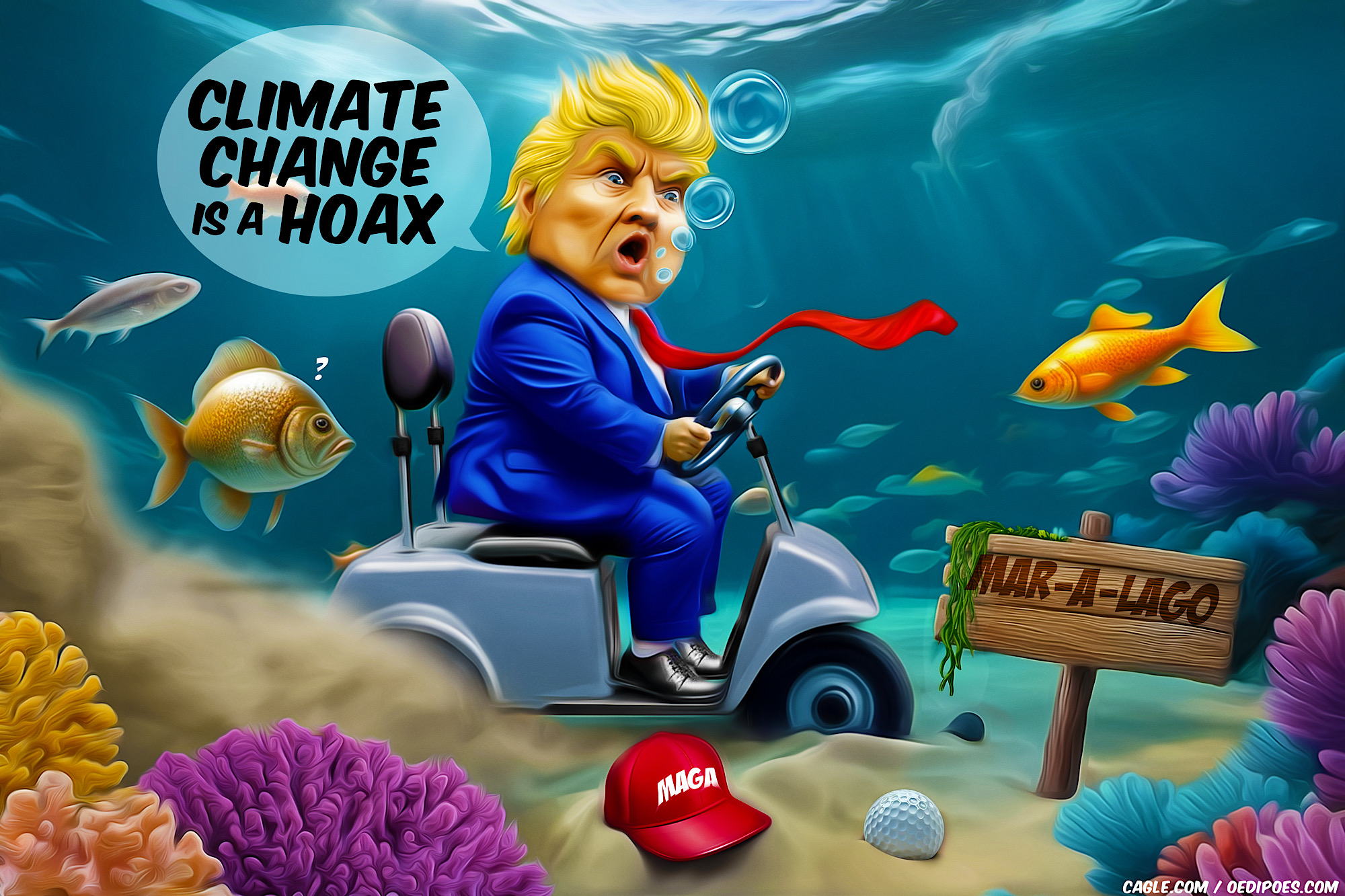
Illustration by Bart van Leeuwn


not enough people took the climate crisis seriously, enabling Republican deniers to ignore it. mid-2020 polls indicated that ten other matters were more important.
Jan 7, 2025 3:22 AM
Not enough people took the climate crisis seriously, enabling Republican deniers to ignore it. mid-2020 polls indicated that ten other matters were more important.
For the last half century, Democrats have responded much more responsibly to our growing climate crisis than have Republicans. Let’s start with the Democratic President Jimmy Carter, elected in 1976. Fortunately, The New York Times’ David Gelles has summed up the one-term president’s climate politics as contrasted with his two-term Republican successor, Ronald Reagan.
Here is a summary of Gelles’s reporting. “In 1979, Carter had 32 solar panels installed on the White House roof.” And he indicated that by 2000 the U. S. should have 20 percent of its energy come from renewable sources. In contrast, in 1986 Reagan removed the solar panels and “went all-in on fossil fuels.”
He also slashed “the federal research budget for clean energy programs at the Department of Energy (created by Carter in 1977). Reagan also ended a tax break for wind installations and “rolled back fuel-economy standards, paving the way for an era of gas-guzzling cars and trucks.”
And writing of tax breaks reminds me that during the Carter presidency, my wife and I received both a federal and Michigan tax break for transforming our front porch into a passive solar collection area. The breaks meant that we ended up only spending less than half of the cost for the transformation.
Related stories
Gelles also points out that “Carter signed more than a dozen major pieces of environmental legislation.” They included the National Energy Act of 1978, which “included the country’s first incentives for clean energy and measures to promote energy conservation,” and the Energy Security Act of 1980, which “went even further to promote alternative fuel sources, including solar energy and biomass.” In contrast, Reagan cut renewable-energy support and reduced coal mining regulations.
Although the Environmental Protection Agency (the EPA) was created in 1970 under President Nixon, it became more active under Carter. Reagan’s first budget proposal, however, featured a 25 percent cut in funding for the agency, and its enforcement actions decreased. Its head “pushed to weaken the Clean Air Act with proposals to loosen pollution standards for automakers and factories.”
In addition to Gelles, Bill McKibben (perhaps today’s leading U. S. climate activist) has recently noted some of Carter’s additional steps in regard to our then still early climate crisis. “He asked for additional hundreds of millions to fund solar projects and research, and offered a billion dollars in tax credits to homeowners who wanted to put panels on their roofs or install wind-energy systems.” In mid 1978 he declared that the “only question is how to cut costs so that solar power can be used more widely and so that it will set a cap on rising oil prices. . . . The sun’s power needs only to be collected, stored, and used.”
Carter also identified one of our chief problems contributing to our present crisis - over-consumption. As McKibben quotes 1979 remarks that Carter made: “All the legislation in the world can’t fix what is wrong” with the U. S.
“Too many of us now tend to worship self-indulgence and consumption. Owning things and consuming things does not satisfy our longing for meaning . . . that piling up material goods cannot fill the emptiness of lives which have no confidence or purpose.”
Of course, in the late 1970s Carter did not realize as much as we do today - almost a half-century later - about energy use and climate. Many of his policies were in reaction to the 1973 Arab oil embargo, the creation of the Organization of Petroleum Exporting Countries (OPEC), rising gas prices, and inflation.
For example, while emphasizing solar energy as an alternative to fossil fuels, he also promoted more domestic coal mining, which as we realize today contributes greatly to the warming of our planet.
In the late 1970s global warming was still considered more of a distant threat, but a threat nevertheless. As the director of the White House Office of Science and Technology Policy wrote in 1977, “The present state of knowledge does not justify emergency action to limit the consumption of fossil fuels in the near term,” but considering their continued use should become part of the U. S.’s long-term plans.
Following Reagan’s two-term presidency his vice-president, George Bush Sr., became a one-term president and later on his son, George W. Bush, became a two-term (2001-2009) president. Between the Carter presidency and that of Barack Obama, Bill Clinton was the only other Democratic president (1993-2001).
His vice president, Al Gore, was especially known for his climate activism, writing An Inconvenient Truth: The Crisis of Global Warming (2006), as well as a documentary based on the same research. A website devoted to the Clinton-Gore administration’s environmental record, highlights some of the administration’s measures dealing with the growing climate crisis.
Although from 1989 until 2016, when Donald Trump won his first presidential race, Republican presidents and Congress were not 100 percent climate-crisis deniers, they were pretty bad. Since most conservatives were Republicans, prominent conservative voices contributed to climate-crisis denial.
Take for example, U.S. conservative talk-show host Rush Limbaugh. In his book See, I Told You So (1993), he stated that “despite the hysterics of a few pseudo-scientists, there is no reason to believe in global warming.” In an August 15, 2005 broadcast he declared that global warming was "one of the biggest hoaxes being perpetrated on the people of the world" and that "environmentalists still cannot prove that this [global warming] is man-made."
Another prominent conservative skeptic was national syndicated columnist George Will, who in February 2009 noted that a Pew poll indicated that the American people ranked climate change last out of twenty issues the government should prioritize. His explanation was that “real calamities take our minds off hypothetical ones.”
In a later column (November 8, 2009), he noted that “although the political and media drumbeat of alarm is incessant, a Pew poll shows that only 57 percent of Americans think there is solid evidence of global warming, down 20 points in three years.”
In general, Will regarded most environmentalists with suspicion, as we see from a 2009 column “Awash in Fossil Fuels”--“Today, there is a name for the political doctrine that rejoices in scarcity of everything except government. The name is environmentalism.”
One of the most prominent Republican political climate-change deniers in the period from 1994 to 2023 was Sen. James Inhofe (OK). In 1997 he called the Kyoto Protocol (1997), an international treaty to reduce greenhouse gas emissions into the atmosphere, a "political, economic, and national security fiasco.” From 2003 to 2007 and again from 2015 to 2017, he chaired the U.S. Senate Committee on Environment and Public Works. In 2012 his The Greatest Hoax: How the Global Warming Conspiracy Threatens Your Future appeared.
As Will indicated in 2009, part of the problem was that not enough people took the climate-change problem seriously, especially in “red states,” thus enabling Republican deniers to ignore or poke fun at the issue. Even by mid-2020 those polled by the Pew Research Center indicated that ten other matters were more important to them.
As bad as the general public’s concern was, Republicans were much worse than Democrats. And they’ve been stuck there for some time. In August 2023 former Republican (but anti-Trumper) columnist David Brooks said he remembered when Republican Senators John McCain and Lindsey Graham, 20 years ago, supported “a big climate change bill.” But even then, he admitted, “there was about a 20-point gap between Democratic views of climate change and Republican. Now it's a 50-point gap.”
Republican Congressional representatives reflected (and helped cause) this big gap. In May 2014, politifact.com could find only 8 out of 278 representatives who admitted that a climate-change crisis existed. And this was before human-caused climate-change denier Donald Trump was elected president in 2016.
During Trump’s first term, several of my essays dealt with how bad his presidency was for the climate crisis. The first one, “Pope Francis vs. Scott Pruitt,” contrasted the pope’s encyclical, which reflected alarm at our situation, with the climate-crisis-denial views of Pruitt, whom Trump had made head of the EPA.
Shortly before the 2018 mid-term elections my “What the Newest Climate Report Signals”—Vote Democratic!” appeared. In late 2019 I ended an essay with these words: “The next major battle, and perhaps the most important one of our lifetime, will be the 2020 presidential and congressional elections. Its results could mark a major turning point in our climate struggle.”
In 2024 Sen. Bernie Sanders summarized Trump’s first term environmental/climate record:
“He withdrew from the Paris Agreement, he weakened clean energy regulations and fuel economy standards, supported multiple pipeline projects, expanded drilling offshore and on public lands, removed climate information from government websites, and appointed judges and agency leaders who undermined our ability to move toward sustainable energy and protect the environment.”
Fortunately, however, Trump was - despite his false claims - defeated in 2020, and in early 2021 Joe Biden became president. In 2022 The New York Times opined that the Biden-supported Inflation Reduction Act (IRA) reflected “the most significant federal investment in history to counter climate change.”
Demonstrating Republican denialism and the influence of fossil-fuel lobbyists and Trumpism, no Congressional Republicans voted for the IRA. According to the money tracking group Open Secrets, the top 20 oil, coal and gas donors gave out over $80 million in campaign contributions in the last two years [prior to Aug. 2023]. That money went almost exclusively to Republicans and conservative groups.
Now, however, Trump has once more been elected president. Although we cannot be 100 percent sure what he will do in his term ahead, his past actions and recent pronouncements are good indicators. And as I indicated in the middle of last year, all indications are that “Bernie Is Right: Electing Trump Would Be Catastrophic for Our Climate.”
Comments

Powered by RoundtableAn AI/DeFi-powered Enterprise Media Operating System. Learn more at Roundtable.io.© Roundtable 2026. By using this site you agree to the Terms of Use and Privacy Policy