
Photo by Caio Cezar


Major League Baseball is behind the curve but fans, environmentalists and public officials in NY and LA have been trying to bring their teams up to speed.
Oct 30, 2025 2:10 PM
Major League Baseball is behind the curve but fans, environmentalists and public officials in NY and LA have been trying to bring their teams up to speed.
Millions of baseball fans have been watching this year’s World Series between the Los Angeles Dodgers and Toronto Blue Jays, building on the huge audience the MLB playoffs attracted over the last few weeks. Nationally, postseason viewership through the American and National League championship series averaged $4.48 million, a 13 percent increase from 2024, making it the most-watched baseball postseason since 2017.
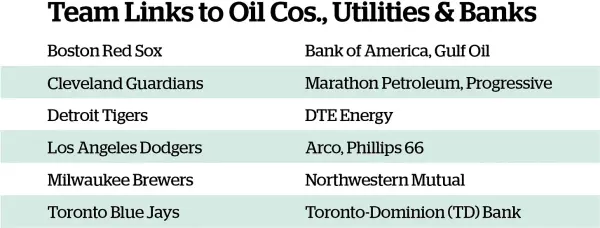
Fans tuning in couldn’t help but notice signage in the ballparks — as well as logos on players’ uniforms — promoting corporations that are exacerbating climate change. Six of the 12 MLB teams in this year’s playoffs — the league champions along with the Boston Red Sox, Cleveland Guardians, Detroit Tigers and Milwaukee Brewers — are sponsored by some of the biggest polluters on the planet as well the financial institutions that underwrite them.
It’s called sportswashing, a play on the term greenwashing. Companies sponsor teams to portray themselves as good corporate citizens, increase visibility, and build public trust, hoping that fans will form the same bond with their brand that they have with their teams. According to a 2021 Nielsen study, 81 percent of fans completely or somewhat trust companies that underwrite sports teams, second only to the trust they have for friends and family.
As it turns out, more than half of the 30 MLB teams are pursuing petrodollars, but baseball is not alone. Three dozen U.S. pro basketball, football, hockey and soccer teams have similar sponsorship deals that afford oil companies, electric utilities, and fossil fuel-friendly financial institutions a range of promotional perks, from billboards and jersey logos to community outreach projects and facility naming rights, according to a survey conducted last fall by UCLA’s Emmett Institute on Climate Change and the Environment.
Related stories
Most sports aficionados are likely unaware that their favorite teams are going to bat for corporate climate destroyers, but baseball fans in New York and Los Angeles are calling out the Mets and Dodgers, demanding that they sever their ties to the fossil fuel industry. Cigarette advertisements, which at one time were ubiquitous in ballparks, were essentially banned because of the threat smoking poses to public health. Given the threat that fossil fuels pose to public health and the environment, shouldn’t their ads — as well as the other trappings of their sponsorships — be banned as well?
Baseball’s Toxic Sponsors
Oil, gas and coal are largely responsible for the carbon pollution driving up world temperatures and triggering more dangerous extreme weather events. Last year the world experienced the highest average global temperature in 175 years of record keeping, and that dubious distinction came on the heels of 10 of the hottest years, according to the World Meteorological Organization.
Those warmer temperatures certainly played a role in producing the 27 weather and climate disasters in the United States last year that caused at least $1 billion in damages, one fewer than the record set in 2023.
Baseball club owners, however, are more concerned about their bottom line than their sponsors’ climate impacts. After all, annual MLB payrolls today average $157 million.
Phillips 66
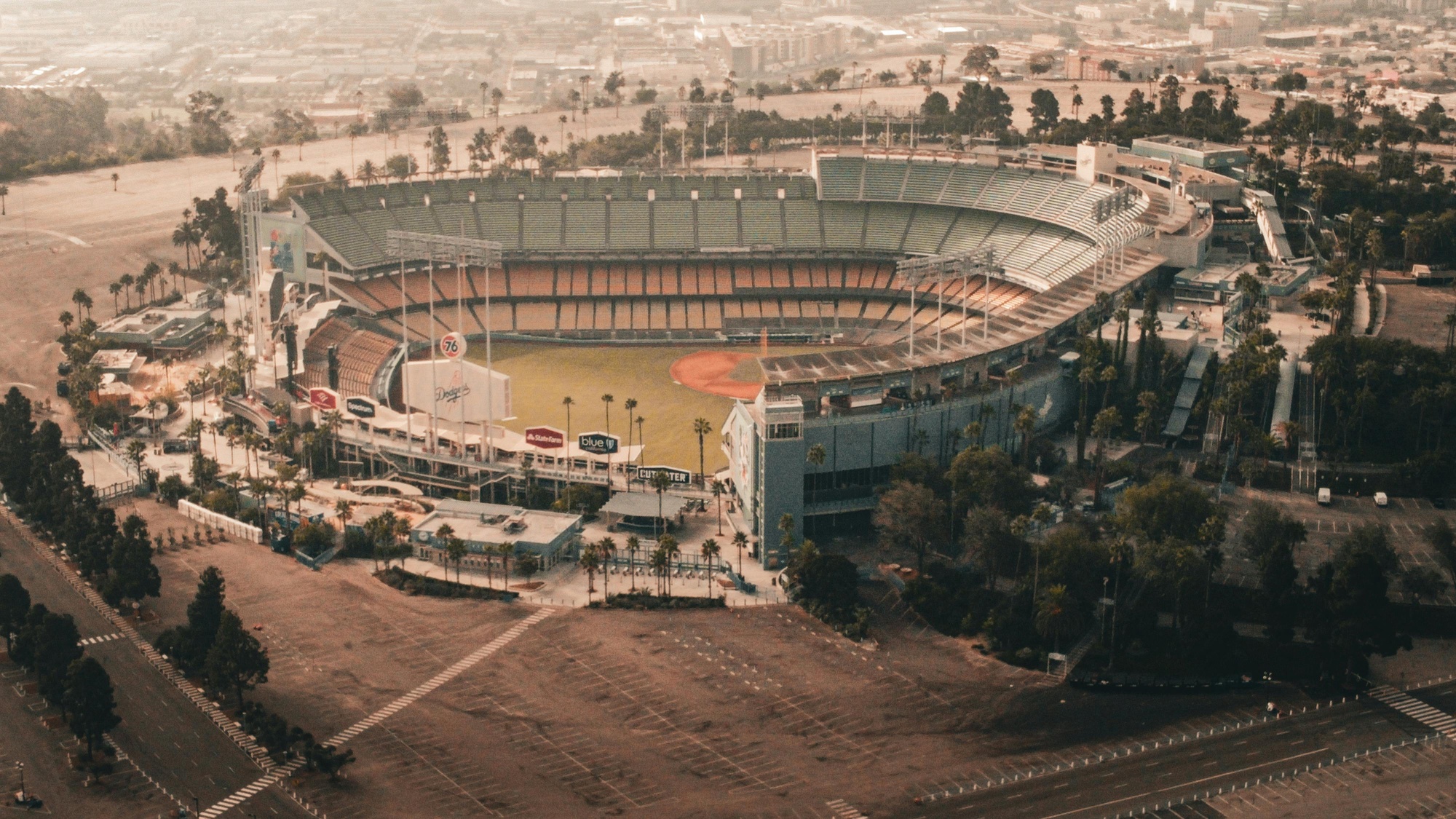
The Dodgers, whose $321 million payroll is the highest in baseball, first partnered with Phillips 66, owner of the 76 brand gas station chain, in 1962. The most visible element of their partnership is the company’s iconic 76 orange logo that sits atop both Dodger Stadium scoreboards. But like most sponsorships, it is about much more than prime ad placement.
Phillips 66 fosters community loyalty, for example, by collaborating with the Dodger foundation’s educational and charitable programs, including a campaign promoting science, technology, engineering and mathematics (STEM) education for underserved elementary and middle-school students. Most of its tie-ins, however, involve various promotions to sell more gasoline.
Customers who buy at least 8 gallons can get a free limited edition 76-Dodger pin or two Dodger home game tickets for the price of one. And on special “76 Stadium Days,” customers who fill up their tanks can get free tickets, T-shirts and other swag.
Phillips 66 has built a devoted customer base over the years by tying itself to the Dodgers, but its environmental track record tells a very different story. It is definitely not a good corporate citizen. The company is among the nation’s top 10 air and surface water polluters in total pounds and the 14th biggest carbon polluter, emitting more than 30 million metric tons in 2022, according to the 2024 edition of Political Economy Research Institute’s “Top 100 Polluter Indexes.”
The company also is one of six major oil and gas companies California sued in June 2024 for climate damages, accusing them of carrying out a “decades-long campaign of deception” to hide the truth about climate change and delay the transition to clean energy. Likewise, it is among 32 companies named in similar lawsuits filed at the same time by three California cities and three California counties:
- Imperial Beach
- Richmond
- Santa Cruz
- Marin County
- San Mateo County
- Santa Cruz County
Marathon Petroleum and Progressive Insurance
Arco, owned by Marathon Petroleum, also advertises in Dodger Stadium. The country’s largest oil refiner with more than 7,000 Marathon and Arco gas stations nationwide, it is among the top 20 air, surface water, and carbon polluters in the country, according to PERI’s 2024 report. It also is one of the oil and gas companies sued by the six California municipalities in June 2024, and the company and its subsidiaries have been fined more than $900 million for federal environmental violations since 2014.
An Ohio-based company, Marathon Petroleum has much closer ties with the Cleveland Guardians. It has been one of the team’s main sponsors since 2021, and the team—who lost to the Tigers in the wild card round—has been wearing its logo on their sleeves since the summer of 2023. Its logo also is prominently displayed in the Guardians’ ballpark and, as part of the uniform patch agreement, is featured on souvenir jerseys given to fans on two game days every season.
Cleveland’s ballpark has been called Progressive Field since 2008, when the Progressive insurance company paid $58 million for naming rights for 16 years. It extended the deal through 2036 for an undisclosed sum last year. While Progressive is a minor player when it comes to fossil fuel investments, it is still a contributor. As of 2024, the company had $306 million invested in 20 utilities and fossil fuel companies, including Duke Energy, Marathon Petroleum and ExxonMobil, according to a report by the German environmental nonprofit Urgewald.
DTE Utility
The Tigers, who lost to the Seattle Mariners in the American League Division Series, partners with DTE, a local fossil fuel-based electric utility. DTE derives 40 percent of its electricity from coal, another 26 percent from fossil gas, and only 12 percent from wind and solar. Although the company is committed to reducing its reliance on coal over the next decade, it plans to replace it with fossil gas, not renewables.
The Blue Jays, Brewers and Red Sox, meanwhile, have commercial ties with financial institutions that invest heavily in fossil fuels.
Toronto-Dominion (TD) Bank
The Blue Jays’ jersey sleeves display the logo of the Toronto-Dominion (TD) Bank, the ninth biggest financier of fossil fuel companies in 2024, when it invested $20 billion, according to the 2025 edition of the “Banking on Climate Chaos” fossil fuel finance report. More than a quarter of that outlay — $5.5 billion — went to the Trans Mountain Pipeline extension, which the report says “poses a grave threat to Indigenous people.” Its U.S. recipients included ConocoPhillips, NGL Energy and Phillips 66.
Northwestern Mutual Insurance
The Brewers, who lost to the Dodgers in the National League Championship Series, wear Northwestern Mutual patches on their sleeves. As of last year, the insurance company had $12.17 billion invested in 146 fossil fuel companies, including ExxonMobil, Marathon Petroleum and Shell, according to Urgewald’s report.
Bank of America and Gulf Oil
Lastly, one of the official sponsors of the Red Sox, who lost to the New York Yankees in the wild card round, is Bank of America. According to the “Banking on Climate Chaos” report, it invested $46 billion in fossil fuels in 2024, second only to JPMorgan Chase. Its U.S. recipients included Occidental Petroleum, Duke Energy and ConocoPhillips.
Besides the Red Sox’ Bank of America connection, an illuminated Gulf Oil sign hangs on the back wall overlooking Fenway Park’s left field grandstand. As Sox fans know, there is also a massive Citgo sign sitting on top of a nearby building that looms over Fenway’s Green Monster, but it is not owned by the Red Sox.
Fans Cry Foul
In June 2024, U.N. Secretary-General António Guterres castigated coal, oil and gas companies — dubbing them the “godfathers of climate chaos” for spreading disinformation — and called for a worldwide ban on fossil fuel advertising. He also urged ad agencies to refuse fossil fuel clients and companies to stop taking their ads. So far, more than 1,000 advertising and public relations agencies worldwide have pledged to refuse working for fossil fuel companies, their trade associations and their front groups.
Major League Baseball is behind the curve, but fans, environmentalists and public officials in New York and Los Angeles have been trying to bring their teams up to speed.
Two years ago, a coalition of groups, including New York Communities for Change, Stop the Money Pipeline and Climate Defenders, joined New York City Public Advocate Jumaane Williams to urge the New York Mets to sever ties with Citigroup — the third biggest fossil fuels financier in 2024 — which paid $400 million for the Mets to call their ballpark Citi Field for 20 years.
“Citi doesn’t represent the values of Mets fans or NYC,” Williams wrote in a tweet. “If they refuse to end their toxic relationship with fossil fuels, the Mets should end their partnership with Citi.” (Although the Mets payroll is nearly as high as the Dodgers’, they didn’t make the playoffs this year.)
While Williams and the coalition initially framed their campaign around the Mets’ ties to Citigroup, most of the coalition’s activity since 2023 has focused more broadly on Citigroup’s fossil fuel financing and not specifically on its Mets sponsorship.
A similar baseball-oriented campaign in Los Angeles, however, is still very much alive. More than 80 public interest groups, scientists and environmental advocates signed an open letter in August 2024 calling on the Dodgers to cut their ties with Phillips 66. “Using tactics such as associating a beloved, trusted brand like the Dodgers with enterprises like 76,” the letter states, “the fossil fuel industry has reinforced deceitful messages that ‘oil is our friend,’ and that ‘climate change isn’t so bad.’”
The campaign has received support from some local elected officials. State Sen. Lena Gonzalez (D-Long Beach), for example, endorsed the campaign earlier this year. “Continuing to associate these [fossil fuel] corporations with our beloved boys in blue is not in our community or the planet’s best interest,” the lifelong Dodger fan told the City News Service, a Southern California news agency, in March. “Ending the sponsorship with Phillips 66 would send the message that it’s time to end our embrace of polluting fossil fuels and work together toward a cleaner, greener future.”
So far, the campaigns in New York and Los Angeles have struck out. Both the Mets and the Dodgers have balked at walking away from sponsorships worth millions. But activists are hoping that more public officials — and more fans — will step up to the plate and pressure their teams to do the right thing. As that baseball sage Yogi Berra astutely observed, “It ain’t over till it’s over.”
This article was produced by Money Trail.
Comments

Powered by RoundtableAn AI/DeFi-powered Enterprise Media Operating System. Learn more at Roundtable.io.© Roundtable 2026. By using this site you agree to the Terms of Use and Privacy Policy