
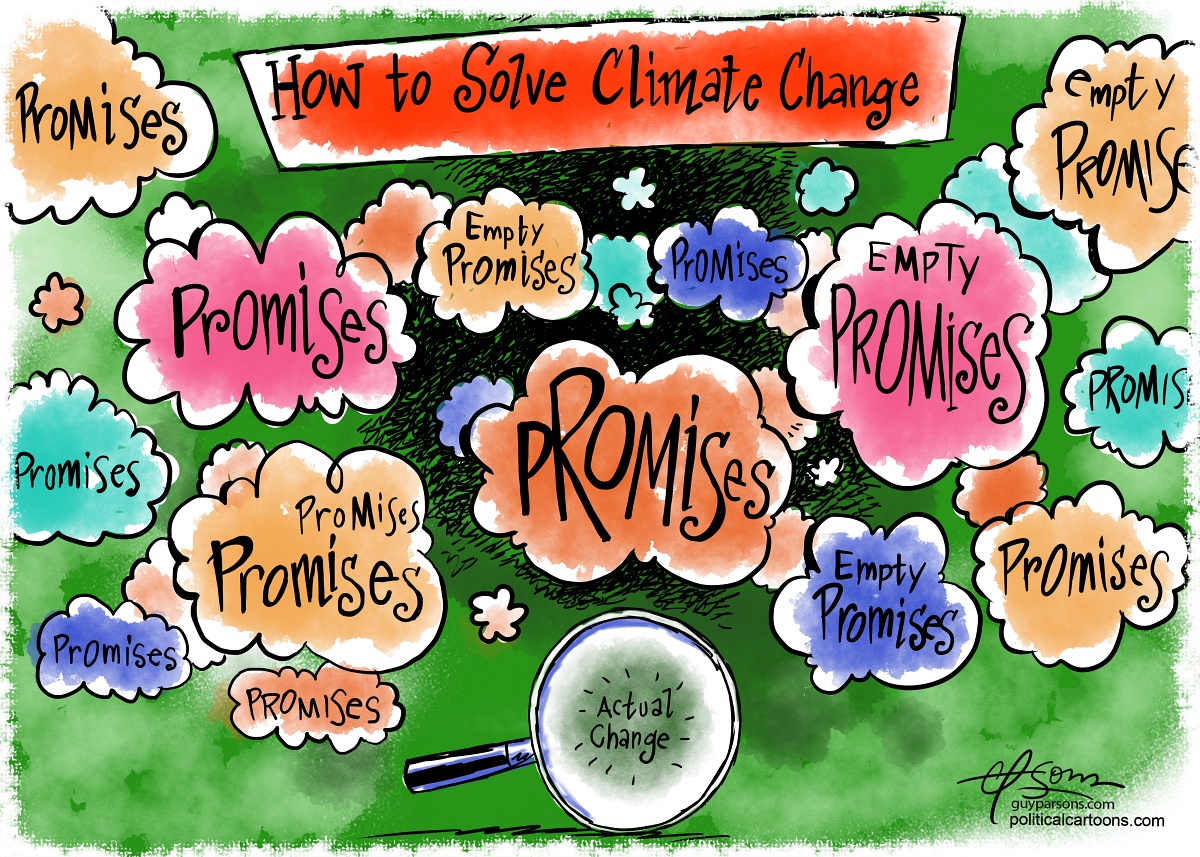
Cagle Cartoons: Guy Parsons


cop28
Dec 19, 2023 3:00 PM
Updated Feb 28, 2024 4:54 AM
Many of the countries attending COP were unhappy with the original draft, including most nations of the European Union and (although Kolbert does not say so) the USA.
The United Nations annual Climate Conference (COP28) has just been completed. Therefore it seems an appropriate occasion to examine how we’re doing. How so, as we near the end of what will be the hottest year in human history? How so, in taking steps to prevent greater future climate damage—droughts, fires, floods, storms, etc., all made worse by climate change.
Even though it has only been a short time since the conference’s end, much has been written about it. Some sources lauded its final statement. For example, the president of COP28, Sultan Ahmed Al Jaber, called it a “historic achievement.” The UN’s website on climate change stated that the conference “closed today with an agreement that signals the ‘beginning of the end’ of the fossil fuel era by laying the ground for a swift, just and equitable transition...In a demonstration of global solidarity, negotiators from nearly 200 Parties came together in Dubai with a decision on the world’s first ‘global stocktake’ to ratchet up climate action before the end of the decade–with the overarching aim to keep the global temperature limit of 1.5°C within reach.”
Other sources, however, were much more gloomy. But since I am no expert, I’ve turned to three individuals who are: David Wallace-Wells, Elizabeth Kolbert, and Bill McKibben.
The first person is a New York Times (NYT) journalist and author of The Uninhabitable Earth: Life After Warming (2019). He is also the author of a New York Times newsletter that subscribers can regularly receive. Kolbert writes for The New Yorker and is the author of The Sixth Extinction: An Unnatural History, which won a Pulitzer Prize in 2015. And McKibben helped found 350.org, which on its website notes that it has “active local groups” in more than 70 countries; provides “more than 10,000 “activists provided with tools and trainings every year”; and last year led or supported worldwide more than 680 “campaigns and events.” In Sen. Bernie Sanders’ 2016 campaign, McKibben acted as an environmental adviser. More recently he founded Third Act, “which organizes people over the age of 60 to work on climate, democracy, and racial justice.” He’s also authored about a dozen books on the environment, including his first, 1989’s The End of Nature. (See here for my review of his latest book).About McKibben the progressive congressman Rep. Jamie Raskin has written, “If we survive the interlocking plagues of climate change, right-wing authoritarianism, and savage inequality, future generations will utter the name of the New England moral visionary and activist McKibben with the reverence we speak of Emerson, Thoreau, and Garrison. ”
Related stories
Regarding the first of these experts, David Wallace-Wells begins by noting the contrast between the positive hype about the conference—“the first time nearly every country on Earth agreed that oil and gas play a role in driving global warming, and the first time they nodded toward the need for a fossil fuel drawdown”—and the catastrophic reality. The main reason for that ugly reality? The “drawdown” is already occurring. “In 2022, 83 percent of new global global energy crisis was green. The question isn’t about whether there will be a transition, but how fast, global and thorough it will be.” And, according to Wallace-Wells, that’s “not fast or global or thorough enough.” Because the COP 28 resolution only “calls on” nations to “contribute” to “transitioning away” from fossil fuels, it’s “quite mealy-mouthed.”
Wallace-Wells refers to the UN Intergovernmental Panel on Climate Change’s “Special Report on Global Warming of 1.5 Degrees Celsius,” published in 2018. It alerted us to the fact that “to avoid really dangerous warming required cutting global emissions almost in half by 2030.” But Wallace-Wells writes, “We are now halfway through that period, and emissions are higher than they were when the report was published.”
He goes on to cite the report’s probable findings that if we end up between 1.5 degrees and 2 degrees, which now seems likely: “More than 150 million people would die prematurely from the air pollution produced by the burning of fossil fuel responsible for that level of warming. Around the world, flooding events that used to arrive once a century....would instead strike annually—and in some places more often than that.” Moreover, “most scientists believe” such a rise “would be a death sentence for the world’s coral reefs. And many believe that, in that range, the planet will lock in the permanent loss of many of its ice sheets, which could bring, over centuries, enough sea level rise to redraw the world’s coastlines.”
Before he ends his NYT opinion piece, Wallace-Wells admits that a few years back he was more optimistic and that “more progress is possible,” that the “Dubai consensus that renewable rollout should triple by 2030 is one sign that, in some areas, impressive change is begetting more ambition.” But then he ends by writing, “for all of our temperature goals, the timelines are growing shorter and shorter, bringing the world closer and closer to futures that looked so fearsome to so many not very long ago.”
Turning next to Kolbert’s assessment in The New Yorker, she mentions early on (as many others have) the irony that “the president of COP28, Sultan Ahmed Al Jaber . . . also happens to be the head of the United Arab Emirates’ [UAE] state-owned oil company.” Thus, she does not find it surprising that the first draft of the final conference statement omitted any language about phasing out fossil fuels. (Like Saudi Arabia, which she tells us gets almost half of its G.D.P. from selling fossil fuels, the UAE makes a lot of money from such fuels, which are a major contributor to global warming.) She quoted former Vice-President Al Gore as tweeting that the first draft, “reads as if OPEC dictated it word for word.”
But many of the countries attending COP were unhappy with the original draft, including most nations of the European Union and (although Kolbert does not say so) the USA. Especially unhappy were “representatives of small island nations, many of which are in danger of disappearing under rising seas.”
Thus, the more acceptable final draft. But, like Wallace-Wells, Kolbert is skeptical and believes that the final statement is “more a measure of previous failures.” (As she says near the end of her article, “after twenty-eight COPs, and twenty-eight years of rising emissions, skepticism is clearly justified.”) She cites the 1992 United Nations Framework Convention on Climate Change, but notes that “since the treaty was adopted, the world has emitted more CO2 than it did in all the prior millennia of human history. This dismal record reflects failures and injustices of many different kinds; what unites them is a refusal—largely by the Global North, but also, increasingly, by nations in the South—to face up to a simple set of geophysical facts. Burning fossil fuels inevitably produces carbon dioxide. CO2 hangs around in the atmosphere for a long time—on the order of centuries—and, the more it builds up in the air, the warmer the world will get.”
And she points out this year could be described as “the most dire,” except the word is “too weak.”—“extreme heat waves, extreme rainfall, rapidly intensifying hurricanes, ever-increasing melt off of the Greenland and West Antarctic ice sheets [five links removed after dash.] (Just in the final days of the COP, heat records were set in places as varied as Spain, China, and Mauritius.)”
She concludes, “What matters, of course, is not what language countries agree to but what they actually do.” In this regard she finds the Saudis, who “have no intention of ceasing to export, or use, fossil fuels,” more honest than the U.S. For we push “for a phaseout [of fossil fuels], but show little evidence of transitioning away from or even slowing down fossil-fuel production. (In recent years, the U.S. has become the world’s largest oil producer, pumping out some twenty million barrels a day, and also the world’s largest producer of natural gas.)”
Like Wallace-Wells and Kolbert, McKibben is skeptical and would not agree with the COP28 president that it was a “historic achievement.” Rather he said, “Virtually every word that Sultan Al-Juber said is nonsense.” But McKibben seems a more indefatigable and hopeful person than the journalists Wallace-Wells and Kolbert. Two years ago regarding his founding of Third Act, pro-business Forbes magazine wrote, “Bill McKibben, who has been called America's foremost environmentalist, never seems to run out of steam. On the contrary, at 60, he's firing up the boilers of activism again.”
He’s also more of an activist than either Wallace-Wells or Kolbert, both primarily journalists. Thus, his reaction to COP28 is affected by that. And he believes that the words about transitioning away from fossil fuels were the most important “victory from this year’s climate talks.” He “urged climate activists to make use of that wording and pressure policymakers to follow through on the pledge,” and that “it will only be a significant victory if we make it one.”
In an interview with a man who about COP28 wrote that “the tortuous nature of the outcome, watered down and officially toothless, left me feeling glum,” McKibben answered: “It shouldn’t discourage us overly...because the UN negotiating process was always going to be a lagging indicator, serving the lowest common denominator. The main hope lies in the rapid fall in the price of renewables and hence their rapid buildout. The challenge for the movement lies in catalyzing that transition off fossil fuel to happen even faster.”
As to be expected, McKibben’s response to COP28 has been to urge more activism. He publicly applauded a letter sent to President Joe Biden and U.S. Energy Secretary Jennifer Granholm by more than 230 groups, urging them to halt the approval process on a new liquefied-natural-gas-export facility in Louisiana. He thought that whether the administration halts the process or not will be a test of its commitment to clean energy. (According to one report, “In the first half of 2023, the U.S. exported more liquified natural gas [a fossil fuel] than any other country, but the process of liquifying, chilling, shipping and burning it creates more greenhouse gas than burning coal.”)
Asked “How can we effect change on an individual level?” McKibben’s response was “the most important thing an individual can do is be less of an individual, and join together with others in movements large enough to change the basic economic and political ground rules. That’s why we build organizations like 350.org or Third Act—to leverage our joint power.”
In addition, however, he seems to suggest that all we progressives need to work hard to insure the 2024 elections turn out okay. His prediction if they don’t? “If the GOP wins, we get at least a four-year pause in progress, not just here but around the world. This election could cost us our democracy and our planet.”
One of 350.org latest efforts, as explained to me and others in a December email from McKibben, was a web “series focused on nonviolence and civil disobedience.” The first program in the series (on 14 December) was on “The History of Nonviolence: From Thoreau and Tolstoy and Gandhi.” A decade ago on this site, I wrote about Tolstoy's pacifism about Tolstoy’s pacifism, and I’ve often mentioned Gandhi and the appreciation of his ideas by Americans such as Dorothy Day and Martin Luther King Jr. Thus, I like McKibben’s emphasis on nonviolent activism and his belief that those working to defang climate change need to pay more attention to strategies and tactics. (In a 2023 book, Practical Radicals: Seven Strategies to Change the World, the authors devote part of a chapter to 350.org and write, “Campaigns win by undermining institutional pillars that hold up a social consensus or by delegitimizing them, just as 350.org has done in its climate change work.)
I also like McKibben’s emphasis on hope. When asked how he maintains it; “how do you not succumb to a kind of climate despair?” He answered, “I get out in the woods every day and remind myself it’s still a beautiful planet despite all we’ve done to it!” Reminds me of one of my favorite poems (written almost a century and a half ago), Gerard Manley Hopkins’ “God’s Grandeur.”
Generations have trod, have trod, have trod;
And all is seared with trade; bleared, smeared with toil;
And wears man's smudge and shares man's smell: the soil
Is bare now, nor can foot feel, being shod.
And for all this, nature is never spent;
There lives the dearest freshness deep down things. . . .
Comments

Powered by RoundtableAn AI/DeFi-powered Enterprise Media Operating System. Learn more at Roundtable.io.© Roundtable 2026. By using this site you agree to the Terms of Use and Privacy Policy