
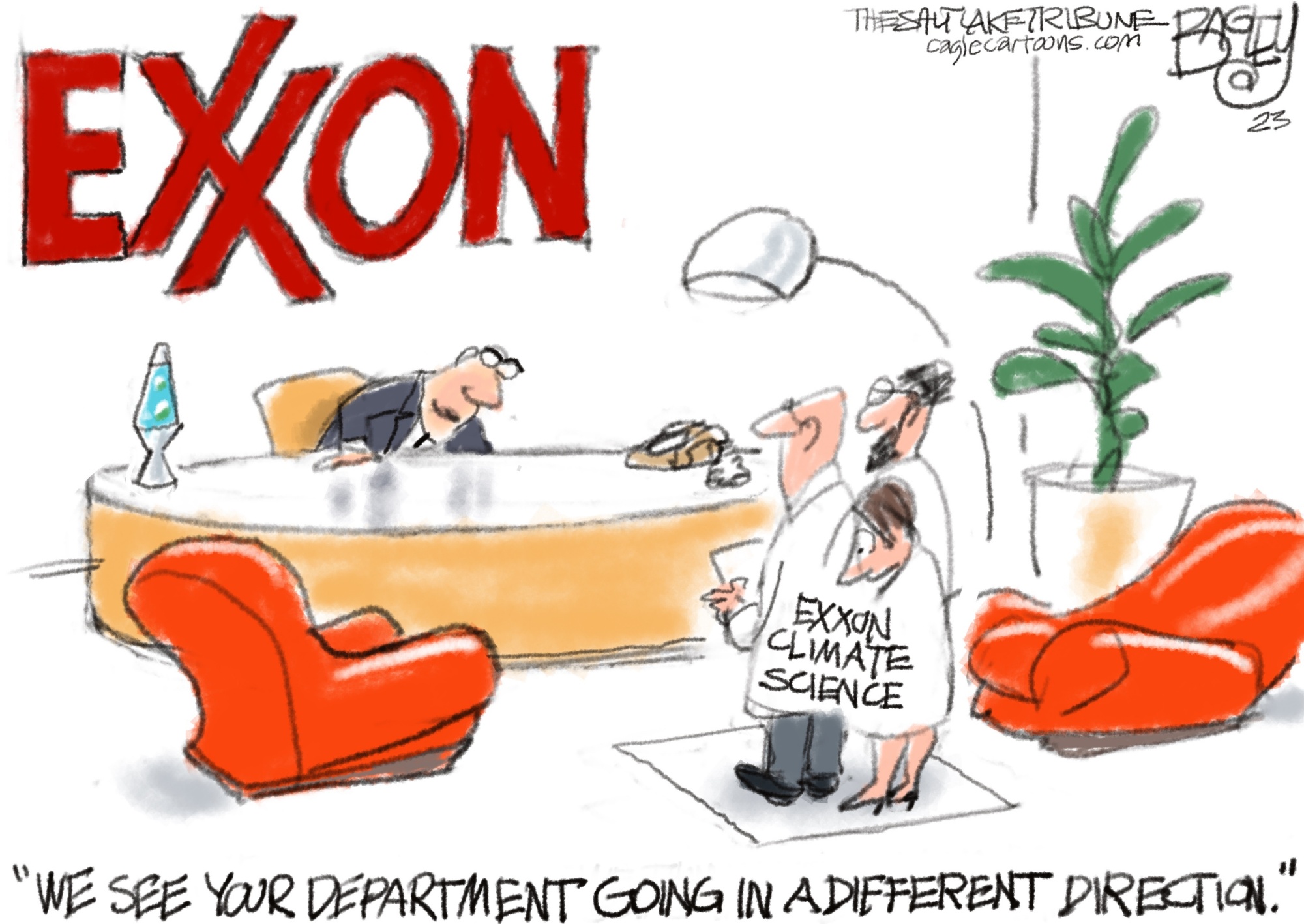
Illustration by Pat Bagley on Cagle Cartoons


Sep 17, 2023 2:00 PM
Let’s remind them that the “men” responsible for the death and misery are the CEOs and shareholders of every fossil fuel company wreaking havoc on the climate.
“Humans caused this disaster! Not climate change!”
After the horrific flooding in Libya caused by the collapse of two dams during heavy rains, many climate change deniers (and even some climate change commentators) are claiming it was corruption and poor infrastructure that led to the deaths of more than 11,000 people.
These folks made similar comments regarding the devastation in New Orleans after the levees burst during Hurricane Katrina. “It’s not a natural disaster! It’s a man-made disaster!”
While it’s true that authorities are responsible for not maintaining the two dams that burst near Derna, it’s also true that without heavier than usual rains, the lack of maintenance wouldn’t have had catastrophic consequences.
Related stories
Climate change doesn’t take place in a vacuum. It’s happening all over the world, where there are corrupt governments, governments without resources, incompetent governments. It’s happening where there’s strong infrastructure and where there’s weak infrastructure.
“Corruption” takes on multiple meanings when the richest nations in the world, with the best infrastructure, are also the nations subsidizing and extracting the most fossil fuels.
Even in rich countries like the U.S., climate breakdown is devastating. Texas, one of the richest states in the country, saw its electrical grid fail during a winter storm. California has one of the strongest economies in the entire world, but the decision not to cut the power near Paradise led to that city’s almost total annihilation. A similar poor decision in Hawaii led to the tragedy in Lahaina.
Much of New Orleans was built on landfill, below sea level. With or without climate change, that probably wasn’t wise.
In rich nations across the world with well-funded infrastructure and reasonably democratic government, humans still build too close to the coast. They still destroy wetlands. They still import non-native grasses that increase wildfire risk. They still build in valleys that act as wind tunnels during firestorms. They still do many things that exacerbate every natural disaster.
Humans are the main cause of climate change, so no matter what specific act of corruption or failed infrastructure or poor planning or mismanagement contributes to any given disaster, humans make up two of the three ingredients for every disaster. The “natural” part exists because climate and weather exist. But humans pumping out greenhouse gases transform the “natural” disaster into unnatural proportions.
It’s impossible to separate natural disasters from man-made disasters because we are bound together through our interactions with nature and one another.
We exploit resources to gain personal wealth. We destabilize other nations to take advantage of their resources. We go to war over oil. We create the instability which ensures that any natural disaster, even before amplification by climate change, will be catastrophic.
Even in a near-perfect world, where our only sin was the continued use of fossil fuels, we’d still be responsible for the deaths, injuries, and property loss from the heavier rains, stronger storms, and hotter heatwaves ravaging communities across the planet.
We can’t dismiss the impact of climate change simply because it affects imperfect humans. There’s no city, state, or nation made of perfect clones of Jesus Christ (or whoever the perfect person in your religion or mythology might be).
Mistakes are part of the human condition. Will we only consider death and calamity the result of “real” climate disaster if it happens in a utopia?
When fossil fuel corporations and their allies frame death and misery as man-made, let’s amplify that framing by pointing out that the “men” responsible for that death and misery are the CEOs and shareholders of every fossil fuel company wreaking havoc on the environment.
Comments

Powered by RoundtableAn AI/DeFi-powered Enterprise Media Operating System. Learn more at Roundtable.io.© Roundtable 2026. By using this site you agree to the Terms of Use and Privacy Policy