


Dec 15, 2025 8:00 AM
Updated Dec 30, 2025 6:13 PM
Isn't it time to admit the young people who are depressed and pissed off about climate change have good reason to be, instead of trying to make their anger the problem?
Someone I consider a friend sent me an American Enterprise Institute [fossil fuel company astro-turf organization] underwritten piece of drivel, which Peter Savodnik (who’s written for the New York Times, Guardian, Medium, The Atlantic, et al.) published under his own name at The Free Press, where he is Senior Editor, and his Substack.
The piece attempts to make the case that alarm over climate change is overblown, and with new facts coming out is actually ebbing. However in the meantime poor academic Roger Pielke Jr. (a senior fellow at AEI, quoted extensively)was driven from his position by his peers for having the audacity to suggest, well, just that.
For those possibly still confused over this particular chestnut, I offer my response. The thrust of the AEI in this and similar fossil company propaganda is to confuse 'political realism' with physical realism. One is our understanding of the nature of the reality in which we live; the other is a lowest common denominator construct of how we choose to act in that reality. One has natural limits, the other is limited only by strength of will, it seems, but that only works for a time.
For certain, reading this will take far less time than reading their propaganda, so I humbly suggest there's really no excuse not to. Other than preferring ignorance to knowledge. That I understand, but cannot condone. Forgive me if that sounds harsh to anybody.
Related stories
To correct the abundant misapprehensions presented in the AEI/Free Press piece, reflect on the following: it's all a question of timing. Allow me to offer eight points, the sum of which I hope will lead you to conclude we are in uncharted, very dangerous waters.
1) The RATE OF CHANGE is what we're talking about. When environmental conditions change too rapidly for a species to adapt, it becomes extinct.
"Extinction is the rule. Survival is the exception."— Carl Sagan.
Despite AI or the latest iPhone, in that sense we are no different than any other species. The idea that humanity has the ability to change the Earth system rapidly for the better via some new technological fix rather than through altering our behavior about how we create and use energy remains fantasy, at this time.
2) Through various means scientists have been able to approximate conditions going back to the beginning of life, 500 million years ago. In that time there have been many periods of vastly higher atmospheric CO2, with far different flora and fauna: but there were no mammals for example, let alone human beings.
3) Climate scientists have been able to analyze conditions more or less directly back 800,000 years. In terms of geologic conditions this has been a relatively stable period, with glacial and interglacial cycles alternating roughly on a 50,000 year cycle. Over the last 800,000 years the shift from a glacial period to an interglacial period has been triggered by atmospheric CO2 shifting between 180ppm (parts per million) and 280ppm, a difference of 100ppm. This shift has previously occurred on the order of 20,000 years. That additional 100ppm of CO2 in the atmosphere made the difference between all of the Northern hemisphere being a frozen ice sheet and the conditions we have now, during which civilization evolved—because that's what it was 20,000 years ago, when atmospheric CO2 was 180ppm. According to the natural cyclic timeframe we should be trending toward another glacial era: instead we're headed in the opposite direction, fast.
4) At the beginning of the industrial revolution (about 1800 AD) atmospheric CO2 was 280ppm. We are now up to 426 ppm, having added 146 ppm in only 225 years (roughly one and a half times what it takes to shift from a glacial to an interglacial, in 20,000 years).
5) The DIFFERENCE IN THE RATE OF TRANSITION between what has occurred over the last 800,000 in a glacial—interglacial transition and that which has occurred on average over the last 225 is roughly 30,000; that is, compared year to year we are adding carbon 30,000 times faster than occurs naturally, which the planet has ways of buffering on a 20,000 year time scale. All data available here.
6) In the example above I did not take into account the fact that the rate is not fixed, but increasing thanks to 5000 lobbyists at every COP (Conference of the Parties) preventing meaningful action. I.e. what we added from year 1800 to 1801 is a lot different than 2023 to 2024:
"The rate of increase in atmospheric carbon dioxide (CO2) has accelerated significantly over the last decade, with an average annual growth rate of about 2.4 parts per million (ppm) from 2011 to 2020, which is three times higher than the average growth rate from the 1960s. In 2024, CO2 levels reached a record high, with a one-year increase of 3.75 ppm, marking the largest increase on record." World Meteorological Association
7) How that shows up: The Earth is not a microwave. If you lock up your car on a hot day and come back in three minutes you may not notice the difference, but come back in an hour and you'll be rolling down the window in a hurry. The CO2 we put into the atmosphere takes 700 years to dissipate. Methane is 80 times worse in terms of heat-trapping over its 80 year span before it degenerates, and because of this, while burning cleaner than coal or oil, more than 3% leakage (from wellhead to point of use) erases this benefit. Under current usage far more than 3% leaks, let alone under increased use when resorted to as a 'bridge fuel'. Nuclear is a negative once you factor in waste disposal, time to build and bring online, carbon to build and mine and refine the ore, while ignoring the increased danger from human incompetence (Chernobyl, Three Mile Island, Santa Susanna), natural disasters (Fukushima, low rivers), war (Ukraine) or terrorism (Indian Point was contemplated as a target by Al-Qaeda) suddenly turning it into something far less beneficial. The difference between your car and the Earth is that there is no window to roll down. How much time do we have to make the necessary adjustments? We don't know. It's beyond the capacity of our models, even with AI; the Earth system is far too complex. The time lag involved lets carbon producers cherry-pick stats to sow doubt, like, 'there are no more hurricanes,' ignoring the fact that the ones that are there are causing far more damage.
NOTE THE INCREASE:
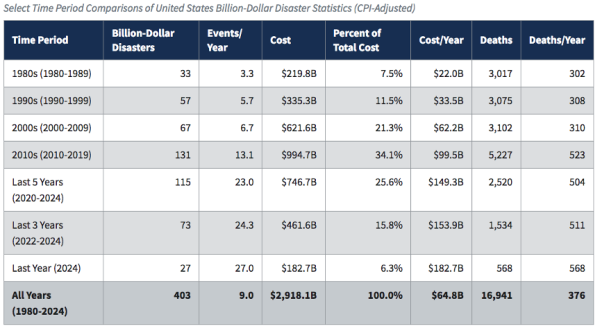
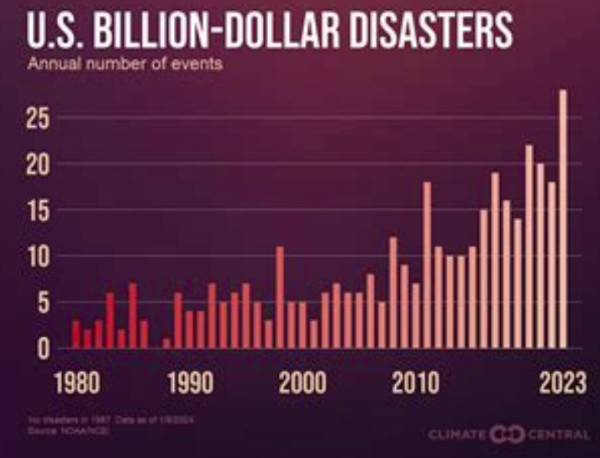
8) In Conclusion: there is cause for alarm, the discontinuance of the use of fossil fuels for energy, and the adoption of solar and wind, which are cheaper now than coal or oil anyway. The fight continues however, because as evidence of the fossil companies' obfuscation becomes widely known they are desperate to avoid culpability for their actions, and our political and media systems, globally, are far too vulnerable to their influence.
Are we past Earth's tipping points? Time will tell...
"I won't be alive to see it," is not an answer reflecting the gratitude we owe for existence.
Isn't it time to admit the young people who are depressed and pissed off about climate change have good reason to be, instead of trying to make their anger the problem?
Comments

Powered by RoundtableAn AI/DeFi-powered Enterprise Media Operating System. Learn more at Roundtable.io.© Roundtable 2026. By using this site you agree to the Terms of Use and Privacy Policy