



Climate Change and Capitalism
Mar 23, 2024 2:20 AM
We avoid labeling our economy either capitalist or socialist and instead just battle for one that was “fair and moral.”
Emerson once wrote, “A foolish consistency is the hobgoblin of little minds. . . . With consistency a great soul has simply nothing to do.” I’m not sure I agree with all of that, but certainly we should all be willing to revise our thinking if we discover new evidence that suggests we should do so.
Previously—in such essays as “Climate Change and Capitalism”—I had viewed capitalism as more the enemy than the friend of our efforts to limit or even end the dangers of climate change. Recently, however, I discovered a new book, Akshat Rathi’s Climate Capitalism: Winning the Race to Zero Emissions and Solving the Crisis of Our Age, which claims “a new perspective on the climate problem.” It attempts to show “why it’s possible to harness the forces of capitalism to tackle the climate problem—and how the work has already begun.”
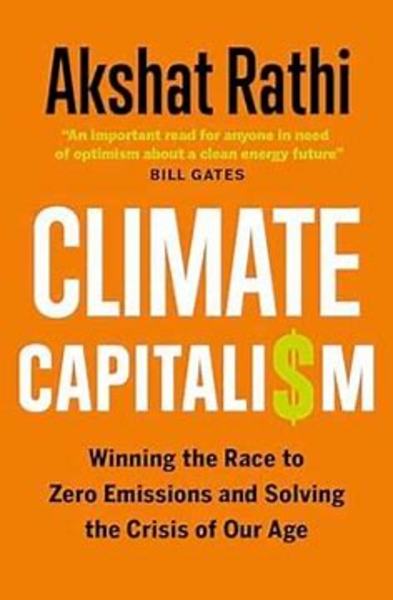
Rathi, who was born in India, received a Ph.D in Chemistry from Oxford University, and is now a British-based climate reporter for the financial news outlet Bloomberg, believes this harnessing has occurred primarily because the driving force of capitalism—the search for profits—is now motivating people to turn toward green energy. He writes, for example, “Capitalists have also woken up to both the cost of inaction and the opportunity of action. Private capital is being redeployed, with more than $35 trillion worth of assets—more than a third of all invested assets—now aligned with global environmental, social, and governance goals. It’s already having an impact.”
Note that Rathi does not say that capitalism is the solution to climate change, only that it can be more of a friend than an enemy towards our present efforts to deal with this present crisis, which threatens to overcome us like an oncoming tsunami.
Related stories
After an introductory chapter, he devotes the remainder of his book to successful examples of how “climate solutions... can be built.” He starts with China and India. He demonstrates how the former has used capitalism in its own “peculiar way to become the world’s largest maker and buyer of electric cars and batteries [giving it... a commanding lead on almost every green technology.” In India he highlights “the success story of solar power.” It demonstrates “how developing countries with messy democracies and weak governance can still grab on to the opportunity to leapfrog the fossil fuel era and start building clean energy at scale.”
Rathi does not say that capitalism is the solution to climate change, only that it can be more of a friend than an enemy towards our present efforts to deal with this present crisis
Poorer countries such as India, however, require outside help, and Rathi demonstrates how such international institutions as the International Energy Agency (IEA) have aided India in its solar initiatives.
Turning to more capitalist countries like the USA, he highlights how capitalists like Bill Gates—"who is one of the biggest private funders of climate technologies and whose lobbying efforts have been crucial in landing the biggest US climate bill"—demonstrate “how private capital and government regulations can work in tandem.” Rathi admits that “fixing capitalism will mean not just reforming how business is done but also completely transforming some industries,” and he thinks that the “hardest will be the change-over of oil and gas companies,” but he still believes the “fixing” is possible. Possible that is if there is general recognition that “government policy” will need to play “a crucial role.”
In his last two chapters, Rathi examines “how to make good climate laws and how that can transform countries and businesses.” Plus, he looks at “how corporate shareholders are starting to use their power to force businesses to change.”
Having summarized Climate Capitalism, we now return to the question of whether or not my earlier articles viewing capitalism as more of an enemy than a friend in the fight against global warming need to be reevaluated. The answer is “yes.” Reevaluated, but not necessarily overturned. The ambivalence stems from two sources:
- The varying ways capitalism has been (and continues to be) defined; and
- past developments vs future possibilities.
About a year ago, I wrote that “Senator Bernie Sanders has a new book out, It’s OK to Be Angry About Capitalism. And in it, his main argument is essentially correct: Our ‘uber-capitalist economic system... is grossly immoral.’” Note that Sanders wrote “uber-capitalist,” thus suggesting various qualifiers of capitalism. And throughout its centuries-long development, we have seen plenty of alterations.
In that same essay, one modification that was mentioned was that of progressives of the 1890-1914 period. They hatched a diverse movement “to limit the socially destructive effects of morally unhindered capitalism, to extract from those [capitalist] markets the tasks they had demonstrably bungled, to counterbalance the markets’ atomizing social effects with a countercalculus of the public weal [well-being].” It did not attempt to replace capitalism, but to have the government and laws constrain it so that it served the public good.
Following an interlude of Republican presidents in the 1920s and early 1930s, Franklin Roosevelt was elected and served as president from 1933 to 1945. Some opponents called him a “socialist,” others claimed that he saved U. S. capitalism.
Whether an individual or political movement was more capitalist or socialist was also disputed in certain areas of post-WW2 Europe, with the “welfare state” in Great Britain being one example. One definition perceived it “as a capitalist society in which the state has intervened in the form of social policies, programs, standards, and regulations in order to mitigate class conflict and to provide for, answer, or accommodate certain social needs for which the capitalist mode of production in itself has no solution or makes no provision.” Others, like Britain’s Margaret Thatcher, thought the welfare state smacked too much of socialism.
By the beginning of the twenty-first century, most of the world’s economies were "mixed,” neither purely capitalistic nor socialistic but combining some degree of private ownership and government economic controls
By the beginning of the twenty-first century, most of the world’s economies were "mixed,” neither purely capitalistic nor socialistic but combining some degree of private ownership and government economic controls. Even the U.S.
State Department in 2001 declared that though “the United States is often described as a ‘capitalist’ economy,” it “is perhaps better described as a ‘mixed’ economy, with government playing an important role along with private enterprise.”
Although Sen. Sanders is a self-proclaimed democratic socialist, in his It’s OK to Be Angry About Capitalism it seems that he is urging the U. S. to adopt not democratic socialism, but a kind of a kind of FDR progressivism or what the economist Joseph Stiglitz calls “progressive capitalism,” which combines a market economy with government regulation. In his Climate Capitalism, Rathi seems to be arguing for a similar “progressive” approach.
It is because of these murky waters in which capitalism floats that I once suggested (five years ago) that we avoid labeling our economy either capitalist or socialist and instead just battle for one that was “fair and moral.” And such an economy—as Sanders, Stiglitz, and it seems Rathi desire—would tackle climate change with a non-dogmatic combination of market and government incentives and whatever government regulation and cross-national cooperation is required.
A second reason Climate Capitalism does not contradict much of what I have earlier written is that Rathi is offering us a blueprint of what our future dealing with climate change could look like. He does not deny that in the past, world leaders and the nations that have followed them have often not been as enlightened (or determined) as they will need to be in the future—that is if we are to avoid a climate catastrophe. As he writes, “There is no denying that unfettered capitalism has contributed to warming the planet.” And, “The unchecked use of fossil fuels... has unleashed climate instabilities that threaten the very fabric of life on Earth. It’s possible that entire swaths of the planet will become uninhabitable.”
Moreover, Rathi realizes that his urgings are no guarantee that his wishes will be followed. His hopes for India’s continuing solar revolution, for example, face very strong future obstacles. Perhaps even more significantly, if in November 2024 Donald Trump is once again elected as U. S. president, many of Rathi’s hopes will undoubtedly be crushed. Trump’s future approach is indicated by the conservative Heritage Foundation’s Project 2025, a 1,000-page plan referred to as the “‘battle plan’ for the first 180 days of a future Republican presidency.” Trump would probably boost the production of fossil fuels; gut the EPA (as he did in his earlier presidency); shred regulations to curb greenhouse gas pollution from cars, oil and gas wells and power plants; dismantle almost every clean energy program in the federal government; and repeal the Inflation Reduction Act, the 2022 law that offered $370 billion for wind, solar, nuclear, green hydrogen and electric vehicle technology.
Such likely actions are just one more reason—out of so many--that progressives must do all they legally can to prevent another Trump presidency.
Comments

Powered by RoundtableAn AI/DeFi-powered Enterprise Media Operating System. Learn more at Roundtable.io.© Roundtable 2026. By using this site you agree to the Terms of Use and Privacy Policy