
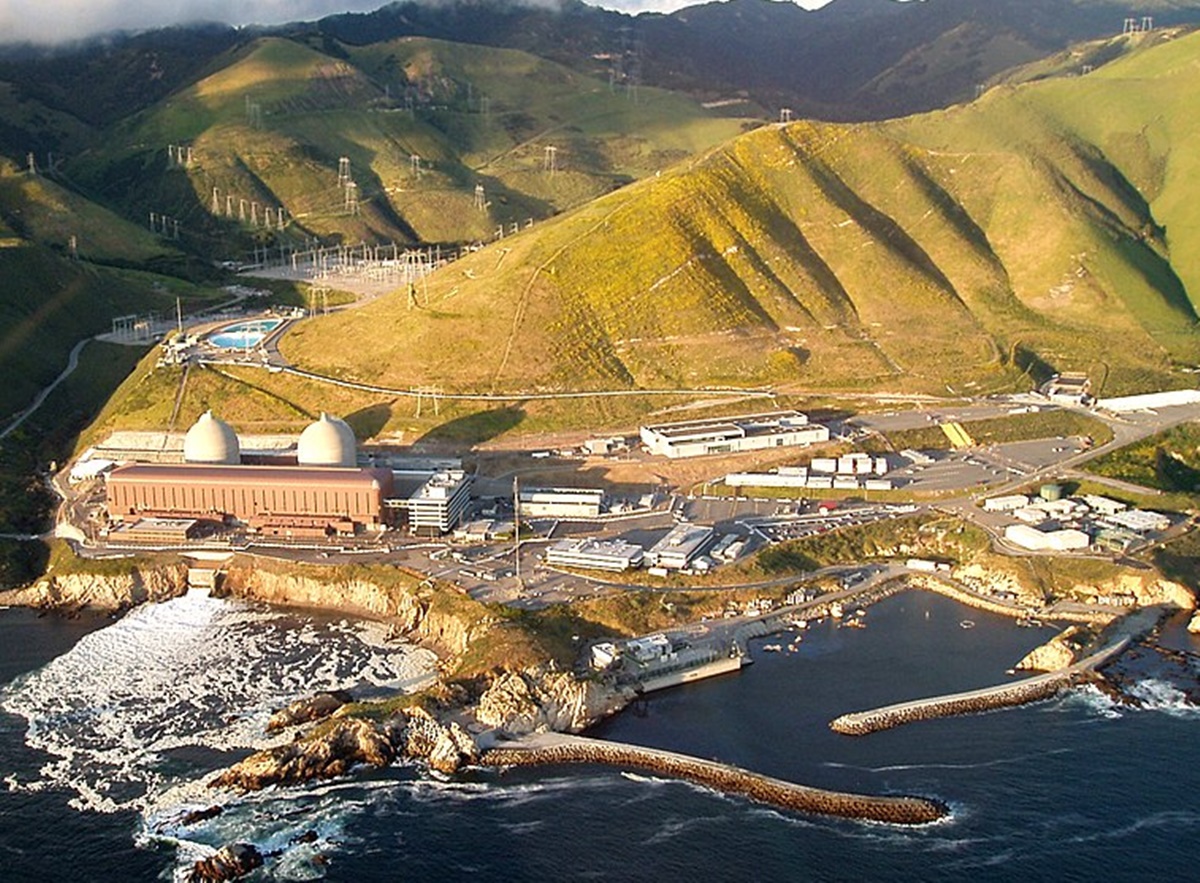
Photo by: emdot - Licensed under the terms of the cc-by-2.0.


Aug 3, 2023 4:29 AM
Updated Feb 28, 2024 4:55 AM
Lethal radiation clouds could pour into Los Angeles, the Central Valley the Bay Area, then across the entire North American continent.
The epic half-century war over central California’s dangerously embrittled atomic reactors at Diablo Canyon is about to explode.
Diablo Unit One is scheduled to shut for re-fueling in October, a process that usually takes about 50 days.
But will it re-open?
That loaded question has ignited intense legal, political, economic and engineering warfare that will help shape how humankind responds to our super-heated climate crisis.
Related stories
It may also define the career of Governor Gavin Newsom, a likely Democratic presidential nominee should Joe Biden falter.
At Ground Zero are Diablo’s embrittled reactor pressure vessels (RPVs), the six-inch-thick metal cylinders containing the plant’s super-hot chain reactions.
Both Diablo reactors are nearly 40 years old. Decades of relentless heat, radiation and pressure have degraded the plant as a whole, taking down the resilience of the RPVs.
Such embrittlement is endemic. Should emergency cooling water be poured into an embrittled super-hot RPV during an unscheduled emergency shut-down, it would most likely shatter. Steam, hydrogen and/or fission explosions would ensue, as happened to three American-designed reactors at Fukushima.
Lethal radiation clouds could pour through the California countryside, into Los Angeles, the Central Valley and the Bay Area, then across the entire North American continent.
In Diablo’s case, lethal radiation clouds far beyond the killing power of those released at Chernobyl and Fukushima—-and at Hiroshima and Nagasaki—-could pour through the California countryside, into Los Angeles, the Central Valley and the Bay Area, then across the entire North American continent.
In 2002 a Nuclear Regulatory Commission (NRC) inspection warned that Diablo Unit One was among America’s five most embrittled cores. The RPV has not been tested since. But there’s every reason to believe the problem has worsened.
The Unit One core was manufactured with substantial quantities of copper, which have since been found to hasten embrittlement. Such amalgams have been banned from subsequent reactor construction. But the soft copper alloy used in manufacturing Unit One’s core underscores the need to test for embrittlement.
Likewise the threat of earthquakes. When the reactors were being built (1969 through 1985) the pubic knew little of the site’s seismic dangers.
Diablo’s owner, Pacific Gas & Electric, revealed in 1973 that it had discovered a major active fault line—-called the Hosgri—-within three miles of the plant. At least ten more seismic faults—many of them interconnecting---have since been revealed within striking distance of the Diablo cores.
Diablo sits just 45 miles from the infamous San Andreas fault, a distance half that of Fukushima from the epicenter of the mega-quakes that repeatedly shook it, leading to disaster.
The tsunami that then swamped Fukushima’s four sea-level nukes was some 40 feet high. Diablo sits 85 feet above sea level. But its intake pipes and other key components are at sea level.
PG&E’s ability to safely manage Diablo is shadowed by a lethal history of catastrophic mismanagement, including 90 counts of federal manslaughter.
In 2010 its poorly maintained gas lines exploded in San Bruno, incinerating eight humans and 19 homes, leading PG&E to plead guilty to eight federal counts of involuntary manslaughter.
PG&E’s mismanaged power lines later ignited fires that devastated northern California, incinerated the town of Paradise, and killed more than 80 humans, causing PG&E to plead guilty to 84 additional federal manslaughter charges.
The company’s negligence and deferred maintenance has accelerated since the landmark 2016 agreement was made to phase out the reactors.
Under California’s coastal protection laws, and the federal Clean Water Act, PG&E faced a legal mandate to install expensive cooling towers meant to mitigate the plant’s massive hot water emissions. Beset by a crumbling infrastructure, rising costs and new renewables pricing Diablo out of the market, PG&E made clear its desire to shut the plant.
In 2016 the company joined in a monumental agreement to close both reactors by 2024 and 2025, when their 40-year Nuclear Regulatory Commission licenses would expire. The deal was signed by then-Governor Jerry Brown, then-Lieutenant Governor Gavin Newsom, the California Assembly, the California Public Utilities Commission and various other state regulatory agencies, nearby local governments, the plant’s labor unions, plus local, state and national environmental organizations (one significant hold-out remains the San Luis Obispo-based Mothers for Peace, which opposes any further operations at the planet).
In violation of the California Environmental Quality Act (signed by then-Governor Ronald Reagan in 1970), and of the federal Clean Water Act (with amendments signed by then-President Richard Nixon in 1972), the company has ducked building cooling towers, and still pours billions of gallons of hot water into the ocean, heating and irradiating the marine environment at Diablo Cove, Avila Beach and beyond.
Even before it opened, Diablo’s construction destroyed critical concentrations of black abalone, which have never returned.
Since the 2016 phase-out agreement, the Nuclear Regulatory Commission has let PG&E duck key maintenance procedures, casting deeper shade on the plant’s safety.
Newsom’s astonishing pro-nuke/anti-solar betrayal has infuriated California’s powerful environmental and consumer movements.
The agreement mandated replacing Diablo’s production capacity with new renewables.
California’s roof-top panels now far exceed power production at Diablo Canyon, even exclusive of large solar farms, wind energy, battery storage and increased efficiency. Individually-owned battery back-up systems, newly installed renewable capacity, and voluntary consumer cut-backs have at least twice avoided regional blackouts.
As large off-shore installations boom ahead worldwide, massive wind turbine production is poised to flow through the switching stations at the shut nuke site at San Onofre, and through the grid at Diablo once the reactors shut.
Diablo’s 2016 shut-down agreement provided for substantial compensation and retraining for the plant’s 1500 workers, many of whom would stay on for decommissioning . Some 70,000 Californians work installing rooftop solar, with far more jobs opening to replace the reactors’ 2300-megawatts of capacity with more roof-top solar, with panels covering the state’s aqueducts and canals, and with both on-shore and off-shore wind arrays.
The Diablo phase-out has been widely embraced as a pioneering template for a sane green transition. With its rare consensus embracing government, labor and the environmental movement, and with a huge boost to the state’s job market, accompanied by a tsunami of cheap, clean, reliable energy, it offered a global blueprint for a Solartopian alternative to a boiling planet.
Burning at 571 degrees Fahrenheit, Diablo’s global warming fires would finally be quenched, along with its uninsured risk to the state’s health, economic and ecological future.
But in 2022, Newsom took a brutal U-turn. Strong-arming the legislature, he demanded $1.4 billion in guaranteed state loans for PG&E while taking another $1 billion in federal money. He forced state agencies to let PG&E ignore a wide range of state laws, including the CEQA requirement for environmental impact assessments, and federal Clean Water Act requirements for cooling towers. Instead Newsom is allowing the plant to continue dumping hot radioactive water into the Pacific.
Meanwhile, Newsom’s hand-picked CPUC rubber-stamped a devastating attack against roof-top solar, gutting the rates at which panel owners could sell their clean power back to the grid, undercutting the state’s rapid transition to renewables.
Newsom’s astonishing pro-nuke/anti-solar betrayal has infuriated California’s powerful environmental and consumer movements. The Mothers for Peace ( www.mothersforpeace.org) and its allies are gearing up for legal challenges certain to shake the state’s political landscape. More than 20,000 citizens were arrested at Diablo before it opened, far more than at any other US reactor site. No Nuke veterans of the San Luis county jail are likely to soon be visiting again, along with their children and grandchildren.
The key moment may come in October, when Unit One may shut for refueling. During a 2019 refueling outage, more than 2,400 Californians signed a petition (www.solartopia.org) demanding Newsom allow an independent inspection before Unit One restarted. Among the signatories are Hollywood mainstays Jane Fonda, Martin Sheen, Lily Tomlin, Graham Nash, Mimi Kennedy, Eric Roberts, Jodie Evans, Ed Asner, Lila Garrett and many more. But he ignored them all.
While the nation and the world debate a “Nuclear Renaissance,” California’s fight centers on the demand for an independent inspection of two old, uninsured embrittled reactors, which are surrounded by earthquake faults while being thoroughly outstripped in price, job-production, safety and stability by a revolution in renewables.
The story has precedent.
In 1991, after it was shut by lightning, the Nuclear Regulatory Commission refused to allow Massachusetts’ Yankee Rowe reactor to re-open without first testing for embrittlement. When it didn’t, the plant shut forever.
This fall, California’s green movement will demand a re-run.
The fuse has now been lit on an epic confrontation with Governor Newsom, PG&E and two infamously decrepit nukes surrounded by earthquake faults, directly upwind from Los Angeles…whose fate hangs in the balance.
Myla Reson and Linda Seeley helped with this article.
Comments

Powered by RoundtableAn AI/DeFi-powered Enterprise Media Operating System. Learn more at Roundtable.io.© Roundtable 2026. By using this site you agree to the Terms of Use and Privacy Policy