



Jul 22, 2021 3:00 PM
Updated Feb 10, 2022 10:41 PM
Rosario Carrillo and John Ma: Through a UBI program, the federal government would provide a designated cash transfer to people, regardless of their income, job, or immigration status.

Paving the Way for Not Just Guaranteed Income Pilots, But Federal Universal Basic Income
The idea of passing universal basic income (UBI) legislation at the federal level is getting serious buzz. People love the idea of ending poverty, and the suffering associated with it, through a national basic income. The nonprofit Income Movement puts this policy milestone at about nine years away. Mayors for Guaranteed Income (MGI) is helping to increase momentum towards this goal. Will California provide the national leadership to cut the timeframe even further?
Through a UBI program, the federal government would provide a designated cash transfer to people, regardless of their income, job, or immigration status. Such a comprehensive and widely inclusive program represents a highly equitable form of unconditional cash allocations.
Through a UBI program, the federal government would provide a designated cash transfer to people, regardless of their income, job, or immigration status.
In contrast, guaranteed income (GI) typically involves local municipalities providing a designated cash transfer to only some members of society, based on certain conditions. In this case, participants are often subject to means testing. A means test is a way to assess a person’s income and financial need. For example, means tests are utilized to determine whether a family is eligible for things like Temporary Assistance for Needy Families (TANF). Often with conditional cash assistance programs, the more income a person earns, the less likely they will continue to be eligible. They can lose benefits if they participate in a GI program. GI programs are also often targeted to provide assistance to certain groups. Based on some GI programs in California, target groups can include incarcerated women, artists, and transition-aged foster youth.
Related stories
The worldwide Basic Income Community, including the North American Basic Income Guarantee (NABIG) Congress and the Basic Income Earth Network (BIEN) Congress, as well as the UBI Center, Basic Income Today, the Stanford Basic Income Lab, and city, county and state governments, deploy varying definitions of what counts as UBI, GI, and even basic income—a general term encompassing the spirit of unconditional cash transfers. We have added our articulations here to match the policy strategy we perceive to be at play in the United States—a de facto policy strategy pieced together by the popularity of the COVID-19 stimulus checks, the advent of the 2021 Child Tax Credit, and the numerous GI pilot programs emerging in cities across the nation. All of these cash transfer developments galvanize the push for UBI at the federal level; and, California is playing a pivotal role.
The widely available COVID-19 stimulus checks have paved the way for the public’s acceptance of the idea of UBI. The checks have become a widely accepted and applauded safety net policy. A study from the University of Michigan found that the two most recent rounds of checks significantly reduced food shortages, financial instability, and anxiety. Between December 2020 and late April 2021—during which Congress signed off on the two expansive coronavirus relief measures—the study found rates of food insufficiency among U.S. households fell by over 40 percent.
But people need and want more cash transfers. There are more than 2.3 million signatures on a Change.org petition started last year that calls on lawmakers to pass legislation for recurring $2,000 monthly payments.
California answered the call for more COVID pandemic relief. The Golden State Stimulus I checks of $600 or $1,200 per tax return targets working and middle-class families and individuals. An ITIN filer who made $75,000 or less (total CA AGI) qualifies. Under the Golden State Stimulus II, individuals with incomes between $30,000 to $75,000 qualify for a $600 stimulus check and qualifying families with kids, including undocumented families, qualify for an additional $500. Many of us in California have already gotten these stimulus cash transfers.
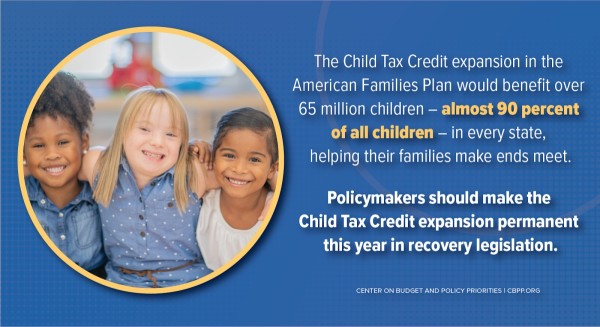
The 2021 Child Tax Credit has further cemented the concept of cash transfers in the public consciousness. Radha Seshagiri, Director at SaverLife, explains that the Child Tax Credit used to be distributed in a lump sum at the same time as other tax refunds. For the 2021 Child Tax Credit, if the IRS processed your 2020 tax return or 2019 tax return, monthly payments are available from July 15, 2021 and through December 15, 2021. This means that families can get up to $300 a month per child. Karen Dolan adds that, “If you didn’t earn enough in the last two years to file taxes, you can simply follow the directions posted on the White House website and sign up as a non-filer.” For mixed-status families, as long as the qualifying children have a social security number, the parents can use an ITIN to file and receive the Child Tax Credit checks.
The Tax Policy Center argues that the 2021 Child Tax Credit will, “deliver more cash support to low-income children than any other federal program, at least for one year.” Great idea, right? Especially during these uncertain economic times. And, yet, not all of the public knows how to get the 2021 Child Tax Credit. The credit is also not permanent. This is why the Economic Security Project, along with other national organizations, teamed up with local organizations to campaign for public awareness of this benefit. The awareness campaign, named Keeping Families Afloat, calls on Congress and the Biden Administration to make the policy permanent and inclusive to all, including immigrant families.
Among the 26 states participating in the Keeping Families Afloat events, California hosted the highest number of events. There were events in Sacramento, Fresno, Watsonville, Orange County, and Los Angeles. In Los Angeles, the event Rally for Child Checks was led by Ground Game LA, Income Movement, and Golden State Opportunity, which offers free tax advice through its grantees like Centro de Ayuda. Held at Hollenbeck Park and Lake on Saturday July 10, 2021, the event featured Congressman Jimmy Gomez (CA-34) who was a national leading voice on June 21, 2021, the White House's Child Tax Credit Awareness Day of Action.
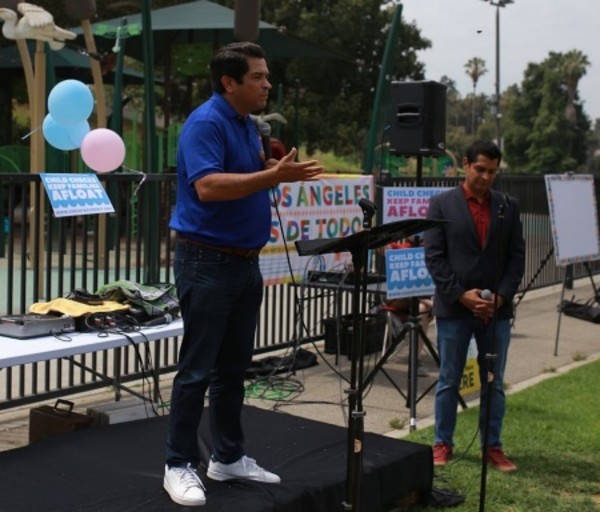
Currently serving on the House Ways and Means Committee, the Congressional Hispanic Caucus, and the Progressive Caucus, Congressman Gomez stated that, along with the Speaker of the House Nancy Pelosi and other representatives, he is fighting to make the 2021 Child Tax Credit permanent by including language in the next budget reconciliation bill package. Seeing the 2021 Child Tax Credit as a segue towards UBI, he said that, “the way you achieve it [UBI] is through a refundable tax credit.” He further underscored his idea: “This is the foundation and programmatic implementation of how you would achieve it [UBI]. Basic income for everyone, not just people with children.”
The five California Keeping Families Afloat events are important for several reasons. They represent the state’s local grassroots community leadership in advancing unconditional cash transfers. They further fuel the momentum for a federal UBI and the alleviation of multiple hardships due to poverty. For places like Fresno, Watsonville, Orange County, and Los Angeles, with high Latinx concentrations, the events engaged the largest racial and ethnic group in the electorate. Like the Black community, the Latinx community has the political power to steer the country towards UBI, if only it is included front-and-center in the basic income discourse.
The five California Keeping Families Afloat events are also important because they provided added visibility to the existing and developing GI pilot programs throughout the state. California’s GI pilots form part of the more than two dozen already launched or in progress nationwide. Leading all of these pilots is the Stockton Economic Empowerment Demonstration (SEED), founded in February 2019 by then-Mayor Michael Tubbs. The pioneering program provided 125 people living in neighborhoods at or below Stockton's median household income an unconditional monthly stipend.
Several other California cities have since either launched or announced cash transfer programs similar to SEED. In June, Oakland launched its program, providing 600 families with low incomes $500 per month for 18 months. Compton is also accepting applications for its GI program, called the The Compton Pledge. Through the Yerba Buena Center for the Arts, San Francisco has a GI program for artists. The six-month pilot program, which finished receiving applications earlier this year, will give 130 local artists affected by the COVID-19 pandemic a $1,000 monthly cash transfer. San Francisco is also home to the Abundant Birth Project, which offers $1,000 per month to 150 Black and Pacific Islander mothers for the duration of their pregnancies and the first six months of their children’s lives. Long Beach has announced that it will launch a program by the end of the year. San Diego and National City have plans to launch programs by September funded through the San Diego for Every Child nonprofit. West Hollywood, Santa Monica, Emeryville, Palm Springs, and Alhambra mayors have joined MGI. No doubt they are looking for ways to fund pilot programs as well.
In the Los Angeles metropolitan area, there are four GI pilot programs in the works. Mayor Eric Garcetti announced a $24 million commitment towards a program making Los Angeles the largest city in the US to test out GI. The Los Angeles County Board of Supervisors passed two guaranteed income motions. The motion by Board Supervisors Holly Mitchell and Sheila Kuehl mentions formerly-incarcerated African American women. The motion by Hilda Solis mentions low income people, regardless of immigration status. The final details of these efforts will be announced in the forthcoming months.
California is teeming with more pilots than in any other state in part due to the message that the Governor’s $35 million budget allocation for guaranteed income funding conveyed across the state.
California is teeming with more pilots than in any other state in part due to the message that the Governor’s $35 million budget allocation for guaranteed income funding conveyed across the state. MGI founder Michael Tubbs, who is now Special Adviser for Economic Mobility and Opportunity for the Governor of California, facilitated work with state leaders leading to the $35 million allocation. On Thursday July 15, 2021, the California legislature unanimously approved the $35 million creating the first state-funded guaranteed income plan in the US. Targeting pregnant people and young adults who recently left foster care, the funds are available to local governments and organizations, which can apply for the money and run their programs.
The California legislature has also placed several cash transfer bills on the floor, including AB-1338 Public social services programs: financial assistance demonstration and research programs and AB-65 California Universal Basic Income Program: Personal Income Tax. While both are being held in suspense by the Assembly Committee on Appropriations, SB-739, the California Universal Basic Income for Transition-Age Youth pilot project, has been re-referred to that committee. Under this bill, a California resident who ages out of the Extended Foster Care Program at 21 years of age during the year of 2022 would receive a basic income of $1,000 per month for 3 years, regardless of what age they entered the Extended Foster Care Program. The bill would exempt the cash transfer, to the extent permissible under federal law, from being considered as income for eligibility and benefit amount determination purposes for specified public social services, programs, and financial aid. SB-739 has some legs to it and would be a major step for California in the campaign towards basic income.
There is a common refrain that makes Californians proud: as California goes, so goes the nation. Is California the leader in unconditional cash transfers? Given the two rounds of California stimulus checks, the representation in the 2021 Child Tax Credit crusade this month, the concentration of pilot programs, the $35 million available statewide for guaranteed income pilots with an additional $24 million available in Los Angeles, and given that over one-fifth of the 57 mayors in MGI so far are in California, the better question is this: will California pave the way for not just local guaranteed income programs, but federal UBI?
September 25, 2021 will mark the 3rd Annual Basic Income March. With its legacy of activism and leadership, will California serve as a linchpin in further shortening the timeline towards a federal UBI? The grassroots community volunteers from Ground Game LA and Income Movement, as well as many other organizations, call on Californians to show up and demand permanent, unconditional cash transfers.

There is no time for piecemeal efforts to patch us together. The times are too hot, too dry, too unstable, too unpredictable. UBI would provide all of us the safety net needed to survive and thrive.
Rosario Carrillo and John Ma
Comments

Powered by RoundtableAn AI/DeFi-powered Enterprise Media Operating System. Learn more at Roundtable.io.© Roundtable 2026. By using this site you agree to the Terms of Use and Privacy Policy