


Aug 3, 2026 10:58 PM
Updated Aug 14, 2026 8:04 PM
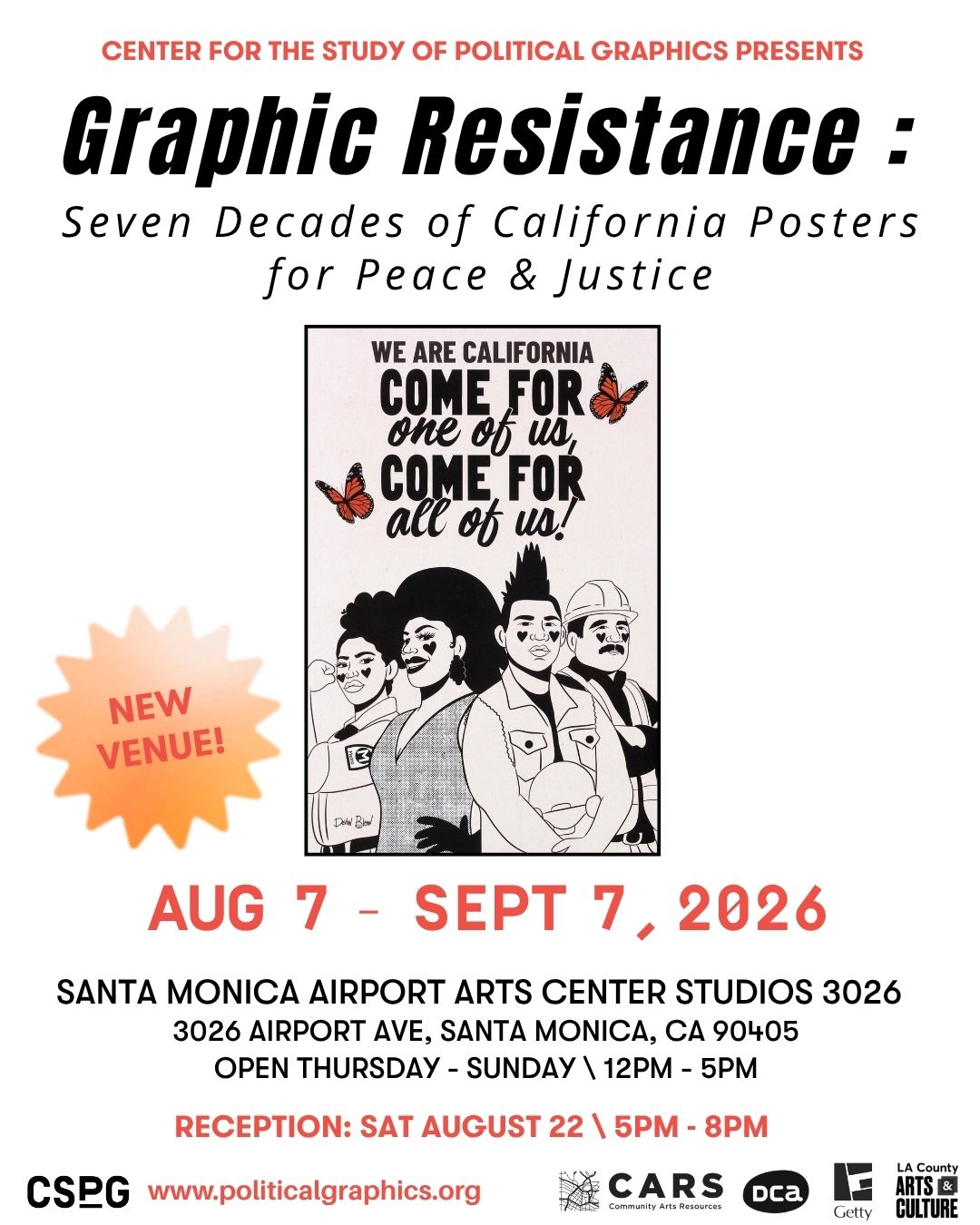
The Center for the Study of Political Graphics presents Graphic Resistance: Seven Decades of California Posters for Peace & Justice will open in Santa Monica from August 7th through September 7th.
We live in a culture saturated with images. Advertising follows us from screen to screen. Political campaigns spend millions trying to capture our attention for a few seconds. Corporations have long understood that an image can bypass intellectual defenses and lodge itself in our consciousness.
Social movements understand that power, too.
For more than three decades, Carol Wells and the Center for the Study of Political Graphics have worked to preserve the visual record of people struggling against war, racism, economic exploitation, environmental destruction, sexism, homophobia and state violence.
The Los Angeles-based archive now holds more than 90,000 domestic and international human-rights and protest posters. Its collection stretches from the 19th century to the present and includes what CSPG describes as the largest collection of post-World War II political posters in the United States. More than 33,000 posters are already accessible through its expanding online catalog.
Related stories
The numbers are impressive. But the real significance of the collection lies in the stories those posters tell.
They document not only what powerful institutions did, but also what ordinary people did in response.
When a Poster Changed Her Life
When Wells and I first sat down to talk, she explained that she had been a social activist since high school, participating in the civil rights movement and protests against the Vietnam War.
She later became an art historian. But the art she studied academically and the politics she practiced outside the classroom seemed to occupy different worlds.
“I was studying the art of the rich and powerful during the day,” she told me, “and protesting the activities of the rich and powerful.”
Political posters initially fell below her radar. They were not considered the sort of objects that commanded the attention given to paintings hanging in museums or works owned by wealthy collectors.
That changed in Nicaragua in 1981.
A UCLA professor who had collected posters since the Vietnam War hired Wells to travel to Nicaragua and gather graphics documenting the young Sandinista revolution. While visiting a women’s organization, she received several copies of a large green poster promoting a forthcoming demonstration.
Wells and her husband kept a few copies and gave the others to people they met. A woman with whom they were staying placed one on her wall.
The poster carried a message about constructing a new country while becoming a new woman.
One day, a neighbor who opposed the Sandinistas arrived seeking medical assistance and brought her eight- or nine-year-old son. The boy wandered around the house, taking in his surroundings, until the poster caught his eye.
“He walked over to it,” Wells remembered. “He had to get close, and I could see him mouthing the words and trying to figure it out.”
The boy may not have completely understood the poster’s meaning. But it had interrupted his routine. The color drew him in. The words caused him to stop. And stopping led him to question.
“What is this about?” Wells asked.
That question became the heart of her life’s work.
“Every time we ask a question, we are not the same person we were before we asked it,” she said. “There is something in the universe confronting us that we don’t understand.”
A successful political poster creates that confrontation. It interrupts. It unsettles. It opens a space in which someone might see the world differently.
“That was the moment of my epiphany,” Wells said. “It was because of this young child looking at a poster and trying to figure it out.”
A Visual Punch
Wells describes an effective poster as “a visual punch.”
It must break through the constant overload of competing images and communicate quickly. Its immediate purpose might be to stop a war, defend workers, fight homelessness, encourage people to vote, demand racial justice or persuade a community to protect itself during a public-health crisis.
But the poster’s importance does not end when the march is over or the immediate campaign disappears from the headlines.
Decades later, it becomes evidence.
“Posters tell the story of struggle at the time,” Wells explained. “They tell the story of what was motivating people and what was inspiring people.”
They preserve the record of battles won and lost—and, just as importantly, the fact that the battles were fought at all.
The stories of social movements are often flattened in textbooks. People appear to have passively received rights from enlightened leaders. The organizing, sacrifice, strategy, repression and conflict that made change possible are reduced to a paragraph or a commemorative holiday.
Political posters resist that erasure.
They reveal that people organized. They marched. They withheld their labor. They challenged governments. They demanded recognition from institutions that insisted they were invisible.
“The corporate press doesn’t tell those stories,” Wells said. “Most of the books people read in schools don’t tell those stories.”
Posters do.
The Center for the Study of Political Graphics preserves the struggles, victories and unfinished work that official histories leave behind. Graphic Resistance: Seven Decades of California Posters for Peace & Justice will open in Santa Monica from August 7th through September 7th.
From Under the Bed to an International Archive
CSPG began modestly.
Before the organization had an office, Wells stored posters in flat files in her apartment bedroom. When she curated an exhibition, she spread the posters across the bed.
If her husband wanted to go to sleep, the archive had to be moved.
The organization gained stability through the extraordinary support of peace activist Aris Anagnos, who created a Los Angeles Peace Center and offered office space to progressive organizations. That assistance allowed CSPG to develop from Wells’s personal collection into an educational and research institution whose exhibitions have appeared in hundreds of locations around the world.
The collection grew because artists, activists and organizers trusted CSPG with the materials they had carried home from demonstrations, stored in basements or saved from political campaigns.
Unlike institutions that begin collecting political art only after the struggle has become safely historical, CSPG frequently receives posters while the issues remain controversial.
A Vietnam War poster can now be treated as a valuable cultural artifact. A poster condemning the destruction of Gaza remains politically explosive because the killing and displacement are not safely confined to the past.
That distinction matters.
Political graphics are not neutral decorations. They are arguments created in the middle of conflict.
Approximately 40 percent of CSPG’s collection is international, Wells told me. It includes thousands of posters from Cuba, Nicaragua, Chile, South Africa, Palestine and Europe, among many other places.
Together, they demonstrate that resistance has always had a visual language—and that movements separated by oceans frequently speak to one another through images.
How the Internet Changed the Poster
Digital technology has transformed the way political graphics circulate.
Earlier posters were often produced through offset printing, screen printing, woodcut, linocut or stencil. Some processes required significant financial investment. Others were inexpensive but extremely labor-intensive.
Distribution could be equally difficult. Posters might remain stacked in bookstores or organizational offices because there was no practical way to get them into the hands of people outside the immediate campaign.
The internet changed that.
Artists can now make posters available as free downloads. Organizers in another city—or another country—can print them within minutes.
Wells recalled how a graphic by the political cartoonist Mr. Fish traveled from the Truthdig website to a CSPG newsletter and then appeared almost immediately on the streets during the protests in Cairo’s Tahrir Square.
“It came from Truthdig to CSPG to the streets of Tahrir Square,” she said. “You just never know in this day and age.”
The technology may be different, but the poster’s essential purpose remains the same: educate, provoke, organize and inspire action.
Seven Decades of Graphic Resistance
CSPG recently completed a successful presentation of “Graphic Resistance: Seven Decades of California Posters for Peace & Justice” at Mercado La Paloma in South Los Angeles.
Displayed from May 23 through July 6, the exhibition brought political art into a busy community gathering place rather than isolating it behind the walls of a conventional museum. Its posters addressed war, labor, racism, immigration, climate change, sexism, homophobia and homelessness.
California is often presented to the world through Hollywood, Silicon Valley, beaches and extravagant wealth. But the state has another history: the farmworker movement, Black liberation struggles, antiwar organizing, immigrant-rights campaigns, feminist activism, environmental justice and movements for LGBTQ+ liberation.
The artists represented in “Graphic Resistance” show that California has helped produce not only trends and fortunes, but also strategies and images that transformed political organizing.
Following the Mercado La Paloma showing, “Graphic Resistance” will open at the Santa Monica Airport Arts Center on August 7 and remain on view through September 7. The Airport Arts Center has listed the CSPG exhibition as part of its 2026 program, describing it as a timely exploration of how artists inspire public action.
The exhibition arrives at a moment when democratic rights, historical memory and the legitimacy of protest are under sustained attack.
That makes CSPG’s work more than an exercise in preservation.
It is preparation.
The Archive as a Form of Resistance
An archive determines what future generations will be able to know.
Whose voices will remain? Whose courage will be documented? Which struggles will be remembered as central to history, and which will disappear because no institution considered them worthy of preservation?
Those are political decisions.
CSPG preserves evidence that change has rarely come from the generosity of the powerful. It has come because people organized, challenged accepted ideas and refused to remain silent.
A protest poster may be printed on inexpensive paper. It may have been stapled to a telephone pole, carried through the rain or taped to the wall of a union hall. Its edges may be torn. Its colors may fade.
But it can still carry the memory of a movement.
It can still ask a question.
It can still deliver a visual punch.
And, as Carol Wells understood while watching a young boy study a poster in Nicaragua, the moment someone begins asking questions is the moment the world can begin to change.
Comments

Powered by RoundtableAn AI/DeFi-powered Enterprise Media Operating System. Learn more at Roundtable.io.© Roundtable 2026. By using this site you agree to the Terms of Use and Privacy Policy