
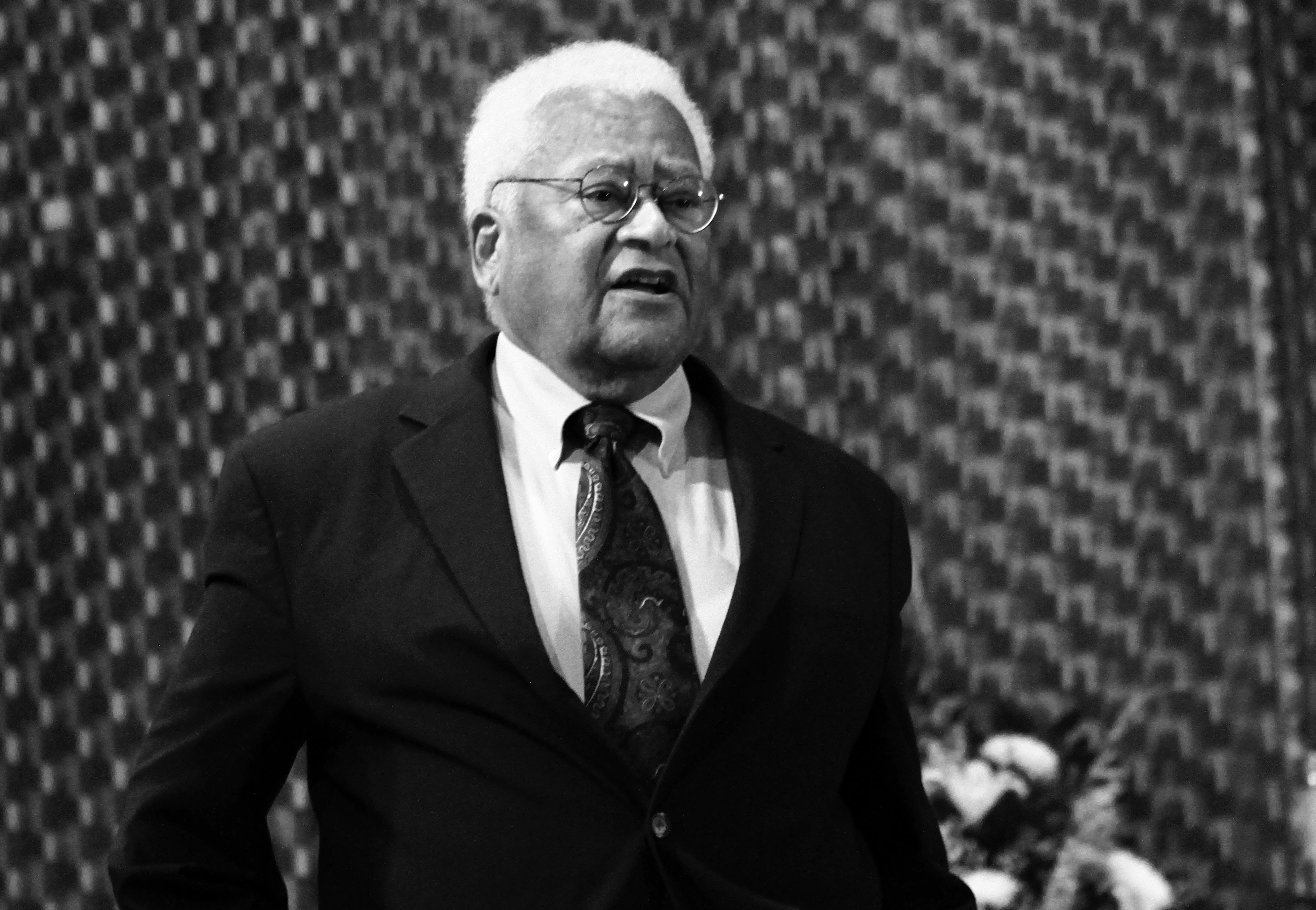


Reverend James M. Lawson
Jul 31, 2024 8:56 PM
The long legacy of Rev. James Lawson begins with his work in the 1950s and 1960s during the Civil Rights era and his relationship with Rosa Parks and Martin Luther King Jr.
The recent passing of Reverend James Lawson, pastor of Holman United Methodist Church in Los Angeles, was momentous. When the news came on June 9th, I felt an immediate and profound sadness, not only for the loss of this truly inspiring man but for what it foretold of the coming national malaise and the propagation of violence here and around the world.
For those unfamiliar with the long legacy of Rev. James Lawson, it begins with his work in the 1950s and 1960s during the Civil Rights era and his relationship with Rosa Parks and Martin Luther King Jr. He was one of their trusted mentors and a spiritual collaborator. Together, they were the locus that changed America for the better and moved the nation toward a more perfect union, using non-violent direct action as their fulcrum for social justice and freedom for all.
Sadly, I never learned about Reverend Lawson in school. His role in the Civil Rights movement was a quiet one and was rarely seen front and center, despite his influence. I first encountered Reverend Lawson appropriately at a peace march. It was a clear, crisp Saturday morning in downtown Los Angeles. January 11th, 2003, was a day that changed my life, not for what I did or what was done to me. But because of what I heard and witnessed.
It was during the tumultuous lead up to the illegal US invasion and occupation of Iraq.
Related stories
I found myself in the midst of a large anti-Iraq war rally near the intersection of Broadway and Olympic. I carried my trusty Nikon F3 and a compact digital video camera. Being a video journalist and documentarian, it was a vigorous moment, feeling engaged and being part of the extraordinary moment of catharsis, a mass nationwide movement, standing against a war before it was launched.
The US was already in Afghanistan, creating chaos and exacting military revenge for the attacks of September 11th in New York, Washington DC and Pennsylvania. I was a forty-something new father and TV producer who had had enough of the bellicose, nationalized propaganda and simply wanted to get out onto the streets with like minded people who saw through the GW Bush regimen of lies dragging America into global conflict on an apocalyptic scale. It was clear to the aware or ‘woke’ as they are pejoratively referred to nowadays, that the web of manufactured fear directed toward an etherial, ill-defined enemy was trapping the collective consciousness of a neuralgic nation. It was truly uplifting to witness so many who were willing to stand against the prevailing winds, despite the incessant drumbeat toward war surrounding us in the mainstream.
The ascendance of this extraordinary global movement was rapid and fundamentally grassroots. There were no multimillion-dollar bequeaths from ‘leftist’ billionaires. Here in Los Angeles, it was a rag-tag coalition of organizations, religious groups, individuals, artists, musicians, socialists, communists, students, the elderly, and the disabled. It was multi-racial and egalitarian — a reinvigorated ‘beloved’ community. It grew in scale and scope because of a collective desire and will to stop an impending war against Iraq with non-violent direct action.
Marching and witnessing the spectacle, I was impressed by the wide range of speeches inspired by various forms of identity politics. It was a gaggle of typically sincere, leftist voices, all contributing to the moment of defiance. With tens of thousands assembled there on the streets of one of the largest cities in the United States, it offered a glimmer of hope. And then came the baritone voice of Reverend James Lawson, drawing the attention of the crowd. Instinctively, I knew this was going to be significant and I wasn’t in a good position to film. What I didn’t know at the time was that the speaker was one of Martin Luther King’s mentors. He was there the day MLK was assassinated at the Lorraine Motel in Memphis. For the rest of his life, Lawson dutifully carried MLK’s dream forward and never wavered because it was his own.
I hustled with my gear through the crowd to get a shot, listening and recording the powerful messages of a great orator, rising to the occasion. It was a spiritual call to arms, a warning about what was to come and a demand to organize. And that ‘praying with your feet’ as Rabbi Abraham Joshua Heschel infamously proclaimed in the midst of the Civil Rights struggle with MLK, was in fact the true divine path to liberation.
The recording of Reverend James Lawson fell into the archive of the period but never left my frontal lobe, as it had sparked a flame in me that continues to burn today. A decade later, in 2010, when I was first introduced to Interfaith Communities United for Justice and Peace (ICUJP) and began documenting their work, I learned about the group of people who founded the organization, its history and deep connection to the peace and justice movement post-9/11. Then it dawned on me that the man I had filmed years earlier was one of the organization’s founders, along with Rabbi Leonard I Beerman of Leo Baeck Temple in Brentwood and Reverend George Regas of All Saints Church in Pasadena — all of them lifelong peace activists beginning in the Vietnam era. INTERFAITH was not a religion to them; it was an expression of a desire to be ‘one’, human family. Lawson together with Regas, Beerman and Maher Hathout, a Southern California Islamic scholar and founder of the Muslim Public Affairs Council, were able to bring tens of thousands of anti-war demonstrators to the streets of Los Angeles and were integral to a burgeoning national movement.
During the 2000s, despite the movement’s early success in bringing millions to the streets in cities across the country, the dominant culture prevailed and dragged the nation into yet another military catastrophe. But ICUJPs work and that of James Lawson continued tirelessly for the next two decades, bringing light to the darkness of the ‘war on terror’ and its global regime of death and devastation. Their commitment to peace, justice and nonviolence was consistent and unwavering. It was their lifelong spiritual mission.
I have worked with ICUJP for over a decade now, producing videos of their events and public displays of defiance, even being on hand for many of them arrested for their acts of civil disobedience. Over the years, I have had many opportunities to meet and interview Reverend Lawson and others within the ICUJP ranks. I have come to learn first hand, thanks to their years of dedication, deep sincerity and spiritual vision, that the path toward peace in heart and mind is the one that Gandhi followed. It is the only proven method with which to challenge the violent and bigoted status-quo of America.
Reverend Lawson’s passing last month came in the midst of yet another turbulent election cycle and it compelled me to return to my archive, looking for poignant examples of Lawson’s speeches and talks. One of his great oratory skills was being able to connect spiritual fortitude with the quest for justice and peace. He called it ‘soul-force’ and embraced the idea of using it as a tool to counter the socio-political ‘wickedness’ of our times. What was striking was his ability to command an audience, crowd, or congregation by speaking to the moment without notes and never scripted.
I reviewed an acceptance speech he delivered following him being awarded the Rev. George Regas Courageous Peacemaker award in 2012 in the sanctuary at Holman UMC. Although I had used portions of this speech in videos over the years, I took a moment and watched through the entire presentation, starting with Regas’ introduction to Lawson, and later Rabbi Beerman’s emotive closing prayer. But it was Lawson’s prescient political analysis, delivered a dozen years ago, that was most striking. The power wasn’t just about the words; it was the sincerity and intensity of his delivery. Truth is eternal; it could have been written today.
‘I am not a Democrat. I was raised a Republican. And was in that party in high school and beyond. But I know that the Republican Party, as it has adopted to the extremes of the old Confederacy, as it has adopted the necessity of carrying on an ideology of racial superiority, as it has adopted the notion that women have a place and it is not a place of equality, as it has adopted the notion that the wealthy and the powerful should control the destiny of 310 million people…
‘I want to urge that we put aside all the political fantasies about these days and instead we unite around the notion that we must get in the way of the forces of spiritual wickedness that will reduce this country to an oligarchy. And end the experience of self-government towards the destiny of every man and every woman already.’
Reverend James Lawson, September 9, 2012.
After revisiting this stirring piece of video in its entirety, I continued to review other interviews I had filmed with Rev. Lawson. And it was most certainly the last one I did with him, conducted in the sanctuary of Holman UMC on behalf of the Leonard I Beerman Foundation for Peace and Justice in 2022. The mission was to have him speak about and the Jewish-Black alliance that energized the Civil Rights movement when Rabbi Abraham Joshua Heschel made common cause with African Americans praying with their feet and marching together. And also to elaborate on his decade’s long spiritual journey with Rabbi Beerman and Reverend George Regas and their quest for love and reason in the wake of the attacks of September 11th.
After revisiting this stirring piece of video in its entirety, I continued to review other interviews I had filmed with Rev. Lawson. And it was most certainly the last one I did with him, conducted in the sanctuary of Holman UMC on behalf of the Leonard I Beerman Foundation for Peace and Justice in 2022. The mission was to have him speak about ‘interfaith’ and the Jewish-Black alliance that energized the Civil Rights movement when Rabbi Abraham Joshua Heschel made common cause with African Americans praying with their feet and marching together. And also to elaborate on his decade’s long spiritual journey with Rabbi Beerman and Reverend George Regas and their quest for love and reason in the wake of the attacks of September 11th.
Rev. Lawson arrived on time, impeccably dressed, clear-eyed and relaxed. I realized then that this interview was going to be significant—a ‘face-to-face’ with perhaps one of the most consequential spiritual and social leaders our time—and it did not disappoint.
Up there to make matrices. And I want to make a pitch this evening. That we in ICUJP, and across our nation, we who know that we can have a better nation and a better world. We who sense that there are invisible worlds and values and visible visions that we try to live by personally, and that we know are the visions of truth and reality.
Photo Credit - Robert Corsini, Videocratic Media.
Comments

Powered by RoundtableAn AI/DeFi-powered Enterprise Media Operating System. Learn more at Roundtable.io.© Roundtable 2026. By using this site you agree to the Terms of Use and Privacy Policy