
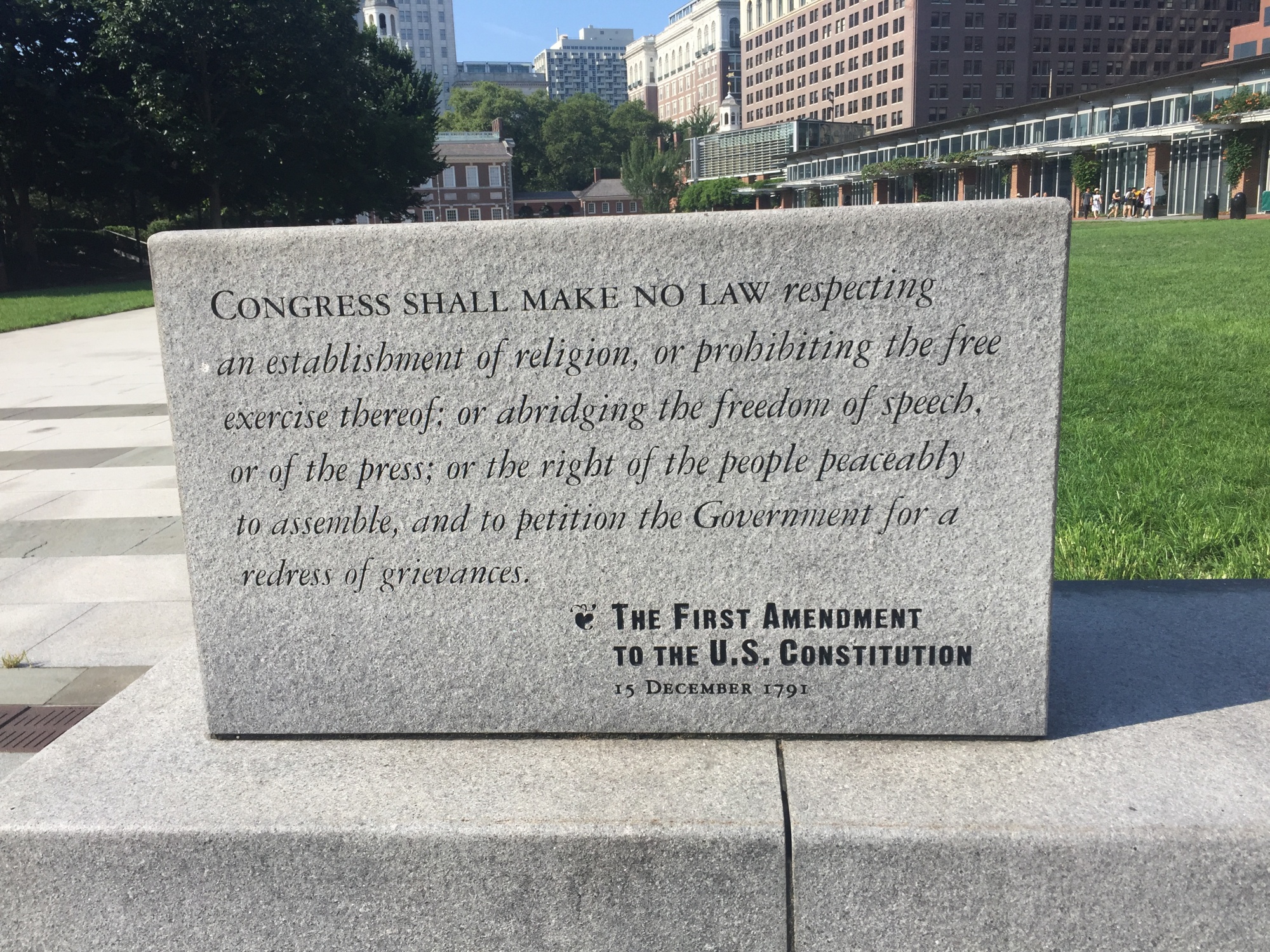
Zakarie Faibis, CC BY-SA 4.0, via Wikimedia Commons


How confident are you that your representative truly represents you and will do everything to protect your rights, as their Constitutional oath of office demands?
Sep 13, 2024 3:10 AM
How confident are you that your representative truly represents you and will do everything to protect your rights, as their Constitutional oath of office demands?
Congress shall make no law respecting an establishment of religion, or prohibiting the free exercise thereof; or abridging the freedom of speech, or of the press; or the right of the people peaceably to assemble, and to petition the Government for a redress of grievances.
When I taught college, my students knew the Second Amendment to the U.S. Constitution far better than the First. They knew they had the right to keep and bear arms. They often didn’t know much about freedom of speech, nor did they know much about Fourth Amendment protections to safeguard privacy against illegal searches and seizures.
Let’s consider the First Amendment. It begins with religion, an essential concern of colonial Americans. Most colonists were not Anglican; they were not members of the established Church of England. Indeed, many had come to the colonies seeking greater religious freedom.
They were “non-conformists” in religion, dissenters, whether Puritan or Catholic or Quakers or Anabaptists or what-have-you. They wanted to practice their religion untrammeled by the government, hence the proscription against an “established” or state-supported religion, and their affirmation that Congress had no authority to interfere in religious practices.
Related stories
Next is freedom of speech, which Congress shall not abridge. The same is true of freedom of the press. The colonists had had plenty of experience being persecuted by the Crown for what they said and what they wrote, so they ensured Americans’ ability to speak and write freely couldn’t be abridged by the powerful for whatever reason. In fact, our ability to speak, write, and publish freely are NOT rights granted to us by the government. They are natural (or “inalienable”) rights.
Again, these freedoms are not privileges granted to us by the government and therefore to be abridged by the government. They are natural rights of all U.S. citizens. It’s not for the government to regulate “hate speech” or to curb “misinformation,” for who is to define what hate speech is, or what information is reliable and what isn’t? Current trends to censor speech in the name of protecting America are a direct threat to freedom of speech and democracy.
Our rights are often misunderstood. There are always those pressuring us to abridge or even to sacrifice our rights, usually in the name of security, safety, and the like. Of course, true security and safety reside in the full exercise of our rights, not in volunteering to relinquish them to “experts” in the government.
Finally, there’s our right peaceably to assemble and to petition the government. Those rights are also under attack, as anyone who’s ever been pepper-sprayed or otherwise attacked by militarized police at peaceful protests can attest. Petitioning the government, meanwhile, isn’t for the faint of heart. Unless you’re rich enough to afford a brigade of lawyers, you may find the government pays little attention to your petition.
The best way to protect our rights is to exercise them. My deepest respect goes to protesters who truly have skin in the game. (I have yet to be tear-gassed or truncheoned to the ground, but that’s because I avoid protests.) I salute everyone out there in the trenches, fighting to keep religion free, fighting to have their voices heard, organizing to protest peaceably and to petition government for a redress of grievances, for there are many grievances we as citizens have in our deeply flawed representative democracy today.
Perhaps the deepest flaw of all: How confident are you that your representative truly represents you and hears your voice? Not only hears it, but respects it? And thus will do everything in their power to protect your natural rights, as their Constitutional oath of office demands that they do?
If we’re not confident of that, “our” government is more enemy than friend. Perhaps the Founders have a lesson here for us about what to do when we face unreasonable and tyrannical rulers who refuse to represent and respect us.
This article was produced by Bracing Views.
Comments

Powered by RoundtableAn AI/DeFi-powered Enterprise Media Operating System. Learn more at Roundtable.io.© Roundtable 2026. By using this site you agree to the Terms of Use and Privacy Policy