


Apr 12, 2026 7:28 PM
Updated Apr 13, 2026 3:33 PM
A canceled author event reveals how modern censorship works—not through bans, but through quiet decisions about who gets to speak in public space.
Public institutions don’t usually censor ideas outright anymore. That’s too obvious. Too easy to challenge. Too 20th century.
Instead, they do something more refined.
They call it neutrality.
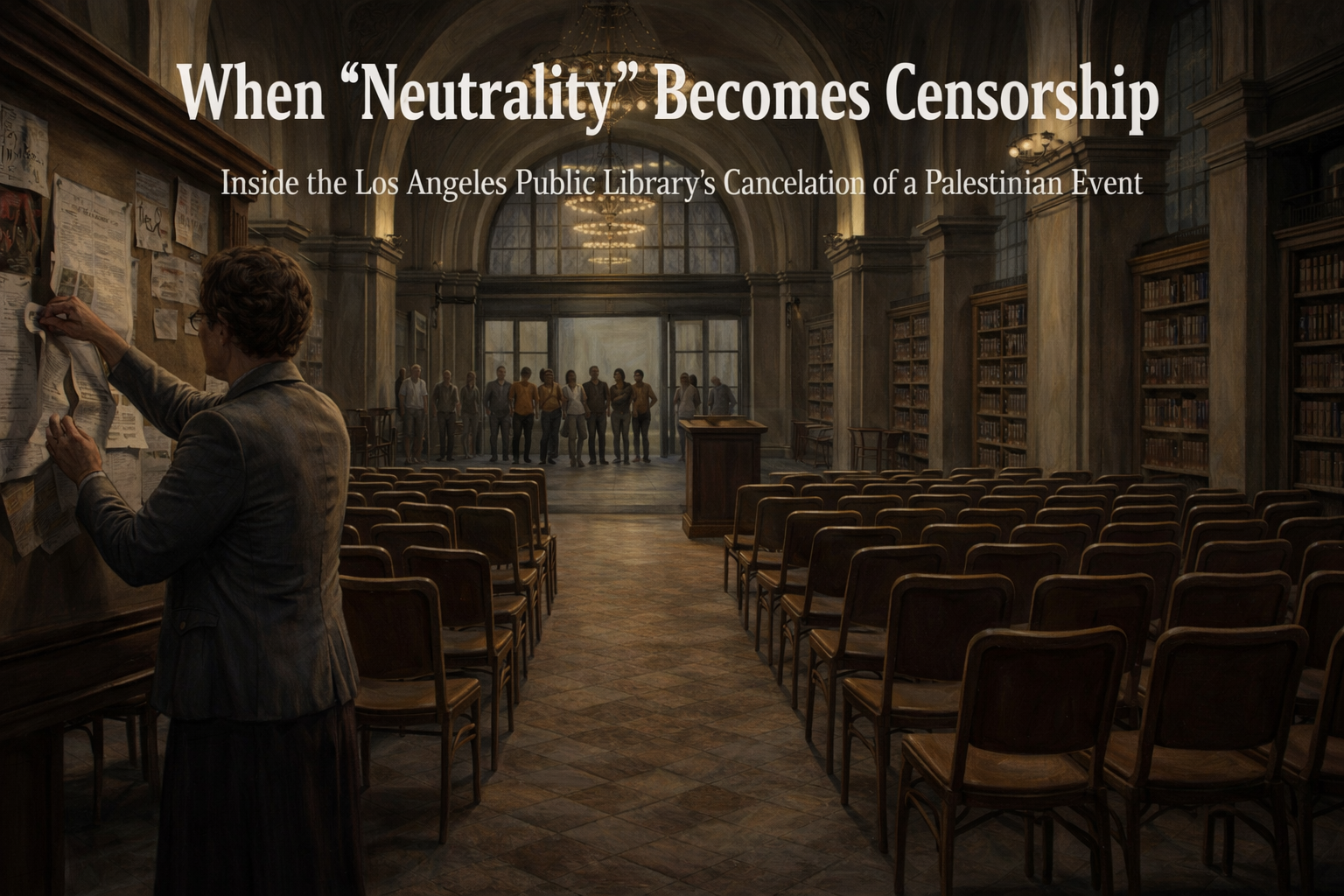
In December 2025, the Los Angeles Public Library canceled a scheduled author event featuring Nora Lester Murad and Jenan Matari as part of “Read Palestine Week.” The event had already been approved, planned, and promoted. Then, just days before it was set to take place, it was pulled.
Related stories
The explanation? The library needed to remain “nonpartisan and apolitical.”
But neutrality, in this case, didn’t mean the absence of politics.
It meant the absence of certain people.
The System at Work
Let’s be clear about what happened.
The Los Angeles Public Library did not:
- Ban a book
- Remove a title from circulation
- Shut down a protest
It did something more subtle—and more consequential.
It rescinded an invitation.
That matters because invitations are how public space is structured. Who gets invited determines who gets heard. And who gets heard determines what counts as legitimate knowledge.
According to reporting and advocacy groups, the cancellation was tied not to the content of the planned event, but to social media posts made by one of the speakers about Gaza and October 7.
In other words:
- The event itself was not evaluated on its merits
- The speakers were evaluated on their politics
This is not neutrality. This is risk management disguised as principle.
Public institutions today operate inside a web of pressures:
- donor sensitivity
- political backlash
- media scrutiny
- fear of protest or disruption
Under those conditions, “neutrality” becomes a decision-making shortcut. Not What is fair? but What is safest?
And “safest” almost always means:
Avoid the voices most likely to provoke discomfort, controversy, or challenge dominant narratives.
The Human Consequence
More than 100 library staff protested the decision. Thousands of members of the public filed complaints. Civil liberties organizations—including the ACLU of Southern California—warned that the cancellation may constitute viewpoint discrimination.
But the deeper harm isn’t procedural. It’s cultural.
When a public library cancels a Palestinian-centered event:
- It signals that Palestinian voices are inherently political in a way others are not
- It teaches young readers—especially in a Teen’Scape setting—that some identities are too controversial for public space
- It narrows the range of stories that are considered safe to hear
As Nora Lester Murad herself has argued, these decisions shape how entire communities are perceived—not through what is said, but through what is allowed to be said at all.
And that’s where the damage compounds.
Because silence doesn’t just remove information. It produces meaning.
This Is How Public Space Shrinks
We tend to think censorship looks like book bans, police raids, or government crackdowns.
But in 2026, censorship often looks like:
- a canceled booking
- a withdrawn invitation
- a quietly revised calendar
No law is passed. No speech is formally prohibited.
But the effect is the same.
Public space contracts.
And it contracts unevenly.
Voices that align with dominant narratives continue to circulate freely, often under the banner of “balance” or “dialogue.” Voices that challenge those narratives are flagged as “political,” “divisive,” or “inappropriate for the venue.”
That asymmetry is the story.
The Myth of the Apolitical Institution
There is no such thing as an apolitical public library.
Every decision is political:
- what books to acquire
- which authors to host
- which histories to center
- which communities to protect
The claim of neutrality does not remove politics. It hides the criteria by which political decisions are made.
And once those criteria are hidden, they become harder to challenge.
That’s why this moment matters.
Because the question is not whether the Los Angeles Public Library should be political.
It already is.
The real question is:
Whose politics are considered acceptable—and whose are disqualified before they even enter the room?
What This Tells Us About Power
This incident fits a broader pattern we’re seeing across universities, cultural institutions, and civic spaces.
Not a crackdown.
A calibration.
Institutions are learning how to:
- maintain the appearance of openness
- while narrowing the boundaries of acceptable discourse
It’s a form of governance that doesn’t prohibit speech—it filters it.
And that filtering happens upstream, before the public ever has a chance to engage.
Closing
The Los Angeles Public Library didn’t just cancel an event.
It made a decision about who belongs in public conversation—and who does not.
And it did so in the name of neutrality.
But neutrality that consistently excludes the same voices is not neutrality.
It’s a policy.
And policies, unlike principles, can—and should—be challenged.
Comments

Powered by RoundtableAn AI/DeFi-powered Enterprise Media Operating System. Learn more at Roundtable.io.© Roundtable 2026. By using this site you agree to the Terms of Use and Privacy Policy