


Sep 21, 2016 10:25 PM
Updated Feb 27, 2023 10:24 PM
Arica Colemant: I’ve been estranged, and happily so, from that God awful song with its glorification of war and schizophrenic musical arrangement.
We have come over a way that with tears has been watered; we have come, treading our path through the blood of the slaughtered.—James Weldon Johnson
By the time I was in the fourth grade at Mary E. Rodman Elementary School in West Baltimore, I hated “The Star-Spangled Banner.” Not only was it an awkward, odious melodic nightmare, I also could not get past the opening phrase of the last sentence of the song: “O’er the land of the free. . .”
Hold up! What?
Slavery was not taught in school, even during what was then dubbed Negro History Week. I learned about slavery while overhearing older relatives’ conversations when they thought the kids weren’t listening. During a field trip to the Fort McHenry National Monument, the battle site which inspired Francis Scott Key’s poem, I asked my teacher, “How could it be the land of the free when ‘we’ had slaves?” But when she and the tour guide, both white women, shot me the evil eye, I was too sorry I had asked.
Related stories
I don’t blame them, though. I mean, we were at a replica of a battlefield. Indeed, American history is a battle, a never ending power struggle over memory. As Maori scholar Linda Tuhiwai Smith states in her book, Decolonizing Methodologies: Research and Indigenous Peoples, “We believe that history is also about justice, that understanding history will enlighten our decisions about the future. Wrong. In fact, history is mostly about power . . . It is because of this relationship with power that we have been excluded, marginalized, and ‘Othered’.”
Of course, I had no idea about the politics of history then. Damn my nine-year-old brain and mouth. Since then, I’ve been estranged, and happily so, from that God awful song with its glorification of war and schizophrenic musical arrangement. I don’t mean to offend by appropriating schizophrenia which is a serious mental illness. But, I can’t imagine a better term which captures the song’s musicology and America’s relationship to the anthem.
Case in point, the histrionics over 49ers quarterback Colin Kaepernick’s refusal to stand during the anthem in protest of police brutality and racial inequality. Those who support Kaep believe his protest is justified by the continued reality of police overreach in Black communities and the racist underpinnings of the song, as Florida Attorney Chuck Hobbs writes about in an article for The Hill.
Those who oppose the quarterback, such as Shirley Carole Isham, a great-great-great-granddaughter of Key who, according to USA Today believes that Kaep’s right to protest is irrelevant:
It just broke my heart to think that someone that gets so much money for playing a ballgame, who is half black, half white would do this . . . So many of his black race are oppressed, but it’s not by the whites, it’s by their own people. Look who their leaders are, and the president. Has (Barack Obama) done anything for these people? If he’s not going to honor his country and his countrymen, he’s dishonoring himself . . . This tells you an awful lot about him."
Girl bye!
Anyway, we must also talk about the country’s schizophrenia regarding how American authenticity is defined by who performs the national anthem and how it is performed.
In 1968, Puerto Rican singer Jose Feliciano performed the national anthem at the World Series; he was booed and the Baseball Commissioner received letters of complaint because the singer’s added Latin flavor was viewed as un-American. It almost destroyed his career.
Legendary singer Marvin Gaye rocked the 1983 NBA All-Star Game with his Motownesque cover which was dubbed “National Healing,” a play on his highly successful single “Sexual Healing;” as did Whitney Houston’s Gospel inspired cover at the Super Bowl in 1990.
Felicano’s 2012 do over at the National League Championship Series received rave reviews which resulted in a new generation of fans; but the 2013 performance by San Antonio, Texas native, eleven-year-old Sebastian De La Cruz at Game 3 of the NBA Finals set social media ablaze. For many “a Mexican kid” singing the anthem mocked American patriotism. Lewie Groh tweeted, “Why is a foreigner singing the national anthem. I realize that's San Antonio but that still ain't Mexico."
Fortunately, the response to the criticism drowned out the vitriol; De La Cruz was invited to Game 4 for an encore performance. President Obama tweeted his support: “Don't miss @selcharrodeoro's encore performance of the national anthem at the #NBAFinals in San Antonio tonight.”
My friend, a middle-aged Puerto Rican woman, expressed shock that adults had so viciously attacked a child just for singing a song. “I don’t understand why they would do that,” she stated. “Do white people get angry when Black people sing it?”
“No,” I responded; “and most wouldn’t care because we have our own national anthem.”
A look of surprise flashed across her face as she blurted out, “What, there’s another national anthem?”
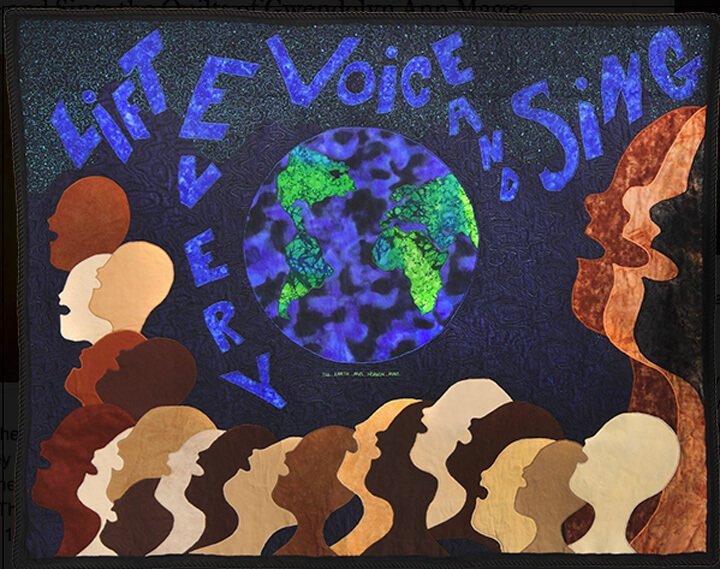
Indeed, “Lift Every Voice and Sing” began as a poem written by James Weldon Johnson which was set to music by his brother John Rosamond Johnson in 1899. In the book Lift Every Voice and Sing: A Celebration of the Negro National Anthem: 100 Years, 100 Voices, Weldon’s creative process is captured in his own words:
I got my first line—Lift every voice and sing. Not a startling line, but I worked along grinding out the next five. When, near the end of the first stanza, there came to me the lines, "Sing a song full of the faith that the dark past has taught us; Sing a song full of the hope that the present has brought us;" the spirit of the poem had taken hold of me. I finished the stanza and turned it over to Rosamond. In composing the two other stanzas I did not use pen and paper. While my brother worked at his musical setting I paced back and forth on the front porch, repeating the lines over and over to myself, going through all of the agony and ecstasy of creating. As I worked through the opening and middle lines of the last stanza: God of our weary years, God of our silent tears, Thou who hast brought us thus far on our way; Thou who hast by Thy might Led us into the light. Keep us forever in the path, we pray. Lest our feet stray from the places, our God, where we met Thee, Lest, our hearts, drunk with the wine of the world, we forget Thee . . . I could not keep back the tears, and made no effort to do so. I was experiencing the transports of the poet’s ecstasy. Feverish ecstasy was followed by that contentment—that sense of serene joy—which makes artistic creation the most complete of all human experiences. When I had put the last stanza down on paper I at once recognized the Kiplingesque touch in the two longer lines quoted above; but I knew that in the stanza the American Negro was, historically and spiritually, immanent; and I decided to let it stand as it was written.
The song was first publicly performed in 1900 in the Johnsons’ hometown of Jacksonville, Florida. A choir of 500 Black school children sang out the lyrics during a program honoring Abraham Lincoln at Stanton “colored” School, where Weldon was principal. The song grew in popularity and was quickly adopted as the “Negro (later Black) National Anthem.”
Singing “The Star-Spangled Banner” followed by “Lift Every Voice and Sing” is a tradition at Black cultural events all over the country.
The Black National Anthem has been the focus of controversy in recent years. On July 1, 2008, just weeks before Obama was set to accept the Democratic Nomination for President in Denver, Colorado, jazz singer René Marie performed a rendition of the anthem at a Denver state event which blended the music of “The Star-Spangled Banner” with the lyrics of “Lift Every Voice and Sing.” Her performance was “denounced by state and local officials” with some calling the performance “a disgrace;” Marie received a barrage of racist emails, phone calls, and death threats.
Bridgette of the conservative blog Don’t Get Me Started stated, “There is NO substitute for the national anthem and what this woman did was rude and in poor taste. There should be no such thing as a ‘black’ national anthem.” Some Blacks including then Senator Obama, concurred. “If she was asked to sing the national anthem, she should have sung that. . . Lift Every Voice and Sing' is a beautiful song, but we only have one national anthem,” Obama stated.
Once again, patriotic provincialism underscored by political pandering, derailed a teaching moment silencing black progressive voices.
The controversy resurfaced when civil rights legend Joseph Lowery invoked the words of the last stanza during his benediction at the 2009 presidential inauguration. Some accused Lowery of stoking racial tensions. But Marian Wright Edelman captured the sentiment of the moment for many African Americans when she stated that the words
. . . made my deepest heartstrings throb. For all of us raised on those beloved words, the symbolism was overwhelming. For over a hundred years, every time it has been sung in a church hall, school auditorium or community meeting, it has enabled us Black folks to sing our own story about our faith in and struggle to make America’s promise real. . . For now, as part of the blessing of our nation and our new young, brilliant President who reflects the DNA of our nation and globe, the Negro National Anthem has become—at long last—part of the larger American hymn. As President Obama’s name is added to the list that begins with George Washington, and his portrait becomes the face of America, the next chapters in Black and American history are being written together.
Yet, as the backlash over Kaep’s protest demonstrates, far too many Americans are only interested in writing a narrative which supports the white nationalistic sentiments expressed in Key’s song. On the other hand, “Lift Every Voice and Sing,” is an expression of an all-inclusive patriotism which embodies “the audacity of hope” for a brighter future while not forgetting the struggles of our past.
Until structural inequality is dismantled in every segment of American society, Key’s words, “O say does that star-spangled banner yet waves o’ver the land of the free. . .,” remains an aspiration. Indeed, a black family in the White House has exacerbated rather than eased racial tensions in this country; and the blood of the slaughtered continues to run unabated in a nation of cowards.
With some chanting, “We want ‘our’ country back” and the potential election of Donald Trump, who wants to “Make America Great [White] Again,” it is clear that we remain a long way off from Dr. King’s dream. The struggle continues. Therefore, in the words of the Black Nation Anthem, “Let us march on ‘til victory is won.”
Comments

Powered by RoundtableAn AI/DeFi-powered Enterprise Media Operating System. Learn more at Roundtable.io.© Roundtable 2026. By using this site you agree to the Terms of Use and Privacy Policy