


Jan 20, 2026 3:50 AM
Updated Jan 20, 2026 6:34 PM
As told by his cousin, this is the untold story of a father’s death, a federal agent’s decision, and a justice system that looked away
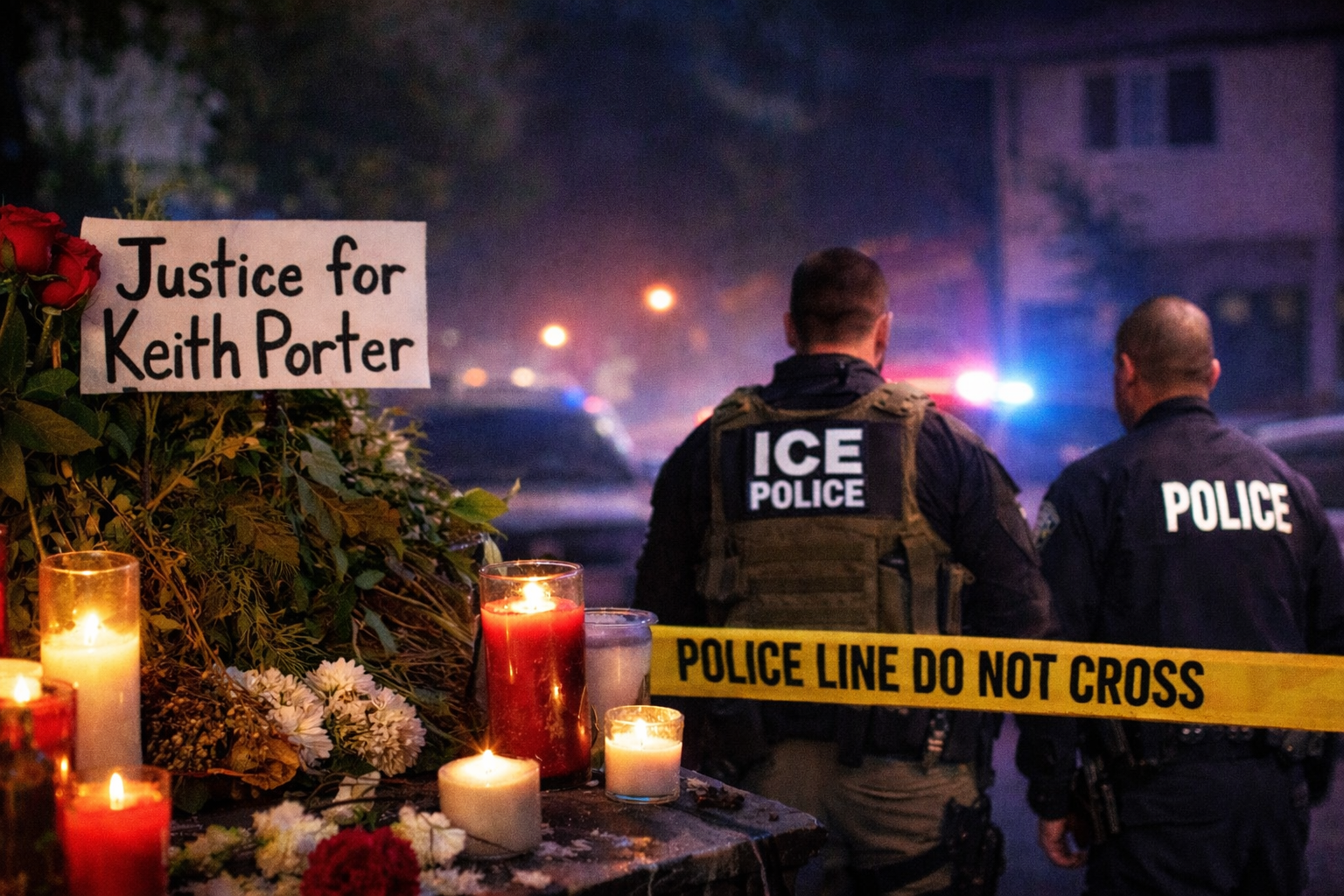
On New Year’s Eve, while much of the country was celebrating the arrival of 2026, Keith Porter, a 43-year-old father, son, neighbor, and community member, was killed outside his own home in Northridge, California.
What follows is not the official version of events.
It is the story of Keith Porter as told to me, Sharon Kyle/LA Progressive, by his cousin, Jsane Tyler—a story shaped by grief, by unanswered questions, and by a growing realization that the public narrative being constructed around Keith’s death does not match the reality his family is living.
According to Tyler, Keith was not committing a violent crime.
He was not fleeing.
He was not threatening anyone.
He was killed by an off-duty agent of Immigration and Customs Enforcement, and that agent has now been publicly named: ICE Officer Brian Palacios.
Related stories
A Life Reduced to a Headline
“Keith was a whole person,” Tyler said. “But that’s not how he’s being talked about.”
Keith Porter was a father. A son who called his mother every morning without fail. A coworker known for his steadiness and his humor. A “girl dad” who bragged endlessly about his children.
None of that appeared in the early reporting.
Instead, Keith was reduced to a single word: suspect.
This, Tyler explained, is how state violence survives scrutiny—not by proving its necessity, but by stripping its victims of context, history, and humanity until the public no longer sees a life worth defending.
What Happened That Night
On New Year’s Eve, Keith stepped outside his apartment. Like many Americans across the country, he fired celebratory shots into the air—an act that may be unlawful, but one that is common, frequently overlooked, and almost never met with lethal force.
An off-duty ICE agent who lived in the same apartment complex observed Keith—not as a neighbor, not as a fellow resident—but as someone to confront.
According to the family, the ICE agent gave three different stories in retelling the events of that night. One of the stories the agent told was that he went outside after hearing shots, obsevered Keith firing into the air, went back inside his residence, put on tactical gear, retrieved his ICE-issued firearm, returned outside, and shot Keith Porter dead.
Tyler said the family still hasn’t seen a complete explanation of what happened, when, how, or why lethal force was used instead of a call to LAPD. Under ordinary circumstances, that is exactly how this situation should have proceeded. An off-duty federal agent, lacking local policing authority and not engaged in any immigration enforcement action, would be expected to contact local law enforcement, report what he believed to be a public-safety concern, and allow trained, on-duty officers to respond. That process exists precisely to prevent unilateral escalation by individuals who are not acting in an official law-enforcement capacity at the time.
Instead of serving as a witness and calling LAPD—who have jurisdiction, backup, de-escalation tools, and established protocols—the agent reportedly chose to insert himself directly into the situation, arm himself, and confront a civilian neighbor. That choice bypassed every safeguard designed to reduce the risk of unnecessary death. It converted what should have been a routine police response into a fatal encounter driven by personal judgment rather than institutional restraint.
As Tyler put it, “If he truly thought something dangerous was happening, why didn’t he do what every civilian is told to do—call the police and step back?”Off-Duty Authority
Key Question: What legal authority does an off-duty ICE agent have to initiate a lethal encounter with a civilian?
ICE agents do not have general police powers when off duty and outside immigration enforcement contexts. Use of force is typically limited to situations involving:
- Imminent threat to life
- Lawful federal enforcement activity
An off-duty agent acting as a private citizen is not automatically cloaked in federal authority.
Relevant sources:
• ICE Use of Force Policy (DHS) – https://www.dhs.gov
• DOJ guidance on off-duty federal officers – https://www.justice.gov
Federal Power Without Limits
Keith Porter’s killing did not occur in a vacuum.
As Tyler noted, similar incidents involving ICE agents have unfolded across the country, including the recent killing in Minnesota of Renee Good just two days after Keith Porter was murdered. The assassination of Renee Good has prompted mass protests and judicial scrutiny. This case has triggered national attention, many questioning whether immigration enforcement has become a pretext for unchecked force.
Keith’s death places Los Angeles squarely within that national pattern.
Jurisdiction and Escalation
Key Question: Can a federal immigration agent escalate a civilian encounter into a lethal one without coordination with local law enforcement?
Generally:
- ICE agents are not authorized to act as local police
- Escalation outside immigration enforcement may violate departmental policy
- Tactical re-engagement (leaving the scene to arm oneself and returning) weakens self-defense claims
Relevant cases:
• Tennessee v. Garner (1985)
• Graham v. Connor (1989)
• Lyons v. City of Los Angeles (1983)
The Legal Shell Game
Tyler described the family’s experience since Keith’s death as a slow erosion of trust.
They have encountered delayed information, no transparency, and an investigation, if there is one, controlled by agencies with a vested interest in minimizing federal liability.
Historically, courts have expanded the definition of “reasonable fear” when the victim is Black and narrowed accountability when the shooter is law enforcement.
Keith’s family is now caught in that legal contradiction.
Legal Analysis Box 3: “Reasonable Fear” and Race
Key Question: How is “reasonableness” applied when the victim is Black?
Legal scholars—including USC Law Professor Jody Armour—have documented how racial bias shapes the “reasonable person” standard, often validating fear that is socially constructed rather than fact-based.
Relevant scholarship:
• Jody Armour, Negrophobia and Reasonable Racism
• DOJ Civil Rights investigations on biased policing
Grief Is Not Closure
The Porter family is not asking for sympathy.
They are asking for:
- The investigation to be made public
- Criminal accountability, not internal review
“We the truth” Tyler said.
Why Keith’s Story Matters
This story is not only about Keith Porter. It is about the expansion of federal policing power into civilian life—and the absence of guardrails when that power turns deadly.
Keith was not an immigrant.
He was not resisting arrest.
He was not a threat to national security.
He was a Black man living in his own neighborhood.
And that was enough.
A Call That Cannot Be Ignored
Keith Porter deserved to see 2026.
His children deserved their father.
And the public deserves to know how federal authority can be weaponized against ordinary people with no consequence.
As told by his cousin, this is Keith’s truth.
It is now the public’s responsibility to decide what to do with it.
Act Now: Please sign the petition demanding the LAPD arrest Brian Palacios
Comments

Powered by RoundtableAn AI/DeFi-powered Enterprise Media Operating System. Learn more at Roundtable.io.© Roundtable 2026. By using this site you agree to the Terms of Use and Privacy Policy