
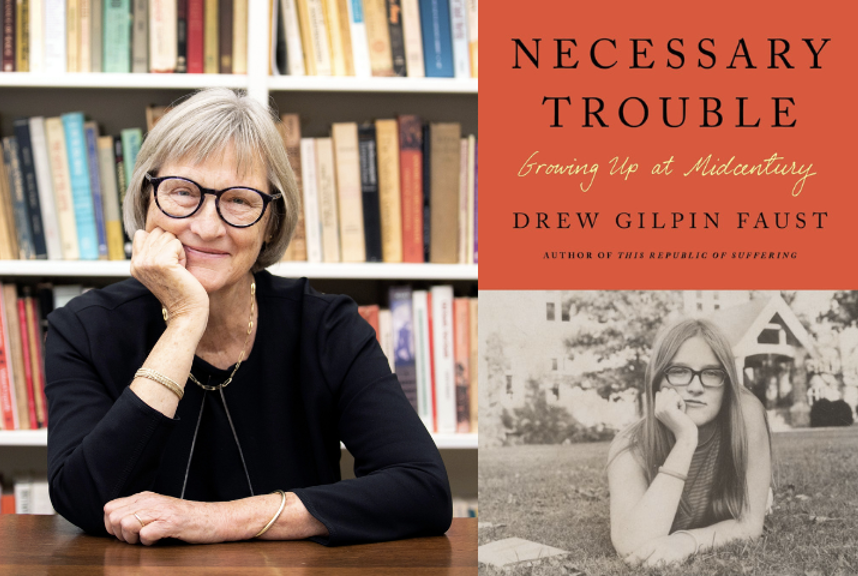


Professor Drew Gilpin Faust (Photo by Stephanie Mitchell)
Aug 30, 2024 2:24 AM
Necessary Trouble, Gilpin Faust's memoir of growing up in mid-century America captures the isolated and repressive world of her youth
Do not get lost in a sea of despair. Be hopeful, be optimistic. . . Never, ever be afraid to make some noise and get in good trouble, necessary trouble. Representative John Lewis
In her engaging new memoir Necessary Trouble: Growing Up at Midcentury (Farrar, Straus and Giroux), Professor Drew Gilpin Faust—the first female president of Harvard University—shares the story of the first two decades of her life. She recalls the isolated and repressive world of her childhood in 1950s Jim Crow Virginia and then her introduction to new possibilities as a young adult during the turbulent 1960s with her intellectual blossoming and commitment as an activist for justice and peace.
To the chagrin of her parents, young Drew refused to conform to the strict requirements of a Southern lady. Her determination to fight against injustice and for truth began early and led to civil rights activism in the South in her teen years and for gender equality and against the Vietnam war—as she thrived on academic challenges offered at her Massachusetts prep school and then as a student leader at Bryn Mawr College. The memoir concludes in 1968 with her Bryn Mawr graduation and the presidential election—before her illustrious career as a professor of history and her Harvard presidency.
As expected of a renowned historian, Professor Faust’s memoir supplies historical context for her tumultuous, formative era. And the book is based on her extensive and meticulous research, including archival documents and family materials. She even located the letter she wrote at age nine to President Eisenhower, a demand that he “make schools and other places accept colored people.”
Related stories
As democracy and the rule of law face perilous challenges now, the memoir offers insights for today. In the prologue, Professor Faust notes that mid-century America may seem like a “foreign country” to readers, but she urges: “The strangeness of that world can perhaps encourage us that at least some things have changed for the better in my life. And at a time when we see many of those advances challenged or even overturned, it can remind us why we don’t want to live in such a world again.”
Dr. Faust is the Arthur Kingsley Porter University Professor at Harvard University. She served as the president of Harvard from 2007 to 2018. During that term, her accomplishments included promoting diversity and inclusion, launching a study of Harvard’s complicity in slavery, and more. Earlier, was the founding dean of the Radcliffe Institute for Advanced Study from 2001 to 2007. Before that, she was the Annenberg Professor of History at the University of Pennsylvania, where she had earned her MA and PhD in American Civilization. She has called herself that History Department’s “first affirmative action hire” as the first woman on that faculty.
Professor Faust, an expert on antebellum and Civil War history, also has written six acclaimed books of history, including the celebrated This Republic of Suffering: Death and the American Civil War (2008), which won the 2009 Bancroft Prize and other awards and was the basis for an award-winning PBS documentary.
Professor Faust graciously talked about her new memoir by telephone from her office in Cambridge.
Robin Lindley: What sparked your memoir now?
Professor Drew Gilpin Faust: Stepping down from the presidency of Harvard and thinking about what I wanted to say to the world as I returned to writing and thinking about history, I realized that the time I'd grown up in was, in the eyes of many young people particularly, . . . like a distant past and one that they were not entirely familiar with. I wanted to point out how extraordinarily constraining those years were for African Americans and for women, but really for everybody in society, and then how things began to change in dramatic ways and how different today is from that time.
Many young people particularly say nothing's changed and they get dispirited. I wanted to show how much has changed because I think that, if we're going to commit ourselves to continuing to change things for the better, we have to believe change is possible. So I want them to know that and see that just within the scope of my own lifetime.
I felt also, as a historian, I've been listening to voices from the past: from the women in the Civil War, or from the dying, or from the bereaved of that war. And I felt I have voice too. I wanted not just to be the recorder and interpreter of other people's voices from the past, but also I wanted to be a voice about the era in which I have lived.
Robin Lindley: You were an extraordinarily astute child who reacted strongly to unfairness and perceived wrongs. And with three brothers, your outlook was shaped as you faced restraints and expectations that didn’t apply to boys.
Professor Drew Gilpin Faust: I believe that I began to be so aware of the unfairness and injustices around me as the only girl in the family. I was unjustly treated and restricted from doing certain things my brothers could do, and I was required to do other things that my brothers didn't have to do.
This unfairness first expressed itself around what I had to wear even when I was quite tiny. I was two or three when my mother started imposing on me a requirement to wear a little lacy, frilly panty above my regular underpants and underneath my dress on certain occasions, and it just drove me crazy. They itched. I didn't know why I had to wear them. And my little organdy dresses itched. Once, I didn't want to sit still and have my portrait done, and I remember very vividly having to wear this itchy dress and just going crazy. The dress was pink too, which drove me crazy. I have always have hated pink, Barbie notwithstanding, ever since.
I believe that being a girl in a family of boys was something that made me much more sensitive to the plight of others around me. My mother repeatedly said it was time that I learned “it’s a man's world, and I'd be happier in my life if I just adjusted to that.” And I thought that was outrageous.
Robin Lindley: How did your parents deal with your questioning of the social reality and your sense of justice?
Professor Drew Gilpin Faust: My parents were very conservative. They were Republicans who voted for Eisenhower and voted for Goldwater. Those political views were paralleled by conservative social views. They didn't question the society in which they found themselves, and they just thought I was a handful.
I fought constantly with my mother. Her “it's a man's world, get used to it” was her effort to persuade me to calm down and adjust myself to the world around me and stop pushing back against it. My father was more disengaged. My mother was the frontline child care person, but my father said to me more than once, “Why be difficult when you can be impossible?” He just threw his hands up and said, “What are you going to come up with next?” So I always felt that they disapproved of me from a quite an early age.
Robin Lindley: And you vividly capture the constricting social conditions in the Virginia of your childhood. What did you see in terms of the treatment of African Americans in your home region—segregated rural Virginia?
Professor Drew Gilpin Faust: I grew up in the 1950s. I was born in 1947, and my consciousness began when Virginia was segregated by law. In the small, rural community in which I lived, white people had the privilege of most of the wealth and opportunity. African Americans were overwhelmingly people who worked as domestics or farm laborers for white people. And the schools were segregated.
I did not fully understand all of this until after Brown v. Board of Education, the Supreme Court decision about desegregation of the schools in 1954. In the aftermath of that, Virginians began to talk about long taken for granted ways of life that were challenged by Brown v. Board. The conversations about these social practices and voices debating how white Virginia should respond opened my eyes to the realities of the system around me: it wasn't just happenstance and it wasn't just accident, but rather there were forces mandating segregation, and the injustice was not a matter of accident but rather a matter of law, policy and practice.
The1950s for me had in a sense two parts. One, when I was very small and nothing was changing, and then beginning after 1954, but particularly after 1956 or so, when I became more aware of these realities and found them at odds with everything I'd been taught in Sunday school about human beings all being welcome in the eyes of God and in regular school where I learned about the Declaration of Independence and the fact that all men are created equal. I saw that the ways people operated were not at all in accordance with what I was being told and, even as a small child, I identified that hypocrisy and spoke out about it.
Robin Lindley: Did you have any Black friends as a child?
Professor Drew Gilpin Faust: That would've been unimaginable in my community. There were no Black children in my school. We might play with Black children from time to time around the farm or my brothers might play poker with young Black men, but there was no cross socialization whatsoever.
The first time I encountered Black people in a situation of community and equality was when I traveled to Eastern Europe in the summer of 1963 as part of a Quaker group that was trying to reach hands across the Iron Curtain in the service of peace. We were young people talking to one another across differences and three of the members of my nine-person group were Black. I lived with them for nine weeks that summer and that's the first time I'd ever had Black friendship or companionship. And I was mightily impressed by the [African Americans] on this trip. They were extraordinary individuals. One of the women, or girl I’d say because she was probably 17, had been one of nine people to integrate the Atlanta schools. She was a brave person and the stories of what she had been subjected to in integrating schools were inspiring and uplifting and made a big impression on me.
Another member of the group was a man from Haverford College who was a co-leader of the trip. He came from an extraordinarily accomplished family. His mother was the only Black undergraduate at Cornell in 1932 and, when Cornell rejected her from medical school, she became only the third African American admitted to the Columbia University Medical School, and later became a psychiatrist. His father was a professor who had studied with W. E. B. Du Bois. He himself was an athlete and a thinker, and a terrific musician who played the banjo to kids from across eastern Europe that summer.
They were amazing people.
Robin Lindley: You called on your skills as a renowned historical researcher for your memoir. You even found a fiery letter you wrote at age nine in 1957 to President Eisenhower demanding that he allow “colored people” to attend segregated schools.
Professor Drew Gilpin Faust: What sparked that letter was my recognition that my school was segregated by law and by intention rather than by accident. It never occurred to me that Black children were forbidden to go to my school. I thought maybe they didn't want to.
But one day, as I was driven home from school by an African American man who worked for my family, I heard on the radio reports of debates in the aftermath of Brown v. Board. The senior senator from Virginia, Harry Byrd, who actually lived just down the road from us, was advocating that Virginia close its schools rather than integrate them.
I asked our driver Raphael [who I called by his first name even though he was an adult--another aspect of custom in Virginia then], “Is it true that if I were Black, I couldn't go to my school?” And he said not a word. I kept at. “Do you mean, if I painted my face Black I couldn't go there?” And he didn't answer. The fact that he didn't answer I knew meant it was true. And I was just outraged and I thought this isn't fair and was against everything I'd been taught.
I wrote an impassioned letter to Eisenhower. I was upset and very bossy in this letter. I ordered the president around and I told him what Christianity means and to make sure schools get integrated. I was full of determination as I sent the letter I didn't tell my parents. I didn't get an answer from Eisenhower but got a general acknowledgement from the White House.
Then I began to wonder, did I really write this letter? And so, in the early two thousands, I thought, I'm a historian, and if I did write this letter, it's likely in the National Archives where letters to the president are kept. So I wrote off, and it was in the Eisenhower Library in Kansas. The library dug it up and sent me a copy of it.
Robin Lindley: And that letter is just one example of your deep historical research for the memoir. You uncovered many personal and archival records.
Professor Drew Gilpin Faust: I am lucky to come from a family of pack rats and people who've not moved all that often and have spent a long time in Virginia. Things just piled up. And, after my father died in 2000, these things were transferred to a Harvard house where I was living because I was the sibling who had the most room. They comprised a remarkable group of memories. I'd been a pack rat myself and kept things like my report cards and notes from people and documents about various activities over the years. And I turned to libraries and more formal archives as well, so I had good amount of rich material as I wrote the book.
Robin Lindley: When you wrote that letter to Eisenhower you were a little kid in segregated Virginia and attending a whites-only school and were fed myths about the Confederate Lost Cause, slavery, and white supremacy.
Professor Drew Gilpin Faust: I began to realize that a lot of what I was being told was not the way the world actually was. For example, when I was in the company of those extraordinary African Americans I described, it would have been very hard to maintain any kind of notion about white superiority in the context of their enormous gifts and accomplishments.
Similarly, I questioned what I was told about women when I went away to school to encounter remarkable women who had not just been wives and mothers, but had done other very accomplished things. And so, the reality of the world challenged these assumptions.
And very much a part of what every white person in Virginia believed was that the Civil War had been fought by heroic individuals who lost only because they were outnumbered. This was the whole Robert E. Lee cult. As I began to study history more closely, I came to recognize that the Confederacy was an endeavor intended to maintain slavery, and that Robert Lee had owned slaves and mistreated slaves, and that he had made mistakes as a general as well.
Over time, both through what I learned in school and what I learned in life, I began to revise a huge amount of what I had been told as a child.
Robin Lindley: You also stress that reading expanded your world.
Professor Drew Gilpin Faust: I always loved to read, and that was a way I found out about a world beyond the very constricted little community in which I grew up.
Robin Lindley: I was struck by your reflections on the books you read. You note that Anne Frank’s Diary of a Young Girl was a powerful influence for you.
Professor Drew Gilpin Faust: It was, I had never met a Jewish person. I didn't know anything about the Holocaust. I got it at a bookstore and chose a particular edition because printed below the title it read: “An Extraordinary Document of Adolescence.” By that time, I was nine or ten and adolescence and older kids were fascinating. That’s why I got the book. Then I found this extraordinary world within it. First, Anne was such a powerful character in the way she was determined to be her own person. And she fought with her mother as I did with mine, and she was going to be a writer, and she wanted a life in which her work and her goals were more central than marriage and family. And then, of course, the bravery of her hiding in this attic and always being at risk. And then the terrible ending to the story, which is not in her diary because she is just carried off. She was first sent to Auschwitz and then she died in Bergen Belsen. For me, that was just a chilling, unforgettable, terrifying story about both the wider world and World War II, in which my father had been a soldier. But it was also a story about bravery in face of something so dire as the Holocaust.
Robin Lindley: A powerful book indeed. You left Virginia as a teen to attend a girls’ prep school in Massachusetts and, for you, that school opened your eyes to the world.
Professor Drew Gilpin Faust: It did very much. I went to Concord Academy that had a formidable head of school, Elizabeth Hall. She seemed to be able to do anything such as taking down a building--a meeting house in New Hampshire--and bringing it board by board to reassemble it as the chapel. She was hands on. Not that she did every board and every nail herself, but she was up on ladders, rebuilding and creating this new chapel at Concord. She also drove around on a tractor to build a skating rink on campus but, at the same time, she delivered wonderful speeches. She was eloquent, she was smart, she ran the school brilliantly, and we were in awe of her. We thought, wow, if a woman can do all that, she can do anything.
And the school also was very intellectually challenging and girls were taken extremely seriously. We were not second-class citizens. Everyone believed that we had unlimited intellectual capacity and we should pursue it, and we were challenged to do so. We were given bad grades when we didn't come up to snuff. It was a different world in terms of what was possible for me and what was expected of me.
Robin Lindley: What an enriching experience. When you were a student there, you saw Dr. Martin Luther King, Jr., speak at neighboring Groton School just a few months before the historic 1963 March on Washington. What do you recall about your experience?
Professor Drew Gilpin Faust: It was in February 1963, and Groton School headmaster, John Crocker, had been quite close to Martin Luther King when he was a student at Boston University, and he asked King if he would spend a couple of days at Groton speaking with students and visiting the community. And King agreed out of his friendship with Crocker.
And Mr. Crocker very generously one night invited students from surrounding schools to come to a talk with Martin Luther King. I eagerly signed up and went over to Groton on a bus after classes. I remember sitting in this darkened room listening to Martin Luther King speak and hearing a kind of oratory I'd never heard before in my life.
He was such a powerful speaker but, to be frank, I had been very impressed by the speech, but I couldn't remember the details. However, an ambitious Groton student had secretly recorded it and I was able to get hold of this recording as I was writing my book. . . It was, in a way, the speech prototype for the “I Have a Dream” speech. It was centered around the notion of the American dream as yet unfulfilled. And he also charged us as Northerners, “You may be in the North, but you are complicit too, and you have a responsibility too to take on these injustices in American life.” It had a big impact on me. I was very engaged with civil rights. I guess I had been since I was nine, but this made me much more determined to meet his demand, which was to not be complicit and to do my small part in trying to realize the essence of the American dream.
Robin Lindley: A powerful experience. And a year later, in 1964, you were a civil rights activist in the South. How did you come to return to the South at this turbulent time?
Professor Drew Gilpin Faust: There was a project in the summer of 1964 organized by the same people who organized the Eastern European trip. We were a group of maybe 18 or so, and we [went] where the Quakers had ongoing projects in cities in the South that involved racial reconciliation and racial justice.
This was just after the Civil Rights Act of 1964 was passed, which had established that there could not be discrimination in public accommodations. What we were doing at times was testing whether those laws were being complied with. For example, we would go in interracial groups to an A & W Root Beer and see if they would serve us. If they didn't, we would report that they had not served us. We were, in a way, just bearing witness. Often in these restaurants, people would just refuse to have anything to do with us. Or at a movie theater, they would not let us in.
We also lived with African American families who had been active in civil rights and with young people who in most cases had been the essence of the movement. For example, in Orangeburg, South Carolina, or in Farmville, Virginia, it was the young people who felt most able to challenge the status quo because they weren't going to be fired from jobs and they weren't going to have their mortgages foreclosed. They had a certain independence that their parents didn't, but nevertheless, they confronted extraordinary challenges. One family I stayed with in Orangeburg had a boy that was nine or ten and he'd been in jail nearly a dozen times for picketing and other activism.
This summer for me was once again inspiring in that it showed what young people could do and sacrifice to [achieve] these goals.
Robin Lindley: I recall the violence against civil rights activists in the summer of ‘64. Were you and your group threatened or attacked?
Professor Drew Gilpin Faust: There was one time in particular when I was walking with an African American member of the group who'd become a good friend. George and I were just walking down a road and a car full of white kids came by and started throwing bottles at us. George was from Birmingham and was experienced in these matters, and he just dragged me up this embankment and into the Black community on the other side of the hill because the notion was these white kids would not dare come into the Black community threatening us. He pulled me out of the way.
A few other members of our group were confronted one hot day when they were swimming in a river. These Black and white boys and girls were swimming together and white kids came up with knives and threatened them. They managed to talk themselves out of that.
So there were a few incidents like that, but nothing like what many of the local young people had experienced over the years, and certainly nothing like what we [heard about] when we were in Birmingham staying with the families on Dynamite Hill that had been affected either directly or indirectly by incidents like the 16th Street Church bombing the year before. One of the families that members of our group stayed with was the family of one of the four little girls who were killed in that bombing. So, we met a lot of people who had been subjected to serious danger and threats, and what we experienced was extremely minor in comparison.
Robin Lindley: And in the fall of 1964, you began undergraduate studies at the prestigious women’s school, Bryn Mawr College, and you were a trailblazer there. As a student leader, you challenged many outdated rules of student conduct.
Professor Drew Gilpin Faust: I think the ideology that justified the rules was that women needed to be protected, and therefore we had to be monitored. Our whereabouts had to be known at all times. We had to sign out. We had to be back in the dorms by a certain time at night. We couldn't have men in the rooms. And then, I'm not sure what the justification entirely was for the clothing rules, but we had to wear skirts to classes. They said that was out of respect for the professors because pants were not worn except in informal situations by women at that time.
The restrictions of movement and dress just seemed increasingly antiquated. And, as my college years went on, the student body became more and more determined to overturn these.
And the sexual revolution also was happening all around us with the advent of the pill and changing sexual mores. And that meant that women wanted to have much more freedom to pursue their relationships and their sexual lives, and also went against the traditional set of restrictions on women. I was central in that effort because I was in student government and we overturned the rules about women's restrictions at dorms and so forth in my senior year.
I tell a little story in the book about these rules that were known as “parietals.” Everybody my age would know what parietals are, but evidently no one a generation younger has ever heard that word. I said to my daughter once, proudly, that I overturned parietals at Bryn Mawr. And she looked at me and said, “What are parietals?” And I think this is very significant because what we did became invisible, so no one can look back and say, oh, can you believe how awful things were then. I think her question is a testament to our success, but it's also a testament to how it's important to recognize the things that have disappeared through human agency and activism that we don't even know were there, or we don't even remember were there.
Robin Lindley: I’m glad historians like you are illuminating these forgotten aspects of our recent past. You also were on the cutting edge of student activism. I was surprised that you were an early member of the SDS, the Students for a Democratic Society, which was often labeled in the news as “radical” and “militant.”
Professor Drew Gilpin Faust: I was. I belonged to the SDS in its milder phase, however, when it was still focused mostly on participatory democracy and on peace in Vietnam. And then the frustrations of the anti-war movement splintered the SDS and sent a lot of its members into much more confrontational and even violent directions with the emergence of the Weather Underground. But I never went that direction. I was always very influenced by my Quaker experiences and remained committed to peaceful protest.
Your memoir is entitled Necessary Trouble, the sort of trouble encouraged by civil rights champion Rep. John Lewis to achieve justice. You became his friend. Did you meet him when you marched in Selma in 1965?
Professor Drew Gilpin Faust: I never met John Lewis until I was president of Harvard; not until many years after I marched in Selma. I knew about him, and I knew he was a hero. I saw him on TV having his head bloodied on Bloody Sunday in Selma, but I met him through activities related to my presidency.
The first time I really interacted with him is when I gave the Jefferson Lecture of the National Endowment for the Humanities in 2010 or 2011, and the National Endowment for the Humanities asked if he would read a poem by Walt Whitman as a lead-in to my lecture. He came to do that and I was just so thrilled that he was there. I just assumed he'd do his part and leave. But he stayed for my lecture and chatted with me during the reception and was just wonderful.
I interacted with him again when we gave him an honorary degree, and then, he very graciously agreed to speak when we launched the project to explore Harvard's history with slavery. When we erected a plaque to four enslaved individuals who'd worked in the house of Harvard's presidents in the 18th century, he came and helped dedicate it, and that was an unforgettable moment.
I also went to the 50th anniversary of the Selma march and rode on the bus with John Lewis from Montgomery to Selma. He pointed out where he'd spent the night before the march and various sites along the way. And he asked if I would give some brief remarks about my experiences in 1965 to the other people on the bus who were mostly members of Congress. So I was extremely honored to do that in 2015.
And then I asked him if he would speak at my final commencement, which he graciously agreed to do. When he got up to start his talk, he greeted the people on the stage and, he turned to me and he said, “Madam President, thank you for making necessary trouble.” I was so honored. And when I was thinking about this book and what to title it, I thought that's the perfect title because that's what I did. I didn't mean to be impossible or difficult or any of those things my father said. I had to do them to survive. It was necessary for me to make this trouble.
I spoke to John Lewis on the phone only a few months before he died. I think that was March of 2020, and he died in July. I asked him if I could have his permission to use those words as a title. And, being John Lewis and being the gracious person that he was, he said he would be honored.
Robin Lindley: Thank you for sharing your memories of your friend and courageous American John Lewis. You don’t cover you years after college, but I when did you decide that you wanted to be a historian?
Professor Drew Gilpin Faust: I'd been very much an activist in college in the 1960s, and I decided I needed to get out of school and reflect on how important school was to me and, if I wanted to spend my whole life inside of the academy, I should be away from it for a little while.
I worked for a couple of years and then knew I needed to go back and do graduate training. And I always loved history. I can't decide whether I became a historian because I think like a historian, or I think like a historian. because I got trained as a historian. But I very much look at the world in terms of what has come before. And when I was president of Harvard and someone would come in with a problem, I always wanted to know the history of it and how it had originated. Sometimes my staff would roll their eyes and tease me about that, but it's very much my orientation towards the world. So, after working for a couple of years after college, I went back to graduate school, and the rest, as they say, is history.
Robin Lindley: Thank you for that background, Professor Faust—and for your many contributions as a renowned historian of the antebellum South and the Civil War. Your work and that of fellow historians is critical in these days of book banning and censorship in parts of the country—at times to avoid student “discomfort.”
Professor Drew Gilpin Faust: I feel very strongly that this effort to erase the past, to make it seem all cheerful and not upsetting to anybody is a travesty and damaging to who we are as people now. And so, I wanted to tell the story of how awful the 1950s were. I don't think we should forget that. And we need to keep making progress and recognize that we have changed things and that we must continue to change them. But to pretend that the history of segregation and injustice never existed would be a disaster.
Robin Lindley: You exude a certain optimism by stressing moments of progress. You caution also about the dangers of nostalgia for times of injustice and intolerance and suggest, I think, that by revealing the truth of our history, we can change for the better. Where do you find hope now?
Professor Drew Gilpin Faust: At this particular moment in the world, hope is a hard thing to hold onto, isn't it? But I do believe that history illuminates the complexities that have to be part of resolving issues for the present and the future. And, if we erase history or deny history, we just don't understand what we're confronting as we try to move forward. We need to see the different ways that have brought us to where we are and the different perspectives that have been part of getting us to where we are going to go somewhere else. For me, that is why history is necessary.
And hope for me rests in to a great degree in young people. Many of the young people I see are committed to doing something about the world, not just about themselves. They’re committed to making the world better and we've seen this forcefully as they have carried much of the burden of addressing climate change. We see it in other dimensions with their insistence on being fair and demanding a just world from us. And so, I continue to have a lot of hope in what they will be able to accomplish in the years to come.
Robin Lindley: Thank you, Professor Faust.
Robin Lindley is a Seattle-based attorney, writer, illustrator, and former features editor for the History News Network. In addition to HNN, his work also has appeared in Writer’s Chronicle, Documentary, LA Progressive, Bill Moyers.com, Re-Markings, Salon.com, Crosscut, ABA Journal, Huffington Post, and more. He is currently preparing a book of selected past interviews. Email: [email protected].
Comments

Powered by RoundtableAn AI/DeFi-powered Enterprise Media Operating System. Learn more at Roundtable.io.© Roundtable 2026. By using this site you agree to the Terms of Use and Privacy Policy