


Aug 31, 2026 3:22 AM
Updated Aug 31, 2026 5:47 PM
We demand rigorous training before granting people life-altering authority over other people, yet rarely require them to understand the cultural assumptions shaping their judgments of others.
The United States has, arguably, the most ethnically and racially diverse population of any country on earth. And yet cultural competency — real, tested knowledge of the human communities one serves — is not an established requirement for most people whose work gives them consequential authority over the lives of others.
That's not because rigor is hard to demand. We demand it constantly.
We just don't demand it here.
We Know How to Gatekeep When We Want To
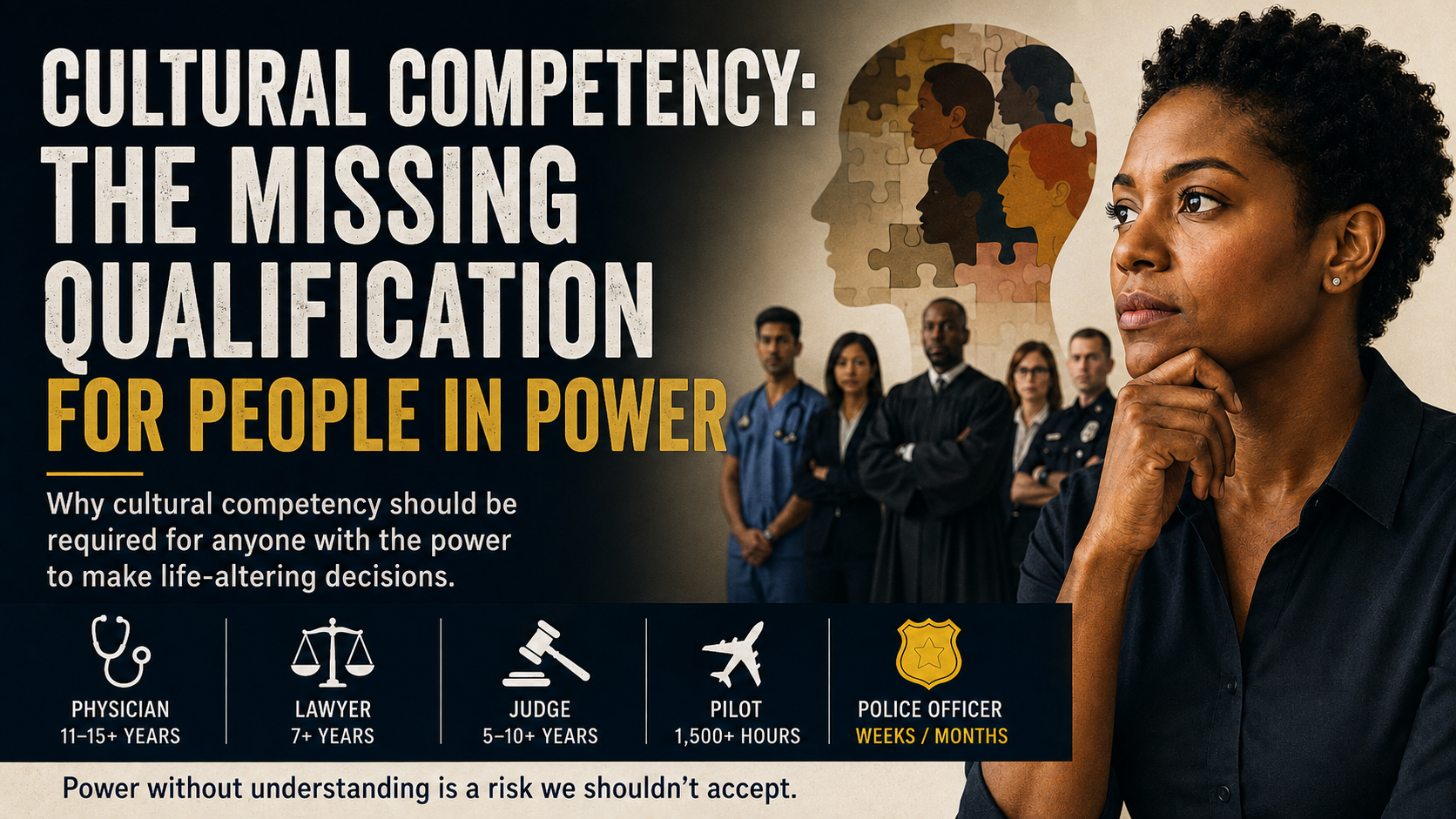
Look at what we already require before trusting someone with life-altering power over another human being.
Related stories
Read that table again and notice what it actually proves. It isn't a list of credentials. It's proof that we are entirely capable of rigor when we've decided something matters.
A physician needs more than a decade of education and training before independent practice. Judges commonly spend years practicing law before taking the bench. Principals generally spend years teaching before being entrusted with an entire school.
We built those thresholds deliberately because we understand that expertise affecting other people's lives has to be earned, not assumed.
So when an occupation or institution leaves out an entire category of expertise, that's not simply an oversight. It reflects a judgment about what knowledge counts.
And the principle should be simple:
Cultural competency should be proportional not to professional status, but to power. The greater a person's authority to make consequential decisions about other people's lives, the greater our obligation to require that person to understand the human beings over whom that authority is exercised.
That applies whether the decision-maker is a physician, judge, police officer, teacher, supervisor, social worker, corrections officer, loan officer, benefits administrator, child-welfare investigator, landlord, hiring manager, or government employee sitting behind a counter.
Some belong to what we traditionally call professions. Some don't.
The distinction matters far less than the power they hold.
What We Keep Choosing to Skip
Cultural competency is the accumulated knowledge, awareness, judgment, and skill needed to understand and work effectively with people whose backgrounds, histories, and relationships to institutions differ from your own.
It is not a seminar or a list of facts about groups. It means understanding how history, power, discrimination, language, class, and community experience shape how people move through institutions — while recognizing that the decision-maker has a culture and blind spots too.
There is an important qualification to the word competency.
In a landmark 1998 article published in the Journal of Health Care for the Poor and Underserved, physicians Melanie Tervalon and Jann Murray-García argued that people exercising authority over others should practice cultural humility, which requires “a lifelong commitment to self-evaluation and self-critique.”
Cultural humility recognizes that no amount of training allows one person to completely master somebody else's culture. A decision-maker must remain capable of questioning assumptions, recognizing power imbalances, and learning from the people whose lives their decisions affect.
And that self-examination has to include something discussions of cultural competency often leave strangely untouched:
Whiteness itself.
Sociologist Ruth Frankenberg argued that whiteness is not the absence of race or culture. She described it as a racial standpoint and as a set of cultural practices that are “usually unmarked and unnamed.”
That invisibility matters.
When the norms of a dominant group become deeply embedded in institutions, they can stop looking like cultural norms at all. They begin to appear simply normal, reasonable, appropriate, or correct.
A white supervisor therefore does not have to consciously believe that white behavior is superior in order to judge a Black or brown employee according to standards developed within predominantly white institutions.
Expectations about eye contact, speech, tone, assertiveness, emotional expression, deference to authority, hairstyles, dress, self-promotion, or what it means to be “professional” can all be culturally situated while presenting themselves as neutral.
The supervisor may sincerely believe, I treat everybody exactly the same, without ever asking who established the standard by which everybody is being measured.
Black people are understood to have a race. Latinos have an ethnicity. Immigrants have a culture. Indigenous people have traditions.
But white Americans can move through the same conversation imagining themselves simply as people — culturally neutral observers evaluating everyone else.
They are not.
White people, like everyone else, have been shaped by history, institutions, communities, customs, assumptions, and racial experience.
Cultural competency therefore cannot mean teaching white decision-makers how to understand everybody else while leaving their own cultural position uninterrogated. Cultural humility begins with a different question:
What am I bringing into this encounter that I have mistaken for universal?
None of this means that only white people can reproduce dominant cultural standards. Once those norms become embedded in institutions, people of any race can absorb and enforce them. A Black supervisor, Latino judge, Asian physician, or Indigenous administrator can also mistake institutional norms for neutral ones.
Cultural competency and cultural humility are obligations for everyone who exercises power over others.
The point is not that whiteness is the only source of cultural bias. It is that in the United States, white norms have historically had unusual power to define what institutions treat as normal, credible, respectable, reasonable, or appropriate — and those norms can be internalized and enforced by anyone.
Everyone has a cultural standpoint. Everyone can have blind spots.
But not every cultural standpoint has had equal power to write the rules by which everyone else is judged.
When Cultural Assumptions Become Institutional Power
A misunderstanding between two neighbors is one thing.
The same misunderstanding in the mind of a supervisor, physician, judge, principal, HR manager, police officer, social worker, teacher, corrections officer, or government administrator can determine whether somebody gets promoted, receives treatment, keeps custody of a child, goes to prison, gets expelled, receives public benefits, gets hired — or survives an encounter with the state.
Institutional power magnifies cultural assumptions.
A physician can know anatomy perfectly and still misread a patient's silence as noncompliance when it's actually fear, cost, or history talking.
A lawyer can know the statute cold and still misjudge a client's refusal to make eye contact, never realizing it's not evasion but a learned response to authority.
Judges rule constantly on credibility, remorse, danger, and “reasonableness” — judgments that are not culturally neutral. A judge who mistakes personal norms for universal ones can turn difference into legal disadvantage without intending to.
A principal who reads a parent's absence as “disengagement” may be missing a work schedule, language barrier, or family's prior mistreatment by schools.
An HR manager deciding who looks “professional” or is “a good fit” can embed enormous bias into categories that feel neutral.
And a police officer who has seconds to interpret a gesture as a threat is necessarily drawing upon what that officer already knows.
These are not necessarily failures of intelligence or effort. They are failures of a kind of knowledge we often never required in the first place.
The problem isn't simply that people in positions of authority may know too little about cultures other than their own.
They may know too little about their own.
The Elephant in the Room
Every occupation in that table can damage a life.
Only one can end one, on the spot, without anyone else's approval in that moment.
Yet policing is among the occupations in which we require the least formal education before granting extraordinary authority over other human beings, including the authority to arrest, use force, and sometimes decide in seconds whether another person presents a mortal threat.
A cultural misreading by a hiring manager can cost someone a job. A cultural misreading by a police officer can cost someone their life.
And notice where much of that scrutiny is directed.
Policing in this country is heavily concentrated around low-level, visible offenses in poor and heavily policed communities. Meanwhile, white-collar wrongdoing can wipe out pensions, destroy livelihoods, poison communities, and impose enormous social costs while being handled through specialized investigations, regulatory proceedings, civil litigation, and lengthy institutional processes.
The contrast matters.
People in heavily policed communities can encounter the coercive power of the state over relatively minor conduct, while people responsible for harms affecting thousands or millions may never experience anything resembling a street encounter with an armed government agent.
The cultural-competency problem therefore isn't only about what an officer knows.
It's also about where institutional power is concentrated, who is subjected to it most frequently, and whose behavior institutions have decided requires constant interpretation and surveillance.
I Watched This Happen for Twenty Years
For a large percentage of my adult life, I worked at a major NASA facility.
It was rigorous. It was demanding. It selected for some of the most technically excellent people I have ever worked alongside, and I'm proud of what we built there.
But you could walk from one room to another and see the limits of technical expertise.
The executive boardroom looked one way.
The cafeteria kitchen looked entirely different.
Neither was an accident, and neither required believing that every person in authority consciously intended that outcome.
Technical expertise was abundant. But knowledge of the human beings affected by institutional decisions was treated differently — as though understanding people were somehow less worthy of serious study than understanding systems, budgets, engineering, law, medicine, or management.
That is the gap I am talking about.
The Closest Thing We Have to a Fix — and Why It Isn't One
Some organizations have tried to limit individual bias through 360-degree performance evaluations — gathering feedback not only from a manager but from peers, direct reports, and sometimes clients.
That's an improvement. Widening the circle of people who get to weigh in makes it harder for one person's blind spots to become the entire verdict on someone's career.
But it doesn't solve the underlying problem.
Five people without cultural competency don't average out into one person with it.
If everyone reviewing an employee shares the same unexamined assumptions about what “professional,” “articulate,” “leadership material,” “aggressive,” “polished,” or “a good fit” looks like, 360-degree feedback can simply reproduce the same cultural judgment through more signatures.
And if the standards themselves were shaped by a dominant culture that does not recognize itself as a culture, adding more people who share those assumptions can make the judgment appear even more objective.
That's the difference between a process fix and a knowledge fix.
Changing who's in the room does not necessarily change what the room knows.
The Reframe
We understand in almost every high-stakes setting that consequential judgment requires knowledge, training, accumulated experience, and demonstrated competence.
Yet when the subject of that judgment is another human being — particularly someone whose history, culture, community, or relationship to institutions differs from that of the person holding power — we become remarkably comfortable with intuition.
Supervisors decide who is “leadership material.”
Judges decide who appears remorseful.
Teachers decide which child is disruptive.
Doctors decide whether a patient is compliant.
Police officers decide whether someone looks threatening.
Hiring managers decide who is a good fit.
Government workers decide whose explanation sounds credible.
Again and again, people exercising institutional authority are called upon to interpret human behavior without being required to understand either the culture of the people they are judging or the culture through which they themselves are doing the judging.
That is the contradiction.
We require people to understand anatomy before they operate on bodies.
We require people to understand law before they argue cases.
We require teachers to study education before we entrust them with classrooms.
But when we give people institutional authority over other human beings, we continue to treat serious knowledge of those human beings — and knowledge of oneself — as optional.
Why?
Further Reading and Resources
Melanie Tervalon and Jann Murray-García, “Cultural Humility Versus Cultural Competence: A Critical Distinction in Defining Physician Training Outcomes in Multicultural Education”
Journal of Health Care for the Poor and Underserved (1998). The foundational article introducing cultural humility as an alternative to the idea that someone can simply “master” another person's culture. Tervalon and Murray-García emphasize lifelong self-evaluation, attention to power imbalances, and institutional accountability. Read via PubMed
Ruth Frankenberg, White Women, Race Matters: The Social Construction of Whiteness
University of Minnesota Press (1993). Frankenberg's influential study examines whiteness not as racial neutrality but as a racial and cultural standpoint whose power partly comes from appearing “unmarked” and universal. Book information and overview
Georgetown University National Center for Cultural Competence
A major research and resource center devoted to cultural and linguistic competency in institutions and systems. Its work emphasizes that cultural competence is not merely an interpersonal skill but something organizations must incorporate into policy, leadership, training, and accountability. National Center for Cultural Competence
U.S. Department of Health and Human Services, National CLAS Standards
The National Standards for Culturally and Linguistically Appropriate Services provide 15 concrete standards for incorporating cultural and linguistic competence into health-care organizations, including leadership, workforce training, communication, community participation, and accountability. National CLAS Standards
Institute of Medicine, Unequal Treatment: Confronting Racial and Ethnic Disparities in Health Care
National Academies Press (2003). This landmark report found that racial and ethnic disparities in health care persist even after differences in access and socioeconomic conditions are considered. It examines how attitudes, expectations, communication, and decision-making within medical institutions contribute to unequal treatment and recommends cross-cultural education as part of the response. Read the report at the National Academies
American Bar Association, Implicit Bias Initiative
A collection of research, training materials, videos, and practical tools examining how implicit bias can affect judges, prosecutors, public defenders, lawyers, jurors, and other actors within the justice system. The ABA materials include research showing that unconscious assumptions can influence judgments even among people committed to impartiality. ABA Implicit Bias Initiative
Jeffrey J. Rachlinski, Sheri Lynn Johnson, Andrew J. Wistrich and Chris Guthrie, “Does Unconscious Racial Bias Affect Trial Judges?”
Notre Dame Law Review (2009). An empirical study examining implicit racial bias among judges and whether such biases can influence judicial decision-making. The researchers found that judges, like other people, can harbor implicit racial biases and that those biases can affect judgment under some circumstances.
U.S. Department of Education, Institute of Education Sciences, “Eliminating School Discipline Disparities”
Research summarized by the Department of Education shows that Black students are more likely than white students to be referred for subjective offenses such as “disruption” or “defiance” and may receive harsher consequences for similar conduct. The research points to teacher and administrator decision-making, racial stereotyping, and implicit bias as contributors to disparities. Read the IES overview
Stanford SPARQ and the U.S. Bureau of Justice Assistance, Strategies for Change: Research Initiatives and Recommendations to Improve Police-Community Relations
This work on policing emphasizes that racial disparities cannot be reduced to the prejudices of individual officers. It identifies implicit bias alongside police-department culture, institutional practices, incentives, and enforcement priorities as potential sources of racial disparities — reinforcing the need to examine systems as well as individuals.
Learning for Justice, Social Justice Standards and Culturally Responsive Teaching Resources
Resources for educators examining identity, diversity, justice, bias, culture, and the relationship between teachers' own perspectives and their interpretation of students. The materials include practical approaches to culturally responsive teaching and anti-bias education. Learning for Justice resources
Comments

Powered by RoundtableAn AI/DeFi-powered Enterprise Media Operating System. Learn more at Roundtable.io.© Roundtable 2026. By using this site you agree to the Terms of Use and Privacy Policy