


Aug 27, 2026 11:56 PM
Updated Aug 28, 2026 2:44 AM
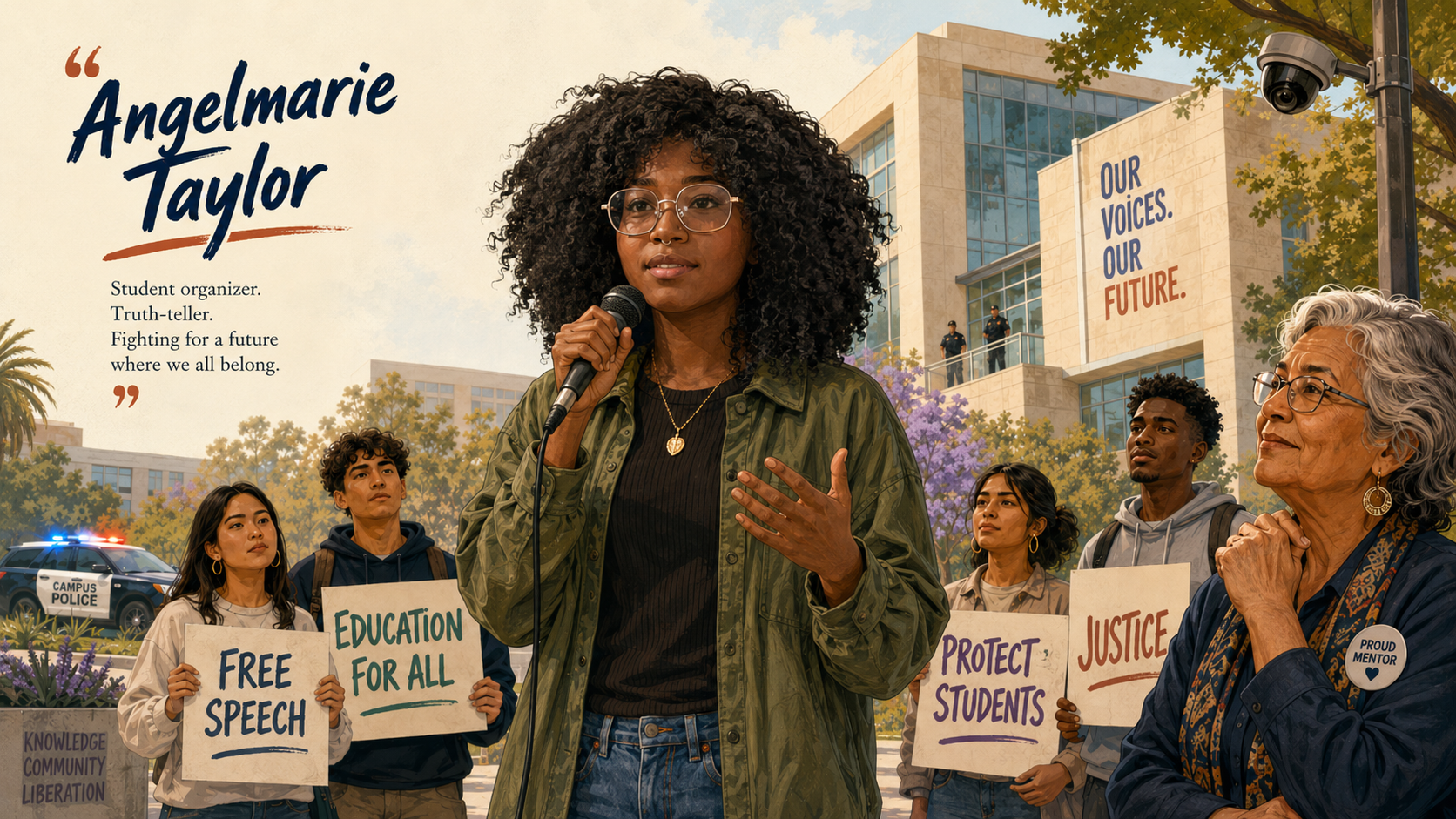
The Black Lives Matter Grassroots Youth Vanguard organizer began organizing at age 10. Now she is fighting campus repression, standing with immigrant communities and building political power.
Older activists talk a lot about “passing the torch” to the next generation.
After spending time with AngelMarie Taylor, I’m beginning to think we may have the metaphor wrong.
Young people like Taylor aren’t standing around waiting for somebody to hand them a torch. They have already picked it up. The more urgent question is whether those of us who have been doing this work for decades are prepared to support them, listen to them and help clear obstacles out of their way.
Taylor is a Youth Vanguard Organizer with Black Lives Matter Grassroots, and when I recently interviewed her, I was struck by the contrast between her youth and the amount of organizing she has already packed into her life.
Related stories
During her years at California State University Channel Islands, she was active with groups including Students for Quality Education, the Black Student Union, reproductive and gender-equity organizing, Students for Justice in Palestine and Students Against Fascism.
But her activism started long before college.
It started when she was 10 years old.
Organizing Because Children Needed Lunch
Taylor told me that she and her siblings sometimes went to school without being able to afford lunch. Rather than accepting that as simply the way things were, she joined student government and began working to make food universally available at her school.
“I started as a student organizer when I was 10 years old,” she told me. “There were so many situations where myself and my siblings were going to school and could not afford lunch.”
That first experience taught her something enormously important: organizing could actually change conditions.
“I got a glimpse at how effective and necessary activism is at a young age,” Taylor said. “I’ve never stopped.”
There is an important lesson there for those of us who are older.
Young people don't need to be protected from knowing what is happening around them. They already know.
“We’re not just seeing what’s going on in society,” Taylor told me. “We’re also feeling it. Us being young people doesn’t make us exempt from the atrocities.”
Some are making a conscious decision to do something about those conditions.
Our job should be to help them.
When Student Activism Becomes Grounds for Punishment
Taylor recently completed her studies at CSU Channel Islands and hopes to continue her education in Pan-African Studies at Cal State Los Angeles.
Her experience at Channel Islands, however, was not the idyllic college experience many parents imagine when they send their children off to school.
Black students make up only a tiny percentage of the CSU Channel Islands student population. Taylor says the anti-Blackness she encountered was compounded by administrative efforts to restrict political activism.
She described experiences that would be troubling for any student: investigations, surveillance, interference with her education and encounters with university police.
Taylor testified before the California Senate Education Committee that she had been investigated three times for alleged violations of campus “time, place and manner” policies involving 11 separate alleged violations.
She told lawmakers that during one period she was disenrolled from her classes; during another investigation, a hold on her account interfered with registering for courses, housing, financial aid and ultimately her graduation. She also testified that she experienced police harassment and administrative surveillance.
“As students,” she told lawmakers, “we pursue education to get degrees, not felonies.”
That sentence ought to stop us cold.
Universities should be places where young people learn to think, challenge assumptions, test ideas and become engaged citizens.
Instead, Taylor believes policies nominally designed to regulate when, where and how students demonstrate have too often been wielded to discourage dissent.
She isn't alone in raising that concern.
Taking the Fight to Sacramento
Taylor eventually took her experience before California legislators in support of AB 2551, legislation by Assemblymember Sade Elhawary addressing student conduct reporting and campus “time, place and manner” restrictions.
The measure would require greater reporting about disciplinary actions connected to protests and create opportunities for students to publicly address the rules governing campus expression.
Taylor is clear that her ambitions go further. She wants to see the restrictive policies themselves abolished.
Her testimony matters because it puts a human face on something that can otherwise sound like an abstract debate over university regulations.
These policies can determine whether a student graduates.
They can determine whether someone receives financial aid.
They can determine whether political participation becomes part of a student’s education—or becomes something a student learns to fear.
For Taylor, the issue is fundamental.
“We should have the freedom to grow into changemakers that our society needs,” she said.
She is right.
From Campus Protest to an Immigration Raid
Taylor’s organizing extends far beyond the university.
Last year she was present during the massive federal immigration enforcement action at Glass House Farms in Camarillo.
Her connection to immigration is personal. Her mother was born and raised in the Philippines, and Taylor describes her family as having experienced the lasting trauma of deportation.
That history shaped how she responded when immigration enforcement intensified in Ventura County.
Taylor went to Glass House Farms with others from the community, including CSU Channel Islands professor Jonathan Caravello.
She says they went to witness and document what federal agents were doing.
What she encountered was tear gas, projectiles and an overwhelming show of force.
Taylor also witnessed Caravello being taken into federal custody.
The experience was especially painful because she considers him not merely a professor but one of the mentors and adults who helped her navigate her way through life.
Taylor says she saw several agents take Caravello down after he attempted to assist a person in a wheelchair amid tear gas.
She described watching someone she trusted disappear into federal custody right in front of her.
Yet the experience did not drive her away from immigration organizing.
She remains involved with Ventura County rapid-response efforts that mobilize when immigration raids occur.
“I don’t regret being there at all,” she told me.
That tells you something about her.
Activism Is Not a Personal Brand
One reason I wanted to interview Taylor was that I have watched her in organizing spaces and sensed something increasingly important in an era when political activism can sometimes become another form of personal branding.
We live in a culture that encourages young people to measure themselves in followers, likes, views and engagement.
There is nothing inherently wrong with social media. Movements use it because movements should use every tool available.
But there is a difference between using social media to build a movement and using a movement to build your social media.
Taylor appears very conscious of that distinction.
She acknowledged that it can be difficult watching people her age remain disconnected while she and other young organizers are confronting serious consequences for political activity.
“Being a young revolutionary is isolating in so many ways,” she said.
But she doesn't write off her generation.
Quite the opposite.
Taylor believes more young people are moving toward activism as conditions around them deteriorate.
And she is searching for ways to bridge the gap between popular culture and political consciousness.
She gave me an example that initially made her laugh.
Among young women, she said, being a “girls’ girl” has become a popular expression of female solidarity.
Why not extend that idea?
A “girls’ girl,” she suggested, should care about girls in Palestine. She should care about girls in Mississippi. She should care about what happens to women and girls beyond the boundaries of her own social circle.
Taylor worried aloud that the example might sound silly.
It doesn't.
That is political organizing.
You meet people where they are and help them make connections they may not yet have made themselves.
Social Media Cannot Replace Organizing
Taylor has also learned something movement veterans know well: social media is useful, but there is no substitute for human relationships.
“As a young person I do get tempted to limit my outreach to social media,” she said.
But simply sending information into the digital universe does not necessarily build political power.
She has begun concentrating more attention on the people she encounters in real life—the people at her school, workplace and in her neighborhood.
Those relationships matter.
Movements are built when somebody who knows you asks you to come to a meeting.
When a coworker explains why something happening on campus matters.
When a neighbor decides to show up.
When one person trusts another enough to take a risk.
Technology changes.
Human beings don't change nearly as much.
“Young People Are Doing Something About It”
Near the end of our conversation I asked Taylor what she would say if she had a megaphone capable of reaching people of my generation.
Her answer was immediate.
“Young people are doing something about it.”
She wanted that understood first.
From K-12 schools to college campuses, young people are organizing.
But, she added, they cannot do it alone.
Then she made a distinction that those of us with gray hair would do well to remember.
Supporting young people does not mean constantly telling them what to do.
“Just because someone might be young does not mean they don’t know what they’re talking about or they don’t know what they’re feeling,” Taylor said.
Older people often confuse experience with omniscience.
We have accumulated knowledge. We have made mistakes. We have survived defeats. Some of us know where institutional bodies are buried.
That knowledge has value.
But it doesn't mean we understand the world of a 20-year-old better than the 20-year-old living in it.
“Really listen,” Taylor urged. “Take time to listen to how we’re feeling, what we’re seeing and what we’re trying to accomplish.”
Then help.
That sounds like a pretty reasonable division of labor to me.
Building Black Student Power
Taylor is now helping build connections among Black students well beyond a single campus.
She described an emerging effort to link Black student organizers regionally through what participants are calling BLM College West and BLM College East.
In California, she says Black Student Union chapters representing more than two dozen campuses—including California State University, University of California and private campuses—have been participating in broader coalition-building.
The goal is not simply networking.
Taylor describes it as an effort to “repoliticize ourselves as Black students” and turn that political education into direct action.
And the demands she describes are hardly radical luxuries.
Affordable tuition.
Food students can actually afford and eat.
Adequate resources.
Accountability for university spending.
Support for historically marginalized students.
These are young people looking at institutions that tell them they should be grateful simply to be admitted and asking a different question:
Why aren't these institutions serving the students they exist to educate?
That is exactly the kind of question young people should be asking.
Ten Years From Now
I asked Taylor where she sees herself in 10 years.
She didn't tell me she wants to run for office.
She didn't name a job title.
She didn't describe a personal brand, television contract or number of followers.
“I don’t plan on doing anything different,” she said.
What she hopes will be different is the number of people standing beside her.
“In 10 years, I hope to have met a lot more people who are trying to do the same thing—to build power with other structures, other freedom fighters in that shared mission.”
She hopes to be working alongside thousands more.
That may have been my favorite answer of the interview.
We Need Each Other
Before we finished, I gave Taylor one piece of advice from nearly seven decades of living and years of activism:
Count the victories.
Movement work can make defeat feel permanent.
The injustice is always bigger than the meeting you just held. There is another election, another killing, another war, another budget cut, another racist policy, another deportation, another politician who disappoints you.
If you measure yourself only against everything that remains undone, despair is almost guaranteed.
So count what moved.
Count the person who showed up who had never attended a protest before.
Count the student who found her voice.
Count the policy you changed.
Count the institution that was forced to answer you.
Sometimes, Taylor told me, the victory may be as simple as organizers managing to sit down and share a meal after an action.
She understands something important there too.
Movements aren't machines.
They are made of people.
Those people have to eat, laugh, rest, love one another, celebrate and occasionally recognize that something they did actually mattered.
I told Taylor that we would continue watching what happens with AB 2551 and, more importantly, what happens after legislation passes—or fails. Passing a bill isn't the end of organizing. Implementation matters. Enforcement matters. Building power matters.
And I invited her to join us at the Left Coast Forum.
Because when I look at AngelMarie Taylor, I don't see someone who might someday become a movement leader.
I see someone doing the work of leadership right now.
Those of us who have been at this for decades have something to contribute: history, experience, institutional knowledge, relationships and lessons learned the hard way.
Young organizers bring something equally indispensable: urgency, imagination, new forms of organizing and firsthand knowledge of the world they are inheriting.
We need their energy.
They can use some of our accumulated wisdom.
But most of all, we need to stop asking when the next generation is going to step forward.
They already have.
The question is whether the rest of us are prepared to stand with them.
Resources for Further Reading and Action
Zeynep Tufekci, Twitter and Tear Gas: The Power and Fragility of Networked Protest
An important examination of how social media has transformed contemporary protest movements—allowing movements to mobilize extraordinarily quickly while sometimes leaving them without the organizational structures needed to build lasting power. Particularly relevant to AngelMarie Taylor’s observations about the difference between social-media outreach and relationship-based organizing.
Read Twitter and Tear Gas
ACLU — Community Control Over Police Surveillance: Technology 101
A guide to surveillance technologies used by law enforcement and other government authorities, including cell-site simulators, automatic license-plate readers, facial and biometric surveillance, CCTV cameras, gunshot-detection systems, hacking technologies, body cameras and predictive-policing tools. The ACLU’s Community Control Over Police Surveillance initiative argues that communities should know what surveillance systems their police departments acquire and have a meaningful role in determining how those technologies are used.
ACLU: Community Control Over Police Surveillance
ACLU — Surveillance, Profits, and the Police
A more recent examination of the expanding role of private technology companies in American policing and the risks created when interconnected surveillance systems give police—and private vendors—access to massive amounts of data. The report looks at technologies including cameras, license-plate readers, drones, real-time crime centers and artificial intelligence.
ACLU: Surveillance, Profits, and the Police
ACLU of Northern California — Know Your Rights: Free Speech at Colleges and Universities
A practical guide to the constitutional protections afforded to students at public colleges and universities, including protests, demonstrations and other forms of political expression on campus.
Know Your Rights: Free Speech at Colleges and Universities
ACLU of Southern California — Know Your Rights When Protesting
Information about the rights of demonstrators, including interactions with law enforcement, documenting police activity, protesting in public spaces and responding to arrests or uses of force.
Know Your Rights When Protesting
California AB 2551 — Equity in Higher Education Act
Follow the California legislation discussed in the interview concerning campus time, place and manner policies, disciplinary actions related to student protest and greater transparency surrounding restrictions on campus expression.
Track AB 2551
Students for Quality Education (SQE)
A statewide student-organizing project founded by California State University students to fight for accessible, affordable and high-quality public higher education. SQE trains students in organizing, political education, coalition-building and direct action.
Students for Quality Education
Afrikan Black Coalition
A statewide network of Black student organizations focused on leadership development, political education, organizing and building collective power among Black students. Its network includes campuses throughout the University of California and California State University systems.
Afrikan Black Coalition
Black Lives Matter Grassroots — Youth Vanguard
The Youth Vanguard develops and supports young organizers working for Black liberation, educational justice and broader social change. AngelMarie Taylor serves as a Youth Vanguard Organizer with Black Lives Matter Grassroots.
Black Lives Matter Grassroots
805 UndocuFund / 805 Rapid Response Network
A community-based network serving California’s Central Coast that responds to immigration enforcement activity, distributes know-your-rights information, documents enforcement actions and helps connect affected families with support.
805 UndocuFund
Comments

Powered by RoundtableAn AI/DeFi-powered Enterprise Media Operating System. Learn more at Roundtable.io.© Roundtable 2026. By using this site you agree to the Terms of Use and Privacy Policy