


Jan 28, 2026 12:54 AM
Updated Jan 28, 2026 1:27 AM
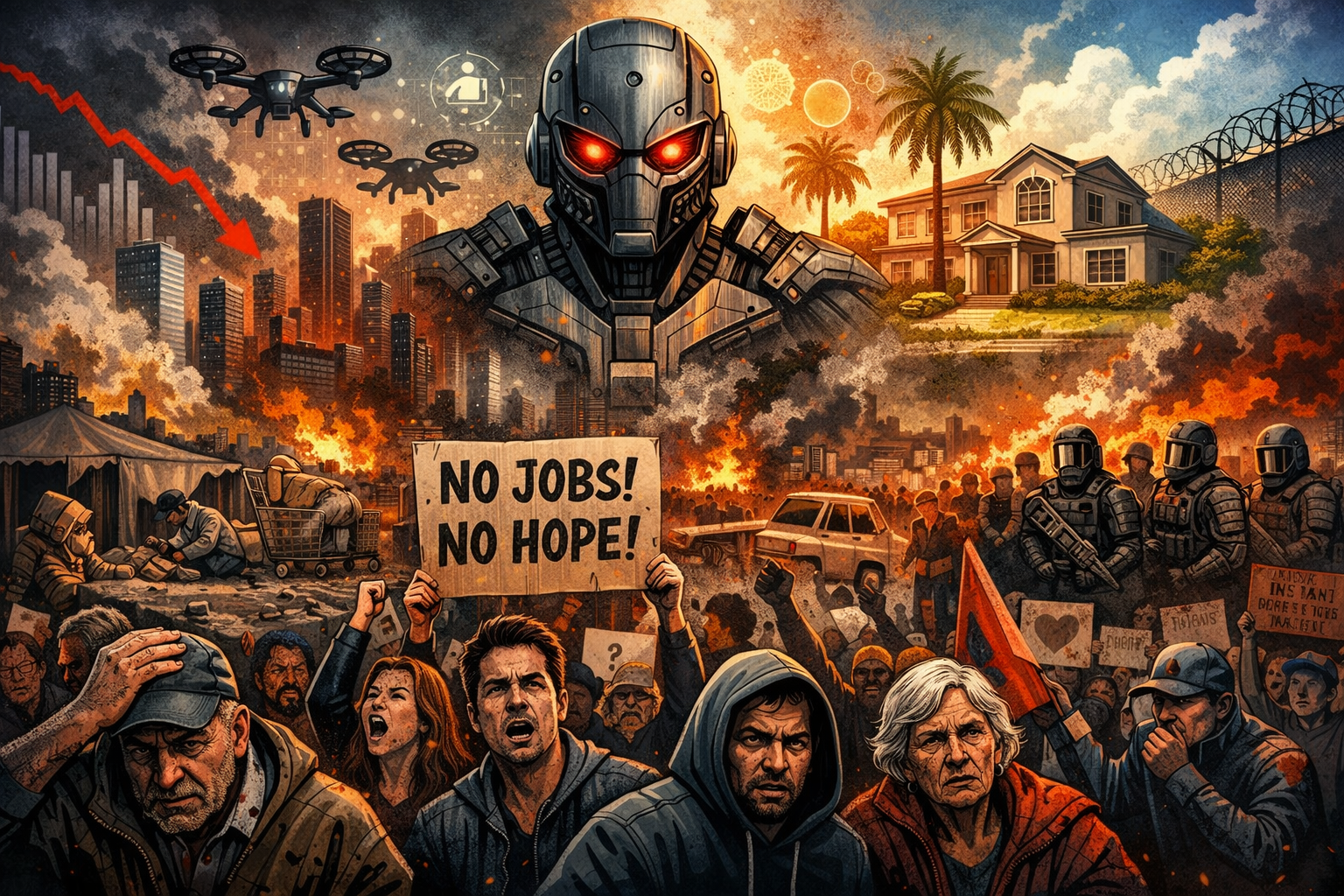
AI Anxiety and the Political Blind Spot. As artificial intelligence threatens jobs, identity, and economic stability, the real danger may be the fear we refuse to confront.
One of the biggest psychological threats we face today, both as a nation and as a world, is one that politicians in both parties are largely ignoring. That judgment may be slightly unfair, since much of this is new and unfolding rapidly, but the constant drumbeat about the rise of AI is, in my view, a major driver of the anxiety now fueling social unrest. We are surrounded by reminders of a future defined by employment uncertainty.
The Psychological Crisis No One in Politics Wants to Name
The growth of AI has already resulted in thousands of layoffs among highly educated workers, and warnings of much more to come are everywhere. They appear on radio and television, in email inboxes, on YouTube, TikTok, messaging apps, social media, and even in casual conversation. This anxiety is compounded by the fact that, for millions of people, the American Dream is just that, a dream. Economic inequality in America has become grotesque.
The long-term implications point simultaneously toward utopia and doom, and the absence of our elected representatives from this discussion only intensifies the frustration. What could be more promising than a social safety net that uses the profits generated by AI to guarantee every citizen enough income to live a fulfilling life, with sufficient free time to pursue education and personal growth?
The Drumbeat of AI Layoffs and the Death of Job Security
Such a shift could help us replace an identity long tied to our jobs with one rooted in being fully mature human beings, possessing the internal confidence to live without scapegoats or supernatural beliefs.
Related stories
At the same time, what could be more threatening than the prospect of AI decimating the labor market at every level, while the top ten percent continue to claim an ever-larger share of the economic pie and the rest of us barely scrape by, always one slip away from living on the street? These fears are not science fiction. They fester in our subconscious every time we are jolted by another AI prophecy.
Neither political party has seriously addressed this psychological elephant in the room, and this neglect steadily increases social unease. The warnings grow more dramatic, and economically, at least half of our elected representatives remain ideologically trapped in a confused version of trickle-down economics.
Make no mistake, the problems ahead, especially in an era of extreme political partisanship, make the challenge of solving them harder than rocket science. Imagine where we will be when jobs begin to vanish like fog in warm sunlight and our politicians have little to offer beyond pointing fingers at “them.”
Economic Inequality Makes the AI Threat Feel Existential
In my view, getting ahead of this issue represents the political opportunity of a lifetime. It is difficult, yes, but what could be a better strategy than putting AI itself to work figuring out how to manage this transition? All we lack is political will. Rewriting our future in the age of AGI will require an all-hands-on-deck effort if we are to generate enough public support to avoid serious social unrest.
Untangling human well-being from politics will be difficult because of our tribalistic predispositions, but it must be done if we are ever too mature as a species.
I believe a thoughtful, well-designed campaign to address AI technology would immediately reduce the legitimate fears of generations of Americans raised in a culture that has traditionally valued human doings more than human beings. It could also lower the temperature of political partisanship.
One of the predictions in my manuscript is that if we succeed in loosening the grip of identity so tightly tied to work, we will see a widespread turn toward liberal education. We live in our heads, and the potential of what that could and should mean is widely misunderstood. We all possess far more capacity for contemplation and reflection than we typically use in expanding our humanity.
I describe our empathic nexus as the mental, metaphorical mind space where empathy is expandable. In this space, we make room for people who do not look, think, worship, or vote like us. It is humanity’s most underused tool for dissolving tribal hostility and replacing suspicion with understanding. When expanded through liberal education, reflection, and the humanities, our empathic nexus becomes the moral equivalent of disarmament, allowing us to trade contempt for compassion and polarization for perspective.
Utopia or Collapse? The Two Futures AI Is Forcing Us to Imagine
The depth of humanistic contemplation, introspection, and reflection our species is truly capable of is largely missing from most texts exploring liberal education, at least from what I have been able to find. My conclusions draw heavily from biology and neuroscience, and while some may be wrong, I am confident that I am on the right track.
In the age of AI, which will magnify both wisdom and folly, the size of our empathic nexus may well determine whether we face global threats together or descend into the small-tribe conflicts that have haunted us since prehistory. A shrunken empathic nexus breeds suspicion. An expanded one breeds understanding. The future will belong to those whose empathic nexuses are large enough to hold all of humanity. Our survival depends on enlarging the metaphorical space in our minds before conflict fills the space in our streets.
Our efforts to create a viable meritocracy have caused us to overlook the fact that most of us are far more capable of intellectual contemplation and reflection than we are given credit for, if only we had the time, attention, and assistance needed to develop those capacities. With the necessary support, more people will intuitively seek the kind of understanding that reassures them that the chance to be fully human is quite enough.
Neuroscience, Identity, and Why Tribal Beliefs Stick
Evolution equipped us with the neurochemical rewards that make learning its own dopamine incentive, but the system must be primed before it becomes self-sustaining. The greater our ability to reflect, relate, and ponder our personal dilemmas, the better we can cope without resorting to blame.
A fascinating area of research in neuroscience, still in its infancy, suggests, as I have mentioned before, that some of the cultural assumptions and beliefs we absorb during childhood are sequestered in parts of the brain that are inaccessible to our prefrontal cortex. In a real sense, they become part of our identity, and this, I think, helps explain why beliefs that fly in the face of science and reason can be passed on for hundreds of generations without serious revision. Research in this area could do a great deal to help us mitigate our innate tendencies toward tribalism.
We simply do not yet understand how much of our predilections for being liberal or conservative are driven by biology or by life experience. In my recent manuscript, I argue that what I characterize as an existential education can indeed make a person more liberal, but I do not know at what point that influence runs up against genetic predispositions.
It is my opinion, based on lived experience and scholarship, that upbringings in authoritative patriarchal cultures can significantly inhibit the ability to relate to others. Today’s MAGA culture should make this clear. Their empathic nexus is treated as protected space.
My father, for example, who was born in 1921, fits the above description. He would have been furious at the mere mention of such a subject, and I believe there is evidence in psychologist Jonathan Haidt’s Moral Theory research that could, if thoroughly examined, lend credence to this notion. There is a caveat, however, in that many of the predilections we attribute to genetics are still poorly understood, and much more research is necessary to determine what predisposes us toward liberal or conservative forms of politics.
If we do nothing about the rapid advancement of AI, if we adopt a wait-and-see posture while employment insecurity skyrockets, I have a troubling vision. Red MAGA hats may be replaced not by reflection or reform, but by something closer to Mad Max.
Comments

Powered by RoundtableAn AI/DeFi-powered Enterprise Media Operating System. Learn more at Roundtable.io.© Roundtable 2026. By using this site you agree to the Terms of Use and Privacy Policy