


Apr 27, 2026 2:30 AM
Updated Apr 27, 2026 3:44 PM
At 5540 Boden Street, the Good Earth Community Garden—guided by community leadership including Stephen Meeks—offers a model of urban sustainability, food access, and grassroots power in Los Angeles.
Along a busy stretch of West Adams—where cars stream past Jefferson and La Cienega—the visual rhythm of Los Angeles suddenly shifts. Amid the asphalt, fencing, and compressed urban landscape, a patch of green breaks through. That unexpected space is the Good Earth Community Garden on Boden Street.
At first glance, it reads as exactly that: a community garden. But that label doesn’t quite capture what’s unfolding there. It’s not only a place where vegetables are cultivated—it’s where relationships are built, knowledge about the environment is shared, and a different way of living in the city begins to take shape. And helping to hold that vision together are people like Stephen Meeks.
Stephen Meeks is a familiar presence within the LA Progressive community. He’s one of those dependable individuals who shows up—to volunteer at our events, from LA Progressive gatherings to the Left Coast Forum. Just as importantly, he brings that same commitment back to his own neighborhood.
A Garden in the Middle of the City
The Good Earth Community Garden sits in West Adams, a neighborhood that has seen waves of demographic change, disinvestment, and more recently, rapid gentrification. The garden occupies multiple lots along Boden Street, creating a continuous strip of cultivated land where there might otherwise be empty or underused urban space.
Related stories
It’s part of the broader ecosystem of community gardens supported by the Los Angeles Community Garden Council, which helps coordinate, sustain, and advocate for more than a hundred gardens across Los Angeles County.
That matters, because community gardens don’t just happen. They require land access, governance, water, tools, and—most critically—people willing to do the ongoing, unglamorous work of maintenance and coordination.
The Good Earth Community Garden has been around for decades—reportedly established around 1970—making it part of a long lineage of urban gardening in Los Angeles.
And like many long-standing gardens, it functions as both a physical space and a social institution.
What Community Gardens Actually Do
It’s easy to romanticize a community garden as a peaceful, almost pastoral escape. But the reality is more complex—and more important.
Community gardens in the United States serve multiple roles simultaneously:
- They provide access to fresh food, especially for people who may not have space to grow their own.
- They create shared green space in neighborhoods that often lack it.
- They function as informal educational sites, teaching everything from composting to nutrition.
- And just as importantly, they build social cohesion—what organizers often call “growing community.”
The Good Earth Community Garden does all of this.
Its programming includes workshops, youth activities, and community events—everything from composting classes to planting sessions for children.
These are not side activities. They are the core of what makes the garden viable. Without continuous engagement, a community garden doesn’t just decline—it disappears.
More about Stephen
If you search, you'll find that Stephen Meeks is listed as the contact for the garden, which means he functions as a central point of coordination. But that doesn't give you a true sense of Stephen's role as the central point of coordination. This is not a small job. In a community garden, the “manager” or lead organizer often does all of the following:
- Coordinates volunteers
- Oversees maintenance and infrastructure
- Interfaces with partner organizations
- Organizes events and programming
- Handles communication and outreach
- Mediates disputes among gardeners
In other words, they hold the system together.
Stephen Meeks also appears in programming tied to the garden, including leading or co-leading activities like garden revitalization efforts and workshops during events such as Earth Day collaborations.
That tells you something else: he’s not just administrative. He’s hands-on.
Leadership in a Community Garden Is Different
Running a community garden is not like running a nonprofit office or even a small business. It’s closer to what you might call distributed leadership under constant constraint.
There’s no large budget.
There’s no formal hierarchy that people reliably follow.
There’s no guarantee of consistent participation.
Instead, leadership is exercised through:
- persuasion
- example
- consistency
- and relationships
The person in charge—or the person perceived to be in charge—has to navigate a rotating cast of participants with different expectations, levels of commitment, and cultural backgrounds.
That’s the context in which someone like Stephen Meeks operates.
And it’s not incidental. It’s structural.
Events as Infrastructure
One of the clearest windows into how the garden functions is through its events.
Take something like an Earth Day gathering. On paper, it looks like a typical community event: workshops, demonstrations, shared activities. But underneath that surface, these events are doing several things at once:
- Reactivating the space through collective labor (e.g., garden revitalization projects)
- Transferring knowledge through workshops on irrigation, composting, and sustainable practices
- Building social ties through shared activities
- Reinforcing identity—this is our garden
At one such event, Stephen Meeks participated in both physical garden work and discussions around environmental safety and sustainability.
That dual role—labor and teaching—is typical of effective community garden leadership.
Sustainability Isn’t Abstract Here
When people talk about sustainability, it can sound like an abstract policy goal. In a place like the Good Earth Community Garden, it’s concrete.
Sustainability shows up as:
- Drip irrigation systems that conserve water
- Composting practices that reduce waste
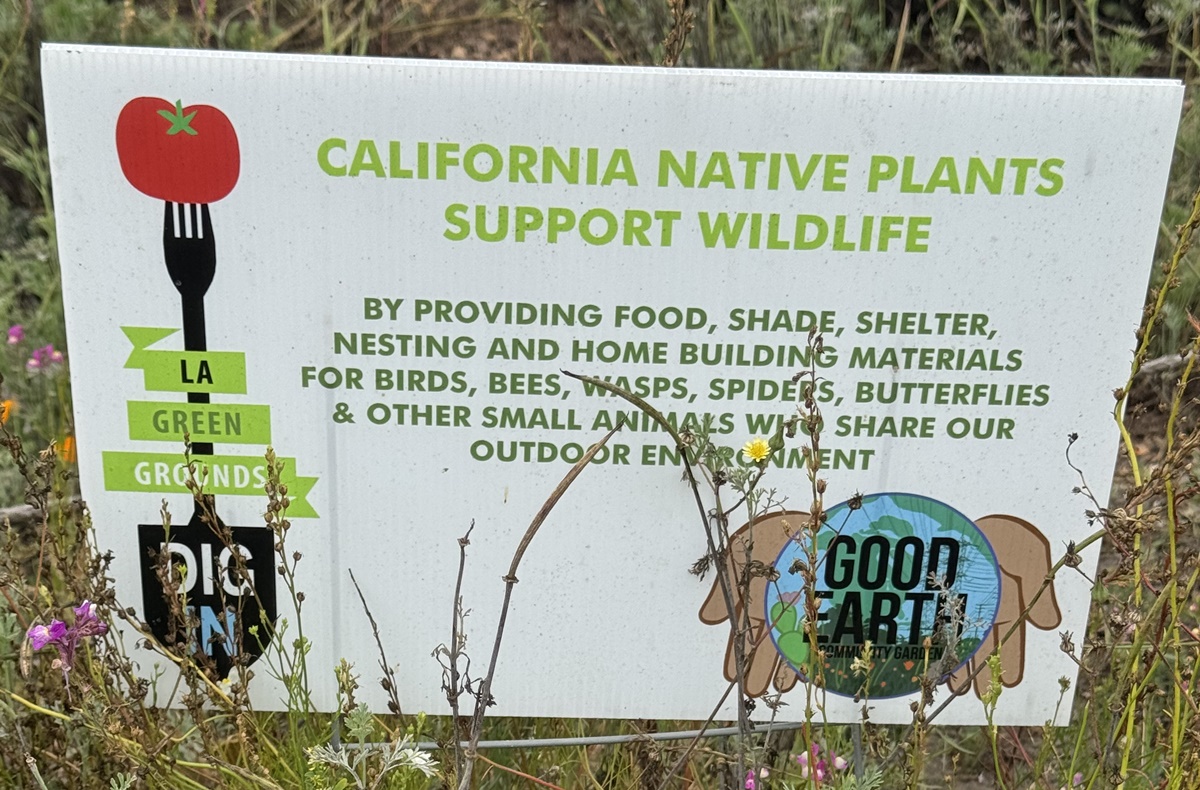
- Planting choices that support pollinators
- Soil management that keeps the garden productive
These aren’t theoretical ideas. They’re daily practices that require ongoing attention and knowledge.
And they’re often taught peer-to-peer, in spaces like this one.
The Garden as Social Infrastructure
If you step back, the most important thing about the Good Earth Community Garden isn’t the vegetables. It’s the relationships.
Community gardens function as social infrastructure—a term used to describe physical spaces that shape how people interact and connect.
In a city like Los Angeles, where social life is often fragmented by distance, class, and race, spaces like this do something rare:
They bring people into sustained, cooperative contact.
That matters.
Because social fragmentation isn’t just a cultural issue—it’s a political and economic one. It shapes who participates, who has access, and who feels ownership over public life.
The Pressure Points
But none of this exists without pressure.
Community gardens in Los Angeles face ongoing challenges:
- Land insecurity: Many gardens exist on land that could be redeveloped
- Funding constraints: Tools, water, and infrastructure cost money
- Volunteer burnout: The same people often carry the load
- Neighborhood change: Gentrification can shift who participates and who benefits
The Good Earth Community Garden is not immune to any of these.
And that means the work of maintaining it is not just about gardening. It’s about defending the space itself.
A Different Model of Urban Life
What’s happening at the Good Earth Community Garden offers a quiet but significant alternative to the dominant model of urban development.
Instead of:
- private consumption
- individual isolation
- and market-driven use of land
You get:
- shared resources
- collective labor
- and community-defined value
That’s not a small shift. It’s a fundamentally different way of organizing space and relationships.
The Unseen Labor
Here’s the part that often gets missed: none of this sustains itself.
The garden doesn’t stay green because of good intentions. It stays green because people show up—again and again—to do the work.
And that work is often invisible:
- unlocking gates
- fixing irrigation lines
- coordinating schedules
- answering emails
- resolving conflicts
This is the kind of labor that rarely gets recognized but determines whether a community space survives.
Stephen Meeks, as a central figure in the garden’s operations, is part of that invisible infrastructure.
Why It Matters
It would be easy to treat the Good Earth Community Garden as a local curiosity—a nice neighborhood feature.
That would be a mistake.
Spaces like this sit at the intersection of several critical issues:
- food access
- environmental sustainability
- urban land use
- and social cohesion
They are small in scale but large in implication.
Because they show what happens when people are given—even temporarily—control over land and the ability to shape their environment collectively.
The Takeaway
The Good Earth Community Garden is not just a garden. It’s a system.
A system held together by:
- land
- labor
- relationships
- and leadership
Stephen Meeks is one of the people helping to hold that system in place—not as a distant administrator, but as a participant in the daily work of keeping it alive.
And that’s the real story.
Not just that the garden exists—but that it continues to exist, in a city where spaces like it are constantly under pressure.
That persistence is the point.
And the people doing that work—quietly, consistently—are the reason it’s still there.
Comments

Powered by RoundtableAn AI/DeFi-powered Enterprise Media Operating System. Learn more at Roundtable.io.© Roundtable 2026. By using this site you agree to the Terms of Use and Privacy Policy