


Aug 23, 2026 8:13 PM
Updated Aug 25, 2026 9:33 PM
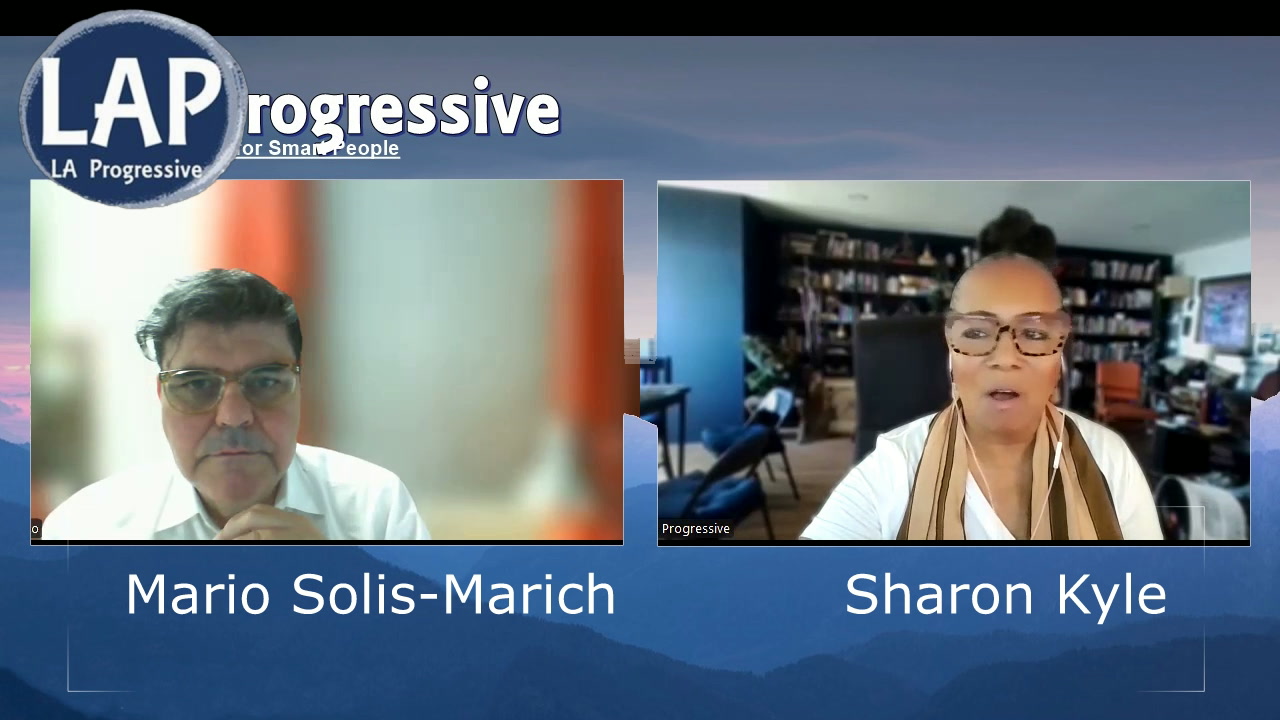
Why Mario Solis-Marich Says America Needs a New New Deal
I always enjoy talking with Mario Solis-Marich because I never quite know where the conversation is going to end up.
Mario is a longtime LA Progressive contributor, political strategist, broadcaster, policy commentator, and now Substack writer. He is also very funny—although he insists he is not a comedian.
“I hear that a lot,” he told me when we recently sat down to talk. “Sometimes the only way to deliver honesty is with a little bit of humor.”
The humor helps, because what we ended up discussing was anything but funny.
Related stories
We began with California unemployment. From there we moved to federal budget cuts, local government austerity, corporate media, the manosphere, Latino men who shifted toward Donald Trump, the disappearance of pathways into the middle class, and finally to the question underneath all of it:
Can Americans who are being squeezed by the same economic system recognize one another as allies before we are persuaded to fight over the scraps?
Mario thinks we can.
But first, he says, we have to understand the frame.
The Cuts Happened in Washington. The Pain Arrives Locally.
One of Mario’s central concerns is the growing disconnect between decisions made by the federal government and the consequences people experience months later in their neighborhoods.
Federal budgets are abstract.
A closed clinic is not.
A laid-off social worker is not.
A city eliminating services is not.
Neither is a family suddenly discovering that an organization it depended upon no longer has the staff or money to help.
Mario argues that this delayed effect allows political responsibility to disappear.
Donald Trump returned to office and his administration moved aggressively to cut federal spending, personnel, grants, and programs. Elon Musk became the public face of that campaign, at one point quite literally appearing onstage wielding a chainsaw as a symbol of government-cutting zeal.
The theater was memorable.
What happens after the theater is less visible.
Communities can absorb financial shocks for a while. States move money around. Cities tap reserves. Nonprofits reduce expenses. Agencies freeze hiring. Organizations stretch grants further.
Then the cushion disappears.
“And now people are feeling the cuts,” Mario told me. “Many times we don't associate what we're feeling on the ground with where the funding source is.”
That distinction matters.
When a city faces a budget shortfall, residents see the mayor and city council.
When a community organization eliminates a program, people see the executive director.
When a hospital closes a service, people see the hospital.
The federal decision that helped create the shortfall may have occurred months earlier and thousands of miles away.
The political danger is obvious.
People know somebody should be held accountable.
They simply may be encouraged to blame the wrong somebody.
Scarcity Has a Politics
Mario pointed to Long Beach, where city officials have struggled with a substantial budget shortfall while attempting to preserve services.
Somebody ultimately feels those cuts.
And it is rarely everybody equally.
People with significant income, private insurance, accumulated wealth and extensive personal resources can often insulate themselves from reductions in public services.
Poor and working-class families cannot.
People with disabilities cannot.
Someone depending on a publicly funded clinic cannot.
A queer teenager relying on a community center cannot.
An elderly person dependent upon publicly supported health care cannot.
A family surviving paycheck to paycheck does not experience a $50 million municipal budget gap as an accounting problem.
They experience it as a closed door.
And that is where scarcity becomes politically useful.
“When you look back at every leader who prizes authoritarianism,” Mario said, “they start off with austerity programs.”
Eventually communities begin fighting one another over whatever remains.
One neighborhood wants its program protected.
Another wants its library open.
Another wants homeless services.
Another wants police.
Another wants parks.
Another wants health care.
The argument gets framed as a competition among those groups rather than as a discussion about how wealth is distributed in the first place.
Mario put it more simply:
“We cannot allow ourselves to be driven into this trap of fighting each other.”
That may be one of the most important lessons of this political moment.
When the Media Covers the Symptom but Not the Cause
This is where Mario’s idea of “The Frame” comes in.
Every story has one.
A frame tells us what matters, where the story begins and—perhaps most importantly—who is responsible.
Mario recently became frustrated watching CNN’s Fareed Zakaria discuss California's economic troubles and unemployment.
The segment, as Mario remembers it, presented California largely as evidence of Democratic governance gone wrong.
But Mario noticed something revealing in the data being displayed: some of the employment losses were occurring in sectors highly dependent upon public spending.
His objection was not that California politicians are above criticism.
Quite the opposite.
Hold them accountable when they deserve it.
But if employment declines partly because billions of federal dollars have disappeared from programs that employ Californians, then leaving federal policy outside the frame fundamentally changes the story.
“You can believe Democrats in California are doing a bad job,” Mario said. “But that's a stupid example of it.”
His broader point is worth dwelling on.
Reporting can be factually accurate and still create a misleading picture.
The unemployment number may be correct.
The budget deficit may be correct.
The number of layoffs may be correct.
But if the audience is never told where the missing money went, it becomes easy to conclude that local officials simply woke up one morning and began firing people.
Context is not decoration.
Context determines meaning.
Follow the Money Upward
There is another fact that makes austerity politics increasingly difficult to swallow.
America is not poor.
We live in a country containing almost unimaginable private wealth.
Yet public debates routinely begin with the premise that there simply isn't enough money.
Not enough for health care.
Not enough for housing.
Not enough for schools.
Not enough for transit.
Not enough for mental-health services.
Not enough for community organizations.
Not enough for the people sleeping beneath freeway overpasses.
Meanwhile fortunes at the very top have reached levels that would have been difficult to imagine a generation ago.
Mario described it as “cash hoarding at the top.”
That formulation gets closer to the real argument than our conventional discussions about government spending.
The question is not simply whether America has sufficient resources.
The question is who controls them and what we have chosen to prioritize.
Mario said something during our conversation that stuck with me:
“The only thing that really trickles down is bad stuff.”
When funding disappears, the consequences cascade.
An organization loses a grant.
It eliminates three jobs.
Those employees reduce their spending.
A local business loses customers.
Another worker loses hours.
A family delays medical care.
Someone falls behind on rent.
Bad stuff trickles down remarkably efficiently.
Wealth has never been nearly so reliable.
America Needs a New New Deal
Mario believes we are ultimately confronting an economic question much larger than Trump.
“We have needed a new deal in this country—a new New Deal—for a long time,” he said.
I agree.
For decades, Americans were sold something approaching a bargain.
Work.
Develop a skill.
Show up.
Build a career.
Maybe join a union.
Buy a modest house.
Raise your children.
Reach some measure of economic security.
That arrangement excluded millions of people, particularly Black Americans and other marginalized communities, and it was never as universal as nostalgia suggests.
But there was nevertheless an economic ladder that existed for a larger portion of working America than exists today.
For many people, that ladder has been pulled up.
Mario and I are roughly the same generation. We remember Los Angeles before encampments became a permanent feature of the landscape.
I remember walking downtown and not seeing human beings sleeping on virtually every block.
Young adults today have no such memory.
That difference matters.
Mario recently considered what adulthood has looked like for someone now in their early 30s.
The dot-com collapse.
September 11.
Wars.
The Great Recession.
A housing crash.
COVID.
Inflation.
Exploding housing costs.
Climate disasters.
Political instability.
Now artificial intelligence threatening to transform employment again.
For younger Americans, instability is not the exception.
Instability is the economy they know.
“You can't tell people to trust the system and work within a system when the system hasn't worked,” Mario said.
Exactly.
Enter the Manosphere
That economic anxiety helps explain something Democrats ignored for far too long: the political movement of some Latino men toward Trump.
Mario has studied the phenomenon closely.
The easiest explanation is to call these voters conservative, misogynistic, misinformed or seduced by Trump's machismo.
There may be elements of all of that.
But Mario believes something deeper was happening.
There was a vacuum.
For many Latino men, he argues, cultural identity remains connected to being a provider—a caballero, a man capable of supporting and protecting his family.
Then the economic ladder disappeared.
Stable jobs became harder to obtain.
Vocational education became more expensive or neglected.
Young men were repeatedly told that college represented success while pathways through skilled trades received far less cultural celebration.
A man who cannot find stable work does not experience that solely as a labor-market statistic.
It can strike at identity itself.
Into that vacuum arrived podcasts and YouTube channels promising answers.
How to succeed.
How to make money.
How to attract women.
How to become stronger.
How to become a man.
Buy this supplement.
Read this book.
Take my course.
Listen to my show.
Eventually some of those spaces became political.
“The siren song of the manosphere,” as Mario called it, reached men through the earbuds they wore while driving, exercising or working.
And the Democratic Party?
Too often, it wasn't there.
Democrats Left an Empty Chair
Mario says warning signs appeared long before 2024.
Increasing numbers of Latino men were registering without a party preference.
Their attachment to Democrats was weakening.
People working inside Latino politics raised alarms.
The response?
Not enough money.
Not enough priority.
Not enough attention.
Meanwhile, Republican campaigns and their allies entered communications spaces Democrats barely understood.
That political failure was compounded by another mistake.
Progressive institutions celebrated the Latino student admitted to Harvard—and understandably so.
But what about the electrician?
The lineman?
The welder?
The mechanic?
The person who might earn an excellent living with skilled vocational training?
Mario acknowledged that blind spot himself.
So do I.
In progressive circles, we have sometimes talked about economic mobility as though everyone should travel through the same doorway.
They shouldn't.
A functioning working-class economy requires many doors.
Independent Media Has to Fill the Vacuum
All of this brings us to media.
Corporate media consolidation has dramatically narrowed the range of voices with resources capable of reaching mass audiences.
Mario believes independent publications—including LA Progressive—therefore have an increasingly important role.
“If there's a thousand of us doing this, it's harder to shut us down,” he said.
That may be the future of independent journalism.
Not one enormous institution everyone reads.
Thousands of smaller institutions.
Podcasts.
Newsletters.
Local publications.
Substacks.
Community radio.
Independent video.
Movement media.
Researchers and writers publishing directly.
The answer to a fragmented information environment may paradoxically be more independent voices, not fewer.
“We have to flood the system,” Mario said, “with real stats, real information, real community perspective.”
I couldn't agree more.
Don't Let Them Make Us Fight Each Other
But none of this works unless we resist the oldest political trick in America.
Division.
Race against race.
Immigrant against citizen.
Black against Latino.
Working class against poor.
Straight against queer.
Native-born against foreign-born.
Men against women.
Public employee against private worker.
The people competing at the bottom are encouraged to believe the person beside them is taking too much.
Meanwhile very few people ask why so much sits above them.
Budget cuts make this strategy especially potent.
Scarcity produces competition.
Competition produces resentment.
Resentment can be racialized.
Politicians have understood that sequence for generations.
Mario and I both come from families that make the absurdity of those divisions particularly obvious.
His longtime partner, Lee, is African American. Their families have been intertwined for decades.
My own family crosses race, ethnicity and nationality in nearly every direction—African American, Caribbean, white, Japanese, Portuguese and Mexican American.
My husband, Dick, is white.
Years ago, I actually caught myself thinking that Dick wasn't really a white man.
Then another voice in my head answered:
Sharon, what the hell are you talking about? He is most definitely a white man.
Of course he is.
And that's the point.
Living and loving across race does not require pretending race doesn't exist.
It demonstrates something far more important:
Difference does not make solidarity impossible.
We already know how to live together.
Millions of American families are doing it every day.
The Next 30 Months
Mario believes the coming political period will determine much more than who wins the next election.
“This country is going to be transformed one way or the other,” he told me.
The question is what kind of transformation.
Do we continue concentrating wealth while dismantling the institutions ordinary people depend upon?
Do we allow economic insecurity to be converted into racial resentment and authoritarian politics?
Or do we finally recognize that Americans across race, ethnicity, gender, geography and sexuality are being presented with versions of the same problem?
Mario calls for a new New Deal.
Maybe that's the right language.
Maybe someone will come up with something better.
But the principles are increasingly clear.
People need stable work.
They need health care.
They need housing they can afford.
They need quality public education and vocational training.
They need communities in which one illness, job loss or rent increase does not send an entire family over a cliff.
And they need an information ecosystem capable of explaining why those things are disappearing.
Most of all, we need to stop accepting the lie that there isn't enough.
There is enough.
What we have is not principally a shortage of money.
It is a shortage of political power among the people who need that money to circulate through schools, hospitals, housing, wages and communities rather than accumulate indefinitely at the top.
The struggle ahead is therefore not Black versus Latino, immigrant versus citizen, young versus old or one impoverished neighborhood against another.
It is a struggle over the structure of the economy itself.
And that means the frame matters.
Because before people can fight the system that is hurting them, they have to see it.
Comments

Powered by RoundtableAn AI/DeFi-powered Enterprise Media Operating System. Learn more at Roundtable.io.© Roundtable 2026. By using this site you agree to the Terms of Use and Privacy Policy