


Aug 21, 2026 8:41 PM
Updated Aug 22, 2026 2:02 AM
As Eaton Fire survivors struggled to rebuild, Altadena Rising accumulated funding relationships, government access, data infrastructure, media reach, and organizational support. Eighteen months later, a private LLC sought federal protection for the ALTADENA RISING mark across five classes tied to recovery work.
I threw some rocks last week. Somebody caught one and threw back a dossier.
They told me they were part of a group of fire survivors who finally had enough distance from the acute phase to turn around and look at what had been built around them.
I wasn’t looking at you.
They were.
Related stories
So I opened the dossier.
And what I saw was bigger than a trademark filing.
What I saw was a public record showing an operation gaining relationships, funding, institutional access, organizational capacity, data infrastructure and media reach around Altadena’s recovery — followed by an effort by a private LLC to secure federal trademark protection across a striking range of activities connected to that recovery.
Storytelling.
Advocacy.
Technology.
Programming.
Case management.
Emotional support.
Community organizing.
Understand what this is.
This is not an investigation into your soul. I don’t know what was in anybody’s head.
This is a conversation with you about what is in the record.
Some of what happened may not have drawn much public attention while it was happening.
But grants leave records.
Programs leave records.
Institutional relationships leave records.
Trademark applications leave records.
And eventually somebody puts the chronology together.
We’re gonna help you fix your face.
Catch these.
Much of what follows should already be familiar to the people involved because it comes from their own websites, their funders, Los Angeles County and the federal trademark record.
Not what I believe.
Not what I suspect.
First, what the record establishes.
Then I’ll tell you what I think it means.
WHILE YOU WERE SURVIVING, SOMEBODY WAS BUILDING
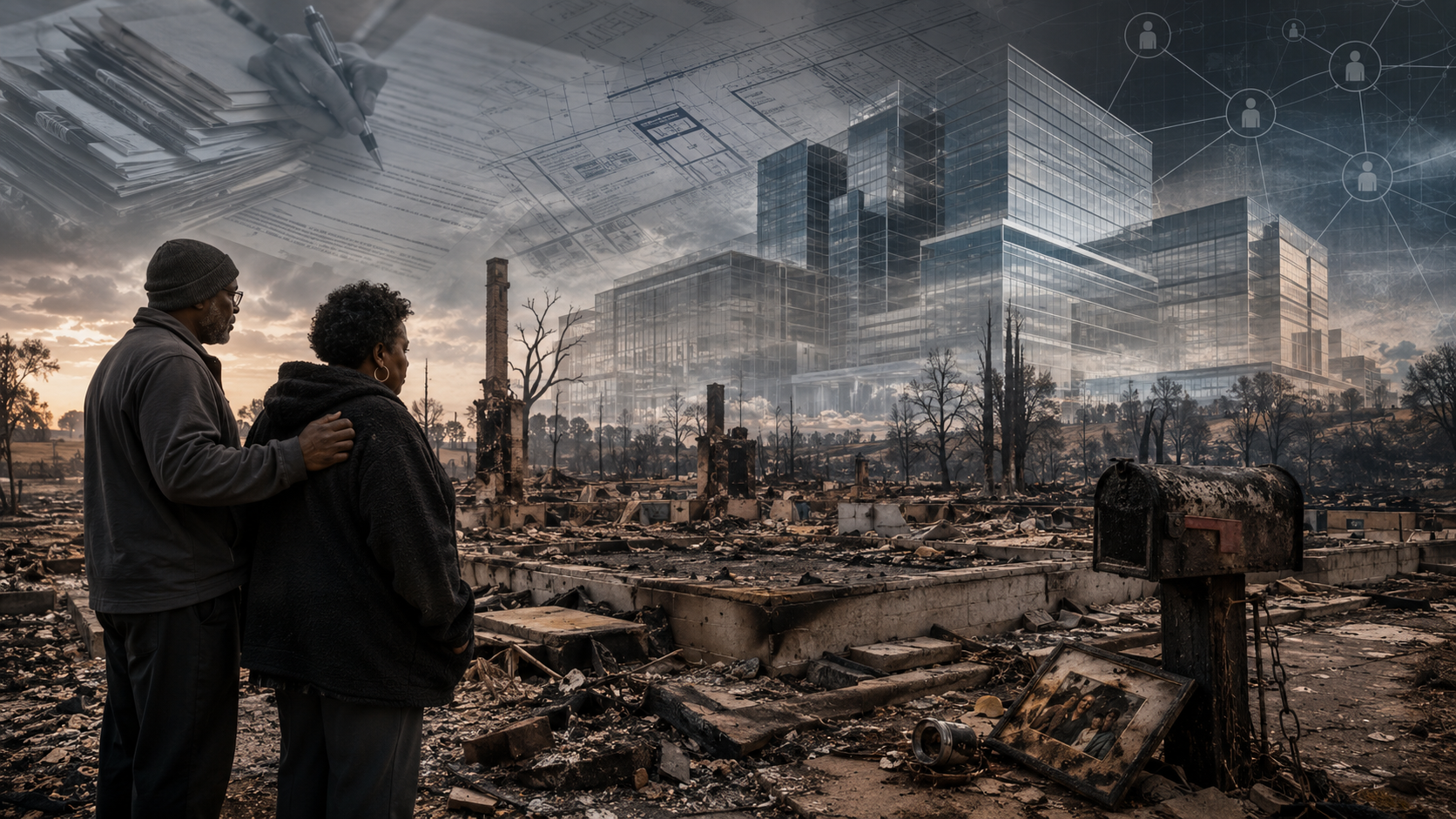
While Black Altadena was trying to survive the first hours, days and months after the Eaton Fire, something else was being built alongside the recovery.
Not after it.
Alongside it.
The ground was still warm.
The architecture was already going up.
That is when the prospectors arrived.
The Eaton Fire started Jan. 7, 2025. According to CAL FIRE’s current incident record, it burned 14,021 acres, destroyed 9,419 structures and killed 19 people.
Survivors were displaced. Homeowners fought insurers. Families entered the maze of remediation, temporary housing, lawsuits, permits and rebuilding.
Black homeowners stared at lots where generational wealth had stood a day before.
Ash where the house had been.
Ash where the photographs had been.
Ash where the life had been.
Ash in spaces and places where recovery programming would later produce meetings, reports, data and content.
That ash belonged to somebody.
That is one timeline.
Now look at the other one.
The public record does not require us to guess about the architecture that developed around Altadena Rising.
Altadena Rising’s own website says the collective advocates for survivors on official recovery boards and committees, brings community data into decision-making spaces, connects survivors with resources and contacts, produces community media, works with funders and government officials, and operates what it calls the community’s “shared data platform” for survivors to report unmet recovery needs.
The organization says it bridges gaps among local relief efforts, “philanthropy, government, and impacted families.”
It sits on the Leadership Council of the Eaton Fire Collaborative Long Term Recovery Board.
And it says its goal is to secure funding, support and “engagement infrastructure” for an ecosystem of recovery and resilience in “Altadena and beyond.”
That is not my description of the machinery.
That is theirs.
And there was formal capacity building.
Los Angeles County’s Justice, Care and Opportunities Department — JCOD — lists Altadena Rising as a member of the 10th cohort of its Incubation Academy. JCOD says the academy equips grassroots organizations to strengthen their operations; its 10th cohort completed a 12-week training program with continued post-graduation support.
Part of the answer to Where’d y’all learn this? is sitting on the County’s own website.
And the money?
FireAid's homepage says its concert raised an estimated $100 million, with the first round of $50 million distributed to more than 120 nonprofit organizations. FireAid’s grantee announcement lists the Black LA Relief & Recovery Fund among the recipients of disaster-relief funding.
The Black LA Relief & Recovery Fund’s 2026 impact report says it granted $3.61 million across 37 organizations.
Altadena Rising is on the list.
Here is where precision matters.
The public documents I reviewed do not disclose how much of that $3.61 million went specifically to Altadena Rising. Nor do they establish that FireAid dollars themselves paid for Altadena Rising’s operations, its lawyers or its trademark application.
So I am not saying they did.
And nothing here is an accusation of misconduct by FireAid. FireAid's site says an independent review by Latham & Watkins found no misuse or misallocation of FireAid funds.
The point is narrower.
Philanthropic capital was part of the recovery ecosystem.
Then look higher.
Altadena Rising also appears in another funding and capacity network.
The Department of Angels' site lists Altadena Rising among its grantees, describing it as the “convening table for community leaders” that hosts biweekly “Collab and Care” meetings of 30 to 40 local leaders working on long-term rebuilding.
Department of Angels says its partner investments can include financial resources, digital tools, operational support, strategic advocacy support and access to experts. It specifically says it supported Altadena Rising in extending its biweekly “Collab and Care” convenings of 30 to 40 local leaders working on long-term rebuilding.
And who built Department of Angels?
The organization’s own page identifies Miguel Santana, president and CEO of the California Community Foundation, and Evan Spiegel, co-founder and CEO of Snap Inc., as co-founders. CCF’s launch announcement and contemporaneous reporting describe roughly $10 million in seed funding from CCF, Snap, Spiegel and Snap co-founder Bobby Murphy
That is a funding network. In my view, it’s a significant one to sit inside of while also seeking federal trademark protection over the language of that recovery — but that’s my inference, not something the record states outright..
Then there is Taylor Campbell.
Campbell is publicly identified as a co-founder of Altadena Rising.
She also owns Contextual Strategy. Her company’s own bio page says she previously served as White House Director of Correspondence Systems Innovation under President Barack Obama.
I am not saying Barack Obama, the Obama White House, Evan Spiegel, FireAid or any political party directed what happened in Altadena. That is not a claim I am making, and I want to be explicit that I have no evidence for it.
My view is this: grassroots does not mean institutionally isolated. This is not a folding table, a Gmail account and some good intentions. Readers should weigh the record above and decide for themselves whether that changes how they read what follows.
WHERE’D Y’ALL LEARN THIS?
Here I want to ask a genuinely open question, not a loaded one: how does a recovery operation build this kind of capacity — in systems, scale, fundraising, data, technology, branding and organizational permanence — so quickly? I don’t know the answer with certainty, and I want to lay out a few possibilities rather than assume one.
Maybe the better question is whether that expertise had to be learned at all.
One possibility: Contextual Strategy markets itself as providing program strategy, operational systems and technology infrastructure, so some of that expertise may have already been in the room rather than acquired along the way. Another possibility is the formal capacity-building programs described above — JCOD’s academy, Department of Angels’ direct support — contributed meaningfully. Likely some combination of both. I don’t have a way to apportion that with confidence, and I’d rather say so than guess.
The public-facing posture was care. Proximity. Showing up. And much of that work may very well have helped survivors.
In my view, proximity to the recovery is not the same thing as living what survivors could not clock out of — evacuation, remediation, temporary housing, insurance fights, lawsuits, rebuilding, empty lots.
Meanwhile, institutional relationships accumulated around the name. Altadena Rising’s own site says it participates in official recovery structures, gathers and uses survivor data, works with funders and government officials and produces community media. The Black LA Relief & Recovery Fund’s impact report says Altadena Rising “works directly with elected officials to elevate community input” and participates in “policy, media and recovery efforts.” Department of Angels funded it. JCOD provided organizational capacity building.
None of that proves profit.
But my conclusion is that it does establish institutional value — meaning: the name and the network built around it had become worth something, whatever the intent behind building it.
If you want my inference, here it is: by June 2026, somebody had concluded that the name ALTADENA RISING was worth seeking federal protection for across five categories of goods and services.
I cannot show you a document proving that trademark registration was the plan in January 2025.
I’m not going to pretend I can.
What I can show you is what accumulated before the application arrived: a platform, a network, funding relationships, government relationships, data infrastructure, media capacity, organizational expertise.
EIGHTEEN MONTHS IN. THEN CAME THE FILING.
Then came June 24, 2026.
That day, according to the trademark filing, Contextual Strategy, LLC filed a federal application for the standard-character mark ALTADENA RISING.
Not Altadena.
Not the survivors.
Not some publicly owned community entity.
The applicant listed in the public trademark record is Contextual Strategy, LLC.
And let's get one legal point straight.
The application reports first-use dates beginning in January 2025.
There is nothing inherently suspicious or improper about filing a trademark application after a mark has already been used. That is ordinary trademark practice; use-based applications require applicants to report relevant dates of first use.
So the fact that the application came later is not the scandal.
The question I think is worth asking is: what accumulated around the name between first use and federal filing?
What accumulated around the name between first use and federal filing?
Between those dates and June 24, 2026 came programming, convenings, grants, government relationships, capacity building, public visibility, data collection and institutional support, per the sources linked throughout this piece.
And data was not incidental. Altadena Rising’s own site says it operates a “shared data platform” where survivors report unmet recovery needs, used in advocacy directed toward government officials, funders, service providers and community leaders. I’d call that infrastructure, using their own framing of what it does — not a loaded term of my own choosing.
FIVE CLASSES. READ THEM SLOWLY.
Read the trademark application — as I understand it from the record available to me — for what it actually tells us.
It is not, legally speaking, a business plan. But it is reportedly a detailed statement of the goods and services with which the applicant says the mark has been used, spanning five international classes (Altadena Rising Trademark Details):
Class 16 — Printed matter. Reports, guides and toolkits concerning community organizing, disaster recovery and advocacy, as well as stickers.
Class 35 — Advocacy, coordination and business-related services. Public advocacy around disaster recovery and equitable resource allocation; volunteer programs; business networking; administrative coordination among charitable organizations; resource directories; matching people needing services with volunteers; coordination of donations and humanitarian activities.
Class 41 — Education and media. Workshops, seminars, training, community events, film and video production, photographs, written stories, articles, reports, guides, toolkits, online publications and searchable materials concerning organizing, recovery, housing justice and advocacy.
Class 42 — Technology. Web-based software for locating community resources and organizing disaster-recovery efforts, along with technology enabling people to share and access recovery information and advocacy resources.
Class 45 — Social and support services. Case management coordinating legal, physical, social and psychological services for disaster-impacted individuals and families. Emotional support. Support groups concerning disaster recovery and long-term community resilience. Information concerning human rights and social justice.
Nineteen people died in the Eaton Fire. The survivors carried a weight that didn’t end when the flames went out — displacement, insurance fights, the slow grind of rebuilding a life.
In my view, that is the population Class 45 is written around. Your grief is not a SKU. Your recovery is not a product line. A trademark cannot make either one private property.
But when so much of a community-recovery ecosystem appears beneath one privately held trademark application, I think it’s fair to ask: where does community recovery end and private institutional ownership begin? That’s a question, not an answer I’m asserting.
Five classifications are not free. The USPTO states that the base application filing fee is $350 for each class of goods or services, although additional fees can apply depending on the application. Five classes therefore produces a base-fee calculation of $1,750, but that does not establish what Contextual Strategy actually paid. USPTO — How Much Does It Cost?
The attorney identified in the ALTADENA RISING application is Stephanie Vanita Trice of K&L Gates LLP, a firm that describes itself as a global law firm with more than 45 offices worldwide. ALTADENA RISING Trademark Record — Justia Stephanie V. Trice — K&L Gates
The public records I reviewed do not tell me who paid the filing fees or the legal bill. So I am asking: Who did?
The application does not prove that anybody profited from the trademark. It does not establish legal ownership of a survivor’s grief, memory, likeness, or personal story. It does not give Contextual Strategy ownership of the Eaton Fire. It does not give anybody ownership of Altadena’s history.
And as of this writing, the public trademark record identifies ALTADENA RISING as a pending new application, not a registered federal trademark. ALTADENA RISING Trademark Record — Justia Official USPTO Trademark Status & Document Retrieval
Profit? The filing doesn’t prove it.
Value? In my view, the act of filing across this many categories speaks for itself — that’s my read of what the filing represents, not a fact the filing itself states.
Now put the pieces beside one another: a co-founder whose private strategy firm’s own bio touts former Obama White House systems experience; a private firm specializing in growth, fundraising, data, technology and branding; Los Angeles County capacity building; a Black LA Relief & Recovery Fund grant relationship; support from Department of Angels — itself launched with roughly $10 million from the California Community Foundation, Snap, Evan Spiegel and Bobby Murphy; a shared survivor-data platform; official recovery-board participation; community media; work with elected officials; and finally, a five-class federal trademark application filed by Contextual Strategy through a global law firm.
My conclusion is that this doesn’t read as the beginning of the story — it reads like the culmination of what came before it. That’s my interpretation of the chronology, and readers are free to draw a different one from the same facts.
So now I am talking to you.
When scrutiny of an institution turns into a fight over who gets to frame the storyteller, the documents can disappear behind the dispute. In my view, that dynamic resembles what media critics sometimes call institutional “capture” — but I want to be clear that’s my characterization, offered as one way to think about it, not a settled fact about anyone’s intent.
But don’t confuse controlling the conversation with answering the documents.
The people were here first. They had houses. Family photographs. Deeds. Businesses. Churches. Memories. Generational wealth sitting on land somebody’s parents or grandparents fought to buy and keep.
The disaster did not create Altadena. And no recovery apparatus created the meaning people attached to surviving it.
In my view, the ash was theirs before the opportunity was anybody else’s — their homes, their possessions, their land, their dead, their memories, their displacement, their recovery.
So here is the question I keep coming back to: what gives somebody else the right to convert value built around that experience into something they move to protect privately? I don’t have a legal answer to that — trademark law doesn’t work that way, and I’m not a lawyer. I’m asking it as a moral question, not a legal one.
I have not found a January 2025 public announcement telling Altadena that Contextual Strategy intended to seek federal trademark registration of ALTADENA RISING across these five classes. If one exists, produce it. I will link it.
What the public record does show is roughly 18 months in which an operation around the name acquired institutional reach — followed by a June 2026 trademark application stating first use beginning near the start of the recovery.
Again: the earlier first-use dates are not themselves unusual. The question I think is worth asking is what accumulated around the name between those dates.
Here is where the record ends and my conclusion begins.
To me, this looks like the institutionalization of value that accumulated around a community recovery effort over time. You are free to draw a different conclusion. The documents are now in front of you, linked throughout this piece so you can check them yourself.
Put the chronology beside the filing. Put the funders beside the capacity building. Put the institutional relationships beside the lawyers. Put the shared survivor-data platform beside Class 42. Put community storytelling beside Class 41. Put disaster case management and emotional support beside Class 45.
What I see, in my own reading of it, is infrastructure being built around a public tragedy while many of the people who lived it were still trying to rebuild what the fire reduced to ash. I see a private LLC seeking federal protection for a mark attached to a remarkably broad range of specified activities: printed recovery materials, advocacy and coordination, community events and media, disaster-recovery technology, case-management and emotional-support services.
The application does not give that LLC ownership of Altadena. It does not give it ownership of the fire. It does not give it ownership of the people.
But in my view, the breadth of what is listed makes public scrutiny not only legitimate — it makes it necessary.
And sitting underneath all of it is their own phrase: “Altadena and beyond.”
Beyond to where?
Earlier I asked where this operational sophistication came from. Let me sharpen that into a genuinely open question rather than a rhetorical one: was the capability mostly already present — through Contextual Strategy’s existing practice — or did it come substantially from the formal capacity-building programs (JCOD, Department of Angels) documented above? I think the honest answer is probably both, in some proportion I can’t determine from the public record.
The more interesting question, to me, is: when did all of that capacity become attached to a name that a private LLC decided to place inside a federal trademark application? The record does not tell me when anyone first recognized the trademark value of ALTADENA RISING. It tells me something we can actually document: while survivors were dealing with displacement, insurance, remediation and rebuilding, the operation around that name developed funding relationships, institutional access, survivor-data infrastructure, media capacity, organizational training and recovery-network support. Then Contextual Strategy reportedly sought federal trademark protection across five classes.
I don’t need to know what was in anybody’s head to ask what that chronology means. That’s a question I’m putting to readers, not a conclusion I’m asserting on their behalf.
The filing date does not move. The five classes, as reported, do not disappear. The institutional architecture was built in between.
And the people who had been busy surviving? Displaced. Fighting insurance companies. Cleaning lots. Trying to replace documents. Trying to find contractors. Trying to keep their land. Trying to figure out whether they could afford to come home.
Eventually, they had enough distance to look around.
They looked up.
Their homes became ash. In my view, somebody else was building value in the meantime — that’s my read of the record laid out above, and I’ve tried to show my work so you can weigh it yourself.
Inside this network is a co-founder whose private strategy company’s own bio touts former White House experience. There is County capacity building. Foundation money. A recovery initiative launched with roughly $10 million from some very deep pockets. Government relationships. Data infrastructure. Professional organizational strategy. And, per the reported filing, a global law firm.
That’s a substantial network of institutional resources, in my assessment.
So here is my final question, and I mean it as an open one: why not point more of that institutional power toward the thing Altadena actually needs most — getting its people home?
Comments

Powered by RoundtableAn AI/DeFi-powered Enterprise Media Operating System. Learn more at Roundtable.io.© Roundtable 2026. By using this site you agree to the Terms of Use and Privacy Policy