


Mar 10, 2026 4:24 AM
Updated Mar 15, 2026 2:53 AM
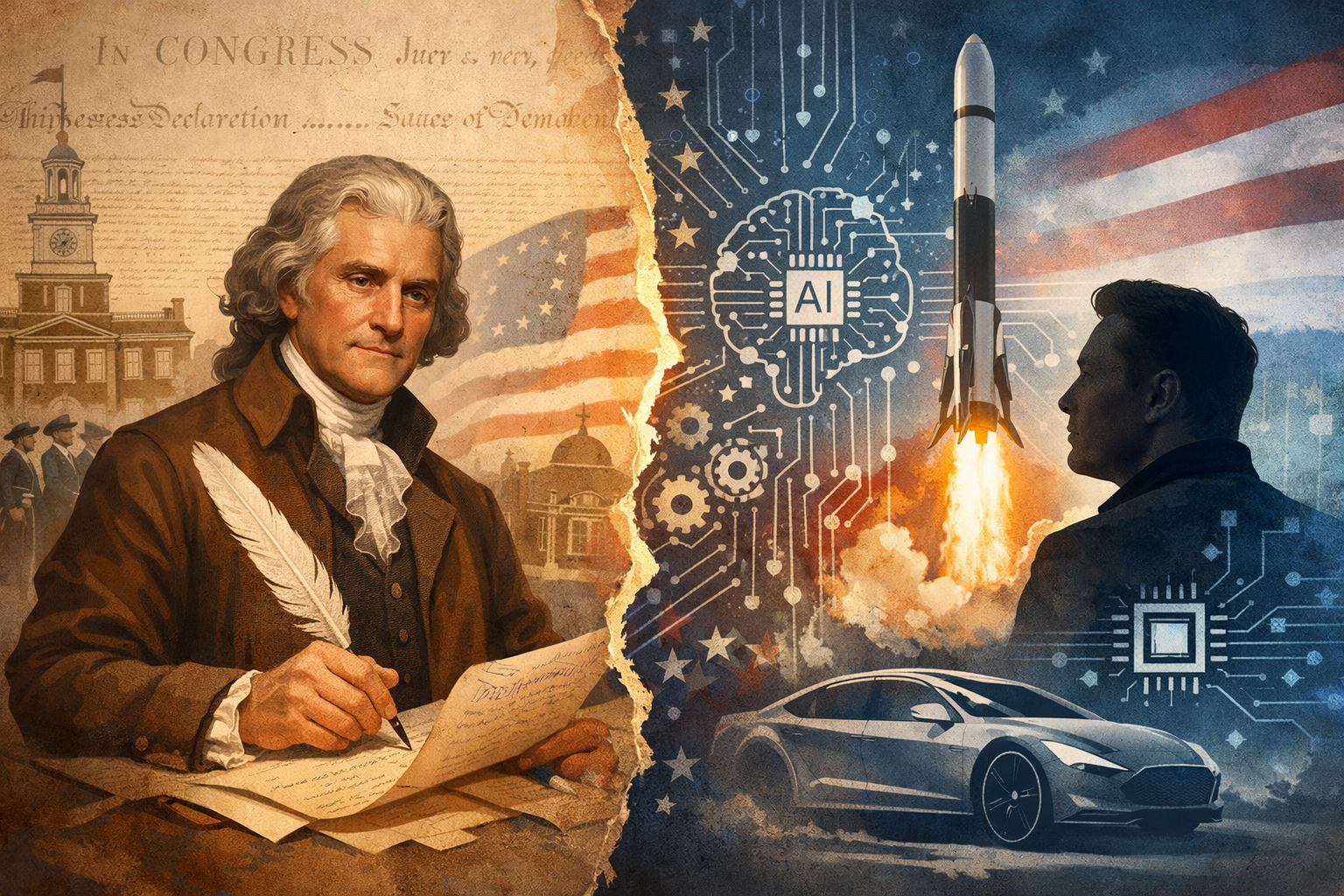
What America’s complicated leaders teach us - progress comes not from perfect leaders, but from imperfect people willing to build a more perfect union.
Two-hundred fifty years after it started, the USA is still being run by people. AI programs are beginning to teach themselves. But they halucinate like people dream, and they make mistakes. No one thinks they are going to take over anytime soon.
So we can think about how to make the next 250 years better than the first, in part by looking at those who were involved in the founding, at those involved today, and perhaps most importantly looking at how we think about them.
Thomas Jefferson and the Paradox of the Founding Fathers
Consider Thomas Jefferson. He wrote the Declaration of Independence, which is still revered among activists around the world for its proclamations on human rights and the rights of humans to change their governments. But for all his eloquence about human equality and the right to seek dignity, Thomas Jefferson enslaved human beings. He had sex with and fathered children with an enslaved teen, Sally Hemings. I don’t know when he started molesting Sally Hemings. Was he also a pedophile?
Which Thomas Jefferson should we revere: the enslaver or the eloquent promoter of human rights and freedoms? How important is it that we choose one or the other?
Related stories
Elon Musk: Visionary Innovator or Controversial Billionaire?
Think of a modern consequential figure, Elon Musk. For some, Musk’s status as the world’s richest man is enough to condemn him. For some that wealth is enough to exalt him. For some, Musk’s use of a small fraction of his wealth to aid the Donald’s 2024 campaign, and his subsequent disruption of nation’s government justifies hating him.
Pre-Civil War southern politicians rejected Jefferson’s Declaration of Independence because it proclaimed the equality of all people. Even today, the State of Texas’ public schools teach that Jefferson was not one of our Founding Fathers because his writing was so offensive.
And today some people who applaud Musk for his wealth and politics, condemn his embrace of science. Just as some who revile Musk’s wealth and politics ignore the reality of his scientific impacts on society.
When Personal Flaws Collide with Public Achievements
At the end of the twentieth century, as people around the globe were beginning to take climate change as a serious problem, rather than as a practically irrelevant scientific topic, Elon Musk took theoretical ideas of better vehicles and showed the world that electrical vehicles could be sensible, economically practical alternatives to smog spewing petroleum powered vehicles.
President Eisenhower, the general who oversaw allied operations that ended WW-II, warned us about a military-industrial complex which would threaten our democracy. Despite his warning, during the cold war, industrial USA learned that control of budget processes could control the national budget.
For decades our “civilian” space exploration agency, NASA, was required to buy new rockets for every scientific rocket launch. Elon Musk, motivated by private profit, challenged the accepted corporate ‘wisdom’ and developed reusable launch rockets, which could be recovered, refurbished and reused, at savings of tens of millions of dollars each. For no public spirited reason, he saved we the tapayers billions of dollars, while reducing the pollution our earlier rockets dumped into the sea.
The Founders’ Real Legacy: Compromise and Cooperation
Like Jefferson, Musk was born into a segregated society and was raised to believe in white supremacy. Does his personal racism, or his corporate greed make his progressivre engineering ideas invalid?
Thomas Jefferson wanted to preserve an economic system based in agriculture and slave labor. He fought against Alexander Hamilton’s efforts to build a national financial system that could integrate with the emerging world wide industrialism. In this he also opposed another man who’s wealth was rooted in agricultural slavery - George Washington.
Jefferson wanted to restrict federal power in order to preserve a lifestyle that was unsustainable. Musk has spent millions of dollars trying to tear apart sections of our industrial empire which threaten his corporate profits and plans. History has proven both men wrong. For Jefferson, at the start of the industrial revolution, his financial and anti-federalist ideas took decades to be proven false. For Musk, operating within the environment of social media, worldwide communications networks and Freedom of Information laws, history has acted much more quickly.
We learned almost as fast as it started that Musk’s “DOGE” efforts lacked any basis in reality. While he slashed budgets, rules and workers, the federal budget soared and federal services collapsed. Adversary nations cheered as secure federal databases were opened to any grifter willing to pay for access.
But the grifts of Elon Musk quickly conflicted with the grifts of Donald Trump. Musk’s electric vehicles and reusable rockets conflicted with the Donald’s bribe-driven promises to bolster the petroleum and war profiteering industries. Musk embraced new technology, including Artificial Intelligence. Intelligence of any kind has always been seen as a threat by the Donald.
And now we see that AI has limitations of its own. It too can act as human as the people who program it. If we were not so busy talking about the ‘efficiency’ of the Pentagon’s “smart” weapons, which so easily targeted and intentionally destroyed a girls’ school in Iran, we might be spending our time making jokes about the same “smart” technology successfully shooting down helium lifted party ballons in Texas. And shooting down a Noem-drone a week later.
The drone killing success in Texas gives us a real world context for the Donald’s successfully telling the Iranian people that they, including the almost 200 school girls, have been “liberated.” For those old enough to recall, the “liberation” in Iran bears a striking resemblance to so many villages we destroyed to “liberate” them in Vietnam.
The killing of childrens’ party balloons and of our own Noem-drone(s?) In Texas, reveals to us that the very scary AI has yet to be made workable. AI robots haven’t yet learned to run over natural ground. And knowing whether to kill or not is a far more difficult task. If AI can’t distinguish between balloons and drones, or good guy drones from bad guy drones, how soon will we be seeing reports of AI powered weapons attacking our own troops?
AI programs can’t made complicated distinctions. But many self proclaiming “revolutionaries” believe that they can. Jefferson and Musk are both complicated people with good and bad characteristics. Dr. Martin Luther King, jr. was a heroic campaigner for human rights and dignity. He was also a womanizer, not afraid to cheat on his wife. Does one behavior cancel out the other? Or is it possible to accept that people from our Founding Fathers to the present day are all complicated and may hold conflicting, conflicted views on a variety of subjects? Must we be “against’ everything “right” to be for improving the USA in the next 250?
As we face a 251st year, might progressives benefit from emulating the Founding Fathers who worked, before the American Revolution fighting started, with each other, overcoming differences over difficult issues in the struggle to establish bonds of common interests?
Political Polarization and the Modern “Winning” Mindset
There was fierce anti-slavery advocacy long before the first shots on Lexington Green (or were the first shots fired at the Boston Massacre, five years earlier?). There was resistance to trade restrictions, at the Boston Tea Party, while southern planters desperately wanted the British navy to continue to ensure their access to markets for cotton and other products. But they found common ground. Can we?
A lot of progressives and liberals seem to have bought into the radical rightwing conviction that “we must win.” But like the rightwing, they are often vague or opaque about what winning means. For the entire Republcan party now, it seems that “winning” consists of establishing a white national theocracy which rejects any form of dissent. We have seen how oppression of theological dissent plays out over centuries. Our Pilgrim and Puritan ancestors were at war with each other back in good olde England. And up to the Kennedy campaign in 1960 millions of protestant voters were told that voting for a Catholic candidate would destroy the nation.
Building the Next 250 Years of American Democracy
Our founders fought against the religious wars that had wracked European nations during their lifetimes. They welcomed the Catholics of Maryland and the Quakers of Pennsylvania. They had Jews as business partners, advisors and even friends. They made treaties with Islamic nations. They had a terrible fear of corporations, having experienced what happens when corporate funding buys privilege from royal government.
With this history we needn’t draw red lines between capitalists and socialists or comunists. We have plenty of socialism mixed in with our oligarchical capitalism. So do most European nations. Is there anything more socialistic than an Oil Depletion Allowance”? Is there anything more American capitalist than a law which bars negotiations for lower drug prices?
Our Founding Fathers had their own important issues to argue over, including slavery, industrial regulations, whether banks should continue to be allowed to rip off depositors with no recourse, and others. And they didn’t find perfect solutions. They weren’t perfect people. But they were committed to trying to build “a more perfect union.” Not a perfect union. But a better one than those they had come from across the sea to escape.
They succeeded by talking TO each other, not AT or OVER each other. They didn’t style themselves as perfect or claim that the new government they formed was peerfect. Might our 250th birthday celebration have more substance if we emulated some of their humility rather than insisting on the superiority of our newer ideas?
Comments

Powered by RoundtableAn AI/DeFi-powered Enterprise Media Operating System. Learn more at Roundtable.io.© Roundtable 2026. By using this site you agree to the Terms of Use and Privacy Policy