


Jun 26, 2026 6:25 PM
Updated Jun 27, 2026 7:49 AM
The Declaration of Independence promised equality while the nation’s founders preserved racial, gender, and economic hierarchies. The promise survives only because the people they excluded have fought to make it real.
The Declaration of Independence promised equality while the nation’s founders preserved racial, gender, and economic hierarchies. The promise survives only because the people they excluded have fought to make it real.More Videos
As the United States approaches the 250th anniversary of the Declaration of Independence, my husband, Dick Price, and I have been thinking about a question that cannot be answered with fireworks, flags, military parades, or patriotic slogans:
Was the American founding an act of hypocrisy—or an expression of hope?
That question inspired the LA Progressive series “All Men Are Created Equal: Hypocrisy or Hope?”
The idea grew out of conversations with our dear friend Stephen Rohde, a distinguished civil rights attorney, longtime ACLU leader, and gifted writer. Throughout 2026, we have invited some of our most valued contributors to examine the Declaration from different perspectives.
Related stories
What did its famous promise mean in 1776?
What has it meant during the 250 years since?
And what would it take for the United States finally to become the democracy its leaders have always claimed it to be?
Dick likes to joke that he writes an article every six months while I write one every six days. He is not entirely wrong. I tend to have burning issues on my mind.
This anniversary is one of them.
One influence on my thinking has been the podcast Scene on Radio, particularly the work of host John Biewen and scholar, activist, and media-maker Chenjerai Kumanyika.
In the podcast’s series on American democracy, The Land That Never Has Been Yet, they asked a question that is rarely framed so directly:
How democratic has the United States ever been?
That is a different question from asking when Black people, women, Indigenous people, working people, immigrants, or LGBTQ people were finally “included” in American democracy.
Inclusion assumes that the building itself is sound and that the problem is simply that certain people were left standing outside.
But what if the structure of the building was undemocratic from the beginning?
What if exploitation, concentrated wealth, racial hierarchy, and restrictions on popular power were not accidental flaws in the American project, but foundational features?
The American Revolution removed the colonies from the authority of the British monarchy. But it did not create anything resembling political, racial, gender, or economic equality.
It transferred political authority from one ruling class across the Atlantic to another ruling class on this continent.
It was revolutionary for wealthy colonists seeking greater control over their property, commerce, and political affairs. It was far less revolutionary for the majority of people living in the colonies.
Women did not gain political equality.
Enslaved Africans did not gain freedom.
Indigenous nations did not gain protection from invasion and dispossession.
Poor people and most people without property did not suddenly acquire equal political power.
The Revolution changed who governed. It did not fundamentally change who was governed.
The Declaration’s most famous passage proclaims:
“We hold these truths to be self-evident, that all men are created equal.”
Those are extraordinary words.
But they were written and approved by wealthy white men, many of whom held human beings in bondage.
Thomas Jefferson, the principal author of the Declaration, enslaved more than 600 people during his lifetime. He fathered children with Sally Hemings, a woman he held in captivity, and he never formally freed her.[1]
Whatever universal philosophical meaning later generations found in Jefferson’s words, the political order created by the Founders did not recognize all human beings as equal citizens.
The people they enslaved were not treated as equal.
The women they governed were not treated as equal.
The Indigenous people whose lands they coveted were not treated as equal.
The laborers whose work produced their wealth were not treated as equal.
The phrase “all men are created equal” did not describe American society in 1776. It expressed a claim that the men declaring independence from Britain wished to make about themselves.
They were asserting their equality with the British ruling class.
They were not proposing the abolition of ruling classes.
The contradiction did not suddenly appear in 1776. Its foundations had been built much earlier.
In 1619, captive Africans taken from the region of present-day Angola were being transported aboard a Portuguese slave ship toward New Spain, in present-day Mexico. English privateers attacked the ship, seized some of the captives, and carried them to Virginia, where they were traded for provisions.[2]
They had been captured, transported across the Atlantic, seized again, and then sold into another colonial labor system.
The labor extracted from Africans would become central to the development of colonial wealth. But such brutality required justification.
A society claiming Christianity, civilization, liberty, and natural rights needed a story explaining why they chose to treat some human beings so brutally. What justified the kidnappings, beatings, sellings, rapes, separtions from family, taking of children, working to exhaustion and even death - the cognitive dissonance required an answer.
Race supplied that answer.
Africans were declared inferior so that their exploitation could be presented as natural.
Whiteness became associated with freedom, citizenship, property, and authority. Blackness became associated with servitude, dependency, criminality, and exclusion.
The racial hierarchy was not created because white colonists first developed an abstract dislike of people with darker skin.
It was created and hardened because domination was profitable. And they wished the profit to continue to flow.
Race helped justify the extraction of labor. The wealth produced through that extraction then reinforced the racial order.
That relationship between race and class remains essential to understanding the United States.
A class analysis without a racial analysis misses how American capitalism was built and maintained.
A racial analysis without a class analysis can miss who profits from division, dispossession, and exploitation.
We need both.
Today, Americans are told that we live in a democracy because most adults can vote.
Voting matters enormously. People fought, bled, and died for that right.
But democracy cannot stop at the entrance to the voting booth. The right to cast a ballot means far less when a small number of wealthy individuals and corporations possess vastly greater power to shape the choices presented to voters and the decisions made after an election.
What kind of democracy allows a small number of individuals and corporations to accumulate enough wealth to shape elections, control media platforms, influence legislation, weaken unions, avoid taxation, and determine the conditions under which millions of people work?
Earlier this month, market valuations briefly made Elon Musk the first person in history whose estimated wealth exceeded $1 trillion.[3]
No human being performs a trillion dollars’ worth of individual labor.
Fortunes of that magnitude are created through ownership: ownership of corporations, technology, patents, platforms, infrastructure, and the labor of other people.
Workers produce the goods.
Workers provide the services.
Workers staff the warehouses, hospitals, schools, restaurants, farms, offices, transportation systems, and factories.
Yet the largest share of the wealth flows upward to the people who own the systems in which that work occurs.
Meanwhile, Black and Latino workers continue to earn substantially less than white workers, and women of color experience some of the largest wage disparities.[4]
Can we call that equality?
Can we call it democracy when millions of people spend nearly all their waking hours under economic systems over which they exercise almost no control?
A meaningful democracy must involve more than formal political rights. It must address housing, healthcare, education, wages, working conditions, environmental safety, and access to the necessities of life.
Political democracy without economic democracy leaves concentrated power largely undisturbed.
Travel helped me understand that many conditions Americans are taught to accept as inevitable are actually political choices.
I was born and raised in the Bronx. I did not leave the United States until I was in my 30s, when my mother, sister, daughter, and I traveled to England to visit relatives.
My grandfather was born in Antigua when it was still a British colony. Some members of his family migrated to the United States. Others moved to England, the Netherlands, and elsewhere in Europe.
The relatives we visited in England were ordinary middle-class Black families. Yet I was struck by the quality of their housing, transportation, public infrastructure, paid leave, and access to services.
British workers are legally entitled to at least 5.6 weeks of paid annual leave. Millions of American workers have no federally guaranteed paid vacation at all.[5]
My relatives could hardly believe that women in the United States could give birth without any national guarantee of paid maternity leave.
They thought we were joking.
Years later, Dick and I visited Japan, where my son was teaching. We traveled through Tokyo and Nagoya. The public transportation was extensive, fast, clean, and reliable. In the places we visited, we did not see the sprawling homeless encampments that have become an accepted part of life in Los Angeles and other American cities.
More recently, we visited Portugal and spent time with family there. Once again, we found ourselves discussing the basic services their society treats as public responsibilities, including universal access to healthcare.
None of these countries is perfect. They have inequality, racism, poverty, political conflict, and social problems of their own.
But seeing other societies made one thing unmistakable:
The deprivation Americans experience is not simply the unavoidable price of modern life.
It is the result of choices.
The United States has extraordinary wealth. What it lacks is a democratic commitment to use that wealth for the common good.
Our series is not called simply Hypocrisy.
It is called Hypocrisy or Hope.
The hope does not come from pretending the Founders were wiser, kinder, or more democratic than they were.
It comes from the people they excluded.
Enslaved people seized the language of liberty and used it against enslavement.
Abolitionists used it against human bondage.
Women used it to demand political and legal equality.
Workers used it to organize unions and challenge industrial exploitation.
Civil rights activists used it to confront Jim Crow.
Immigrants, LGBTQ people, disabled people, Indigenous movements, peace activists, environmental justice organizers, and countless others have insisted that the promise of equality must apply to them as well.
Hope is not found in worshipping the Founders.
Hope is found in the people who refused to accept the Founders’ limitations.
We saw that hope in Minnesota during the bitter winter protests against the Trump administration’s immigration enforcement operations.
After federal immigration agents killed Renée Good, a mother and poet, and Alex Pretti, an intensive-care nurse, thousands of people took to the streets. They stood against fear, repression, and the targeting of immigrant communities, including Minneapolis’s Somali community.[6]
Dick was born in Minneapolis. I was born in New York City. We both felt deeply moved watching ordinary people refuse to surrender their neighbors.
We have also drawn hope from the election of Zohran Mamdani as mayor of New York City and from the broader movement demanding affordable housing, childcare, healthcare, public transportation, and government that serves working people rather than wealthy donors.
We do not expect perfection from any elected official. No mayor can single-handedly overcome a political and economic system designed to constrain fundamental change.
But elections can reveal what people are hungry for.
And people are hungry for a government that makes daily life more livable.
One measure of real progress would be the enactment of Medicare for All.
Healthcare should not depend on your employer, your income, your race, your age, your immigration status, or the state in which you happen to live.
A country cannot credibly call healthcare a privilege while calling itself a democracy.
Research has repeatedly found that racial resentment influences opposition to universal healthcare programs. That should not surprise us. Throughout American history, public programs have often lost white political support when they were perceived as benefiting Black people, immigrants, or poor people.[7]
That is one reason racial and economic justice cannot be separated.
Universal healthcare would not eliminate racism. But it would establish the principle that every human life has value independent of wealth and employment.
It would be a major step toward the society described in the Declaration but never created by its authors.
The men who wrote the Declaration were flawed human beings.
That description, however, is not enough.
Everyone is flawed.
The more important question is whether the systems they created require oppression and violence to survive.
Any system that depends upon patrols, prisons, deportations, disenfranchisement, hunger, homelessness, racial terror, stolen labor, or the silencing of dissent does not deserve preservation merely because it is old.
We do not have to repeat the Founders’ failures.
We do not have to accept a society in which some people enjoy unimaginable abundance while others cannot afford food, medicine, rent, clean water, or a safe place to sleep.
We have the knowledge, resources, and human capacity to build something better.
The obstacle is not scarcity.
It is concentrated power.
The Declaration is both hypocrisy and hope.
It is hypocrisy because the men who proclaimed equality denied it to most of the people around them.
It is hope because the excluded took those words, expanded their meaning, and turned them into a demand the ruling class could never completely silence.
The Founders wrote the promise.
They did not fulfill it.
That work belongs to us.
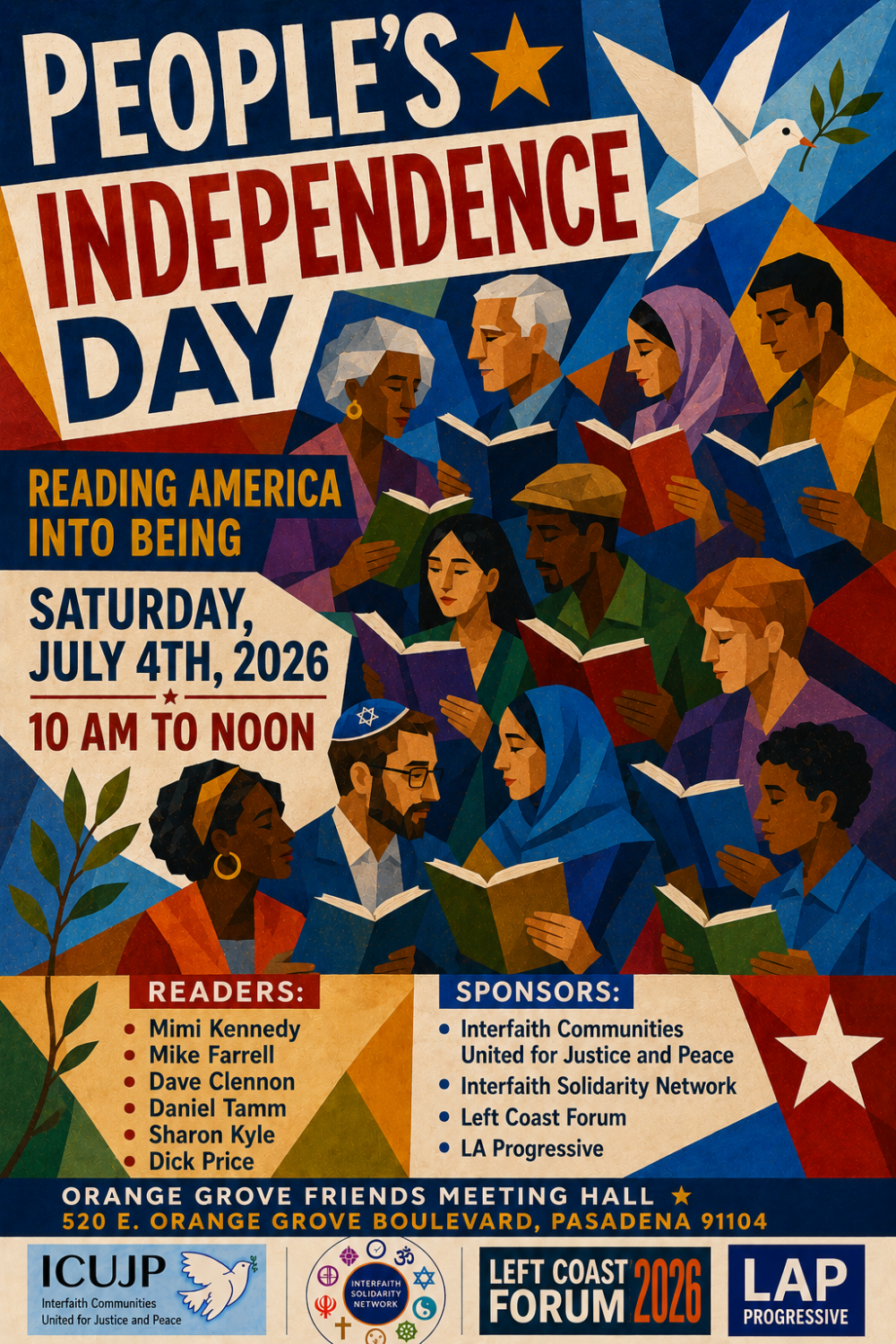
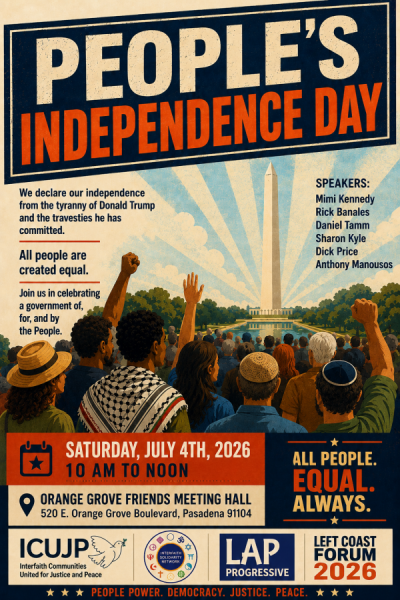
On Saturday, July 4, 2026, from 10 a.m. until noon, Dick and I will join friends, artists, activists, and community members for People’s Independence Day at the Orange Grove Friends Meeting Hall, 520 East Orange Grove Boulevard in Pasadena.
The free gathering will feature readings, music, reflection, and conversation about the work of building a true democracy—a government of, for, and by the people.[8]
We hope you will join us.
The 250th anniversary should not be an occasion for national mythology.
It should be an invitation to tell the truth, imagine something better, and begin reading America into being.
Source notes
[1] Monticello reports that Jefferson enslaved more than 610 people during his lifetime and identifies Sally Hemings as an enslaved woman who had six children with him.
[2] The Africans who arrived in Virginia in 1619 had been taken from Angola aboard the Portuguese São João Bautista, which was bound for New Spain before privateers seized some of its captives.
[3] SpaceX’s June 2026 public offering briefly pushed Musk’s estimated wealth beyond $1 trillion; subsequent market changes moved it back below that threshold.
[4] Recent Bureau of Labor Statistics data show significantly lower median weekly earnings for Black and Hispanic full-time workers than for white workers.
[5] Nearly all workers in the United Kingdom are legally entitled to 5.6 weeks of paid annual leave.
[6] Renée Good and Alex Pretti were killed by federal immigration officers in Minneapolis in January 2026, amid a major federal enforcement operation and widespread protests.
[7] Studies have found a relationship between racial resentment or subtle racial prejudice and opposition to the Affordable Care Act or universal healthcare.
[8] People’s Independence Day is scheduled for Saturday, July 4, from 10 a.m. to noon at Orange Grove Friends Meeting Hall, 520 East Orange Grove Boulevard, Pasadena.
Comments

Powered by RoundtableAn AI/DeFi-powered Enterprise Media Operating System. Learn more at Roundtable.io.© Roundtable 2026. By using this site you agree to the Terms of Use and Privacy Policy